

Usability68Design71Speed82Security74Accessibility79Growth58

Cycling through all six. Tap any point to stop.

Measured on six things

API that detects product photo rotation and tells you how...

Growth

58

A real, specific pain point (rotated product photos) with a published accuracy paper as a wedge against generic vision APIs. Narrow category, early stage (domain 0.4 years), but clearly positioned.

Screenshots

1 / 1

About this app

BlueVetaUpright is a specialized API that detects if a product photo is sideways or upside-down and provides the exact rotation needed to correct it. It boasts over 95% accuracy on core rotations and handles fine tilts with a calibrated confidence score. The API is pay-as-you-go with no subscription, starting at $3 for credits that never expire, and offers both signal-only and corrected image responses. Ideal for e-commerce platforms, marketing teams, and developers integrating AI vision, it ensures product images are always upright for downstream processing. Built by the team behind BlueVeta, it combines geometric checks and multiple AI models for reliable results, with transparent confidence scores and notes. The API supports various image formats, including HEIC, and can process raw bytes or URLs. With its focus on accuracy and reliability, BlueVetaUpright solves a critical pain point in automated image handling.

Key features

  • 1Detects sideways/upside-down product photos with 4-axis rotation (0/90/180/270°) and fine-tilt angles
  • 2Returns exact rotation needed plus calibrated confidence score and plain-language notes
  • 3Optional corrected image response via ?returnImage=true for 1.5 credits
  • 4Free live demo on homepage: drop a photo, see the real API reply before signing up
  • 5Pay-as-you-go pricing: 3¢/credit, $3 minimum, credits never expire, no subscription
  • 6Supports JPEG, PNG, WebP, GIF, TIFF, AVIF, and HEIC; raw bytes or public URL input

Target customer profile

Drawn from the product itself, not from a survey.

Demographic

E-commerce store owners and managers

Pain points

Manually checking and fixing thousands of product images is time-consuming and error-prone; rotated images harm user experience and sales.

Primary needs

Automated, accurate rotation detection and correction to maintain professional product listings and improve conversion rates.

Demographic

Developers building AI vision pipelines

Pain points

General vision APIs often misjudge rotated product photos, causing downstream errors and extra processing time.

Primary needs

A reliable rotation detection API to pre-process images before feeding into AI systems, ensuring higher accuracy and efficiency.

Demographic

Marketing teams managing product content

Pain points

Inconsistent image orientations across channels lead to poor brand perception; manual fixes slow down campaign launches.

Primary needs

A scalable solution to automatically correct image orientation, saving time and ensuring consistent visual presentation across platforms.

Human reviews

What people found in BlueVetaUpright

Written by Scout Forge members. We do not verify that a reviewer purchased or installed the app.How we handle reviews

Paid review

Funded by the developer, who could not block publication — and the reviewer was paid the same either way.

20credits
Steven Miller

Steven Miller

Oct 27, 2026

I tried the BlueVetaUpright free demo with a product photo to see how it handles image orientation, and the overall workflow was pleasantly straightforward. The main idea is immediately understandable: upload a photo, let the service determine whether it is upright, sideways, or upside down, and then use the suggested rotation to correct it. I especially liked that the result is not limited to a simple yes/no answer. The API provides the rotation direction, confidence information, and additional flags when the system is not confident or when EXIF orientation disagrees with what is actually visible in the image. I also went through the API reference. The request/response structure is relatively easy to understand, and supporting either raw image data or a public image URL makes the API practical for different upload workflows. The distinction between the four-axis rotation result and the more precise full rotation is useful, particularly for applications that need to decide whether an automatic correction is safe. The one area that was slightly unclear at first was what I should expect to see immediately beside the demo result. I would have liked a more prominent explanation of each returned field—especially the difference between the 4-axis confidence and the full-rotation confidence—directly alongside the result rather than having to connect the demo output with the API documentation. A short example response with labels explaining each value would make the first interaction easier. Overall, BlueVetaUpright feels focused rather than overloaded with features. Its narrow purpose is also its strength: it solves a specific image-processing problem and gives developers enough information to decide when an automatic correction is appropriate and when human review is safer.

Paid review

Funded by the developer, who could not block publication — and the reviewer was paid the same either way.

5credits
Andrey Kashirin

Andrey Kashirin

Oct 20, 2026

UI wasn't clear for me from the first sight, but function works fast and reliable. also I'm not a target audience that probably slowed understanding. UI/UX standard and looks clear

Test an app and get paid in credits

Developers fund these. You keep the credits whatever your verdict.

Scout Review

Written by AI from measured evidence, scored out of 100.

Re-reviewed Oct 22, 2026 · previously 86/100

BlueVetaUpright is a focused, well-executed API for a genuinely annoying problem: detecting and correcting rotated product photos. The free live demo is the best part — you can drop a photo and see the real API reply before signing up. Pricing is transparent and pay-as-you-go with credits that never expire. Speed is excellent (desktop 100/100, mobile 91/100) and the security headers are complete. The gaps are compliance (no SOC 2, pen-test, or bug bounty), accessibility polish (one contrast failure, no WCAG statement), and the strategic question of whether a single-purpose rotation API can grow beyond a feature.

Measure by measure

Usability

68

Free live demo lets you drop a photo and see the real API reply, and the reference documents actual field names. Onboarding to first value is fast; deeper docs and integrations are thinner.

Design

71

Coherent navy/light-blue palette, clear pricing hierarchy with a 'MOST POPULAR' tier, and a readable API reference. Undercut by a tiny low-contrast hero footnote and an inconsistent first demo card.

Speed

82

Lighthouse mobile 91/100 (LCP 3.0s, CLS 0, TBT 0ms) and desktop 100/100. Snappy, well-optimized site with no reported lag complaints.

Security

74

Full security header suite (HSTS, CSP, frame protection, Referrer-Policy, Permissions-Policy) plus SPF/DMARC — 12/12 on the probe. No public SOC 2, ISO, or pen-test page found.

Accessibility

79

Lighthouse accessibility 97/100, with one failing audit on color contrast (the tiny hero footnote). No WCAG statement or multi-language support found; keyboard nav appears functional.

Growth

58

A real, specific pain point (rotated product photos) with a published accuracy paper as a wedge against generic vision APIs. Narrow category, early stage (domain 0.4 years), but clearly positioned.

Improvement areas

  • No public SOC 2, ISO 27001, pen-test report, or bug bounty/disclosure policy
  • Accessibility: one contrast failure on hero footnote, no WCAG statement, English-only
  • Documentation is thin — leans on a research paper link rather than a full API reference
  • No batch endpoint or webhook for high-volume e-commerce pipelines

Design & Usability

The site is visually coherent: a navy and light-blue palette carried through the hero, demo cards, and pricing, with a clear 'MOST POPULAR' tier and a readable API reference. The free live demo is the standout usability move — drop a photo, see the actual 4-axis rotation check and the real API reply, no signup. Pricing is transparent ($3 minimum, 3¢/credit, credits never expire). The weak spots are small but real: a tiny low-contrast hero footnote, an inconsistent first demo card, and documentation that leans on a 'read the full paper' link rather than a deep reference.

Speed & Security

Speed is a genuine strength: Lighthouse mobile 91/100 (LCP 3.0s, CLS 0, TBT 0ms) and desktop 100/100, with no lag complaints in the collected evidence. Security is solid on the transport layer — HTTPS enforced, HSTS, CSP, frame protection, Referrer-Policy, Permissions-Policy, plus SPF and DMARC, 12/12 on the probe. What's missing is the compliance layer: no public SOC 2, ISO 27001, pen-test report, or bug bounty page. For an API that ingests customer product photos, that's a gap worth closing before enterprise buyers show up.

Accessibility & Growth

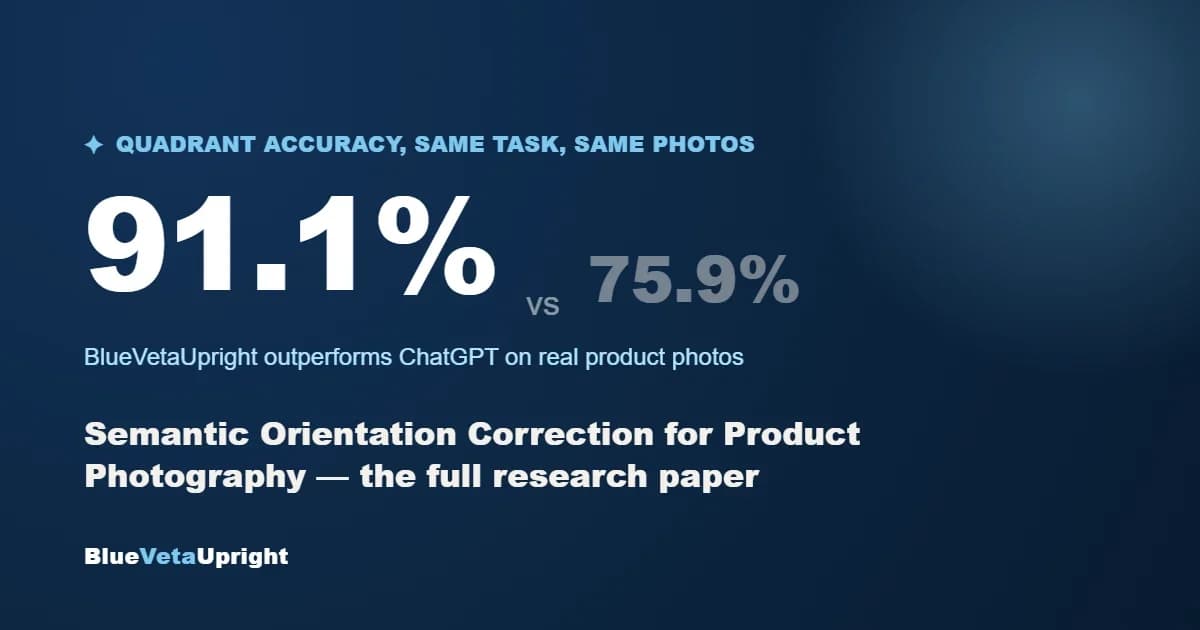
Accessibility scores 97/100 on Lighthouse with a single failing audit — insufficient color contrast, which lands squarely on the tiny hero footnote. There's no WCAG statement and no multi-language support, so the automated score flatters a site that hasn't done the human-facing work. Growth is the more interesting question: the problem (rotated product photos breaking listings and vision pipelines) is real and specific, and the published accuracy paper (99.02% clean-rotation, 96.67% across angles) is a concrete wedge against generic vision APIs. But it's a narrow feature category, the domain is 0.4 years old, and the incumbents are one product update from matching it.

Conclusion

If you're building an e-commerce or vision pipeline and rotated images are costing you time, this is a clean, honest tool with a real demo and a published accuracy paper — worth a $3 test. If you need enterprise compliance paperwork or a platform that grows with you, look elsewhere for now. The bones are good; the next year decides whether it's a product or a feature.

Suggestions for improvement

  • Publish a security/compliance page with SOC 2 status, pen-test summary, and a bug bounty or disclosure policy.
  • Fix the hero footnote contrast and add a WCAG 2.1 AA accessibility statement.
  • Expand the API reference into real docs: error codes, rate limits, SDK examples, and a changelog.
  • Add a batch endpoint and a webhook for corrected images to serve e-commerce pipelines at scale.
How we score

Alternatives comparison

Named competitors, point by point. Nobody paid to appear here or to be left out.

BlueVetaUprightGoogle Cloud Vision APIAmazon RekognitionClarifai
Specialized rotation detection for product photosYes — core purpose, 95%+ accuracy on 4-axis rotationsPartial — general image analysis, not specialized for rotationPartial — orientation detection as part of broader analysisPartial — may require custom training for high accuracy
Free live demo without signupYes — drop a photo, see real API reply on homepageLimited — requires GCP account and billing setupLimited — requires AWS account, free tier onlyLimited — trial requires account creation
Pay-as-you-go pricing with non-expiring creditsYes — 3¢/credit, $3 minimum, credits never expireYes — per-request pricing, no credits modelYes — per-request pricing, no credits modelMixed — subscription tiers plus usage-based options
Published accuracy methodology and head-to-head benchmarksYes — full paper vs GPT, Gemini, Claude; 99.02% clean-rotationGeneral benchmarks only, not rotation-specificGeneral benchmarks only, not rotation-specificGeneral benchmarks only, not rotation-specific
Enterprise compliance (SOC 2 / ISO / pen-test)Not found — no public compliance pageYes — full Google Cloud compliance suiteYes — full AWS compliance suiteYes — SOC 2 and enterprise compliance available

Comparing options? See BlueVetaUpright alternatives, scored side by side

View all Development & Engineering
Scout Forge

A platform dedicated to providing unbiased reviews of newly launched applications, analyzing everything from their features to their full potential.

info@scoutforge.net

© 2026 Scoutforge. All rights reserved.
