Cycling through all six. Tap any point to stop.
Measured on six things
Free night-sky planner for 31,842 cities that rates each night on cloud cover, darkness and moonlight, then adds planet positions, Moon times, aurora outlooks and ISS passes.
Growth
62Real problem, specific wedge (single go/no-go score + southern-hemisphere awareness), and a clear gap versus weather-only or planetarium-only peers. Free model limits monetization headroom.
Screenshots
1 / 1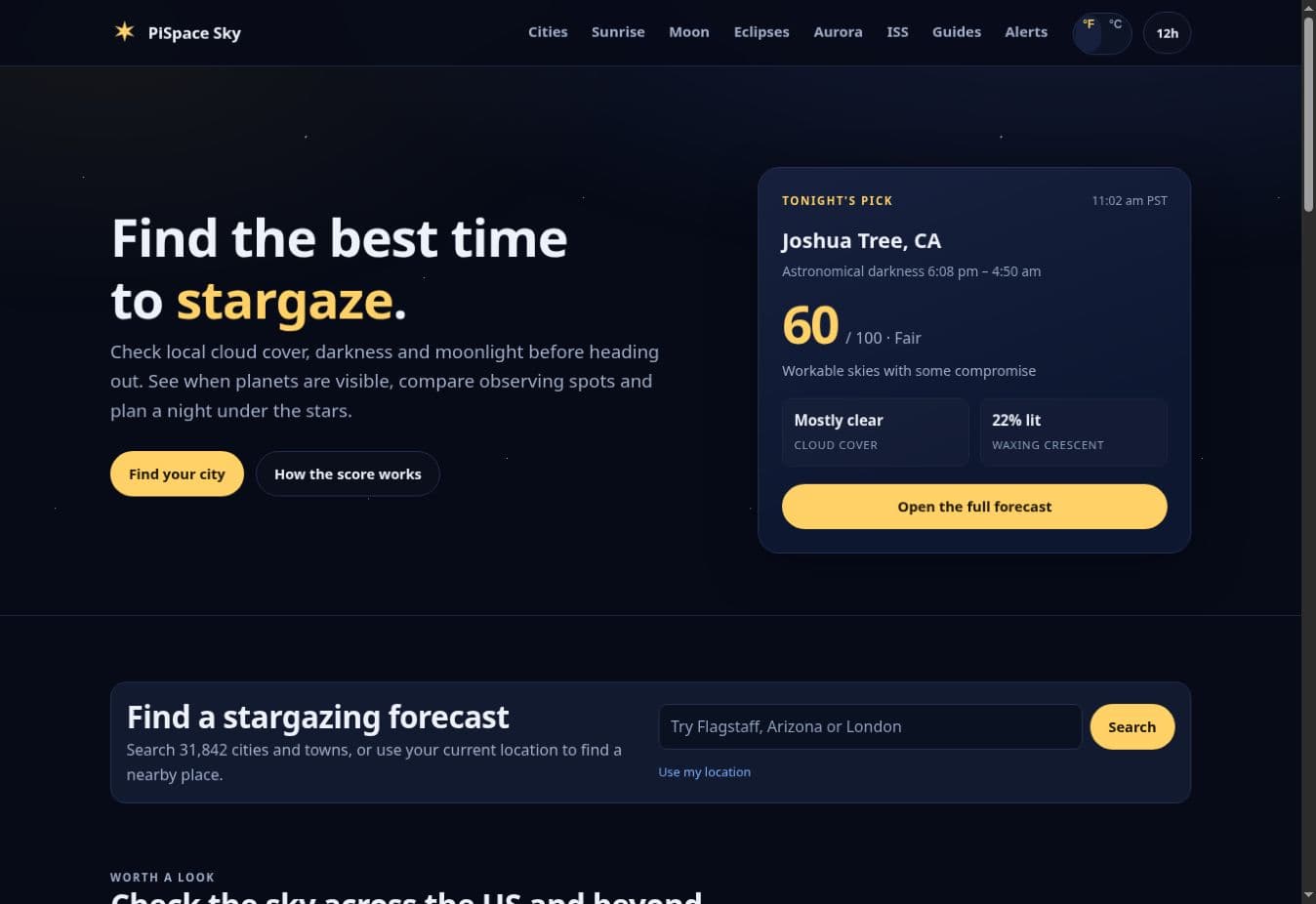
About this app
Free night-sky planner for 31,842 cities that rates each night on cloud cover, darkness and moonlight, then adds planet positions, Moon times, aurora outlooks and ISS passes.
Key features
- 1Single observing score per night combining cloud cover, darkness and moonlight for 31,820 cities.
- 2Planet positions, Moon times, aurora outlooks and ISS passes in one dashboard.
- 3Deep beginner guides library covering dark adaptation, binocular plans and southern skies.
Target customer profile
Drawn from the product itself, not from a survey.
Demographic
Backyard stargazers and hobbyist astronomers (25-55) using binoculars or a beginner telescope
Pain points
Confusing to combine cloud forecasts, moon phase, and twilight into one go/no-go decision
Primary needs
A single observing score that tells them whether tonight is worth setting up equipment
Demographic
Astrophotographers and night-sky photographers planning sessions around new moon and clear windows
Pain points
Wasting clear nights on washed-out skies or missing short moonless windows
Primary needs
Precise moonless dark windows, cloud timing, and alerts for promising imaging nights
Demographic
Casual skywatchers and event chasers (families, travelers) interested in eclipses, meteor showers, aurora, and ISS passes
Pain points
Missing upcoming events or not knowing if local conditions allow viewing
Primary needs
Event calendars with local visibility, timing, and simple guidance on where and when to look
Demographic
Stargazers in the Southern Hemisphere underserved by northern-centric astronomy tools
Pain points
Guides and advice built around northern seasons, directions, and Polaris
Primary needs
Southern-hemisphere-aware planning and guidance without northern assumptions
Scout Review
Written by AI from measured evidence, scored out of 100.
PiSpace Sky is a free night-sky planner covering 31,820 cities, scoring each night on cloud, darkness and moonlight while adding planet positions, aurora outlooks and ISS passes. It's fast (100/100 Lighthouse), accessible (100/100), and well-secured (11/12 headers), with a deep guides library. The main weakness is a live data gap — featured cities currently show 'forecast unavailable' — which undercuts the core promise. Against Clear Outside, Timeanddate and Stellarium, it's the only one combining a go/no-go score with events and beginner guides.
Measure by measure
Usability
63Search and geolocation are front and center, and the guides library is genuinely deep. But the live homepage showing 'forecast unavailable' for every featured city undercuts the core promise.
Design
72Clean, editorial layout with well-structured data cards for Sun, Moon, aurora and ISS. Consistent typography and spacing; feels modern and trustworthy for a free tool.
Speed
88Lighthouse mobile 100/100 with LCP 901ms, CLS 0 and TBT 0ms; desktop also 100. Genuinely fast, well within the top of the measured band.
Security
74Full header stack: HSTS, CSP, frame protection, Referrer and Permissions policies, plus SPF. DMARC is missing and no security/compliance page was found.
Accessibility
78Lighthouse a11y 100/100, with °F/°C and 24h toggles. No published WCAG statement and English-only content keep it from the top of the band.
Growth
62Real problem, specific wedge (single go/no-go score + southern-hemisphere awareness), and a clear gap versus weather-only or planetarium-only peers. Free model limits monetization headroom.
Improvement areas
- Featured cities currently show 'forecast unavailable,' undercutting the core promise.
- DMARC missing from an otherwise complete security header stack.
- English-only content despite 217-country coverage.
Design & Usability
PiSpace Sky presents a clean, editorial interface with well-organized data cards covering Sun, Moon, aurora and ISS at a glance. Search and geolocation are prominent, and the guides library — 20+ beginner topics from dark adaptation to southern-sky planning — is unusually deep for a free tool. The weak point is the live experience: the homepage currently shows 'TONIGHT'S FORECAST IS UNAVAILABLE' for every featured city, which undercuts the core promise of a single go/no-go score. Design is above-average; usability is competent but the data gap is a real flaw.
Speed & Security
Speed is a standout: Lighthouse mobile and desktop both score 100/100, with LCP 901ms, CLS 0 and TBT 0ms — genuinely among the fastest sites in this category. Security is solid but not exceptional: HTTPS enforced with HSTS, CSP, frame protection, Referrer and Permissions policies, plus SPF. DMARC is missing, and no SOC 2, ISO or dedicated security page was found, which is normal for an indie tool but keeps it out of the top tier.
Accessibility & Growth
Accessibility scores a perfect 100/100 on Lighthouse, with °F/°C and 24h toggles showing attention to user preference. There's no published WCAG statement and content is English-only, which caps it below the top of the band. Growth is a judgement call: the product names a real problem (combining cloud, moon and twilight into one decision), targets a specific underserved segment (southern-hemisphere and beginner stargazers), and differentiates from Clear Outside, Timeanddate and Stellarium by combining scoring, events and guides. The free model limits monetization headroom, but the wedge is real.
Conclusion
For backyard stargazers who want one answer to 'is tonight worth it?', PiSpace Sky is a genuinely useful free tool with a clear niche and strong technical foundations. The southern-hemisphere awareness and beginner guides are real differentiators. Fix the forecast availability gap and add DMARC plus a security page, and this moves from 'promising' to 'recommended.'
Suggestions for improvement
- Resolve the 'forecast unavailable' state for featured cities — it's the first thing visitors see.
- Add DMARC to complete the email security stack alongside the existing SPF record.
- Publish a brief security/privacy page to build trust for a location-aware tool.
- Add multi-language support to match the global 217-country coverage.
Alternatives comparison
Named competitors, point by point. Nobody paid to appear here or to be left out.
 PiSpace Sky |  Clear Outside |  Timeanddate | Stellarium Web | |
|---|---|---|---|---|
| Observing-night score (go/no-go) | Yes — single score combining cloud, darkness, moonlight | No — hourly weather data, no combined score | No — reference times only | No — planetarium view only |
| Weather / cloud forecast | Yes — MET Norway cloud samples with resolution flags | Yes — 7-day hourly cloud, seeing, transparency | No | No |
| Sky events calendar (eclipses, showers, ISS) | Yes — eclipses, Moon phases, ISS passes, aurora | No | Yes — eclipse catalogs and Moon phases | Partial — real-time sky, no event calendar |
| Beginner guides / education | Yes — 20+ practical guides incl. southern skies | No | Limited — reference articles | No |
| Southern-hemisphere awareness | Yes — dedicated southern-sky and equator guides | Partial — location-based but northern-centric guidance | Yes — location-based times | Yes — location-based sky view |
Clear Outside
A free 7-day astronomy weather forecast from First Light Optics covering cloud cover, seeing, transparency, and darkness hour by hour—strong on weather, lighter on event planning.
Timeanddate
A broad time and astronomy reference with sun and moon times, moon phases, and eclipse catalogs for virtually any location—great for reference, but not an observing-night scorer.
Stellarium Web
A browser-based planetarium that shows the sky from your location in real time—ideal for star-hopping and identifying objects, though it doesn't forecast weather or score nights.
Comparing options? See PiSpace Sky alternatives, scored side by side
More Travel & Exploration apps
View all Travel & Exploration
Peanut Tennis
89Find tennis courts & tournaments in Australia

Roami eSIM
88A global travel eSIM app offering instant activation, no ...

TheBean.ai
84Adaptive AI personal trainer that evolves with your progr...

EchoWi
83Track and optimize your brand's visibility in AI answers.

Stampsy App
83Find every country you've been to in your photos and collect a passport stamp for each one.

Bracket2026
82Interactive 48-team World Cup 2026 bracket predictor with...

Vote-n-Venture
79AI-powered group travel planning app that simplifies decision-making with collaborative voting and bookable itineraries.

SpeakSpots
78An AI-powered travel assistant that creates personalized itineraries via WhatsApp, perfect for quick and easy trip planning.
Remember
78An iOS app that enhances memory by capturing, tagging, and organizing items with smart contextual features.

Suitpax
78AI-powered CRM for corporate travel, streamlining workflows with AI assistants for itinerary planning and expense tracking.

Carpooly
76Carpooly is a smart carpooling platform that simplifies ride-sharing for schools, work commutes, and daily transportation needs.

LocoMap
76A user-friendly, privacy-focused platform for creating and sharing personalized maps with collaborative features.


A platform dedicated to providing unbiased reviews of newly launched applications, analyzing everything from their features to their full potential.
info@scoutforge.net© 2026 Scoutforge. All rights reserved.
