Cycling through all six. Tap any point to stop.
Measured on six things
Bring RSS, Telegram, X and YouTube into a feed that learns from what you approve, reject and explain. Repeating coverage of the same event goes into one story with original links. Built by a newsletter editor. From $9/mo.
Security
52HTTPS enforced and secure cookies set, but no HSTS, CSP, frame protection, Referrer-Policy, Permissions-Policy or DMARC — 4/13 header checklist points. Telegram access is claimed read-only with encrypted credentials; no SOC 2/ISO/pen-test published.
Screenshots
1 / 3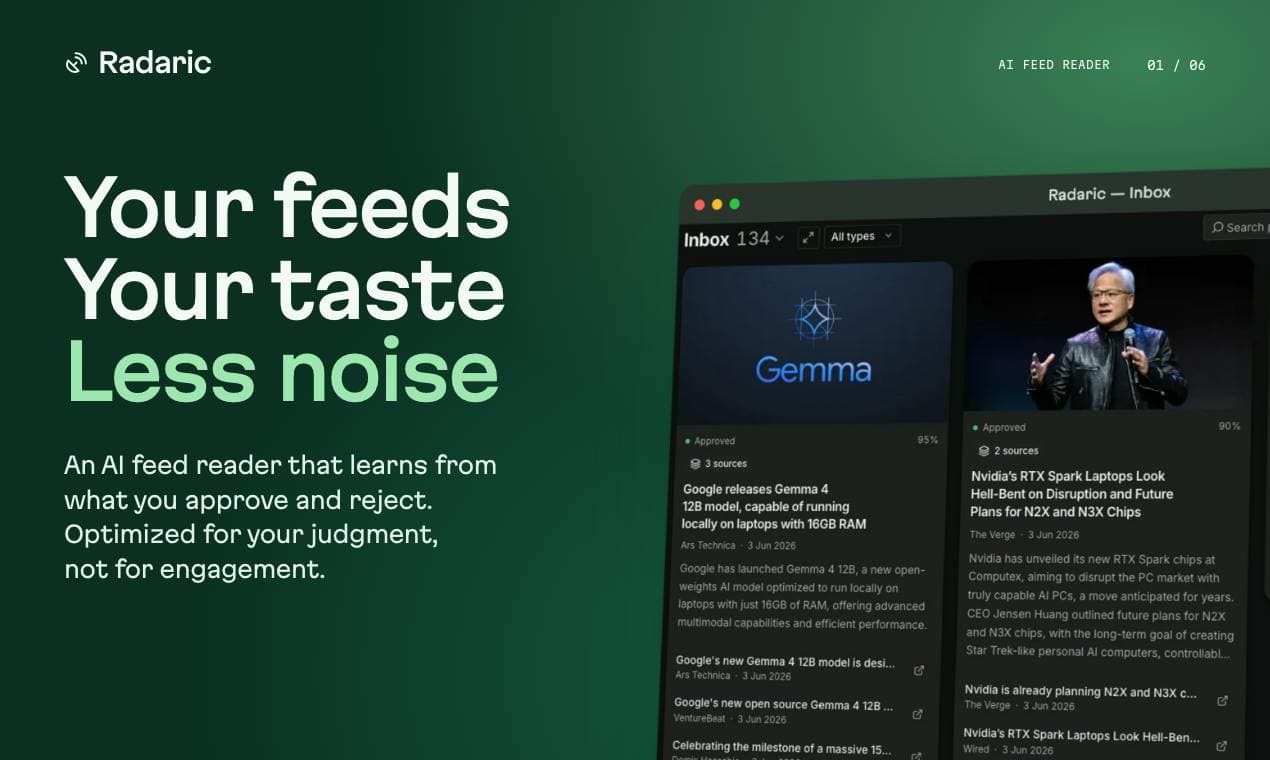
About this app
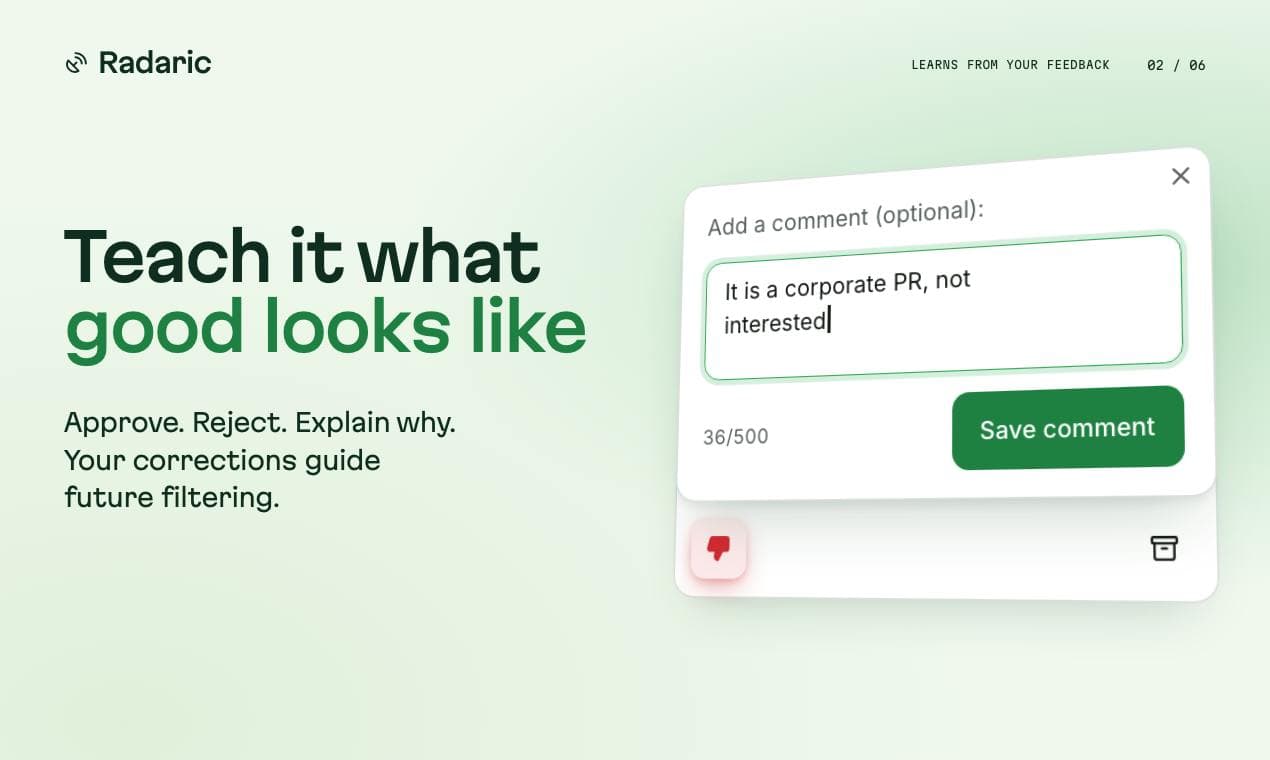
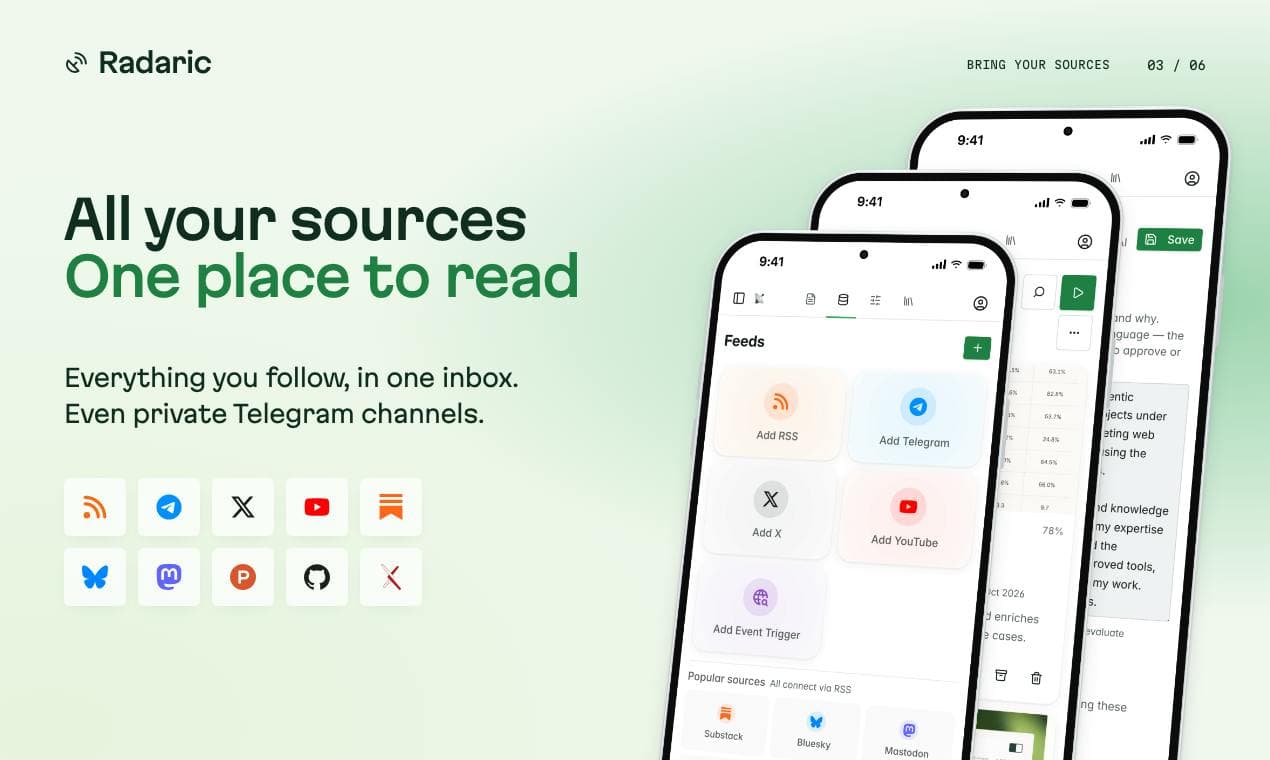
Bring RSS, Telegram, X and YouTube into a feed that learns from what you approve, reject and explain. Repeating coverage of the same event goes into one story with original links. I edit Zhurnalus, a weekly design digest with 500+ issues since 2016, and Radaric started as the tool I built for my own curation. The part that matters most is teaching the filter. "Design" is a starting point, but it does not capture an editor's taste: a case study, a minor product update and corporate PR can all match the same keywords. You describe what matters in plain language, then approve or reject posts, adding a reason when it helps. That feedback gives the AI context, and you can see its reasoning and revisit what it filtered out. RSS, Telegram including private channels, and YouTube live in one inbox, with X on Pro. When several sources cover the same event, the posts become one story with the original links attached. Lite is $9/month, Pro $59/month. 30-day money-back guarantee.
Key features
- 1Taste-learning AI filter that improves from approvals, rejections and explanations
- 2Cross-source story deduplication across RSS, Telegram (private), X, YouTube, Substack, Bluesky, Mastodon, Product Hunt, GitHub and arXiv
- 3YouTube transcript reading and private Telegram channel support
- 4OPML import from Feedly/Inoreader plus one-click source adds
Target customer profile
Drawn from the product itself, not from a survey.
Demographic
Newsletter writers, editors, and independent publishers
Pain points
Drowning in hundreds of feeds; repeating triage across 15 sources covering the same event
Primary needs
Faster discovery of genuinely relevant stories and automatic deduplication
Demographic
Researchers, analysts, and product/design professionals
Pain points
Scrolling endless social and RSS feeds; losing hours to manual curation
Primary needs
A personalized, low-noise feed that learns their niche and filters fast
Demographic
Content creators and social media managers
Pain points
Juggling Telegram, X, YouTube, and Substack; missing cross-platform trends
Primary needs
One unified inbox with multi-source coverage and deduplicated news
Demographic
Power users of Feedly, Inoreader, or Telegram-first readers
Pain points
One-size-fits-all AI filters and no support for private Telegram or YouTube transcripts
Primary needs
A reader whose AI adapts to their personal taste and covers more source types
Scout Review
Written by AI from measured evidence, scored out of 100.
Radaric is a taste-learning feed reader built by an editor who clearly uses it daily, and that shows in the copy, the onboarding flow, and the cross-source story deduplication that actually merges a Russian Telegram channel, an English X thread and a Portuguese RSS feed into one story. The wedge is real: Feedly's AI is the same for everyone, Inoreader has no taste-learning, and neither handles private Telegram or YouTube transcripts. The execution has rough edges — mobile LCP at 6.6s, a security header posture of 4/13, a comparison table with no headers, and no free tier — but none of them are fatal. The pricing is the biggest question: $59/month for X parsing against Feedly Pro+ at $18 is a steep ask for an early-stage product.
Measure by measure
Usability
68Four-step onboarding is spelled out clearly, OPML import from Feedly/Inoreader is offered, and one-click adds cover Substack, Bluesky, Mastodon, Product Hunt, GitHub and arXiv. No free tier, but a 30-day money-back guarantee softens the trial.
Design
72Confident editorial landing page with numbered steps, a Feedly/Perplexity comparison table, and a named founder with a 500-issue track record. Copy is specific and on-brand for editors.
Speed
58Lighthouse desktop 93/100 but mobile 71/100 with a 6.6s LCP — well past the 2.5s 'good' threshold. CLS 0 and TBT 51ms are clean; the mobile hero is the bottleneck.
Security
52HTTPS enforced and secure cookies set, but no HSTS, CSP, frame protection, Referrer-Policy, Permissions-Policy or DMARC — 4/13 header checklist points. Telegram access is claimed read-only with encrypted credentials; no SOC 2/ISO/pen-test published.
Accessibility
70Lighthouse 91/100 with three real failures: insufficient color contrast, viewport blocking user zoom (user-scalable=no), and a large table with headerless <td> cells. No WCAG statement published.
Growth
62Real problem (cross-source triage + dedup), specific target (newsletter editors), and a genuine wedge — taste-learning filter plus private Telegram and YouTube transcripts that Feedly/Inoreader structurally don't do. Early stage (domain 0.6 years), so headroom is real but unproven.
Improvement areas
- Mobile LCP of 6.6s fails Core Web Vitals — compress hero assets and preload fonts
- Security headers at 4/13 — add HSTS, CSP, frame protection, Referrer-Policy, Permissions-Policy and DMARC
- Accessibility: add <th> headers to the comparison table, remove user-scalable=no, fix contrast
- Pricing gap between $9 Lite and $59 Pro with no middle tier and no free trial
Design & Usability
Radaric's site reads like it was written by someone who actually uses the product — because it was. The numbered 01-04 flow, the Feedly/Perplexity comparison table, and the named founder with 500+ Zhurnalus issues give it more credibility than most indie SaaS landing pages. Onboarding is spelled out clearly: connect feeds, AI filters, AI learns, read. OPML import from Feedly/Inoreader is a smart migration path, and one-click adds for Substack, Bluesky, Mastodon, Product Hunt, GitHub and arXiv broaden the surface well beyond RSS. The main usability friction is the absence of a free tier — the 30-day money-back guarantee is a reasonable substitute, but it asks for a credit card before the user has seen the filter learn anything.
Speed & Security
Desktop Lighthouse lands at 93/100, but mobile is 71/100 with a 6.6-second LCP — the hero is heavy enough to fail Core Web Vitals on phones, which is where most feed-reading happens. CLS 0 and TBT 51ms show the underlying build is clean; this is a fixable asset problem, not an architecture one. Security is the weaker story: HTTPS and secure cookies are in place, but the header probe found no HSTS, CSP, frame protection, Referrer-Policy, Permissions-Policy or DMARC — 4/13 checklist points. For a product that asks users to connect private Telegram channels and X accounts, that's a thin posture. The site claims read-only Telegram access and encrypted credential storage, which is the right claim, but no SOC 2, ISO, pen-test or bug bounty is published to back it up.
Accessibility & Growth
Accessibility scores 91/100 on Lighthouse, but the three failing audits matter: insufficient color contrast, a viewport that blocks pinch-zoom on mobile, and a large comparison table with headerless <td> cells. The last one is ironic for a product aimed at editors — a screen reader user hits that table and gets a wall of unlabeled cells. No WCAG statement is published. Growth is the more interesting dimension: the problem is real (cross-source triage and deduplication across RSS, Telegram, X, YouTube), the target is specific (newsletter writers and independent publishers), and the wedge — a filter that learns from approvals and rejections, plus private Telegram and YouTube transcripts — is something Feedly and Inoreader structurally don't do. The category has headroom, but the $59/month Pro tier against Feedly's $18 and Inoreader's lower pricing is a hard sell for a two-person shop.
Conclusion
If you're an editor or newsletter writer drowning in 15 sources covering the same event, Radaric is worth the 30-day money-back trial — the dedup and taste-learning are genuinely differentiated. If you're a casual RSS user, Feedly or Inoreader will do the job for less. The product needs to fix its mobile LCP, ship a real security header set, and either justify the $59 Pro tier or bring it down before it can compete on price.
Suggestions for improvement
- Fix the mobile LCP (6.6s) — compress the hero image and preload the primary font to get under 2.5s.
- Add HSTS, CSP, X-Content-Type-Options, Referrer-Policy, Permissions-Policy and DMARC — 4/13 is thin for a product handling private Telegram credentials.
- Add <th> headers to the Feedly/Perplexity comparison table and remove user-scalable=no from the viewport meta.
- Reconsider the $59 Pro tier — Feedly Pro+ is $18 and Inoreader is cheaper; either justify the gap with more Pro-only sources or lower the price.
Alternatives comparison
Named competitors, point by point. Nobody paid to appear here or to be left out.
 Radaric |  Feedly | Inoreader |  Research assistant tools (e.g., Perplexity) | |
|---|---|---|---|---|
| Price (entry tier) | $9/month (Lite) | ~$18/month (Pro+) | Free tier; paid from ~$9/month | $2,000+/month (enterprise) |
| Taste-learning AI filter | Yes — learns from approvals, rejections and explanations | No — same AI for all users | No — rule-based automation only | No — general research assistant |
| Private Telegram channel support | Yes, automated | No | No | Manual only |
| Cross-source story deduplication | Automatic grouping with original links | No | No | Manual |
| YouTube transcript reading | Yes | No | No | No |
| Free tier / trial | No free tier; 30-day money-back guarantee | Free tier available | Free tier available | Free tier available |
Feedly
Popular RSS reader with AI filtering (Pro+ around $18/month), but its AI is the same for every user and it focuses on RSS rather than Telegram, YouTube transcripts, or private channels.
Inoreader
Feature-rich RSS reader with automation rules and OPML support, but lacks taste-learning AI and automatic cross-source story deduplication.
Research assistant tools (e.g., Perplexity)
Enterprise-grade AI research assistants can cost $2,000+/month and require manual setup, versus Radaric's from-$9/month approach focused on personalized feed curation.
Comparing options? See Radaric alternatives, scored side by side
More Productivity apps
View all Productivity
Qamarero
92An all-in-one hospitality software for restaurants and ba...

The Stack Newsletter
92A weekly newsletter delivering curated tech jobs, intervi...

EmbedMyReviews
92White-label reputation management software for agencies s...

StoryPad
92Privacy-first open source journal app with a continuous t...

Puzzly – B2B Lead Generation & Sales Intelligence Platform
92Puzzly is an all-in-one B2B lead generation platform that...

Notion
92All-in-one AI workspace for docs, projects, and knowledge...

Vibe Coding Agent Skills
92A free, open-source platform offering 110 AI agent skills...

CC Switch
91Open-source desktop app for switching AI coding providers...

username.md
90One verified handle for your online identity, readable by...

PitchWhip
90AI cold call scripts & direct dials from LinkedIn

What the GIF
89Frame-perfect video-to-GIF maker that runs entirely in yo...

AuditCloser
89White-label website audits that close deals for digital a...


A platform dedicated to providing unbiased reviews of newly launched applications, analyzing everything from their features to their full potential.
info@scoutforge.net© 2026 Scoutforge. All rights reserved.
