Cycling through all six. Tap any point to stop.
Measured on six things
AI agents that run your entire software delivery lifecycle
Speed
33Lighthouse mobile 34/100 with an 11.5s LCP and 3.2s TBT — the hero demo embed and heavy media are eating the budget. Desktop 61/100 is better but still mid.
Screenshots
1 / 1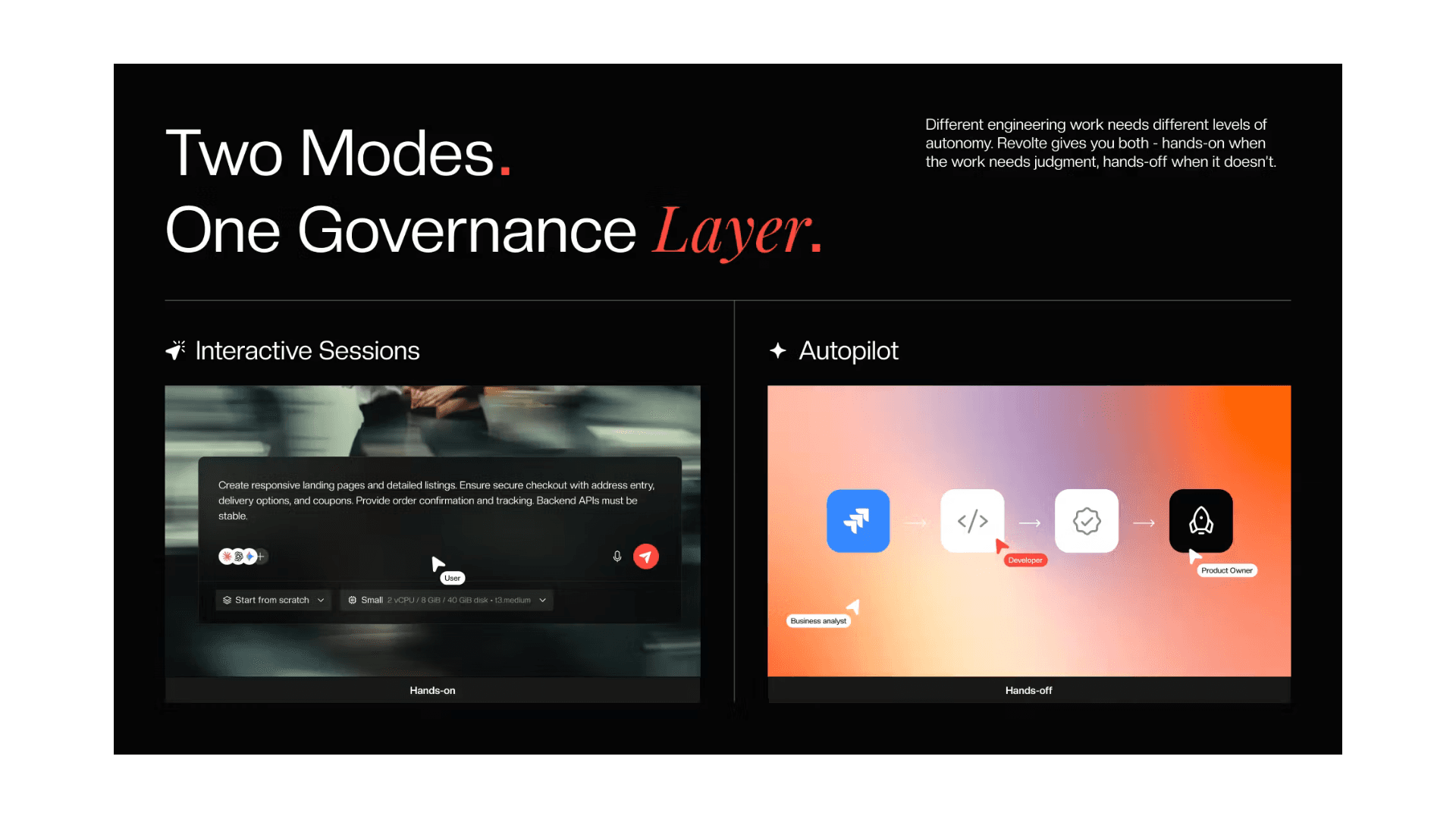
About this app
Revolte is an AI-native software delivery platform that helps engineering teams turn intent into production-ready software faster, safer, and with greater control. Instead of focusing only on code generation, Revolte uses intelligent AI agents to orchestrate the entire software delivery lifecycle—from planning and implementation to code reviews, quality and security validation, deployments, and runtime monitoring. Engineers remain in control of every critical decision while AI automates repetitive, execution-heavy work across the SDLC. Unlike fragmented DevOps toolchains that require multiple point solutions for CI/CD, security, observability, and automation, Revolte unifies software delivery into a single, developer-first platform. Its AI agents work together to reduce context switching, streamline engineering workflows, and improve delivery consistency without compromising governance or reliability.
Key features
- 1Agentic SDLC orchestration: AI agents run development, testing, deployment, and runtime ops end-to-end with human approval gates on high-risk decisions.
- 2Governance and auditability: every agent action logged, human-in-the-loop authorization before production changes, DORA and Flow dashboards.
- 3Transparent credit-based pricing: Free tier, $20 Starter, $199 Growth, custom Enterprise with BYOC/on-prem; credits at $0.04 ($0.03 on Growth).
Target customer profile
Drawn from the product itself, not from a survey.
Demographic
Engineering leaders at mid-to-large enterprises
Pain points
Slow release cycles, compliance risks, lack of visibility into AI actions
Primary needs
Governed AI that accelerates delivery without sacrificing control or auditability
Demographic
DevOps and platform engineering teams
Pain points
Manual toil in CI/CD, testing bottlenecks, integration complexity
Primary needs
End-to-end automation that integrates with existing pipelines and infrastructure
Demographic
QA and security engineers
Pain points
Insufficient test coverage, production incidents, security vulnerabilities
Primary needs
Scalable test automation, proactive anomaly detection, and human-approved fixes
Scout Review
Written by AI from measured evidence, scored out of 100.
Revolte is an AI-native software delivery platform that positions itself as the governed alternative to point tools like GitHub Copilot, GitLab Duo, and Harness — agents that run the full SDLC from intent to production, with human approval gates and full audit trails. The pitch is sharp and the target customer (engineering leaders at mid-to-large enterprises with compliance pressure) is specific. The pricing page is unusually transparent for the category, with a real free tier and credit-based metering. The measured evidence tells a more mixed story: security headers are strong (10/12), accessibility is decent (93/100 with real WCAG failures), but mobile performance is poor (34/100, 11.5s LCP) and the design, while above-average, has visible rough edges. The biggest open question is verification — SOC 2 is claimed but not published, and the governance differentiator is asserted more than proven.
Measure by measure
Usability
63Four-tier pricing with credit metering is unusually legible for this category, and 'Start Free' is a real path. Hero CTA split and low-contrast workflow labels cost it points.
Design
71Coherent red accent and a real product demo in the hero beat most agentic-AI landing pages. Pink demo background and inconsistent 'Book a Demo' button styles keep it from the top of the band.
Speed
33Lighthouse mobile 34/100 with an 11.5s LCP and 3.2s TBT — the hero demo embed and heavy media are eating the budget. Desktop 61/100 is better but still mid.
Security
7410/12 security headers, HSTS, DMARC and SPF all present. SOC 2 and GDPR are claimed on the Enterprise tier but no public report or trust page was found to verify.
Accessibility
70Lighthouse a11y 93/100 is strong, but contrast, touch-target, and accessible-name failures are real WCAG issues. No published a11y statement or WCAG conformance claim.
Growth
62Real problem (fragmented DevOps toolchain), specific wedge (governed agentic delivery with human-in-the-loop), and a clear enterprise land-and-expand motion. Differentiation vs. Harness is asserted more than proven.
Improvement areas
- Mobile performance: Lighthouse 34/100 with 11.5s LCP — the hero demo embed and heavy media need compression and lazy-loading.
- Trust and verification: SOC 2 and GDPR are claimed on the pricing page but no public trust center, report, or audit link exists.
- Accessibility gaps: contrast, touch-target, and accessible-name failures remain despite a 93/100 Lighthouse score; no WCAG conformance statement.
Design & Usability
Revolte's homepage is a cut above the usual agentic-AI slop: a real product demo in the hero, a coherent red accent, and a pricing page that actually explains what a 'credit' is instead of hiding behind 'Contact Sales.' The four-tier structure — Free, $20 Starter, $199 Growth, custom Enterprise — is legible, and the credit metering ($0.04/credit, dropping to $0.03 on Growth) is unusually honest for the category. Where it slips: the hero splits attention between a red 'Start Free' and a grey 'Book a Demo,' the demo embed's pink background fights the rest of the page, and the bottom workflow diagram uses low-contrast text on near-black that's genuinely hard to read. The 'Book a Demo' button also appears in at least three different styles across the page, which reads as unfinished rather than intentional. Solid, not polished.
Speed & Security
Speed is the weak spot. Lighthouse mobile scores 34/100 with an 11.5-second LCP and 3.2-second TBT — the hero demo embed and heavy media are the obvious culprits. Desktop fares better at 61/100 but is still mid-pack. For a product whose pitch is 'faster releases,' a landing page that takes eleven seconds to render on mobile is an awkward look. Security is the opposite story: the HTTP probe found 10/12 headers in place, including HSTS, frame protection, Referrer-Policy, Permissions-Policy, plus SPF and DMARC. The one gap is CSP, which is the header that actually mitigates XSS. The pricing page claims 'SOC 2, GDPR & custom compliance' on the Enterprise tier, but no public trust center, report, or audit link was found — so that claim is unverified. For a product selling governance and auditability to enterprises, the missing trust page is a real gap.
Accessibility & Growth
Accessibility lands at 70: Lighthouse scores 93/100, which is genuinely good, but the failing audits are the ones that matter — insufficient color contrast, touch targets too small, and visible text labels without matching accessible names. Those are WCAG failures, not nitpicks, and there's no published accessibility statement or conformance claim to point to. On growth, the idea holds up. The problem — fragmented DevOps toolchains forcing teams to stitch together CI/CD, security, observability, and automation — is real and expensive. The wedge is governance: every agent action logged, every high-risk decision routed to a human, which is exactly what compliance-bound enterprises need before letting AI touch production. Pricing supports a clean land-and-expand motion from free hobby tier to enterprise BYOC. The honest limit: 'governed agentic delivery' is a positioning, not a moat. Harness, GitLab Duo, and Copilot are all racing toward the same pitch, and Revolte's differentiation is asserted on the site more than demonstrated with benchmarks or case studies.
Conclusion
Revolte is aiming at a real problem with a real wedge, and the execution is above the category median. The pricing transparency and security-header discipline suggest a team that understands enterprise buyers. But the gap between the pitch ('governed agentic delivery') and the proof (no public trust center, no benchmarks, no case studies with names) is where this review lands. If you're an engineering leader evaluating this against Harness or GitLab Duo, the questions to ask in a demo are: show me the SOC 2 report, show me the audit log format, and show me a customer who's actually running agents against production. The product might be excellent — the evidence to prove it isn't public yet.
Suggestions for improvement
- Publish a trust center with the SOC 2 report, subprocessors, and data-residency details — enterprise buyers check this before the demo.
- Fix the mobile LCP (11.5s). Compress the hero demo embed, lazy-load below-fold media, and ship a static fallback for slow connections.
- Resolve the three Lighthouse a11y failures (contrast, touch targets, accessible names) and publish a WCAG 2.2 AA conformance statement.
- Add a CSP header and a public security.txt / disclosure policy — for a governance product, the missing CSP is a credibility gap.
Alternatives comparison
Named competitors, point by point. Nobody paid to appear here or to be left out.
 Revolte |  GitHub Copilot |  GitLab Duo |  Harness | |
|---|---|---|---|---|
| Scope: full SDLC orchestration vs. point solution | End-to-end agentic SDLC: planning, implementation, review, security, deploy, runtime monitoring | Individual coding assistance only — no deployment, testing, or runtime coverage | DevSecOps suite with code suggestions and security scanning, not fully autonomous delivery | CI/CD and feature-flag automation with AI, but not agentic end-to-end SDLC orchestration |
| Governance and auditability of AI actions | Every agent action logged; human-in-the-loop gates above risk threshold; DORA/Flow dashboards | No agent-action audit trail; suggestions are developer-reviewed inline only | Security scanning and policy controls, but no agentic action audit log | Pipeline governance and approval gates, but not framed around AI agent action auditing |
| Pricing transparency and entry point | Free tier, $20 Starter, $199 Growth, custom Enterprise; credit metering at $0.04/credit | $10/mo Individual, $19/user Business, $39/user Enterprise (approx.) | Bundled into GitLab Premium/Ultimate tiers; no standalone Duo free tier | Free tier plus usage-based pricing; enterprise custom quotes |
| Deployment flexibility (cloud, BYOC, on-prem) | Revolte Cloud, BYOC, private, and on-prem options on Enterprise tier | SaaS only; GitHub Enterprise Cloud or Server for self-hosted | SaaS and self-managed GitLab options | SaaS and self-managed (Harness Self-Managed Enterprise Edition) |
GitHub Copilot
AI pair programmer that suggests code in real-time, but focuses on individual coding rather than full lifecycle automation.
GitLab Duo
AI-powered suite for DevSecOps that assists with code suggestions and security, but not as deeply autonomous as Revolte.
Harness
AI-driven software delivery platform that automates CI/CD and feature flags, but lacks Revolte's agentic, end-to-end approach.
Comparing options? See Revolte alternatives, scored side by side
More Productivity apps
View all Productivity
The Stack Newsletter
92A weekly newsletter delivering curated tech jobs, intervi...

Qamarero
92An all-in-one hospitality software for restaurants and ba...

EmbedMyReviews
92White-label reputation management software for agencies s...

StoryPad
92Privacy-first open source journal app with a continuous t...

Notion
92All-in-one AI workspace for docs, projects, and knowledge...

Puzzly – B2B Lead Generation & Sales Intelligence Platform
92Puzzly is an all-in-one B2B lead generation platform that...

Vibe Coding Agent Skills
92A free, open-source platform offering 110 AI agent skills...

Gerty
91Private, local AI assistant for Mac that runs offline

CC Switch
91Open-source desktop app for switching AI coding providers...

username.md
90One verified handle for your online identity, readable by...

PitchWhip
90AI cold call scripts & direct dials from LinkedIn

What the GIF
89Frame-perfect video-to-GIF maker that runs entirely in yo...


A platform dedicated to providing unbiased reviews of newly launched applications, analyzing everything from their features to their full potential.
info@scoutforge.net© 2026 Scoutforge. All rights reserved.
