

A platform dedicated to providing unbiased reviews of newly launched applications, analyzing everything from their features to their full potential.
info@scoutforge.net© 2026 Scoutforge. All rights reserved.
A platform dedicated to providing unbiased reviews of newly launched applications, analyzing everything from their features to their full potential.
info@scoutforge.net© 2026 Scoutforge. All rights reserved.
A platform dedicated to providing unbiased reviews of newly launched applications, analyzing everything from their features to their full potential.
info@scoutforge.net© 2026 Scoutforge. All rights reserved.
Cycling through all six. Tap any point to stop.
Measured on six things
Open-source LLM observability – one line of code to monit...
Very new (June 2026 launch), active GitHub with frequent commits, but zero external reviews or community traction yet.
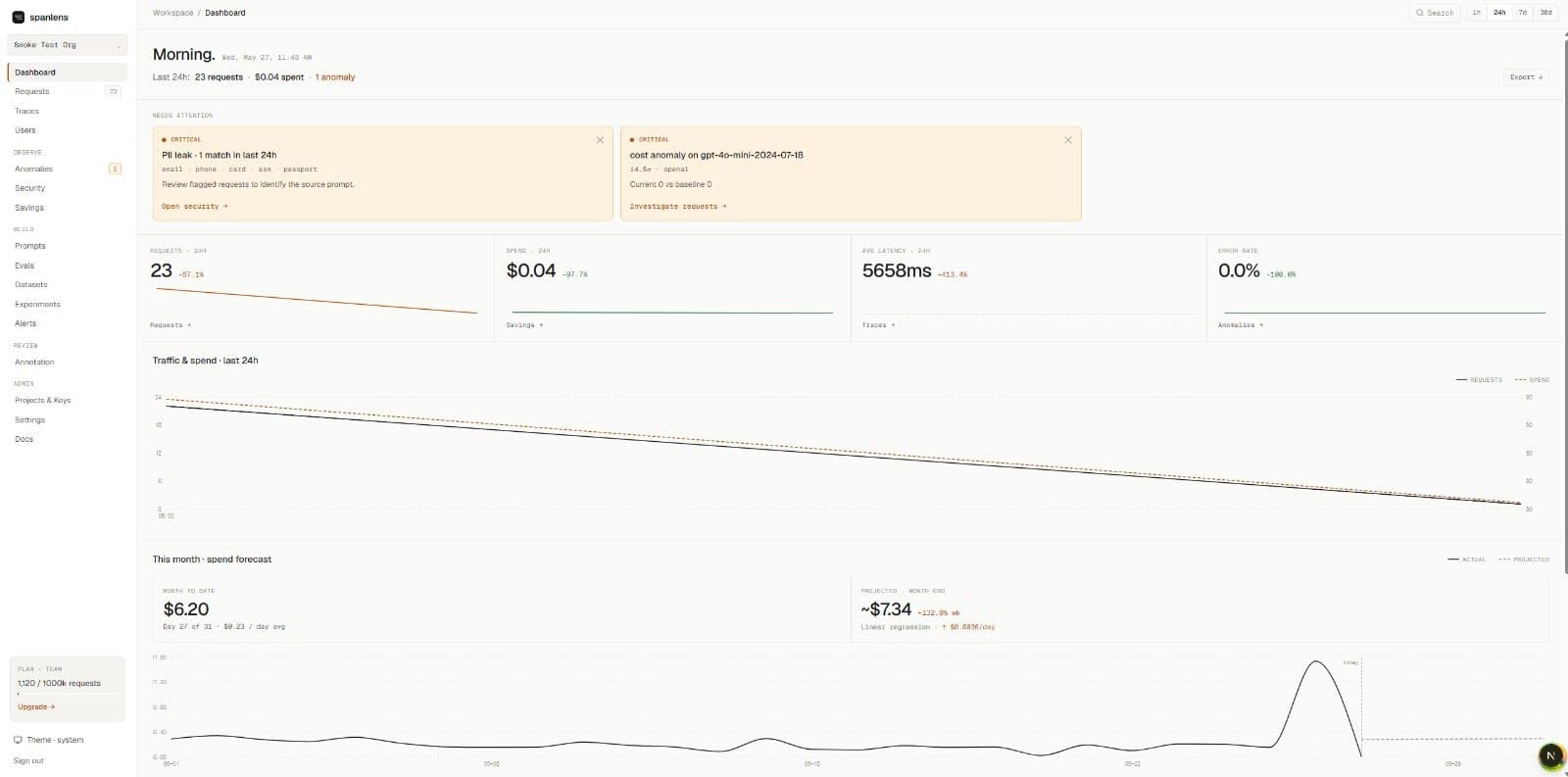
I've been testing Spanlens for the last few days, and I'm genuinely impressed. It's an open-source (MIT) LLM observability platform that logs every request to OpenAI, Anthropic, and Gemini with just one line of code. Setup is ridiculously easy – you simply swap your provider SDK for Spanlens's drop-in, and boom, you get request logging, cost tracking, agent tracing, anomaly detection, PII scanning, model recommendations, evals, and experiments. The self-hosted option means your data never leaves your VPC, which is huge for compliance. I love the waterfall traces for debugging multi-step agents – it shows critical path, cost attribution, and latency outliers instantly. The cost dashboard is a lifesaver for understanding why your AI bill spiked. And the eval/experiment workflow lets you replay real traffic against different models and prompt versions, so you can actually measure quality improvements before shipping. With a free tier for 50K requests/month and Pro at $29/month, it's in...
Drawn from the product itself, not from a survey.
Demographic
AI/ML engineers building LLM-powered applications
Pain points
Debugging black-box LLM calls, tracking costs across multiple providers, identifying latency bottlenecks
Primary needs
One-line integration, detailed request logs, cost breakdowns, agent tracing
Demographic
Platform teams monitoring production AI workloads
Pain points
Anomaly detection, PII leakage, compliance requirements, multi-team budget management
Primary needs
Security scanning, anomaly alerts, role-based access, audit logs, self-hosting
Demographic
Product managers optimizing AI feature quality and cost
Pain points
Comparing model performance, validating prompt improvements, controlling AI spending without sacrificing quality
Primary needs
Eval scores, experiment comparisons, model cost recommendations, dataset replay
Written by AI from measured evidence, scored out of 100.
Spanlens is a fresh, MIT-licensed LLM observability tool that excels at dead-simple integration and practical features like agent tracing, cost recommendations, and experiment replay. It directly addresses pain points in the provided alternatives—easier setup than Langfuse, more evals than Helicone, and self-hosting unlike LangSmith. The free tier and flat pricing are attractive, but its youth means real-world validation is still pending.
Extremely easy one-line/CLI setup, rich docs, live demo, and framework integrations make onboarding fast for LLM devs.
Polished, modern landing with live interactive demo, clean visuals for traces/costs, and consistent branding across sections.
Site and demo feel snappy; vendor claims sub-3ms overhead with async design, though no independent benchmarks exist.
Strong self-host + PII scanning story; MIT license and Docker deployment, but no audits or compliance certifications published.
Responsive modern site with readable demo tables; no WCAG claims, alt text details, or accessibility documentation found.
Very new (June 2026 launch), active GitHub with frequent commits, but zero external reviews or community traction yet.
Spanlens delivers a genuinely polished landing experience with an interactive live demo that showcases request logs, cost tracking, and waterfall traces in real time. The one-line SDK swap and CLI wizard make it feel instantly usable for AI engineers already working with OpenAI/Anthropic/Gemini. Documentation is thorough, covering self-hosting, LangChain callbacks, and experiments. Compared to peers like Langfuse (more complex SDK) or Helicone (lighter on evals), the onboarding friction is noticeably lower. The UI emphasizes practical dashboards over flashy animations, which fits the target audience of platform teams and PMs who need cost visibility and agent debugging fast.
Performance claims center on sub-3ms overhead via async ingestion, and the demo dashboard renders thousands of events without lag. Self-hosting via a single Docker command keeps data in your VPC, paired with built-in PII regex scanning and secret masking—strong for compliance-sensitive workloads. However, the absence of published SOC 2, ISO, or independent audits keeps the security posture in the 'solid but unremarkable' band. No breach history exists simply because the product is brand new. Speed and security are competent table stakes rather than differentiators versus established alternatives.
The site is responsive and the demo tables are readable, but there are no accessibility statements, WCAG mentions, or multi-language support. Growth is the weakest dimension: launched around June 2026, the GitHub repo shows healthy commit activity and a clear positioning table versus Langfuse/Helicone, yet independent reviews, Product Hunt traction, or community size are nonexistent. With only demo data claiming 1,204 users and no G2/Capterra presence, Spanlens is still in the 'promising early project' phase rather than proven product.
Conclusion
If you're an AI engineer tired of black-box LLM spend or debugging multi-step agents, Spanlens is worth a 30-second test drive via the live demo. Just don't bet production compliance on it until audits appear.
Named competitors, point by point. Nobody paid to appear here or to be left out.
 Spanlens Spanlens |  Langfuse Langfuse |  Helicone Helicone |  LangSmith LangSmith | Arize Phoenix | |
|---|---|---|---|---|---|
| Integration complexity | One-line SDK swap or CLI init | More complex SDK setup | Proxy-based, moderate complexity | LangChain-native, framework lock-in | More complex setup for evals |
| Self-hosting | Docker one-liner, free forever | Supported, more involved | Supported | Not self-hostable | Open-source, self-hostable |
| Evals & experiments | LLM-as-judge + dataset replay | Strong evals & prompt management | Limited evals focus | LangChain-centric evals | Strong LLM evals & drift detection |
Langfuse
Open-source LLM observability with traces, evals, and prompt management. Self-hostable, but SDK more complex.
Helicone
LLM observability with caching and rate limiting. Focused on cost control but less emphasis on evals and traces.
LangSmith
LangChain's observability platform, tightly integrated with LangChain ecosystem. Not self-hostable and seams with other frameworks.
Arize Phoenix
Open-source AI observability with focus on LLM evals and drift detection. More complex setup and less cost transparency.
Comparing options? See Spanlens alternatives, scored side by side
What the review was written against. A verdict with no sources is an opinion.

A no-code Solana token creator that deploys SPL tokens in...

A free, open-source platform offering 110 AI agent skills...

Open-source desktop app for switching AI coding providers...

Fast EU VAT validation API for developers, covering 27 EU...

Claw Messenger is an iMessage API service that gives AI a...

PERM Processing Time is an independent data analysis platform that helps users navigate the U.S. Department of Labor’s permanent labor certification process.

AI-powered Dubai real estate data platform with 12M+ DLD ...

BeartIMAGE is a free, web-based image processing platform engineered for fast, bulk photo editing and conversion directly in your browser.

macOS app for App Store screenshots: 3D mockups, auto-tra...

Real-time monetization infrastructure for AI products tha...

A native macOS process explorer and advanced monitor that...

A developer-first financial data API providing structured...
A platform dedicated to providing unbiased reviews of newly launched applications, analyzing everything from their features to their full potential.
info@scoutforge.net© 2026 Scoutforge. All rights reserved.