

A platform dedicated to providing unbiased reviews of newly launched applications, analyzing everything from their features to their full potential.
info@scoutforge.net© 2026 Scoutforge. All rights reserved.
A platform dedicated to providing unbiased reviews of newly launched applications, analyzing everything from their features to their full potential.
info@scoutforge.net© 2026 Scoutforge. All rights reserved.
A platform dedicated to providing unbiased reviews of newly launched applications, analyzing everything from their features to their full potential.
info@scoutforge.net© 2026 Scoutforge. All rights reserved.
Cycling through all six. Tap any point to stop.
Measured on six things
Automated API monitoring for OpenAPI specs with change classifications
HTTPS is enforced, but the header probe found no HSTS, CSP, frame protection, X-Content-Type-Options, Referrer-Policy, or Permissions-Policy, and no SPF or DMARC. Checklist 2/12; no SOC 2, ISO, or pen-test claims found.
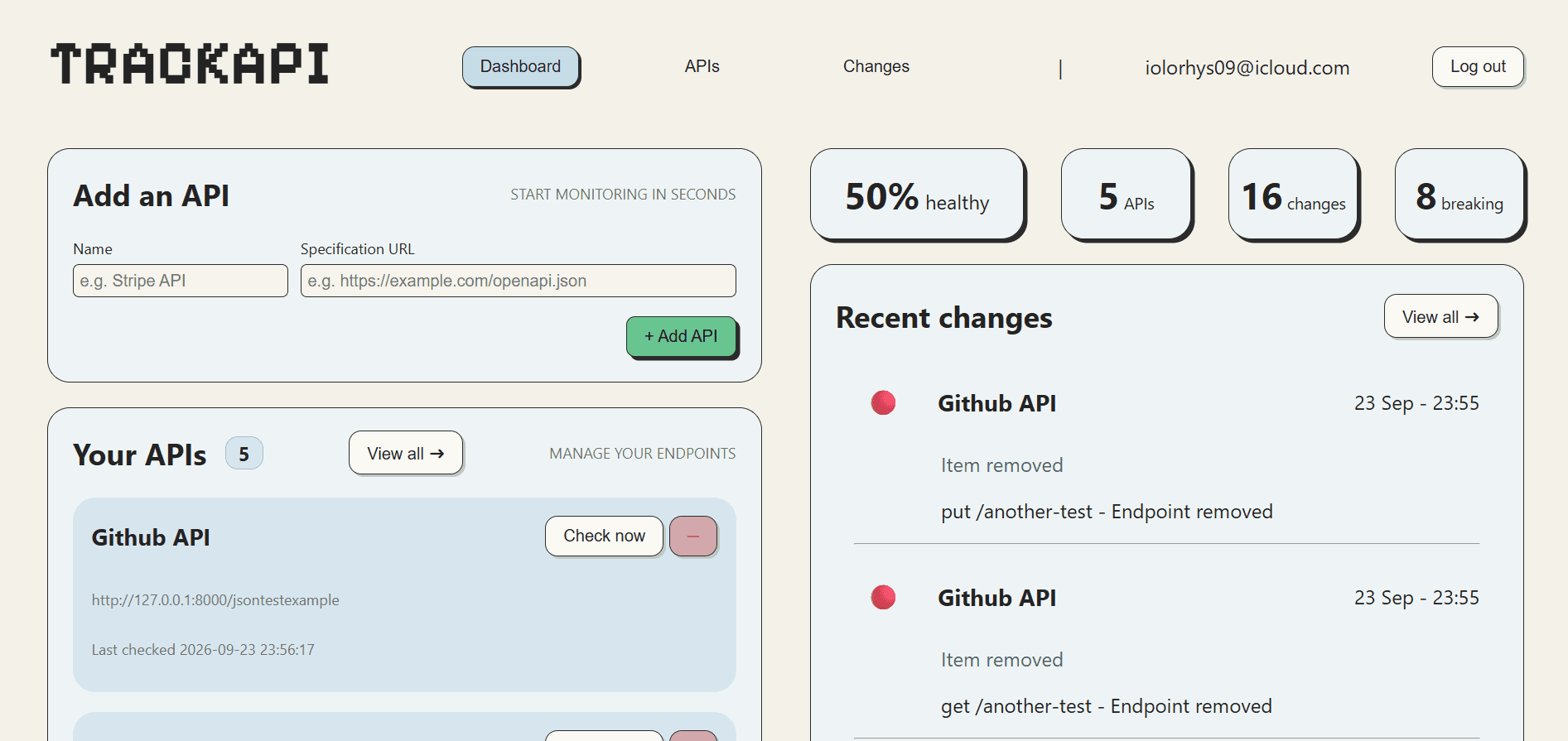
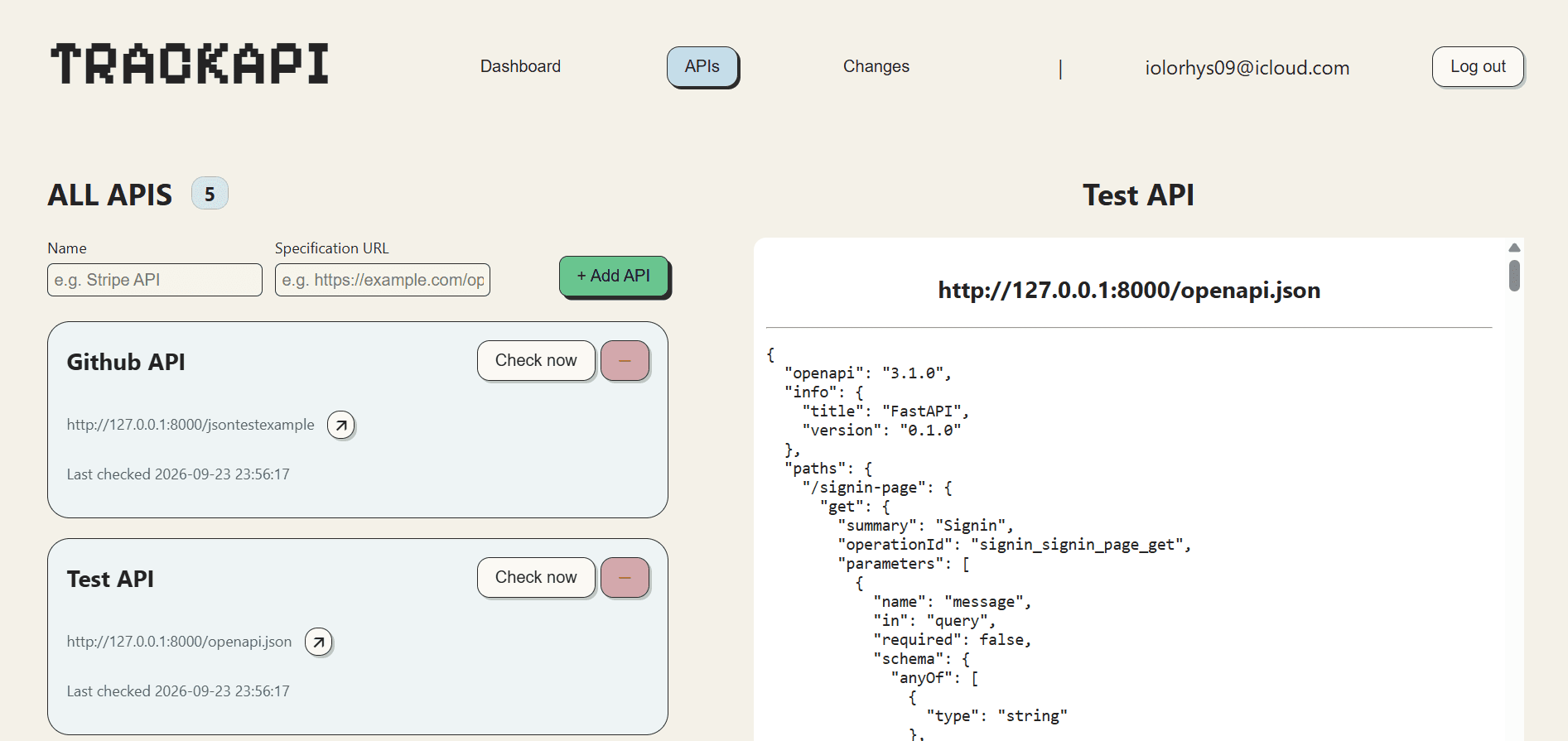
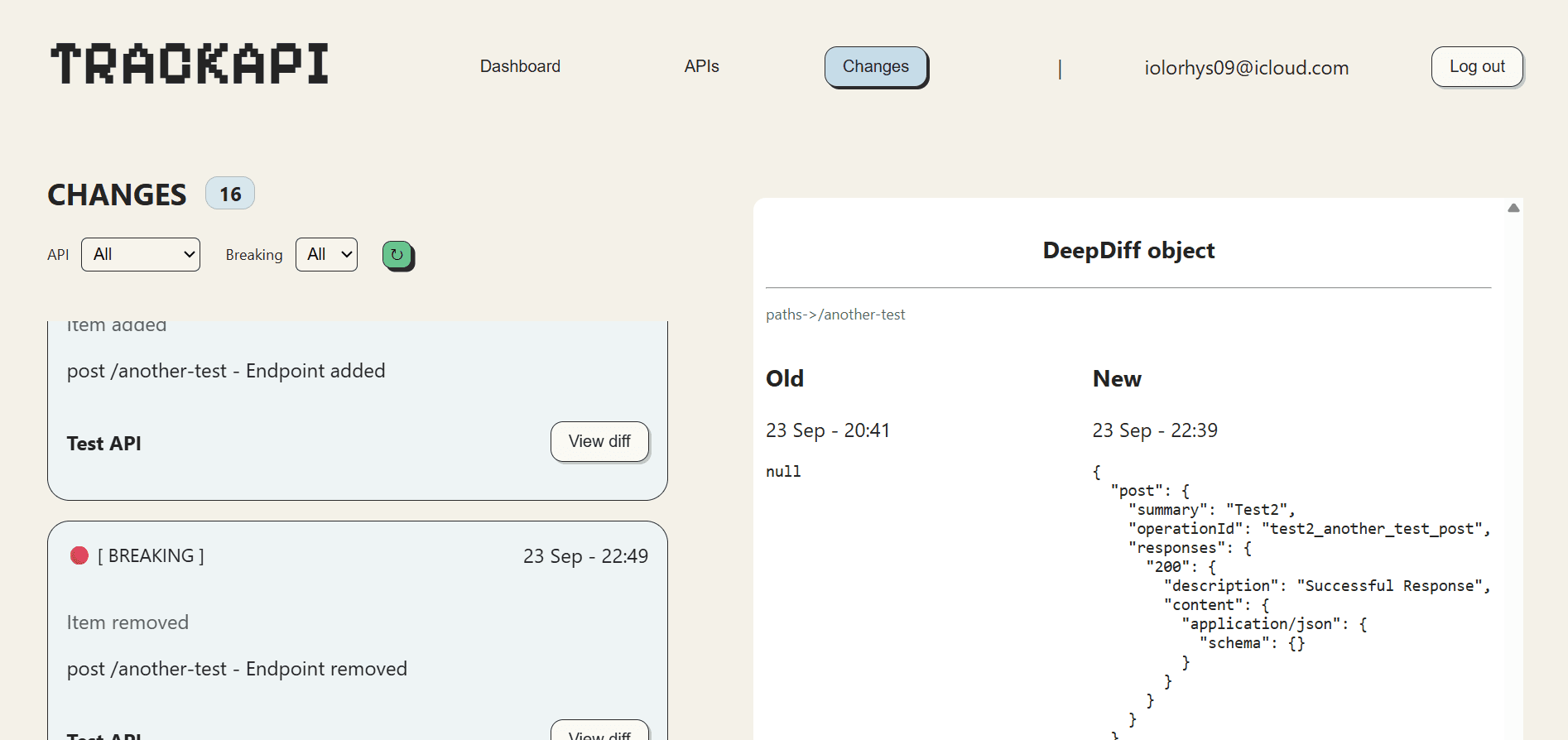
TrackAPI is a developer tool that automatically monitors your API's OpenAPI specifications and alerts you to changes, helping you maintain stability and avoid unexpected breaking changes. Simply provide the URL to your OpenAPI spec, and TrackAPI will check it every 6 hours (or on-demand) for updates. Each change is classified as non-breaking, potentially breaking, or breaking, so you can quickly assess the impact. You receive email notifications with details, including the latest spec and DeepDiff output for precise root-cause analysis. Built for development teams, API product managers, and DevOps engineers, TrackAPI ensures you're always in the loop about API changes, whether you're maintaining internal microservices or public-facing APIs. With its focus on OpenAPI standards and clear change categorization, it's a lightweight yet powerful addition to your API toolchain.
Drawn from the product itself, not from a survey.
Demographic
Backend Developers
Pain points
Manual API spec monitoring is time-consuming and error-prone; breaking changes can slip into production unnoticed.
Primary needs
Automated tracking of OpenAPI specs with immediate alerts on changes and clear classification of impact.
Demographic
DevOps Engineers
Pain points
Ensuring API stability across deployments is challenging; lack of visibility into spec changes leads to integration failures.
Primary needs
Continuous monitoring of API specs with detailed change reports to prevent downstream issues.
Demographic
API Product Managers
Pain points
Coordinating API changes across teams and communicating breaking changes is difficult without a centralized tracking system.
Primary needs
Automated notifications and change history to keep stakeholders informed and manage API lifecycle effectively.
Written by AI from measured evidence, scored out of 100.
TrackAPI does one thing and does it clearly: watch an OpenAPI spec, tell you when it changes, and classify the change as non-breaking, potentially breaking, or breaking. The landing page is clean, the onboarding is a single URL paste, and the email alerts include the spec and DeepDiff output — exactly the right artifacts for a developer to act on. Speed is strong (desktop 97, mobile 81), and accessibility is close to clean at 94. But the product is surrounded by missing scaffolding: no docs, no pricing page, no dashboard screenshots, no security page, and a security header checklist of 2/12. For a tool that handles spec URLs and email addresses, the absence of HSTS, CSP, SPF, and DMARC is a real gap. The idea is sound and the wedge over Postman and Optic is real, but execution outside the core monitoring loop is thin. It's a promising early-stage tool that needs to finish the product around the feature.
Onboarding is genuinely simple: paste a spec URL, get checks every 6 hours plus a manual 'check now'. Email alerts include the spec and DeepDiff output. No visible docs, pricing, or help center in the fetched material.
Clean single-column landing page with a clear hero and CTA, but no product screenshots or dashboard previews. Emoji color-coding for change severity reads more like a README than a polished SaaS brand.
Lighthouse desktop 97/100 and mobile 81/100, with CLS 0.002 and TBT 29ms. Mobile LCP of 4.6s is the weak spot, well above the 2.5s 'good' threshold, but the page is light and stable overall.
HTTPS is enforced, but the header probe found no HSTS, CSP, frame protection, X-Content-Type-Options, Referrer-Policy, or Permissions-Policy, and no SPF or DMARC. Checklist 2/12; no SOC 2, ISO, or pen-test claims found.
Lighthouse accessibility 94/100, with two failing audits: non-sequential heading order and a missing main landmark. No accessibility statement, WCAG claim, or multi-language support found in the site content.
Real, specific problem — breaking OpenAPI changes slipping into production — with a clear wedge over Postman (no manual monitor setup) and Optic (remote email alerts, not local/CI). Early stage, but the idea has room.
TrackAPI's landing page is clean and to the point: a hero, a 'Start Tracking' button, and four feature blocks explaining spec monitoring, email alerts, change classification, and DeepDiff output. The problem is what's missing. There are no screenshots of the actual dashboard, no pricing page, no docs, and no help center in the fetched site content. For a developer tool, that's a real gap — devs want to see the UI and read the docs before they hand over a spec URL. Onboarding itself sounds painless: paste your OpenAPI spec URL, get checks every 6 hours, plus a 'check now' button for instant results. Email notifications include the latest spec and DeepDiff objects, which is exactly what you'd want for root-cause analysis. The emoji-based severity coding (🟢 🟠 🔴) is functional but reads more like a GitHub README than a polished product. The bottom-of-page 'leave some feedback' section appears to be an empty placeholder. Usability is competent where it exists, but the surrounding scaffolding — docs, pricing, demo — is thin.
Speed is TrackAPI's strongest measured dimension. Lighthouse desktop scores 97/100 and mobile 81/100, with a near-perfect CLS of 0.002 and TBT of just 29ms. The mobile LCP of 4.6s is the one blemish — above Google's 2.5s 'good' threshold — but the page is light and stable, and there are no user complaints about lag in the collected evidence. Security is where the picture darkens. HTTPS is enforced, which is table stakes, but the header probe found no HSTS, no CSP, no frame protection, no X-Content-Type-Options, no Referrer-Policy, and no Permissions-Policy. SPF and DMARC records are also absent, meaning email spoofing of the trackapi.uk domain is trivial. The checklist score is 2/12. There are no SOC 2, ISO, or pen-test claims on the site, and no security page. For a tool that asks developers to hand over their OpenAPI spec URLs and email addresses, the security posture is thin. None of this is unusual for an early-stage indie tool, but it's a real gap against what a security-conscious buyer would expect.
Accessibility scores 94/100 on Lighthouse, which is genuinely good, but two audits fail: heading elements are not in sequentially-descending order, and the document has no main landmark. Both are quick fixes, and their presence suggests the page was built without an a11y pass. There's no accessibility statement, no WCAG conformance claim, and no multi-language support in the site content. On growth, the idea holds up. The problem — breaking OpenAPI changes slipping into production unnoticed — is real and expensive. The target segments are specific: backend developers, DevOps engineers, and API product managers. The wedge against the listed alternatives is clear: Postman requires manual monitor setup and doesn't classify spec changes the same way; Optic focuses on local development and CI rather than continuous remote monitoring with email alerts. That's a legitimate differentiator. The category has room — API change management is a growing concern as microservices proliferate. The limit is that this is a narrow, single-purpose tool in a crowded developer-tooling market, and the domain was registered very recently, so there's no traction to point to yet.
Conclusion
TrackAPI is the kind of tool that makes you wonder why it didn't already exist. The core loop — paste a spec URL, get email alerts with DeepDiff output when something changes — is exactly what a backend team needs to stop breaking changes from sneaking into production. The change classification (non-breaking, potentially breaking, breaking) is a genuinely useful layer that Postman and Optic don't offer in the same form. But the product is half-built around the edges. No docs means new users are on their own. No pricing page means you can't tell if it's free or paid. No security headers means a security-conscious team will hesitate before handing over their spec URLs. None of these are hard to fix, and the speed and accessibility scores show the foundation is solid. If the maker fills in the gaps — docs, pricing, security headers, a dashboard preview — this could be a genuinely useful addition to a lot of API toolchains. For now, it's a sharp idea with a thin wrapper.
Named competitors, point by point. Nobody paid to appear here or to be left out.
 TrackAPI TrackAPI |  Postman Postman |  Optic Optic | |
|---|---|---|---|
| Automatic OpenAPI spec change monitoring | Yes — monitors spec URLs every 6 hours automatically, plus on-demand checks. | Partial — API monitoring requires manual monitor setup; no automatic OpenAPI spec change tracking. | Partial — focuses on local development and CI integration for change detection, not continuous remote monitoring. |
| Change classification (breaking vs non-breaking) | Yes — classifies every change as non-breaking, potentially breaking, or breaking. | No — does not classify OpenAPI spec changes by impact level. | Partial — detects API changes but classification is tied to local/CI workflows. |
| Email alerts with change details | Yes — email includes latest spec and DeepDiff output for root-cause analysis. | Yes — monitor alerts available, but setup is manual and spec diff detail varies. | Partial — alerts are primarily CI/local-development oriented rather than remote email notifications. |
| Free tier or trial availability | Not stated in fetched site content — no pricing page found. | Yes — free tier available with paid plans for teams. | Yes — open-source core with paid cloud offering. |
Postman
Postman offers API monitoring and testing, but it requires manual setup of monitors and doesn't automatically track OpenAPI spec changes with the same level of change classification.
Optic
Optic provides API change detection and documentation, but it focuses more on local development and CI integration rather than continuous remote monitoring with email alerts.
Comparing options? See TrackAPI alternatives, scored side by side

Open-source desktop app for switching AI coding providers...

Fast EU VAT validation API for developers, covering 27 EU...

Real-time & historical market data API for stocks, forex,...

Claw Messenger is an iMessage API service that gives AI a...

O tradutor de mangá com IA traduz capítulos em lote, personaliza textos e oferece edição visual para estúdios.

gift card software, international gift card, international visa gift card, gift card API

Cloud AI agents with persistent disk, memory, and real CL...

Design And Animate QR Codes People Want to Scan

A developer-first financial data API providing structured...

Connect AI agents to 10,000+ real-world tools and APIs

Moderation, routing, intent and scoring for any text over one Jev-compatible API, hosted in the EU.

Real-device browser automation for AI agents
A platform dedicated to providing unbiased reviews of newly launched applications, analyzing everything from their features to their full potential.
info@scoutforge.net© 2026 Scoutforge. All rights reserved.