Cycling through all six. Tap any point to stop.
Measured on six things
Trust Me Bro checks one claim against published research and publishes a public receipt: a verdict, sources for and against, and the limits of the check. Free: 5 checks a month, no card. Also Chrome extension, API, MCP.
Growth
63Real problem (manual fact-checking doesn't scale), four named segments, and a genuine wedge: verdict + for/against sources + shareable receipt with citation export. Domain is 0.3 years old — early, but the idea has room.
Screenshots
1 / 1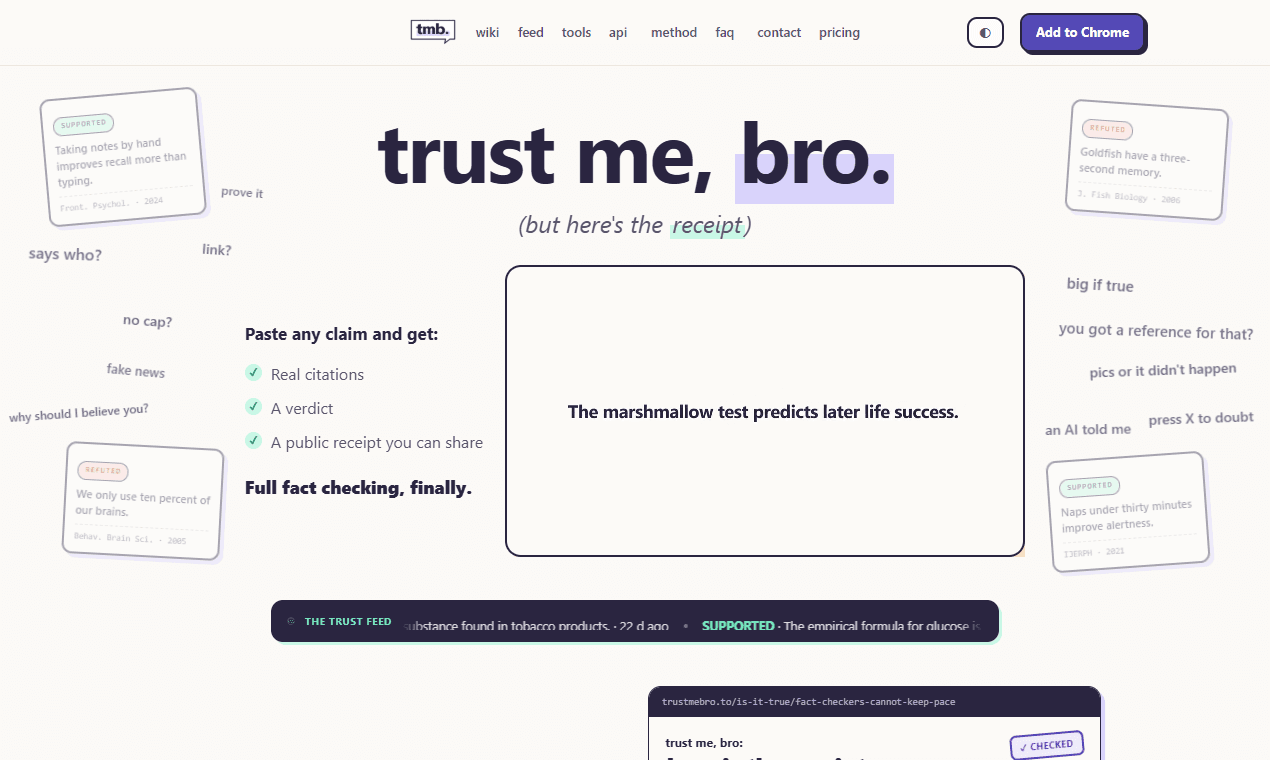
About this app
Trust Me Bro checks one claim against published research and publishes a public receipt: a verdict, sources for and against, and the limits of the check. Free: 5 checks a month, no card. Also Chrome extension, API, MCP. Tagline: Check a claim against published research. Get a receipt. Contact: receipts@trustmebro.to
Key features
- 1Claim checking against published research with a SUPPORTED/REFUTED verdict and sources for and against.
- 2Public shareable receipt pages with APA, MLA, Chicago, BibTeX and RIS citation export.
- 3Chrome extension, API and MCP access for developers and product teams.
- 4Free tier: 5 checks/month, no card. Paid: $9.99/mo Bro (400 checks), $29.99/mo Pro (1,000 checks).
Target customer profile
Drawn from the product itself, not from a survey.
Demographic
Journalists and researchers
Pain points
Need to verify claims quickly but manual fact-checking is slow and often incomplete.
Primary needs
Reliable citations and shareable evidence for articles or reports.
Demographic
Students and academics
Pain points
Struggle to find credible sources for essays and debates amid misinformation.
Primary needs
Fast access to peer-reviewed evidence and proper citation formats.
Demographic
Social media users
Pain points
Frustrated by viral falsehoods and arguments with no evidence.
Primary needs
Quick, shareable receipts to debunk or support claims in conversations.
Demographic
Developers and product teams
Pain points
Need to integrate fact-checking into apps but lack in-house solutions.
Primary needs
API access to automate claim verification with source-backed results.
Scout Review
Written by AI from measured evidence, scored out of 100.
Trust Me Bro is a fact-checking tool that takes a claim, checks it against published research, and publishes a public receipt: a verdict, sources for and against, and the limits of the check. The site is confident and well-designed, the receipt pages are genuinely good editorial layouts with full citation export, and the pricing is clear — 5 free checks/month, $9.99 for Bro, $29.99 for Pro, with semester and annual options. Speed is strong (mobile Lighthouse 94/100, TBT 0ms) and security headers are nearly complete at 11/12. The gaps are accessibility (contrast and touch target failures despite a 93 audit score), missing frame protection, no compliance certifications, and an unverified onboarding flow. Against Consensus, Snopes and GPTZero, the wedge is real: nobody else gives you a verdict plus for/against sources plus a shareable receipt with BibTeX export. Whether that's worth $29.99/month is the open question.
Measure by measure
Usability
68Free tier is 5 checks/month with no card, paid tiers at $9.99 and $29.99 with semester and annual options. Receipts export APA/MLA/Chicago/BibTeX/RIS. Chrome extension, API and MCP advertised. Onboarding flow itself not directly tested.
Design
71Editorial, confident look: a wall of 'trust me bro' phrases as hero art, then live SUPPORTED/REFUTED cards with journal names. Receipt pages are clean and readable. Pricing tiers ('Bro', 'Pro') carry the joke without breaking the layout.
Speed
82Lighthouse mobile 94/100 with LCP 3.0s, CLS 0.012, TBT 0ms, FCP 1.1s. Desktop 82/100 — a bit heavier but still solid. No lag complaints in the collected evidence.
Security
76Probe shows HTTPS enforced, HSTS, CSP, X-Content-Type-Options, Referrer-Policy, Permissions-Policy — 11/12 checklist points. Frame protection missing. Billing via Stripe. No SOC 2 / ISO / bug bounty page found in collected evidence.
Accessibility
68Lighthouse a11y 93/100 but two real fails: insufficient color contrast and touch targets too small/spaced. No WCAG statement or a11y page found. English-only in collected content. Keyboard nav and screen reader support not independently verified.
Growth
63Real problem (manual fact-checking doesn't scale), four named segments, and a genuine wedge: verdict + for/against sources + shareable receipt with citation export. Domain is 0.3 years old — early, but the idea has room.
Improvement areas
- Accessibility: fix color contrast and touch target size failures flagged by Lighthouse.
- Security: add frame protection (X-Frame-Options or frame-ancestors) to prevent receipt iframing.
- Compliance: publish a security/compliance page and pursue SOC 2 or a pen-test for journalist trust.
- Onboarding: document the signup-to-first-receipt flow publicly; it's currently unverified.
Design & Usability
Trust Me Bro's design leans into its own joke without collapsing into it. The hero is a wall of 'trust me bro' phrases — 'source: vibes', 'my uncle said so' — which reads as a knowing wink rather than a gimmick, and the live claim feed underneath (SUPPORTED/REFUTED cards with journal names and years) does the actual selling. The receipt page is the strongest design asset: claim, verdict, sources for and against, and a full citation block with APA/MLA/Chicago/BibTeX/RIS export. That's a real editorial layout, not a template. Usability is competent: 5 free checks/month with no card is a fair hook, $9.99 and $29.99 tiers with semester and annual options are clearly priced, and the Chrome extension, API and MCP are all advertised. The one gap is that the onboarding flow itself wasn't directly tested — the site sells the output well but the signup-to-first-receipt path is unverified.
Speed & Security
Speed is a genuine strength. Lighthouse mobile scores 94/100 with LCP 3.0s, CLS 0.012, TBT 0ms and FCP 1.1s — the TBT of zero is the standout, meaning the page is interactive almost immediately. Desktop drops to 82/100, which suggests heavier desktop assets, but nothing alarming. Security is solid on the technical side: the HTTP probe found HTTPS enforced, HSTS, CSP, X-Content-Type-Options, Referrer-Policy and Permissions-Policy all present, 11 of 12 checklist points. The one miss is frame protection — no X-Frame-Options or frame-ancestors — which matters for a product whose whole value proposition is a shareable receipt that could be iframed elsewhere. Billing runs through Stripe, which is the right call. What's missing is the compliance layer: no SOC 2, ISO, pen-test or bug bounty page found in the collected evidence. For an early-stage product that's normal, but for a tool journalists and researchers will feed sensitive claims into, it's the next thing to build.
Accessibility & Growth
Accessibility scores 93/100 on the automated Lighthouse audit but fails two real checks: insufficient color contrast and touch targets that are too small or too closely spaced. Those are the two failures that most directly affect real users — low-vision readers and anyone on a phone — and neither is hard to fix. There's no accessibility statement or WCAG conformance claim on the site, and the content is English-only. Keyboard navigation and screen reader support weren't independently verified. Growth is the more interesting question. The problem is real and well-named: manual fact-checking doesn't scale, and the site even fact-checks its own claim about that with three cited sources. The wedge against the listed alternatives is concrete — Consensus summarizes papers but gives no verdict or receipt, Snopes is manual with no API, GPTZero doesn't fact-check at all. Trust Me Bro's differentiator is the verdict-plus-for/against-sources-plus-shareable-receipt format with citation export, and the API/MCP angle positions it as infrastructure rather than a destination site. Four named segments (journalists, students, social users, developers) is broad but each has a plausible use case. The domain is 0.3 years old, so traction is minimal — but the idea itself has room, especially if the API becomes the real product.
Conclusion
The honest verdict on Trust Me Bro is that it's a well-executed early-stage product with a clear idea and a few fixable rough edges. The design and speed are above average for its stage, the receipt format is genuinely differentiated, and the pricing is fair. The accessibility failures and missing frame protection are the kind of things that should be fixed before scaling, and the absence of any compliance certification is normal for a 0.3-year-old domain but worth watching. If the API and MCP angle lands, this becomes infrastructure; if it stays a consumer fact-checking site, it's competing with Snopes on brand and Consensus on depth. Either way, the receipts are real — which is more than most of the internet can say.
Suggestions for improvement
- Fix the two Lighthouse accessibility failures: bump color contrast to WCAG AA and enlarge touch targets on mobile.
- Add X-Frame-Options or a frame-ancestors CSP directive so receipts can't be iframed into scam pages.
- Publish an accessibility statement and a security/compliance page — even 'SOC 2 in progress' builds trust with journalists.
- Document the onboarding flow and first-receipt path publicly so new users know what to expect before signing up.
Alternatives comparison
Named competitors, point by point. Nobody paid to appear here or to be left out.
 Trust Me Bro |  GPTZero |  Consensus |  Snopes | |
|---|---|---|---|---|
| Produces a verdict (SUPPORTED/REFUTED) on a claim | Yes — explicit verdict with sources for and against | No — detects AI-generated text, does not fact-check | No — summarizes papers, no verdict | Yes — manual verdicts in articles |
| Shareable public receipt with citation export | Yes — share links plus APA/MLA/Chicago/BibTeX/RIS | No | Partial — paper summaries, no receipt format | No — article pages only |
| API / developer integration | Yes — API and MCP, 100–1,000 calls/mo by tier | Yes — API available | Limited — no public fact-check API | No |
| Free tier | 5 checks/month, no card | Limited free scans | Free search with limits | Fully free, ad-supported |
| Automated claim checking (no human in the loop) | Yes — automated with published sources | N/A — different task | Yes — AI search over papers | No — manual editorial process |
GPTZero
Detects AI-generated text but doesn't fact-check claims; lacks evidence retrieval and receipts.
Consensus
AI-powered search engine for research papers; provides summaries but no verdicts or shareable receipts.
Snopes
Manual fact-checking site with articles; not automated, no citation formatting or API.
Comparing options? See Trust Me Bro alternatives, scored side by side
More Productivity apps
View all Productivity
Qamarero
92An all-in-one hospitality software for restaurants and ba...

The Stack Newsletter
92A weekly newsletter delivering curated tech jobs, intervi...

EmbedMyReviews
92White-label reputation management software for agencies s...

StoryPad
92Privacy-first open source journal app with a continuous t...

Puzzly – B2B Lead Generation & Sales Intelligence Platform
92Puzzly is an all-in-one B2B lead generation platform that...

Notion
92All-in-one AI workspace for docs, projects, and knowledge...

Vibe Coding Agent Skills
92A free, open-source platform offering 110 AI agent skills...

CC Switch
91Open-source desktop app for switching AI coding providers...

username.md
90One verified handle for your online identity, readable by...

PitchWhip
90AI cold call scripts & direct dials from LinkedIn

What the GIF
89Frame-perfect video-to-GIF maker that runs entirely in yo...

AuditCloser
89White-label website audits that close deals for digital a...

A platform dedicated to providing unbiased reviews of newly launched applications, analyzing everything from their features to their full potential.
info@scoutforge.net© 2026 Scoutforge. All rights reserved.
