

A platform dedicated to providing unbiased reviews of newly launched applications, analyzing everything from their features to their full potential.
info@scoutforge.net© 2026 Scoutforge. All rights reserved.
A platform dedicated to providing unbiased reviews of newly launched applications, analyzing everything from their features to their full potential.
info@scoutforge.net© 2026 Scoutforge. All rights reserved.
A platform dedicated to providing unbiased reviews of newly launched applications, analyzing everything from their features to their full potential.
info@scoutforge.net© 2026 Scoutforge. All rights reserved.
Cycling through all six. Tap any point to stop.
Measured on six things
Track Pokémon card prices, sales, and market trends with ...
Desktop Lighthouse 94/100 but mobile 56/100 with a 12.2s LCP and 382ms TBT — the card-art-heavy grids punish phones hard. Desktop is fine; mobile is not.
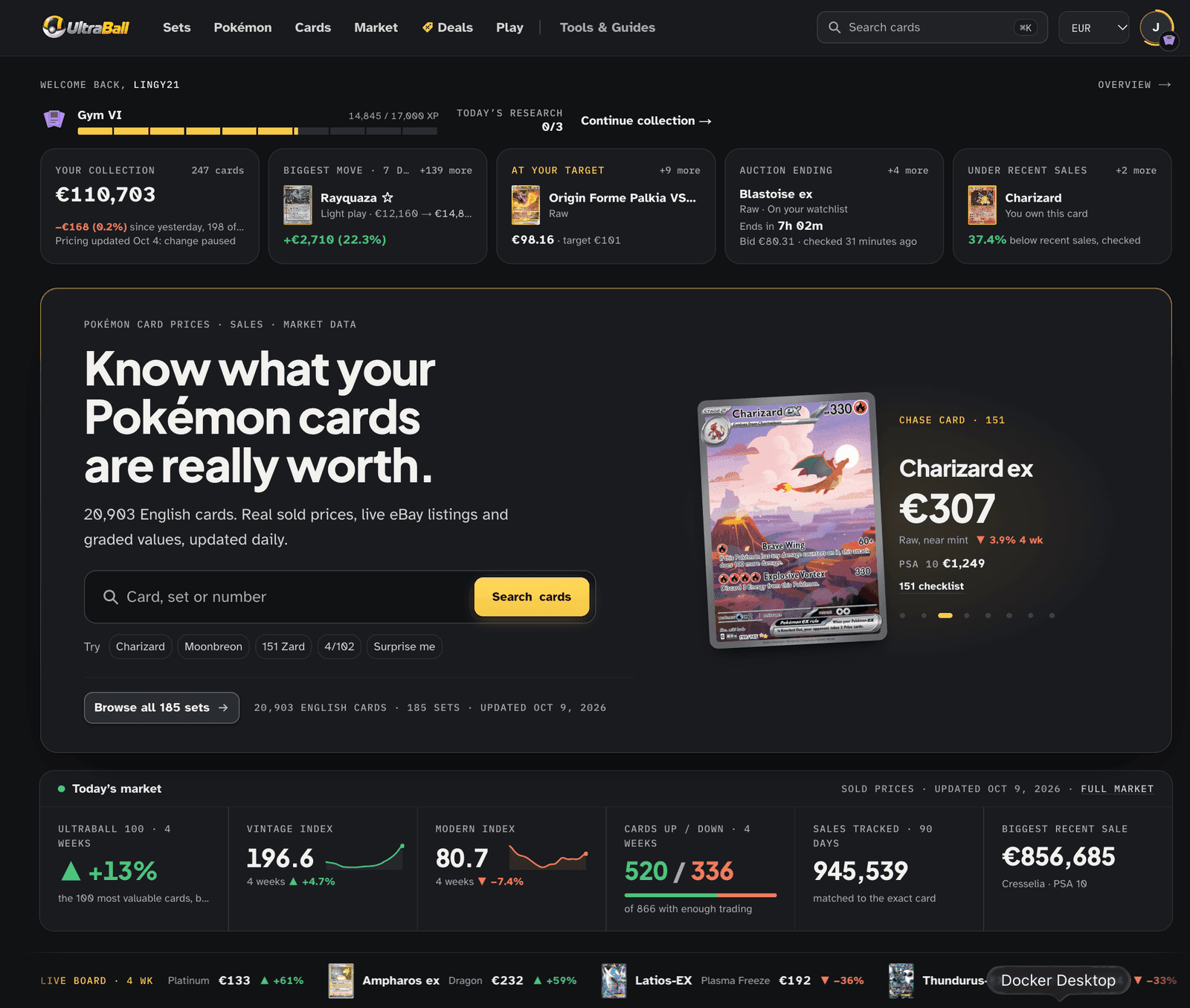
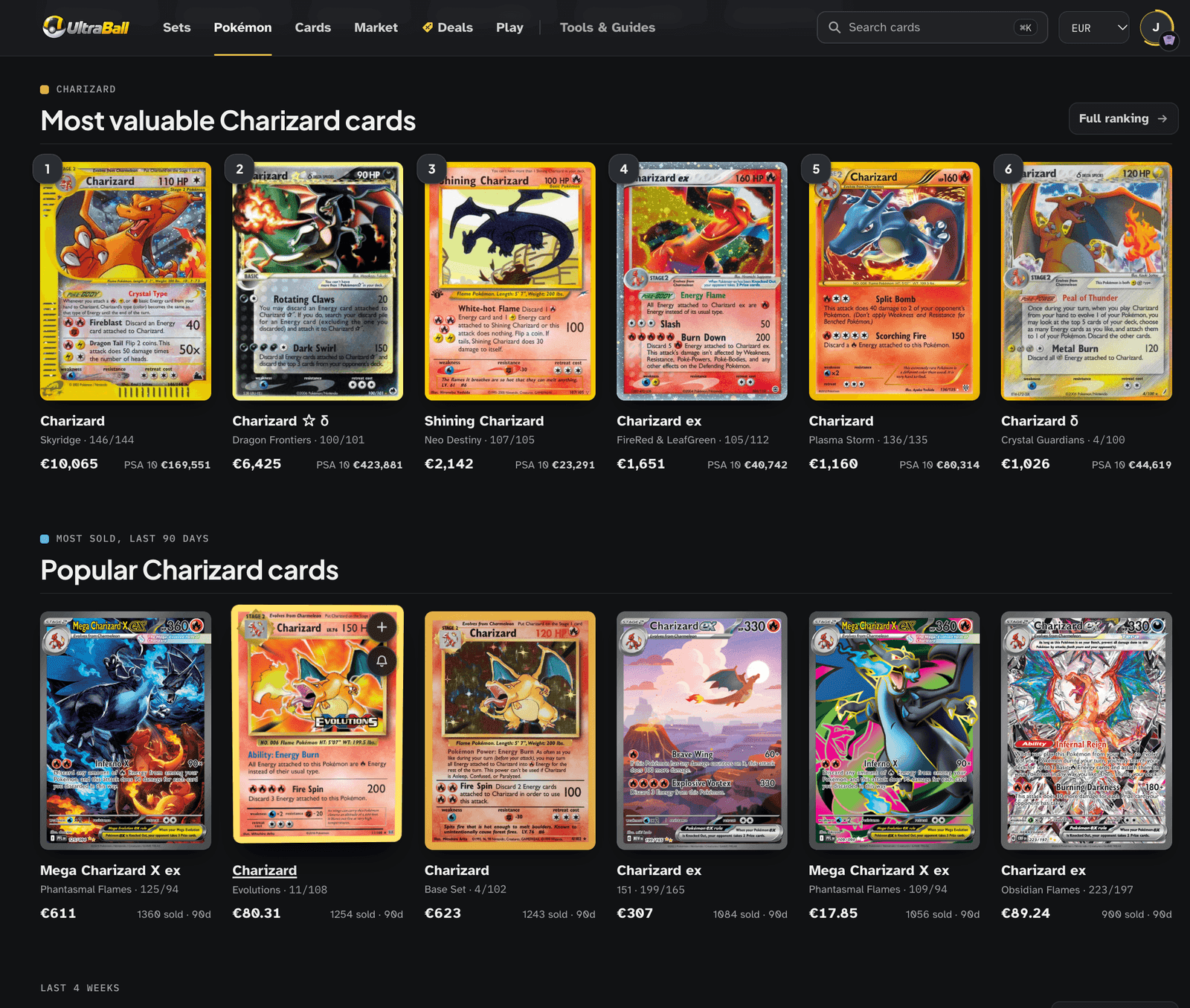
UltraBall is a comprehensive database and analytics platform for English Pokémon card collectors, investors, and enthusiasts. It tracks 20,903 cards across 185 sets, from the 1999 Base Set to the upcoming 30th Celebration. The platform provides real-time market values, recent sales data, graded prices (PSA, CGC, BGS, SGC, TAG), price history charts, liquidity metrics, and confidence indicators. Users can explore by Pokémon, set, era, rarity, and more. UltraBall also offers powerful tools like a grading calculator, AI card grader, collection tracker, and market indices. With daily updates and a focus on data accuracy, UltraBall helps you know what your cards are really worth, whether you're buying, selling, or holding.
Drawn from the product itself, not from a survey.
Demographic
Pokémon card collectors (hobbyists)
Pain points
Uncertainty about card values, difficulty tracking price trends, and identifying rare cards.
Primary needs
Accurate, up-to-date pricing, easy search, and collection management tools.
Demographic
Investors and resellers
Pain points
Need reliable market data to make informed buying/selling decisions, track liquidity, and spot trends.
Primary needs
Real-time sales data, market indices, price alerts, and historical trends.
Demographic
Casual enthusiasts and returning collectors
Pain points
Overwhelmed by the vast number of cards, unsure where to start, and how to identify valuable cards.
Primary needs
Simple guides, price checkers, and curated lists of valuable cards.
Written by AI from measured evidence, scored out of 100.
UltraBall is a serious, well-built Pokémon card database with real depth — 20,903 English cards, 185 sets, 929,045 matched sales in 90 days, daily updates, and editorial guides that go beyond raw price dumps. The design is above category average and the accessibility audit is flawless. The problems are concrete and fixable: mobile performance is poor (56/100, 12.2s LCP), the security headers are half-configured (6/12, no CSP, no frame protection), and there's no visible pricing page or trial, which makes the business model opaque to a first-time visitor. Against TCGplayer, PriceCharting and PSA Card Facts, UltraBall is the most focused English-Pokémon analytics product of the three — but it's competing on data quality in a category where data quality is the whole game.
Search sits right under the hero with quick links (Try Charizard, Surprise me), 185 sets and 1,025 Pokémon browsable, and real editorial guides. No pricing page or free trial surfaced.
Dark, high-contrast card-art layout with disciplined grid rhythm and clear typographic hierarchy. Hero container is too wide on desktop, and footer/methodology text is tiny and low-contrast.
Desktop Lighthouse 94/100 but mobile 56/100 with a 12.2s LCP and 382ms TBT — the card-art-heavy grids punish phones hard. Desktop is fine; mobile is not.
HTTPS enforced with HSTS, SPF and DMARC in place, but no CSP, frame protection, X-Content-Type-Options, Referrer-Policy or Permissions-Policy. 6/12 on the header checklist.
Lighthouse accessibility 100/100, keyboard-friendly ⌘K search, 30+ currency switcher. No published WCAG statement, so the automated perfect score is the ceiling of what's verified.
Real, specific problem (what's my card worth?) with a clear English-only wedge, daily data, and tools TCGplayer and PriceCharting don't bundle. Category has headroom; moat is data depth.
UltraBall's design is genuinely good for the category: a near-black canvas that makes card art pop, disciplined grid rhythm across the most-traded, popular-Pokémon and popular-sets sections, and a yellow CTA that never gets lost. The visual audit flags two real problems — a hero container so wide the text block floats in dead space on desktop, and footer/methodology text rendered tiny and low-contrast on black. Usability is solid where it counts: search sits directly under the headline, quick links ('Try Charizard', 'Surprise me', '4/102') remove the blank-page problem, and the database is deep — 20,903 cards, 185 sets, 1,025 Pokémon, 929,045 sales tracked in 90 days. The editorial guides (set release dates, Japanese vs English market) are a real differentiator versus raw price trackers. The gap: no pricing page, no free trial, no live demo surfaced anywhere in the fetched content, so a new visitor can't tell what the ceiling costs before signing up.
Speed is a tale of two devices. Desktop Lighthouse lands at 94/100, which is genuinely fast. Mobile lands at 56/100 with an LCP of 12.2 seconds, 382ms total blocking time and 3.3s FCP — the card-image-heavy grids are brutal on a phone, which is exactly where a collector standing in a card shop will open this. CLS is a clean 0, so the layout is stable; it's the payload and main-thread work that hurt. Security is half-built: HTTPS is enforced with HSTS, SPF and DMARC are published, but the probe found no Content-Security-Policy, no frame protection, no X-Content-Type-Options, no Referrer-Policy and no Permissions-Policy — 6 of 12 checklist points. No SOC 2, ISO, pen-test summary or bug bounty page surfaced. For a site handling account data and collection values, the missing CSP and clickjacking protection are the two worth fixing first.
Accessibility is the strongest measured dimension: Lighthouse's axe-core audit returns a perfect 100/100, the site ships a ⌘K search shortcut and a 30+ currency switcher, and the dark theme's contrast on primary text is strong. The caveat is that automated checks cover only part of WCAG — no accessibility statement, no WCAG conformance claim, and no evidence of screen-reader testing was found, so 80 is the honest ceiling of what's verified rather than a claim of full compliance. Growth is a judgement on the idea, not the traction. The problem is real and monetizable: collectors, resellers and investors genuinely don't know what a raw or graded card is worth, and the alternatives each cover only part of it — TCGplayer is a marketplace with price guides, PriceCharting is a broad multi-category tracker, PSA Card Facts is graded-only population data. UltraBall's wedge is English-only depth plus bundled tools (grading calculator, AI card grader, collection tracker, market indices, liquidity metrics) that none of the three alternatives package together. That's a defensible niche, but it's a data-pipeline business: the moat is freshness and accuracy, not features, and the category has room without being winner-take-all.
Conclusion
If you collect English Pokémon cards and you've been bouncing between TCGplayer listings, PriceCharting pages and PSA pop reports to figure out what something is actually worth, UltraBall is the first tool here that tries to answer that in one place. The grading calculator, AI grader and collection tracker are the kind of bundled workflow the alternatives don't offer. What holds it back isn't the idea — it's the plumbing: a 12-second mobile LCP will lose the card-shop user, and the missing CSP and clickjacking headers are the kind of thing that's cheap to add and embarrassing to skip. Publish pricing, ship the security headers, and get mobile under four seconds, and this moves from 'good niche tool' to 'default tab.'
Named competitors, point by point. Nobody paid to appear here or to be left out.
 UltraBall UltraBall |  TCGplayer TCGplayer |  PriceCharting PriceCharting |  PSA Card Facts PSA Card Facts | |
|---|---|---|---|---|
| Price data coverage for English Pokémon cards | 20,903 English cards, 185 sets, daily updates, 929,045 sales matched in 90 days | Marketplace price guides driven by live listings and sales on the platform | Historical prices across video games and trading cards, including Pokémon | Auction prices and population reports focused on PSA-graded cards |
| Graded card pricing (PSA, CGC, BGS, SGC, TAG) | Graded values across PSA, CGC, BGS, SGC and TAG alongside ungraded prices | Primarily raw/ungraded marketplace listings; graded data limited | Graded price tiers (e.g. PSA 10) tracked per card | PSA-only graded auction prices and population reports |
| Market analytics (indices, liquidity, trends) | Vintage and modern market indices, liquidity metrics, confidence indicators, price history charts | Sales volume and price trend data tied to marketplace listings | Historical price charts per card; no aggregate market index | Population counts and auction results; no market index or liquidity metric |
| Collection management and grading tools | Collection tracker, grading calculator, AI card grader, price alerts | Seller inventory tools and marketplace listings; no grading calculator | Collection tracker with value totals; no AI grader or grading calculator | Grading submission services and pop reports; no collection tracker |
| Editorial guides and release calendar | Bylined guides (set release dates, Japanese vs English market) plus upcoming-set calendar | Marketplace blog and seller content; not a structured release calendar | Minimal editorial content; focused on price data pages | PSA editorial and set registry content, not a release calendar |
TCGplayer
A popular marketplace for trading card games, offering price guides and sales data for Pokémon cards.
PriceCharting
Tracks prices for video games and trading cards, including Pokémon, with historical data and grading info.
PSA Card Facts
Provides population reports and auction prices for graded cards, but not as comprehensive for raw cards.
Comparing options? See UltraBall alternatives, scored side by side

An all-in-one hospitality software for restaurants and ba...

AI-powered personalized face swap art platform creating c...

An all-in-one platform for creators to sell digital produ...

AI tools for Etsy sellers — keyword research, listing optimization, and shop insights

Stripdo is a smart invoicing tool that automatically gene...

Track and optimize your brand's visibility in AI answers.

Lightweight A/B testing platform with no-code visual editor for fast, simple website optimization.

Avenum is a self-checkout app that streamlines retail shopping with QR code scanning and payments.

AI-powered Shopify app for boosting sales with smart upselling, rewards, and urgency tools.

AI-powered customer service agents that automate support ...

AI-powered furniture photography tool that creates stunni...

AI-driven analytics tool for e-commerce profit optimization with real-time tracking and predictive insights.
A platform dedicated to providing unbiased reviews of newly launched applications, analyzing everything from their features to their full potential.
info@scoutforge.net© 2026 Scoutforge. All rights reserved.