Cycling through all six. Tap any point to stop.
Measured on six things
Find where your online store loses sales
Accessibility
38Lighthouse accessibility 54/100 with three structural failures: no <title>, no [lang] on <html>, no main landmark. Multi-language support exists but the markup doesn't declare it.
Screenshots
1 / 1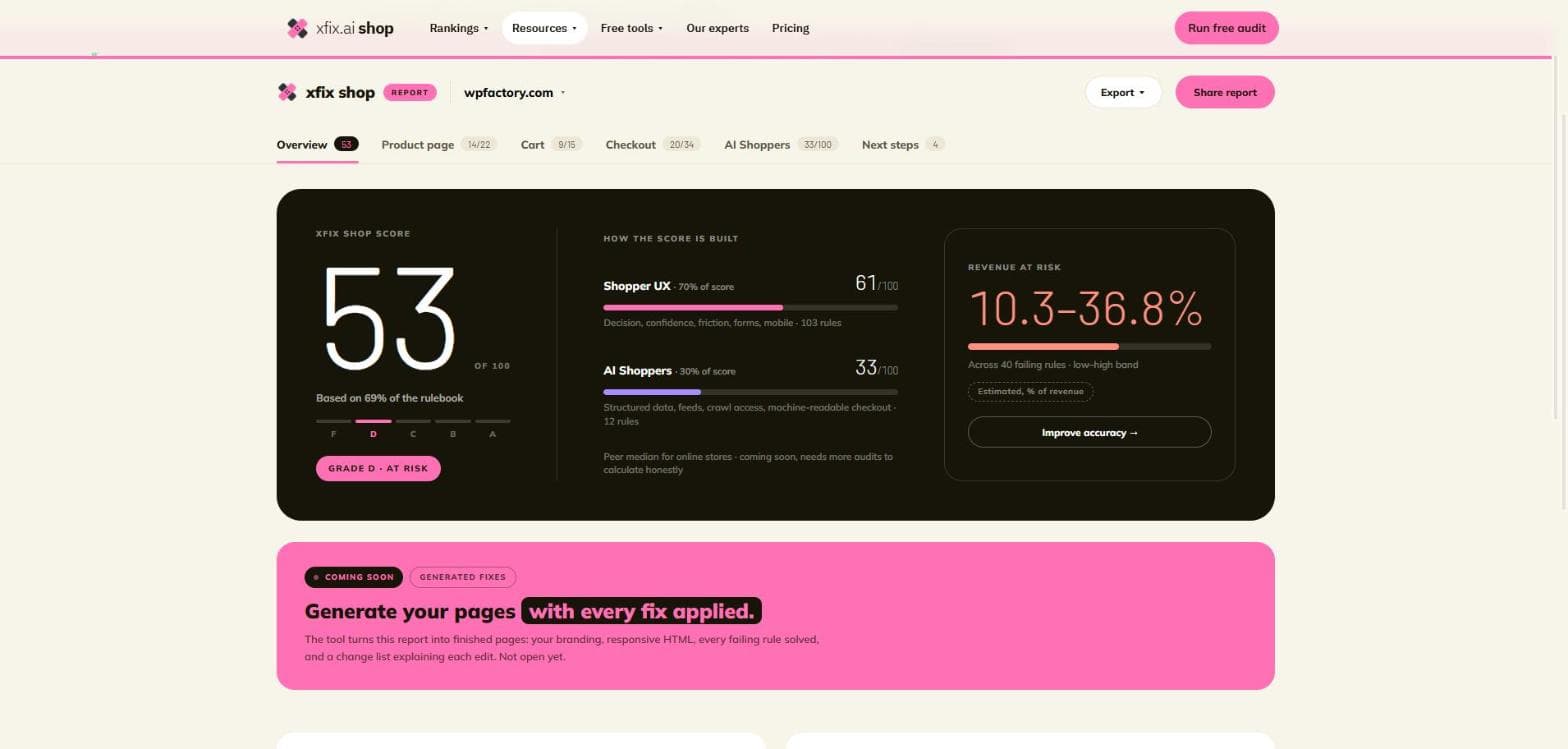
About this app
xfix shop is an ecommerce UX audit that finds where an online store loses sales. Paste a store link and it shops the store like a first-time customer: product page, cart and checkout, stopping before payment. Nothing on the store changes. It checks 115 published rules, such as whether price, stock and delivery date are where buyers look, whether guest checkout exists and whether shipping cost appears before payment. Every finding is ranked by the revenue it puts at risk, with a screenshot, why it matters and the fix. The report gives a score out of 100, and a re-audit shows the before-and-after score. It also scores whether AI assistants like ChatGPT, Gemini and Copilot can find the store and buy from it. Works in English, Arabic and Spanish. Free plan: 3 stores and the top 7 issues per report. Full report $29 once; Pro from $49/month.
Key features
- 1No-install store walk: audits product page, cart and checkout against 115 published rules, stopping before payment
- 2Findings ranked by revenue at risk, each with a screenshot, why it matters, and the specific fix
- 3AI Shoppers score: checks whether ChatGPT, Gemini and Copilot can read products, price and stock, and buy from the store
Target customer profile
Drawn from the product itself, not from a survey.
Demographic
Ecommerce store owners on Shopify, WooCommerce, BigCommerce, Magento, Zid, or Salla
Pain points
Unsure why visitors leave without buying; lack of UX expertise; limited budget for professional audits
Primary needs
Identify high-impact fixes ranked by revenue loss; improve conversion rates; get actionable steps without technical overhead
Demographic
Conversion rate optimization (CRO) specialists and UX consultants
Pain points
Time-consuming manual audits; need for evidence-based findings; explaining value to clients
Primary needs
Quick, data-backed audits with screenshots and benchmarks; ability to re-audit and prove improvements; white-label reports for clients
Demographic
Agencies managing multiple ecommerce stores
Pain points
Scaling audits across clients; maintaining quality; demonstrating ROI of UX changes
Primary needs
Multi-store dashboards; branded PDF reports; automated re-audits to track progress and justify retainers
Scout Review
Written by AI from measured evidence, scored out of 100.
xfix shop is a no-install ecommerce UX audit that walks your product page, cart and checkout against 115 published rules and ranks every finding by revenue at risk. The pitch is sharp: paste a URL, get a scored report with screenshots and fixes in 3-4 minutes, re-audit to prove improvement. The landing page is polished and the onboarding is genuinely low-friction. The free plan is generous enough to be useful (3 stores, top 7 issues) and the $29 one-off report is a smart entry point for store owners who don't want a subscription. The weaknesses are real but fixable: accessibility is poor (54/100, missing title, lang and main landmark), security headers are mostly absent (4/12), and mobile LCP sits at 4.1s. The AI-shopper angle is the most interesting differentiator — it's a question Hotjar and Crazy Egg don't answer. For an early-stage tool, this is a competent, well-positioned product with clear room to grow.
Measure by measure
Usability
68URL input plus CTA in the hero gets you to a report in 3-4 minutes with no install. Free plan shows 7 issues; full report $29 or Pro from $41/mo. Clear, low-friction onboarding.
Design
71Clean card-based landing page with disciplined pink accents and a realistic dark-mode audit mockup. Hero subtext contrast and washed-out free-tool cards are the weak spots.
Speed
68Lighthouse mobile 80/100 with LCP 4.1s and TBT 57ms; desktop 93/100. Solid overall, but the 4.1s mobile LCP is the number to watch on slower connections.
Security
52HTTPS enforced with SPF and DMARC in place, but no HSTS, CSP, frame protection, X-Content-Type-Options, Referrer-Policy or Permissions-Policy. 4/12 checklist points.
Accessibility
38Lighthouse accessibility 54/100 with three structural failures: no <title>, no [lang] on <html>, no main landmark. Multi-language support exists but the markup doesn't declare it.
Growth
62Real problem (stores lose sales to fixable UX issues), specific wedge (no install, no tracking script, revenue-ranked findings), and a growing AI-shopper angle. 500 audits on 269 stores is early but real.
Improvement areas
- Accessibility: Lighthouse 54/100 with missing <title>, [lang] on <html>, and main landmark
- Security headers: only 4/12 checklist points — no HSTS, CSP, frame protection or Referrer-Policy
- Mobile performance: LCP 4.1s on mobile despite 93/100 desktop score
Design & Usability
The landing page is well-crafted: a disciplined pink accent, a realistic dark-mode audit mockup showing 90/115 and 60/100 scores, and a card-based layout that separates sections cleanly. The hero puts the store URL input directly next to a large pink 'Audit my store, free' button, which is exactly where it should be. Onboarding is genuinely low-friction — no install, no theme edit, no admin access, and the site claims a 3-4 minute turnaround. The free plan gives 3 stores and the top 7 issues; the full report is $29 once, Pro is $41/month annual, Agency $166/month. The weak spots are visual: hero subtext and disclaimer text sit low-contrast on the beige background, the free-tools cards use very light gray icons and borders that feel under-emphasized next to the pink CTAs, and the nav bar packs in many links plus language and sign-in elements, creating density at the top. Usability is strong where it matters — the path from URL to report is short and the report itself uses progress bars and risk percentages for quick comprehension.
Speed & Security
Speed is solid but uneven. Lighthouse mobile scores 80/100 with LCP 4.1s, CLS 0, TBT 57ms and FCP 3.0s; desktop scores 93/100. The 4.1s mobile LCP is the number to watch — it's the one metric that could cost you a store owner on a slower connection. No user complaints about lag appeared in the collected evidence. Security is the weaker half: HTTPS is enforced and SPF and DMARC are in place, but the HTTP header probe found no HSTS, no CSP, no frame protection, no X-Content-Type-Options, no Referrer-Policy and no Permissions-Policy — 4 out of 12 checklist points. No SOC 2, ISO, pen-test or bug bounty claims appear in the collected site content. For an early-stage tool that audits stores without installing anything, the missing headers are a hardening gap rather than a red flag, but they're cheap to fix and worth fixing.
Accessibility & Growth
Accessibility is the weakest dimension. Lighthouse scores 54/100 with three structural failures: the document has no <title> element, the <html> element has no [lang] attribute, and there is no main landmark. The site does support English, Arabic and Spanish, but the markup doesn't declare the language, which is exactly the kind of thing screen readers need. No accessibility statement or WCAG conformance claim appears in the collected content. Growth is a different story: the problem is real (stores lose sales to fixable UX issues), the target customer is specific (Shopify, WooCommerce, Salla, Zid, Magento, BigCommerce owners who can't afford a professional audit), and the wedge is concrete — no install, no tracking script, findings ranked by revenue at risk, plus an AI-shopper readiness score that Hotjar, Crazy Egg and Lucky Orange don't offer. The category has headroom as AI shopping grows. Traction is early — 500 audits on 269 stores, domain registered October 2024 — but the idea itself is well-positioned.
Conclusion
If you run a Shopify, WooCommerce or Salla store and you're guessing why visitors leave without buying, xfix shop is worth the free audit — the revenue-at-risk ranking is more actionable than a heatmap you have to interpret yourself. The $29 one-off report is a low-risk way to see the full picture before committing to Pro. Just don't expect it to replace a real accessibility audit or a security review; it audits your store's UX, not your infrastructure. The AI-shopper readiness score is the feature to watch — as more shoppers ask ChatGPT and Gemini what to buy, stores that can't be read by agents will quietly lose sales. Fix the missing headers and the accessibility basics, and this becomes a genuinely strong tool for its price point.
Suggestions for improvement
- Add HSTS, CSP, X-Content-Type-Options, Referrer-Policy and Permissions-Policy headers — the probe found only 4/12 checklist points.
- Fix the three Lighthouse accessibility failures: add a <title>, set [lang] on <html>, and add a main landmark.
- Improve mobile LCP (currently 4.1s) by optimizing hero images and preloading the primary CTA assets.
- Raise contrast on hero subtext and disclaimer text, and darken the free-tools card icons and borders.
Alternatives comparison
Named competitors, point by point. Nobody paid to appear here or to be left out.
 xfix shop |  Hotjar |  Crazy Egg |  Lucky Orange | |
|---|---|---|---|---|
| Installation required | No — audits live URL, no script or theme edit | Yes — tracking script on every page | Yes — tracking script on every page | Yes — tracking script on every page |
| Time to first insight | 3-4 minutes, no traffic needed | Days to weeks — needs visitor traffic | Days to weeks — needs visitor traffic | Days to weeks — needs visitor traffic |
| Findings ranked by revenue at risk | Yes — every finding shows % of monthly revenue at risk | No — heatmaps and recordings, no revenue estimate | No — heatmaps and scrollmaps, no revenue estimate | No — recordings and polls, no revenue estimate |
| AI assistant / agent readiness check | Yes — 12 rules for ChatGPT, Gemini, Copilot readability and purchase | No | No | No |
| Pricing model | Free (3 stores, 7 issues); $29 one-off; Pro $41/mo; Agency $166/mo | Free tier; paid plans from ~$32/mo | Free trial; paid plans from ~$29/mo | Free trial; paid plans from ~$18/mo |
Hotjar
Behavior analytics and user feedback tool that records sessions, creates heatmaps, and runs surveys to understand user behavior.
Crazy Egg
Website optimization tool offering heatmaps, scrollmaps, confetti reports, and A/B testing to improve conversion rates.
Lucky Orange
Conversion optimization suite with session recordings, heatmaps, polls, and live chat to uncover user experience issues.
Comparing options? See xfix shop alternatives, scored side by side
More E-commerce apps
View all E-commerce
Qamarero
92An all-in-one hospitality software for restaurants and ba...

Portrait Gift
88AI-powered personalized face swap art platform creating c...

Creastor
88An all-in-one platform for creators to sell digital produ...

CraftPilot
87AI tools for Etsy sellers — keyword research, listing optimization, and shop insights

StoreToAds
87AI ad generator that turns real product photos into multi...

Stripdo
87Stripdo is a smart invoicing tool that automatically gene...

Nano Banana 2.1 AI Image Generator
86Create and edit 4K images with AI, fuse up to 14 referenc...

BlueVetaUpright
86API that detects product photo rotation and tells you how...

Scale Ova
86AI agent that builds & runs your Shopify

Kaniva
85Your business is hard enough. Your software shouldn’t be.

Journeva: Multi Carts and Upsell
83A Shopify app with a free plan that lets a customer shop with more than one cart and share a cart, with room for upsell offers.

EchoWi
83Track and optimize your brand's visibility in AI answers.


A platform dedicated to providing unbiased reviews of newly launched applications, analyzing everything from their features to their full potential.
info@scoutforge.net© 2026 Scoutforge. All rights reserved.
