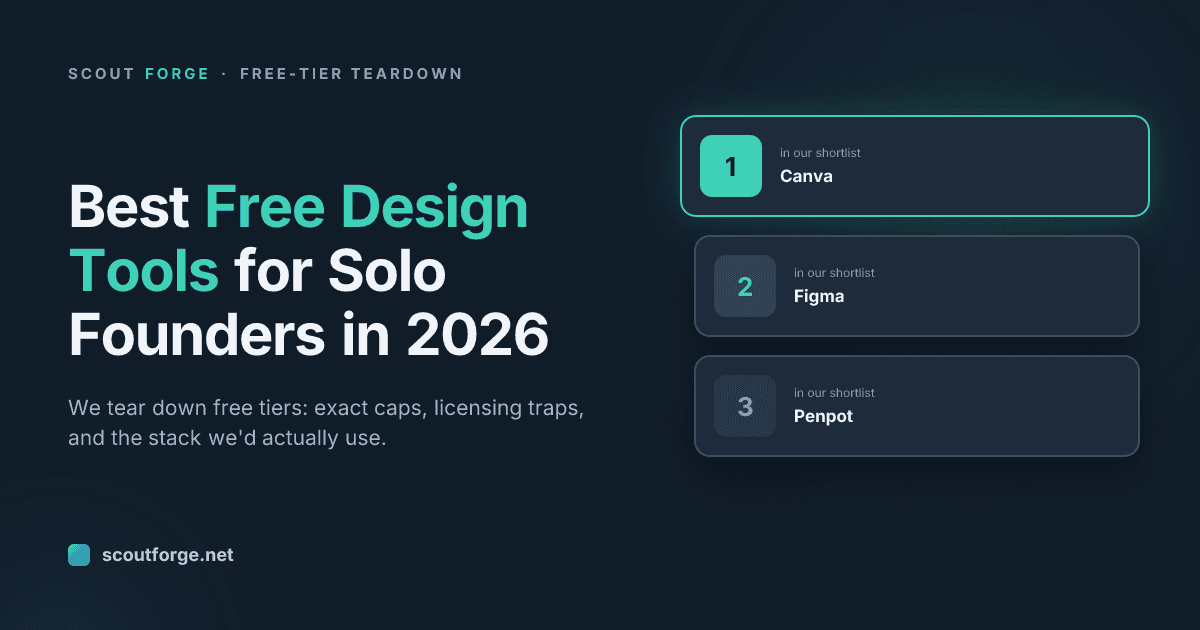
The real question isn't "which design tool is free" — it's "which free tool will still be free when I actually need to ship the thing." Most roundups stop at listing features. They tell you Canva has templates and Figma has collaboration. They don't tell you that the free plan quietly becomes a paid trap the moment you add a second collaborator, need a vector export, or try to use a stock asset in a paid product.
We've spent the last week tearing down the free tiers of the tools founders actually reach for — not the obscure ones with three users. For each tool, we state the exact cap: seats, exports, projects, watermark rules, and commercial-use licensing. Then we map each tool to the specific founder artifact it's honestly good for — a landing page, an app icon, a pitch deck, a social ad, a brand kit. And we flag where the free tier stops being free in practice.
Here's the short version: there is no single free tool that covers everything. A solo founder building a landing page and a pitch deck needs a different stack than a three-person team building a product UI. The tool that's free forever for one person is a per-seat bill for two. The tool that's free with no seat cap has a learning curve that will eat your weekend.
If you're evaluating any of these tools for a business decision, our methodology explains how we score apps independently — and no, money can't buy a score. We also have a guide on how to vet a new app before you hand over your data.
Let's get into the teardown.
Why "Free" Design Tools Cost Founders Time, Not Money
A free design tool is never actually free. The cost is just deferred. Sometimes it's deferred into a monthly bill the moment you add a teammate. Sometimes it's deferred into a low-resolution export that looks fine on a phone and terrible on a printed banner. Sometimes it's deferred into a licensing clause you don't read until a lawyer sends you an email.
The three costs that actually matter for a founder are seats, exports, and licensing. Seats are the obvious one: a tool that's free for one person becomes a per-user subscription for two. Exports are the sneaky one: a free plan that lets you design anything but only download a watermarked PNG at 800 pixels is a demo, not a tool. Licensing is the dangerous one: a free stock photo that's fine for a personal mood board may not be fine on a landing page that sells a product.
We've seen founders build an entire brand on a free plan, then hit the wall exactly when it mattered — during a funding round, a product launch, or the first real marketing push. That's why this teardown exists. We're not going to tell you a tool is "free" without telling you what breaks.
The criteria we use throughout:
- Seats — how many people can actually collaborate before you pay.
- Exports — resolution, format, watermark, and vector availability.
- Projects — how many files or designs you can keep active.
- Watermark rules — whether your export carries the tool's branding.
- Commercial licensing — whether you can legally use what you made in a paid product or client work.
- The upgrade trigger — the specific moment the free tier stops being enough.
How We Evaluated These Tools (And What "Cap" Means Here)
We checked every limit against the vendor's own pricing and help pages in October 2026. Where a number isn't published or changes frequently, we say so and tell you to check the current page. We don't guess.
Scout Forge scores are editorial and independent, based on six dimensions — design, usability, speed, security, accessibility, and growth — on a 0–100 scale. A tool can score well on Scout Forge and still have a free tier that's useless for your specific use case. The score measures the product, not the generosity of the free plan.
A "cap" here means a hard limit that forces a decision. It's not a soft suggestion. When we say Figma Starter limits you to three design files, we mean the fourth file requires a paid plan or deleting something. When we say Kittl's free plan restricts designs to personal use, we mean you cannot legally use them for a client project.
Here's the comparison table we'll reference throughout. Every number is hedged and sourced from the vendor as of October 2026.
| Tool | Free Seats | Export Limit | Projects/Files | Commercial Use | Upgrade Trigger |
|---|---|---|---|---|---|
| Canva | 1 (solo) | Standard formats | Unlimited designs | Yes (with license terms) | Second editor or Brand Kit #2 |
| Figma Starter | 1 editor + viewers | Full quality | 3 design files | Yes | Fourth file or second editor |
| Penpot | Unlimited | Full quality | Unlimited | Yes | Enterprise features only |
| Photopea | 1 (browser) | Full quality | Unlimited (local) | Yes (you own work) | Ad removal only |
| Kittl | 1 | Low-res PNG/JPG, 800px | 5 projects | No — personal use only | Any commercial use |
| GIMP | Unlimited (local) | Full quality | Unlimited (local) | Yes | None |
| Inkscape | Unlimited (local) | Full quality | Unlimited (local) | Yes | None |
| Adobe Express | 1 | Standard formats | 5GB storage | Yes | Generative AI limits |
| Pitch | 5 members | Full quality | Unlimited presentations | Yes | 6th member or more guests |
Now let's go through each tool properly.
Canva Free: The Default Choice, With a Real Ceiling
Canva is where most founders start, and for good reason. The free plan is genuinely useful: 1 Brand Kit, 5GB of cloud storage, access to over 4.7 million stock assets and 1.6 million templates, and up to 20 monthly uses of Standard or Premium AI tools, as of October 2026. That's enough to design a landing page, a pitch deck, and a month of social posts without paying a cent.
The wall you hit first is collaboration. Canva Free is a solo tool. The moment you want a co-founder or a contractor to edit the same design, you're on a paid plan. The second wall is the Brand Kit: one kit means one logo, one color palette, one font set. If you're testing two brand directions, you're manually swapping assets.
The third wall is less obvious: Canva Free assets carry commercial-use rights subject to Canva's license terms, and using them in client work or paid products is permitted under the free plan license. That's good news — but the license terms are specific, and you should read them before you put a Canva stock photo on a product page that will be seen by 100,000 people. The free plan's AI tool cap of 20 uses per month also runs out fast if you're generating variations.
Who should pick Canva Free: a solo founder who needs marketing graphics, a basic pitch deck, and social assets, and who doesn't need a second editor. Who shouldn't: anyone building a product UI, anyone who needs a second collaborator immediately, or anyone who plans to scale a brand across multiple products. For a deeper look at landing pages specifically, see our teardown of free landing page builders.
Figma Starter: Best for Product UI, Worst for Team Handoff
Figma is the industry standard for product design, and its Starter plan is genuinely free — but it's built for a solo designer exploring, not a team shipping. As of October 2026, the Starter plan limits you to 3 Figma Design/Sites files, 3 FigJam files, 3 Figma Slides files, 30 days of version history, unlimited drafts, and 150 AI credits per day up to 500 per month.
The cap that actually hurts is the three-file limit. Three design files sounds like a lot until you realize a single product can have a design system file, a component library file, and a working file for the current screen. The fourth file forces a decision: delete something, archive something, or pay. The 30-day version history is also shorter than you think — if you need to roll back a change from six weeks ago, it's gone on the free plan.
The second editor problem is real here too. Figma Starter allows unlimited viewers, but only one editor. A second designer who needs to actually edit — not just comment — triggers a paid seat. That's the upgrade trigger for most small teams, and it's a hard one.
Where Figma Starter genuinely shines is solo product UI work. If you're a technical founder designing your own app screens, Figma is the right tool, and the free plan is enough until you either need a fourth file or a second editor. For marketing graphics, it's the wrong tool — Canva or Photopea will get you there faster.
If you're evaluating Figma against alternatives, our Design & Creativity category has independent scores on a range of tools.
Penpot: The Open-Source Figma Alternative With No Seat Cap
Penpot is the answer for teams that refuse per-seat pricing. The core product is fully open source, and the Professional cloud plan is $0 per user per month with unlimited files, teams, and collaborators, as of October 2026. That's not a typo. The cloud plan is free, and the self-hosted option is free too. Penpot introduced an Enterprise tier in September 2026 with paid options, but the core remains free and unlimited.
The trade-off is ecosystem maturity. Penpot's plugin ecosystem and community file library are smaller than Figma's. If you rely on Figma community files or a specific plugin, Penpot won't have it. But if you're building a design system from scratch and want to avoid the per-seat bill that Figma imposes the moment you add a second designer, Penpot is the strongest free Figma alternative we've found.
Penpot's design-to-code workflow is also genuinely useful for technical founders — it outputs CSS and SVG natively, which can save a step between design and implementation. Who should pick Penpot: a small product team that needs real collaboration without per-seat costs, or a founder who wants to self-host their design tool. Who shouldn't: anyone who needs Figma's specific plugin ecosystem or community files.
Photopea: Free Photoshop-Style Editing in a Browser Tab
Photopea is a browser-based image editor that opens PSD, AI, XD, and other Adobe formats. It's free with advertisements, and — critically — the privacy policy states that users own all created work and may use it commercially without restriction or attribution. That's a clean licensing position, and it matters.
Photopea is the right tool for one-off raster edits, not ongoing brand work. Need to retouch a screenshot, resize an asset, or open a PSD a contractor sent you? Photopea does it in a browser tab without installing anything. Need to build a brand kit, maintain a component library, or collaborate with a team? That's not what it's for.
The ad-supported model is the main annoyance. The ads are in the browser window, not on your exported files — there's no watermark on your output. A Premium subscription removes the ads, but the free version is fully functional. Who should pick Photopea: anyone who occasionally needs Photoshop-level editing without paying for Photoshop. Who shouldn't: anyone building a collaborative design workflow or a large asset library.
Kittl: Fast Branded Graphics, Tight Free Download Caps
Kittl is an AI-first design platform that's genuinely good at typography-led social graphics and print-ready designs. But its free plan is one of the most restrictive in this teardown. As of October 2026, the Kittl Free plan allows 5 projects, 500MB of storage, low-resolution PNG/JPG exports (up to 800px at 72dpi), 100 AI tokens, and — critically — restricts designs to personal use only.
The personal-use restriction is the dealbreaker for founders. You cannot legally use a Kittl Free design in a paid product, client work, or a commercial landing page. That's not a soft limit; it's a licensing line. The low-resolution export cap also means anything you download from the free plan will look fine on a phone screen and blurry on a desktop or in print.
Kittl's strength is speed: it can generate a typography-led social graphic faster than Canva for certain styles. But the free plan is effectively a trial. Who should pick Kittl Free: someone testing the tool for personal projects or evaluating whether the Pro plan is worth it. Who shouldn't: any founder who needs commercial-use assets or high-resolution exports. If you're building a brand, this free tier is not for you.
The No-Cap Desktop Fallbacks: GIMP and Inkscape
If you want a tool that is free with no account, no cap, and no upgrade trigger, the open-source desktop apps are still the answer. GIMP is the raster editor — current stable version 3.2.6, released September 2026, licensed under the GNU General Public License. Inkscape is the vector editor — current stable version 1.4.4, released May 2026, also GPL-licensed. Both are completely free with no tiers, no caps, and no watermarks.
The cost is the learning curve. GIMP and Inkscape are powerful, but they are not Canva. The interfaces are utilitarian, the workflows are less forgiving, and there's no template library to start from. You're building from scratch, which is exactly what some founders want and exactly what others don't have time for.
Who should pick GIMP or Inkscape: a founder who needs a specific raster or vector edit, wants full control over the output, and is willing to spend an afternoon learning the tool. Who shouldn't: anyone who needs to ship a branded asset in the next hour. These are tools for people who already know what they're doing or are willing to learn.
Adobe Express, Looka and Pitch: The Specialist Free Tiers
Three specialist tools round out the free landscape, each with a different kind of free tier.
Adobe Express is Adobe's Canva competitor, and its free plan is more generous than you might expect. As of October 2026, the free plan provides 5GB of storage, 10 days of version history, over 100,000 templates, 4,000+ Adobe Fonts, over 1 million royalty-free assets, and limited daily generative AI generations — without requiring a paid Creative Cloud subscription. That's a real free tier, not a trial. The main limits are the daily AI generation caps and the storage ceiling. Adobe Express is a genuine free option for social graphics and quick marketing assets, especially if you're already in the Adobe ecosystem.
Looka is an AI logo and brand kit generator. The free tier is a preview: you can design a logo for free, but downloading it requires a paid package starting at roughly $20 one-time for a basic download, with annual Brand Kit subscriptions from about $129 per year. Looka's free tier is a demo, not a tool. It's useful for exploring logo directions before you commit, but you cannot use the output without paying.
Pitch is presentation software built for pitch decks, and its free plan is genuinely usable. As of October 2026, Pitch Free supports up to 5 workspace members, unlimited presentations, 10GB of total storage, 2 external guests, and 100 lifetime AI credits. That's enough for a small team to build and iterate on a pitch deck without paying. Pitch Free is the strongest free pitch-deck option we found — the 5-member cap is generous compared to Canva's solo free tier, and the unlimited presentations mean you can iterate without a project limit.
Quick Chooser: Which Free Tool for Which Founder Artifact
This is the section most readers will screenshot. Here's the mapping of founder artifact to recommended free tool, with the cap to watch.
| Founder Artifact | Recommended Free Tool | The Cap to Watch |
|---|---|---|
| Landing page graphics | Canva Free | Solo editor; 1 Brand Kit |
| App icon / favicon set | Photopea or PhotonPages Favicon Generator | Photopea ads; PhotonPages is browser-only |
| Pitch deck | Pitch Free | 5 members; 2 external guests |
| Social ad graphics | Canva Free or Adobe Express Free | Canva AI uses (20/month); Express daily AI limits |
| Brand kit | Canva Free (1 kit) or Penpot (unlimited) | Canva caps at 1; Penpot has learning curve |
| Product UI / design system | Figma Starter or Penpot | Figma: 3 files, 1 editor; Penpot: ecosystem maturity |
| One-off raster edit | Photopea | Ads in browser |
| Vector logo / illustration | Inkscape | Learning curve |
| Color palettes / contrast checking | KColor | None — free with no paywall |
For favicon and social media asset generation specifically, PhotonPages Free Favicon Generator scores 80 on Scout Forge and converts a logo into a full set of website branding assets with no registration required.
The Licensing Traps Founders Miss on Free Plans
The most expensive mistake on a free plan is not the upgrade fee — it's building a brand on assets you can't legally use at scale. Here are the traps we see founders hit, in order of how badly they hurt.
The personal-use trap. Kittl Free restricts designs to personal use only. If you use a Kittl Free design in a client project or a paid product, you're outside the license. The fix is simple: don't use Kittl Free for anything commercial. But founders miss it because the tool doesn't warn you at export time.
The stock-asset trap. Canva Free allows commercial use of its assets, but the license terms are specific. Using a Canva stock photo on a landing page is generally fine. Using it as the core of a product you're selling — like a template you resell — may not be. Read the license before you build a business on a free asset.
The font trap. Free fonts are not always free for commercial use. A font that's free for personal use may require a license for a commercial product. This applies to fonts bundled with free tools and fonts you download separately. The safest approach is to stick to fonts with explicit commercial-use licenses, like Google Fonts or Adobe Fonts on a free plan.
The downgrade trap. What happens to your designs if you downgrade from a paid plan to a free one? In most tools, your files remain but you lose access to paid features — Pro-only templates, advanced exports, or AI credits. If you've built a brand kit on a Pro plan and downgrade, you may lose the brand kit entirely. Test an export before you commit to downgrading.
The ownership trap. Photopea's privacy policy states that users own all created work. That's the cleanest position we found. Other tools are less explicit. If you're building something you might sell or license, check the ownership clause before you invest hours.
Verdict: The Free Design Stack We'd Actually Recommend
For a solo founder shipping a landing page, pitch deck, and social assets, the stack is Canva Free + Photopea + Pitch Free. Canva covers the branded graphics and the pitch deck basics. Photopea covers the one-off raster edits that Canva can't do. Pitch Free covers the pitch deck with better collaboration than Canva if you have a co-founder. Total cost: $0, with the caveat that Canva's solo-editor limit means you're doing the design work yourself.
For a 2–5 person product team, the stack is Penpot + Canva Free (for marketing) or Penpot + Adobe Express Free. Penpot gives you unlimited collaboration without per-seat costs, which is the single biggest free-tier advantage we found. Canva or Adobe Express covers the marketing graphics that Penpot isn't built for. The moment a second designer needs to edit in Figma, you're paying per seat — Penpot avoids that entirely.
The single tool worth paying for first is Canva Pro. If you're going to spend money anywhere, the jump from Canva Free to Pro unlocks the second editor, more Brand Kits, and Pro-only exports. It's the upgrade that most directly removes the walls a solo founder hits. At roughly $120 per year per person as of October 2026, it's the cheapest way to unblock a two-person marketing workflow.
The point at which each free tier stops being enough:
- Canva Free: the second editor, or the second Brand Kit.
- Figma Starter: the fourth design file, or the second editor.
- Penpot: only if you need Enterprise features — the core stays free.
- Photopea: only if the ads become unbearable — the functionality stays free.
- Kittl Free: the moment you need commercial use — which is immediately, for a founder.
- Pitch Free: the sixth member, or more than 2 external guests.
- Adobe Express Free: when you hit the daily AI generation limits consistently.
If you're evaluating any of these tools for a team decision, our how we handle reviews page explains the independence of our scoring. And if you're building a design tool yourself, list it on Scout Forge — the listing is free and it gets the same editorial scoring as everyone else.
FAQ
Is Canva free for commercial use?
Yes, with conditions. Canva Free assets carry commercial-use rights subject to Canva's license terms, and using them in client work or paid products is permitted under the free plan license as of October 2026. However, the license terms are specific, and you should read them before using a Canva asset as the core of a product you're selling or reselling.
Is Figma free forever?
The Figma Starter plan is free with no announced end date, but the limits are real: 3 design files, 3 FigJam files, 3 Figma Slides files, 30 days of version history, and 1 editor. The free plan is enough for a solo designer exploring, but a second editor or a fourth file triggers a paid plan. "Free forever" doesn't mean "free for your whole team."
What's the best free Figma alternative?
Penpot is the strongest free Figma alternative we found. Its Professional cloud plan is $0 per user per month with unlimited files, teams, and collaborators, and the core product is fully open source with a self-hosting option. The main trade-off is a smaller plugin ecosystem and fewer community files than Figma.
Can I sell products made with free design tools?
It depends on the tool and the asset. Photopea explicitly states that users own all created work and may use it commercially without restriction. Canva Free allows commercial use under its license terms. Kittl Free restricts designs to personal use only, so you cannot legally sell products made with Kittl Free assets. Always check the specific license before you sell.
Do free design tools watermark my exports?
Some do, some don't. Canva Free, Figma Starter, Penpot, Photopea, GIMP, Inkscape, Adobe Express Free, and Pitch Free do not watermark exports. Kittl Free restricts exports to low-resolution PNG/JPG files but does not apply a visible watermark — the restriction is the resolution and the personal-use license, not a watermark. Looka's free tier is a preview only; you cannot download a logo without paying.
What's the best free tool for a pitch deck?
Pitch Free is the strongest free pitch-deck option we found. It supports up to 5 workspace members, unlimited presentations, 10GB of storage, and 2 external guests as of October 2026. Canva Free also works for a solo founder, but its collaboration limits make Pitch the better choice for a small team.
Browse our full Startup Growth category for more founder-focused teardowns, or see all our articles for independent app reviews across every category. If you're building a design tool, list your product on Scout Forge — the listing is free, and it gets the same editorial scoring as everyone else.
