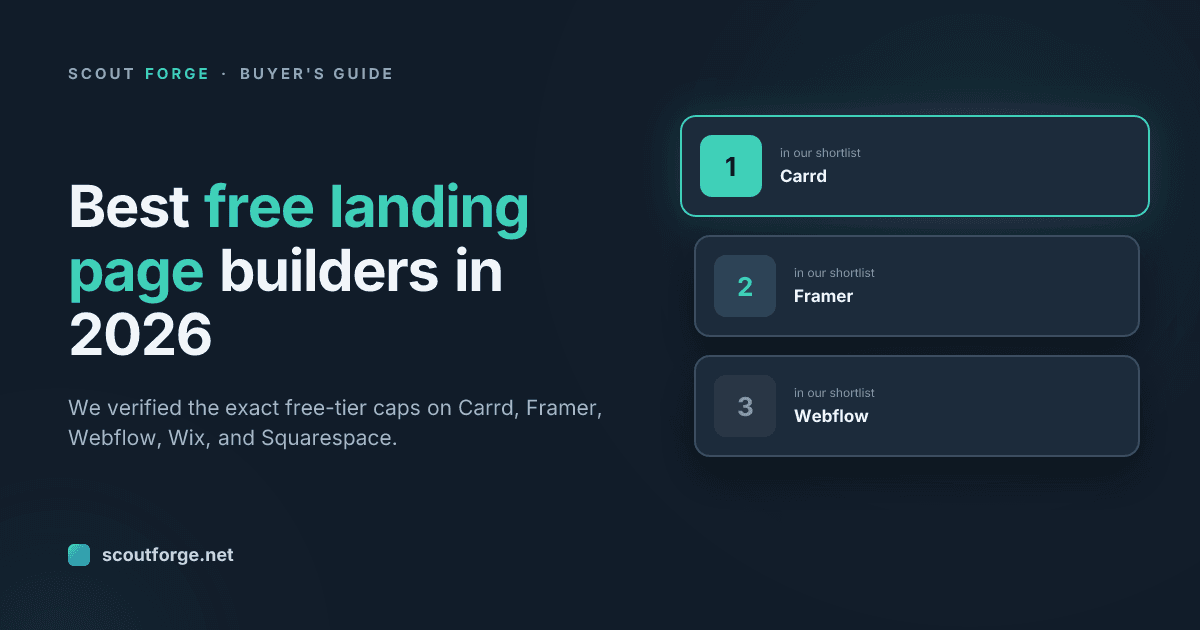
A "free" landing page builder is only free until you hit a cap that forces you to pay — and most lists never tell you where that line is. You do not need a tool that can do everything. You need a tool that can get a page live, connect a real domain, and collect signups without surprising you at the worst possible moment.
We are the Scout Forge team. We score software independently on a 0–100 scale across six dimensions: design, usability, speed, security, accessibility, and growth. Nobody pays to appear in this article, and nobody pays to change a score. When we review a landing page builder, we do not care about how many templates it advertises. We care about what the free plan actually lets a founder do before the credit card comes out.
That means documenting the exact ceilings: visitor caps, page limits, custom domain support, A/B testing availability, form submission ceilings, and forced branding. These are the fine-print details that kill a launch. A builder that forces its own logo on your page is not free — it is advertising your product while you advertise theirs. A builder that caps you at 1,000 visitors a month is fine for a waitlist and useless for a Product Hunt launch.
This guide scores the genuinely usable free landing page builders we could verify from primary sources as of October 2026. We leave out tools whose free-tier details we could not confirm — including WordPress.com, Unbounce, Leadpages, Mailchimp, and HubSpot — rather than guess at numbers that might be wrong. If a tool's free plan is a trial, we say so. If it has no permanent free tier, we say that too.
Why Most "Free Landing Page Builder" Lists Waste Your Time
Most roundups rank builders by feature count. That is backwards. A founder launching a product does not need 200 templates. They need three things: a page that loads fast, a custom domain that looks professional, and a form that collects emails. Everything else is noise.
The problem is that free tiers are defined by their caps, not their features. A builder can advertise "unlimited pages" and still be useless if it slaps a banner across your footer. A builder can offer a gorgeous editor and still fail you if it caps form submissions at 50 a month — which is roughly one signup per working day. The question is never "what can this tool do?" It is "what will this tool let me do before I have to pay?"
That is why we score launch-readiness over polish. A beautiful editor you cannot publish on your own domain is a demo, not a launch vehicle. A fast page with someone else's logo on it is a billboard, not a brand. We apply the same six dimensions we use for every app on Scout Forge — design, usability, speed, security, accessibility, and growth — but we weight them toward the moment a founder actually ships.
Here is the uncomfortable truth we keep finding: the best free landing page builder for a solo founder is rarely the one with the most features. It is the one whose free tier lets you look professional for the longest time. That usually comes down to one thing: whether you can use a custom domain without paying.
How We Scored These Builders (And What "Free" Really Means)
We checked five specific caps on every builder we could verify:
- Visitor or bandwidth cap — how much traffic you can absorb before the page breaks or the plan forces an upgrade.
- Page limit — whether you can build one page, three, or a thousand.
- Custom domain support — the single biggest professionalism signal for a founder.
- A/B testing — whether you can run experiments without paying.
- Forced branding — whether the builder puts its own name on your page.
We also looked at form submission limits where the builder publishes them. A landing page without a working form is just a brochure.
"Free" means different things across these tools. Some have a permanent free tier with real limits. Some have a free trial that expires. Some have no free tier at all and should not appear on a "free builder" list in the first place. We only include tools whose free offering we could confirm from official pricing or help pages as of October 2026.
A note on scores: we do not publish Scout Forge scores for tools we have not fully reviewed. In this article, we reference our scoring dimensions and methodology — which you can read in full on our methodology page — but we do not invent scores for products that are not in our catalogue. Where a tool is listed on Scout Forge, we link to its page. Where it is not, we link to the official source we verified.
The Free-Tier Caps at a Glance (Comparison Table)
This is the table that saves you an afternoon of reading pricing pages. All figures are as of October 2026 and come from official sources we verified.
| Builder | Visitor / Bandwidth Cap | Page Limit | Custom Domain | A/B Testing | Forced Branding |
|---|---|---|---|---|---|
| Carrd | Not published (lightweight pages) | 3 sites (1 page each) | No (Pro from $19/year) | No | Yes ("Made with Carrd") |
| Framer | 1,000 visitors / 100MB bandwidth per month | 1,000 pages | No (Basic from $10/month) | No | Yes ("Made in Framer" banner) |
| Webflow | 1 GB bandwidth per month | 2 static pages | No | No | No (Webflow.io subdomain) |
| Wix | 1 GB bandwidth per month | Not published | No (paid plans only) | No | Yes (Wix ads and branding) |
| Squarespace | 14-day trial only | 14-day trial only | Trial only | No | Trial only |
Two things jump out. First, no verified free plan allows a custom domain. If you want your own URL, you are paying — the only question is how little. Second, forced branding is the default. Carrd, Framer, and Wix all put their name on your free page. Webflow does not, but it caps you at two pages and a subdomain.
The rest of this article breaks down each builder in detail, then maps them to launch stages so you can self-select.
Carrd: The Cheapest Way to Get a Real Custom Domain Live
Carrd is the quiet workhorse of the indie web. It builds one-page sites — fully responsive, fast, and absurdly simple. The free Basic plan gives you up to three sites, but each one is a single page, and each one carries a "Made with Carrd" badge. No custom domain on the free tier.
What Carrd does brilliantly is get out of your way. The editor is clean, the templates are tasteful, and the pages load almost instantly because there is almost nothing to load. For a founder whose entire launch is a headline, a paragraph, and an email capture form, Carrd is enough.
The wall you hit first. You cannot put your own domain on a free Carrd site. The moment a founder wants to look like a real company — not a side project — they need Carrd Pro Standard at $19/year, which includes custom domains and removes the branding. That is the cheapest paid path to a professional landing page we know of, and it is a one-time annual cost, not a subscription treadmill.
Where Carrd breaks down is anything beyond a single page. You cannot build a pricing page, an about page, or a blog. You cannot run A/B tests. The free tier is a sketchpad, not a launch platform — but for a pre-launch waitlist or a simple "we exist" page, it is genuinely free and genuinely useful.
Who should pick it. Solo founders who need one page, a form, and a custom domain for under $20 a year. Who should not. Anyone who needs multiple pages, A/B testing, or a CMS.
If you want a Scout Forge-reviewed alternative in the same spirit, ViralVant scores 80 and is an AI-powered landing page builder aimed at quick, high-converting pages. It is a different beast — AI-assisted rather than hand-built — but it sits in the same "get a page live fast" lane.
Framer: Best Free Tier for Design-Led Founders
Framer is the designer's landing page builder. It comes from a design-tool lineage, and it shows: the editor is precise, the animations are genuinely impressive, and the free plan is unusually generous on paper. As of October 2026, Framer's free plan includes up to 1,000 pages, 10 CMS collections, 100MB of bandwidth per month, and 1,000 visitors per month. You publish on a example.framer.app subdomain.
The catch is the banner. Free Framer sites display a "Made in Framer" badge. For a design-led founder, that badge is a credibility problem — it tells visitors you did not pay for your own website. It is the same branding tax Carrd charges, but on a tool that markets itself as the premium option.
The wall you hit first. The visitor cap. 1,000 visitors a month sounds fine until you post on Hacker News or launch on Product Hunt and burn through it in a day. The bandwidth cap of 100MB is similarly tight if you use large images or video. Framer's free tier is a portfolio, not a launch platform.
Custom domains require Framer Basic at $10/month. That is a real subscription, not a one-time fee, and it is where Framer stops being "free" in any meaningful sense. If you are a designer who wants to show off what Framer can do, the free tier is a playground. If you are a founder who needs a professional domain, you are paying $120 a year before you have a single customer.
Who should pick it. Designers and founders who want the best-looking free page possible and can tolerate the badge and the subdomain. Who should not. Anyone who expects real traffic or needs a custom domain on day one.
Webflow and WordPress.com: Powerful, But the Free Tier Bites
Webflow is the most powerful no-code builder on this list, and its free Starter plan is the most honest about what "free" means. You get a webflow.io subdomain, two static pages, limited CMS, 1 GB of bandwidth per month, and 50 form submissions. No custom domain.
Two pages is enough for a landing page and a thank-you page. 50 form submissions is enough for a slow trickle of signups. 1 GB of bandwidth is enough for a text-heavy site with optimized images. The free tier is not generous — it is a trial with no expiration date.
The wall you hit first. Form submissions. 50 a month is the ceiling that forces an upgrade for any founder who actually gets traction. If your launch works, you will hit 50 signups in the first week and have to pay for a site plan. That is not a failure of Webflow — it is the point. The free tier exists to get you hooked on the editor, not to host your business.
Webflow's real strength is the editor itself. If you are building something complex — a marketing site with a CMS, dynamic content, and custom interactions — Webflow is the best tool on this list. But the free tier is not where that complexity lives. It is a sandbox.
We are omitting WordPress.com from the detailed comparison because we could not verify its free-tier landing page specifics from primary sources as of October 2026. What we can say from long experience: the free tier of any hosted WordPress product tends to include ads, a subdomain, and no plugin access — but we will not print numbers we cannot source. If you want WordPress, treat it as a paid decision from day one.
Who should pick Webflow's free tier. Founders who want to learn the tool before committing to a paid plan. Who should not. Anyone who needs a working form on a real domain this month.
Wix and Squarespace: The Mainstream Free Options, Honestly Assessed
Wix is the most recognizable name on this list, and its free plan is the most honest about what you are giving up. You get a wixsite.com subdomain, Wix ads and branding on your page, 500 MB of storage, and 1 GB of bandwidth per month. Custom domains require a paid plan.
The Wix ads are the dealbreaker. They are not subtle — they sit on your page and tell every visitor you are on the free tier. For a founder trying to build credibility, that is worse than no page at all. A Wix free site says "I am testing an idea" when you want it to say "I am building a company."
The storage and bandwidth caps are also tight. 500 MB is fine for a text-and-image landing page, but the moment you add video or a gallery, you are close to the ceiling. And 1 GB of bandwidth is roughly 10,000 page views of a lightweight page — enough for a small launch, not enough for a viral one.
Squarespace is the honest outlier: it has no permanent free tier. You get a 14-day free trial with access to most features, and then you pay. That is not a free landing page builder — it is a free trial of a paid one. We include it here because it shows up on every "free builder" list, and it should not. If you want Squarespace, budget for a paid plan from day one.
Who should pick Wix's free tier. Almost nobody launching a real product. It is fine for a personal project or a school assignment. Who should not. Any founder who cares about looking professional.
Unbounce, Leadpages, Mailchimp and HubSpot: Marketing-Suite Builders on Free
We are grouping these four together for a reason: we could not verify their free-tier landing page caps from primary sources as of October 2026. That is not a judgment on the tools — Unbounce and Leadpages are serious conversion platforms, and HubSpot's free CRM is genuinely useful. But we will not print visitor caps or page limits we cannot source.
What we can say from the broader market context: these are marketing-suite builders, not pure landing page tools. Unbounce and Leadpages are built for conversion optimization and A/B testing — which is exactly what a founder needs after launch, not before. Mailchimp's landing pages are an add-on to its email platform. HubSpot's free tools are a gateway to its CRM.
The honest guidance: if you are choosing between a pure page builder and a marketing suite, pick the page builder for launch day and the marketing suite for iteration. The page builder gets you live faster and cheaper. The marketing suite gets you data and experiments after you have traffic. Trying to do both on a free tier usually means doing neither well.
If you need A/B testing specifically, do not expect it on any free landing page builder we verified. A/B testing is a paid feature across the board. The free path to experimentation is to build two pages manually and split traffic yourself — which is more work but costs nothing.
Which Free Builder Fits Which Launch Stage
Pre-launch waitlist. You need one page, a form, and a link you can share. Carrd free is enough — three sites, simple forms, fast pages. The "Made with Carrd" badge is acceptable when you are collecting emails from early adopters. If you want a Scout Forge-reviewed AI alternative, ViralVant or ByteSites both score 80 and generate pages from prompts.
Launch day. You need a custom domain, no forced branding, and enough bandwidth to survive a traffic spike. None of the verified free tiers deliver all three. The cheapest path is Carrd Pro Standard at $19/year. The most capable path is Framer Basic at $10/month. Pick based on whether you value annual frugality or design flexibility.
Post-launch iteration. You need A/B testing, analytics, and a CMS. This is where free tiers stop being relevant. Webflow's paid plans, Unbounce, and Leadpages are built for this stage. If you are still on a free tier after launch, you are leaving signups on the table.
The uncomfortable summary: free landing page builders are for pre-launch and early validation. The moment you have real traffic, you pay — and that is the correct trade. A $19/year Carrd Pro plan that converts 2% of visitors is a better investment than a free Wix page that converts 0.5% because it is covered in ads.
The Caps That Actually Force You to Pay (And How to Delay Them)
Across every builder we verified, four caps force an upgrade:
-
Custom domain. The single most common trigger. No verified free plan allows one. Delay tactic: use a free subdomain for early validation, then pay for the domain the week before you share the page publicly. Carrd Pro Standard at $19/year is the cheapest path.
-
Visitor or bandwidth ceiling. Framer caps at 1,000 visitors and 100MB a month. Webflow caps at 1 GB. Wix caps at 1 GB. Delay tactic: compress images aggressively, avoid video, and use a lightweight analytics tool. PrettyInsights scores 81 on Scout Forge — a privacy-first analytics option that matters when every kilobyte counts against a bandwidth cap.
-
Form submissions. Webflow caps at 50 a month on the free tier. Delay tactic: use a free form tool like Formify or Formflow — both score 80 and 79 respectively on Scout Forge — and embed it on your free page. That decouples your form ceiling from your page builder's ceiling.
-
Forced branding. Carrd, Framer, and Wix all add it on free tiers. Delay tactic: there is no delay. You either accept the badge or you pay. The badge is a conversion killer, not a cosmetic issue.
The meta-lesson: the cheapest way to stay free longer is to decouple your components. Use a free page builder for the page, a free form tool for the form, and a free analytics tool for the data. When one component hits its cap, you upgrade that one component — not the whole stack.
Verdict: The Best Free Landing Page Builder for Founders in 2026
The best free landing page builder for founders is Carrd — not because its free tier is generous, but because its paid tier is honest. The free Basic plan gets you three one-page sites with branding. The jump to a custom domain and no branding is $19/year, one time, no subscription. That is the cheapest professional landing page on the internet, and it is fast, secure, and accessible by default.
The runner-up is Framer, but only for design-led founders who can tolerate the badge. The free tier's 1,000 pages and 10 CMS collections are impressive on paper, but the visitor cap and forced branding make it a portfolio tool, not a launch vehicle. If you are a designer who wants to show off, Framer is the best free option. If you are a founder who wants signups, Carrd Pro is the better $19.
Webflow's free tier is a sandbox, not a launch platform. Wix's free tier is a billboard. Squarespace has no free tier. The marketing suites are for after launch, not before.
If you want to see how these tools and their alternatives score on our full six-dimension methodology, browse our Website Builders category. And if you are building a landing page builder of your own, list it on Scout Forge — the listing is free, and it gets scored the same way as everyone else. No paid rankings, no bought scores.
FAQ
Is there a truly free landing page builder?
Yes, but with caveats. Carrd, Framer, Webflow, and Wix all have permanent free tiers as of October 2026. However, none of them allow a custom domain on the free plan, and most force their own branding on your page. "Truly free" means you can publish a page and collect signups without paying — but you will look like a free user.
Can I use a custom domain with a free landing page builder?
No. None of the verified free plans — Carrd, Framer, Webflow, or Wix — support custom domains as of October 2026. The cheapest path to a custom domain is Carrd Pro Standard at $19/year. Framer Basic at $10/month is the cheapest monthly option.
Which free landing page builders include A/B testing?
None of the verified free tiers include A/B testing. It is a paid feature across the board. If you need to experiment for free, build two versions of your page manually and split traffic yourself using a link shortener or a simple analytics tool.
What happens when I hit the free tier's visitor or form cap?
The page does not disappear — the builder typically throttles traffic, blocks new form submissions, or prompts you to upgrade. On Webflow's free tier, form submissions stop at 50 a month. On Framer, you hit a visitor ceiling at 1,000 a month. Plan your upgrade before you launch, not after you hit the cap.
Is Wix free plan good for a startup landing page?
No. The Wix free plan shows Wix ads and branding on your page, which undermines credibility. It also caps storage at 500 MB and bandwidth at 1 GB. For a founder trying to look professional, a Wix free site sends the wrong signal. Pay for a plan or use a different tool.
Why did you leave out WordPress.com, Unbounce, Leadpages, Mailchimp, and HubSpot?
Because we could not verify their free-tier landing page caps from primary sources as of October 2026. We do not print numbers we cannot source. Some of these tools have no permanent free tier at all, and others bundle landing pages into broader marketing suites. If you are considering them, check their current pricing pages directly.
If you found this useful, read our companion piece on the best free email marketing tools for small teams — it applies the same cap-first logic to email. And if you are building a landing page builder, a form tool, or anything else founders need at launch, list your product on Scout Forge. The listing is free, the scoring is independent, and money cannot buy a score.
