Cycling through all six. Tap any point to stop.
Measured on six things
Structured web data for developers and AI agents.
Growth
62A real, specific problem — agents that need to buy data without a human — with a clear wedge: self-signup, price-before-run, pay-per-result. Bright Data and ScrapingBee sell infrastructure; this sells a checkout counter for bots.
Screenshots
1 / 1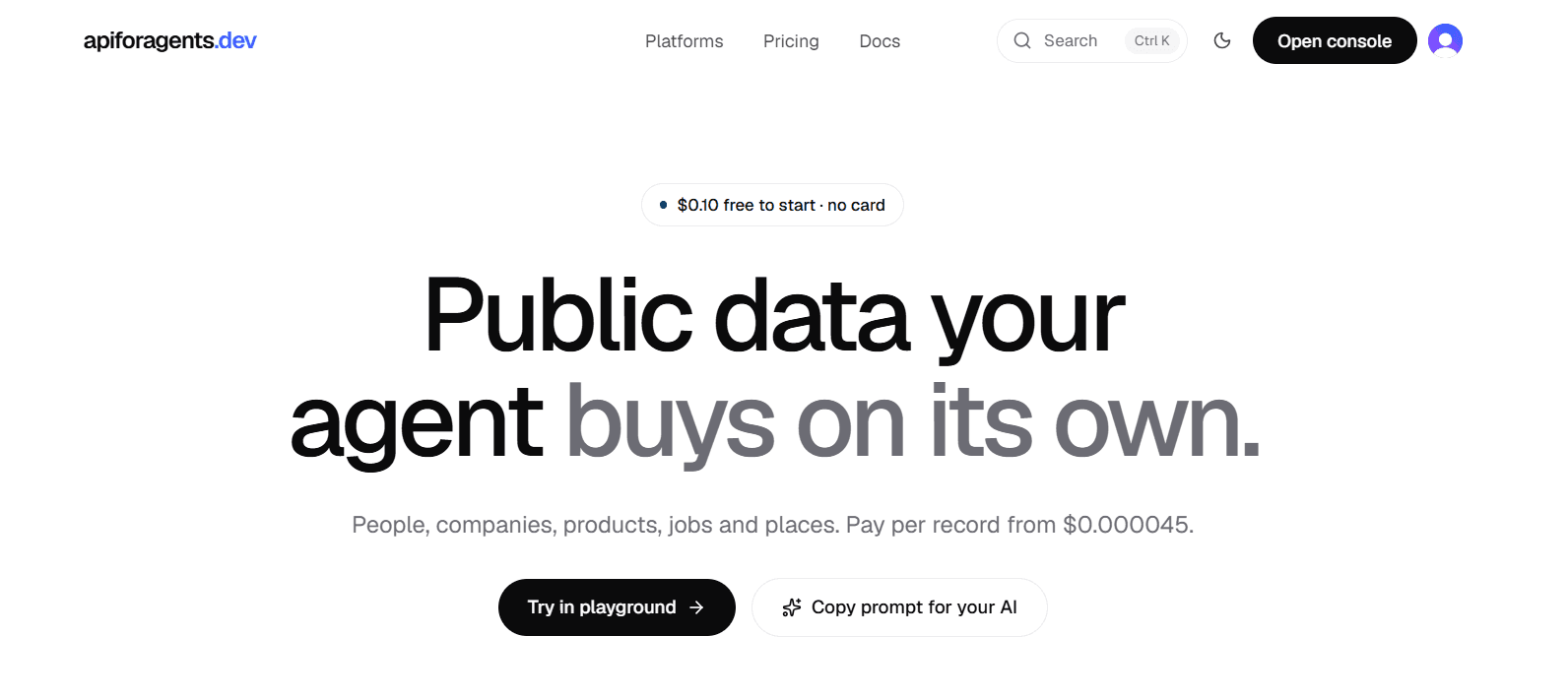
About this app
API for Agents is a pay-as-you-go public data API designed for AI agents to autonomously purchase data. It aggregates over 30 platforms—including LinkedIn, Instagram, TikTok, Google Maps, Amazon, and more—under a single API key. Agents can sign themselves up, check prices before each call, and only pay for successful results, with no subscription required. Pricing starts at $0.000045 per record, and every new account gets $0.10 free credit. The service is accessible via a no-code playground, direct API, or integrations with Claude, ChatGPT, Cursor, n8n, and Python, supporting CSV/JSON downloads. It is ideal for developers, AI engineers, and growth teams who need flexible, on-demand public data without long-term contracts.
Key features
- 126 platforms (LinkedIn, Instagram, TikTok, Amazon, Google Maps and more) under a single API key with per-record pricing from $0.000045.
- 2Free price quote before every call, estimateOnly and maxUsd caps, and no charge for empty results or errors.
- 3Three on-ramps sharing one balance: no-code playground, AI prompt for Claude/ChatGPT/Cursor, and direct API with CSV/JSON export.
Target customer profile
Drawn from the product itself, not from a survey.
Demographic
AI developers and engineers building agents
Pain points
Complex data sourcing, multiple API keys, high costs
Primary needs
Unified API with transparent pricing and easy integration
Demographic
Growth and marketing teams in startups
Pain points
Manual lead generation, expensive data subscriptions
Primary needs
Pay-per-result data for people and companies without commitment
Demographic
No-code automation users (n8n, Zapier)
Pain points
Limited data access, technical barriers
Primary needs
Simple playground or integration to fetch data without coding
Scout Review
Written by AI from measured evidence, scored out of 100.
API for Agents is a pay-per-record public data API aimed squarely at AI agents, and it's unusually honest about what it is: 26 platforms, one key, a price shown before every call, and no subscription. The landing page earns its keep by showing real output with a real cost instead of abstract art, and the docs give you three genuine ways in — playground, AI prompt, or curl. The measured profile is respectable rather than spectacular: desktop speed 98 but mobile 75 with a 5.6s LCP, accessibility 96 with two minor audit failures, and 10 of 13 security headers with no CSP and no published audit. The product is roughly three months old, so the absence of SOC 2, reviews and community is stage-appropriate rather than damning. What it has going for it is a clear, specific wedge against Bright Data and ScrapingBee — per-result billing and agent self-signup — and a pricing page that lists every single rate down to $0.000045. What it doesn't have yet is proof that anyone besides the maker is using it.
Measure by measure
Usability
68Three documented on-ramps (playground, AI prompt, code) sharing one balance, a free quote before every run, and a live platform grid. Onboarding is genuinely short. Logged-in vs logged-out header states look inconsistent.
Design
71Clean monochrome-plus-blue system with a hero that shows real output and a per-call cost. The 26-platform index is scannable. Held back by text-only integration row and a cookie banner clipping the footer.
Speed
68Desktop Lighthouse 98/100, but mobile is 75 with a 5.6s LCP — the largest contentful paint is doing a lot of heavy lifting on phones. CLS 0 and TBT 226ms are fine. Fast on a laptop, sluggish on a phone.
Security
74HTTPS enforced with HSTS, secure cookies, SPF and DMARC, plus X-Content-Type-Options, Referrer-Policy and Permissions-Policy — 10/13 probe points. No CSP and no frame protection. No SOC 2 or audit claims found.
Accessibility
80Lighthouse accessibility 96/100 with only two failing audits: a contrast ratio issue and mismatched accessible names on labeled elements. No WCAG statement published. Strong automated result, minor real gaps.
Growth
62A real, specific problem — agents that need to buy data without a human — with a clear wedge: self-signup, price-before-run, pay-per-result. Bright Data and ScrapingBee sell infrastructure; this sells a checkout counter for bots.
Improvement areas
- Mobile performance: 5.6s LCP drags the Lighthouse mobile score to 75 despite a 98 on desktop.
- Security headers: no Content-Security-Policy or frame protection; no SOC 2, ISO or pen-test claims published.
- Accessibility polish: two failing audits (contrast ratio, accessible names) and no WCAG statement.
- Design finish: text-only integrations row, sparse mid-page cards, and a cookie banner overlapping the footer.
Design & Usability
The homepage does the one thing most API landing pages fail at: it shows the actual product. The hero is a People-search card with three named results, city tags and a 'Cost $0.012' footer, so you understand what you're buying before you scroll. The monochrome-plus-blue palette is applied consistently and the 26-platform index with green Live dots is genuinely scannable. Where it slips is the middle of the page — the three-step cards and feature cards carry very little text and float in a lot of whitespace, and the 'Works with' row renders Claude, ChatGPT, Cursor, n8n and Python as plain grey words instead of logos, which makes the integrations look unfinished. Usability is the stronger half: three documented on-ramps (playground, AI prompt, code) all draw on the same account and balance, every call shows a free quote before it runs, and the docs spell out the five-step playground flow. The header state is inconsistent between logged-out and logged-in captures, which is a small polish miss rather than a real blocker.
Speed & Security
Speed is a tale of two devices. Desktop Lighthouse lands at 98/100, which is genuinely fast. Mobile is 75/100 with a 5.6s Largest Contentful Paint — that LCP is the number that matters, because it's the moment a phone user actually sees the page. CLS 0 and TBT 226ms mean nothing is jumping around or locking up the main thread, so the problem is payload and render timing, not jank. Security is competent without being impressive: the probe found HTTPS enforced, HSTS, secure cookies, SPF, DMARC, X-Content-Type-Options, Referrer-Policy and Permissions-Policy — 10 of 13 checklist points. What's missing is a Content-Security-Policy and frame protection, both of which are cheap to add and both of which are absent. There's no SOC 2, ISO or pen-test claim anywhere on the site, which is normal for a product this young but means enterprise buyers will have questions. The privacy stance is at least stated plainly: public pages only, nothing behind a login, with contacts as the one named exception.
Accessibility & Growth
Accessibility is the strongest measured dimension: Lighthouse scores 96/100 and only two audits fail — a contrast ratio issue and visible text labels that don't match their accessible names. Both are fixable in an afternoon. There's no published accessibility statement or WCAG conformance claim, so a procurement team will have to take the automated score on faith. Growth is where the interesting question lives. The problem is real: AI agents increasingly need to fetch structured public data, and today that means a human setting up a Bright Data or ScrapingBee account, managing proxies, and reconciling a bill. API for Agents collapses that into one key, a price shown before every call, and per-result billing — a checkout counter for bots rather than a proxy farm. That's a genuine wedge against the listed alternatives, and the 26-platform coverage plus the agent-native signup flow is the concrete reason to pick it. The honest limit is that the wedge is copyable: Bright Data has the data relationships and the capital to bolt on per-result billing whenever it wants, and the 'agent signs itself up' story depends on agents actually being trusted with payment credentials, which is still an open question across the industry.
Conclusion
The thing to watch is whether 'agents buy their own data' becomes a real purchasing pattern or stays a demo. If it becomes real, API for Agents is positioned well: the pricing model, the free quote before every call, and the maxUsd cap are exactly the guardrails an autonomous buyer needs. If it doesn't, this is a well-built scraper API with a futuristic tagline. Either way, the immediate work is unglamorous: fix the mobile LCP, add a CSP, publish an accessibility statement, and put real logos in the integrations row. None of those are hard, and all of them are the difference between 'promising' and 'trusted.'
Suggestions for improvement
- Cut mobile LCP from 5.6s — compress the hero assets and preload the largest image; desktop already proves the stack can be fast.
- Add a Content-Security-Policy and frame-ancestors header; you're two headers away from a clean 13/13 probe.
- Fix the two failing a11y audits (contrast ratio, accessible names) and publish a short WCAG 2.1 AA statement.
- Replace the grey 'Works with' text with real Claude, ChatGPT, Cursor, n8n and Python logos — it's the cheapest credibility on the page.
Alternatives comparison
Named competitors, point by point. Nobody paid to appear here or to be left out.
 API for Agents |  Bright Data |  ScrapingBee | |
|---|---|---|---|
| Pricing model | Pay per record from $0.000045; $5 first top-up; no subscription; balance never expires | Subscription/committed plans plus pay-as-you-go; enterprise contracts common | Monthly plans based on API credit volume; free trial credits |
| Agent-native signup and billing | Agent signs itself up, no card, price shown before each call, maxUsd cap | Human account setup, dashboard-driven, enterprise onboarding | Human signup with API key; no agent self-provisioning |
| Data coverage | 26 platforms incl. LinkedIn, Instagram, TikTok, Amazon, Google Maps, jobs boards | Very broad web scraping, proxies and curated datasets across many domains | General-purpose scraping of arbitrary URLs with headless browsers |
| No-code access | Playground with plain-word forms, CSV/JSON download, AI prompt for Claude/ChatGPT/Cursor | Web Scraper IDE and no-code dataset builders; steeper learning curve | API-first; dashboard for usage, limited no-code extraction |
| Security and compliance | HTTPS, HSTS, secure cookies, SPF/DMARC; no CSP; no published SOC 2/ISO | Published compliance program (SOC 2, ISO, GDPR) and enterprise security docs | HTTPS, GDPR-oriented policies; compliance documentation available |
Bright Data
Web data platform offering proxies and datasets for scraping.
ScrapingBee
Web scraping API with headless browsers and proxy rotation.
Comparing options? See API for Agents alternatives, scored side by side
More API Service apps
View all API Service
CC Switch
91Open-source desktop app for switching AI coding providers...

TaxID
90Fast EU VAT validation API for developers, covering 27 EU...

eSignSimple
89Free, fast e-signatures for docs & PDFs with audit trail.

Webfetch
89Web scraping API that turns any URL into HTML, text, Mark...

issued.live
89Free certificate transparency search and SSL lookup with ...

tradutor de mangá com IA
88O tradutor de mangá com IA traduz capítulos em lote, personaliza textos e oferece edição visual para estúdios.

OBVELO
88Privacy gateway that masks personal data in LLM traffic

LurkAPI
88Public social media data as clean JSON, in one request

SiftingIO - Market Data API
88Real-time & historical market data API for stocks, forex,...

Claw Messenger
88Claw Messenger is an iMessage API service that gives AI a...

GeoGen
88Marketing teams want to know what AI says about them; GeoGen answers with daily data, while agencies and resellers turn the same data into a service.

BenchFleet
88Desktop hub to control real Android phones with AI agents...


A platform dedicated to providing unbiased reviews of newly launched applications, analyzing everything from their features to their full potential.
info@scoutforge.net© 2026 Scoutforge. All rights reserved.
