Cycling through all six. Tap any point to stop.
Measured on six things
Marketing teams want to know what AI says about them; GeoGen answers with daily data, while agencies and resellers turn the same data into a service.
Usability
66Five clear tiers, a 7-day trial on entry plans, plain-language sidebar and a 5-phase task board. Docs depth and real onboarding flow couldn't be verified from outside.
Screenshots
1 / 1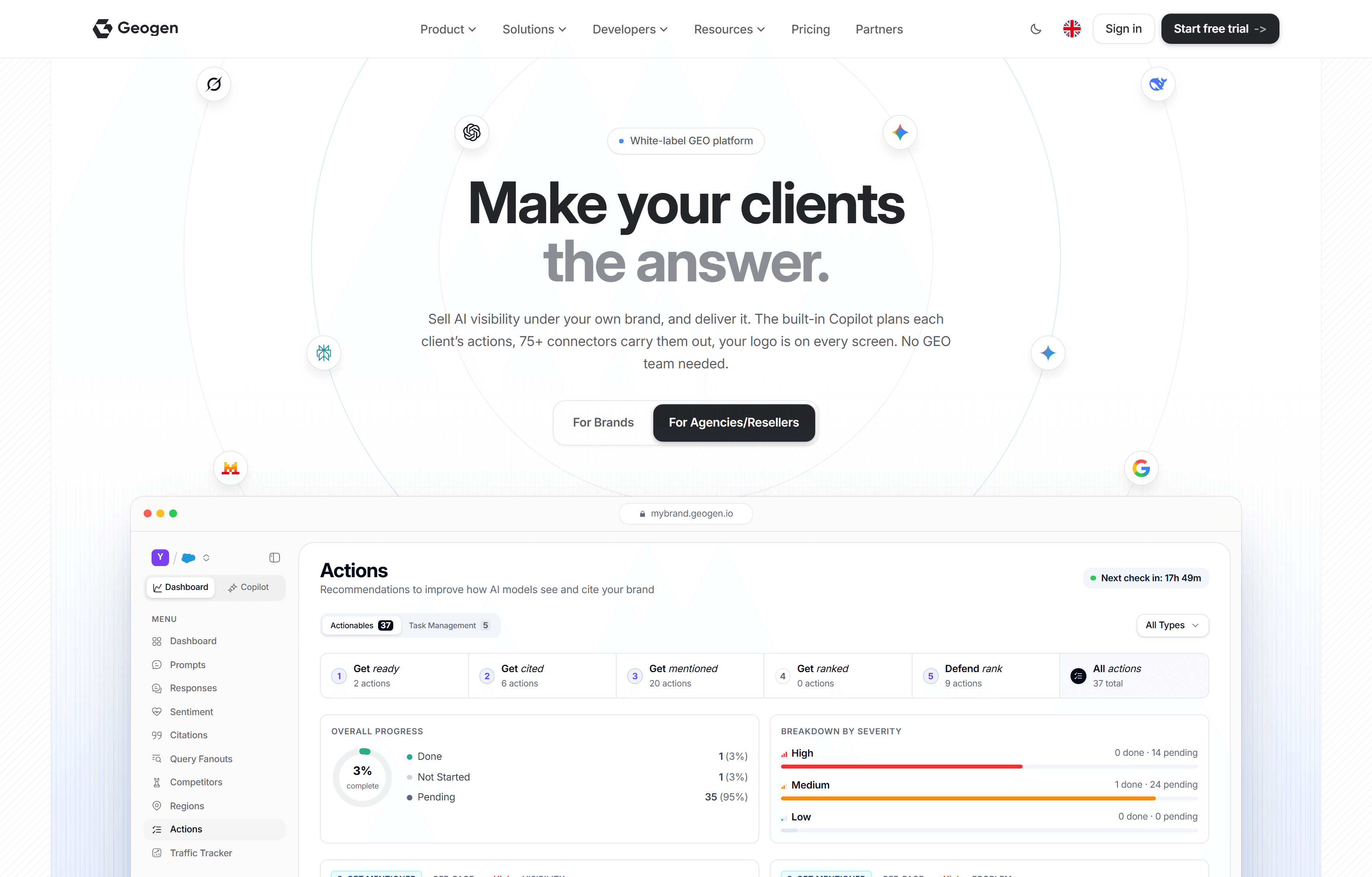
About this app
An e-commerce agency lives on product pages, category pages and the questions shoppers ask before buying. GeoGen lets it track those questions as prompts, run them every day on every engine in the plan and see whether the client's products are named, in what position and with which pages cited. The agency's logo is on the dashboard, each client has a workspace with its own plan, limits, credits and members, and the agency sets the price. Competitors are detected automatically and ranked by share of voice, and the task board turns gaps into actions planned with the Copilot. Coverage runs across 16 AI engines, and developers can use the REST API for their own reports.
Key features
- 1Daily prompt tracking across 16 AI engines with named/position/citation data per engine
- 2White-label dashboards, per-client workspaces with own plans, credits and members
- 3Five-phase action plan and task board, planned by the in-app Copilot
- 4REST API (30+ endpoints), CLI and MCP server for embedding and automation
- 5Automatic competitor detection ranked by share of voice, plus sentiment and LLM traffic analytics
Target customer profile
Drawn from the product itself, not from a survey.
Demographic
Brand Marketing & SEO Teams
Pain points
Brand is invisible in AI answers; lack of data on why competitors are cited instead.
Primary needs
Daily tracking across multiple AI engines, sentiment analysis, and a clear action plan to improve visibility.
Demographic
Digital Agencies & Resellers
Pain points
Need to offer new GEO services without building custom tech; requires scalable client management.
Primary needs
White-label dashboard, multi-client workspaces, automated reporting, and reseller margin opportunities.
Demographic
Platforms & Hosting Providers
Pain points
Clients expect AI visibility features; internal development of GEO tools is costly and slow.
Primary needs
API access, CLI tools, volume pricing, and the ability to embed AI visibility data into existing products.
Scout Review
Written by AI from measured evidence, scored out of 100.
GeoGen is a Generative Engine Optimization platform that tracks how brands appear in AI answers across 16 engines, then turns the gaps into a phased action plan. It's aimed squarely at agencies and resellers: white-label dashboards, per-client workspaces with their own plans and credits, a reseller programme paying 30-50%, and a REST API, CLI and MCP server for platforms that want to embed the data. Pricing runs from €20/month Micro to €475/month Pro, with Custom for agencies and enterprises. The site is fast and technically well-secured, the dashboard mockup is convincing, and the positioning is sharp. The weak spots are polish in the lower homepage sections, no trial on the tiers agencies actually buy, and no compliance certifications published despite selling into agency-client relationships.
Measure by measure
Usability
66Five clear tiers, a 7-day trial on entry plans, plain-language sidebar and a 5-phase task board. Docs depth and real onboarding flow couldn't be verified from outside.
Design
71Analyst-grade dashboard mockup with real data above the fold and a smart Brands/Agencies split. Undercut by a cropped 'Search moved' heading and a demo panel with an empty answer bubble.
Speed
88Lighthouse mobile 96/100 (LCP 1.4s, CLS 0, TBT 219ms) and desktop 100/100. Genuinely fast, well within the top of the measured band.
Security
76Full header suite (HSTS, CSP, frame protection, Permissions-Policy), SPF and DMARC set — 12/12 on the probe. No SOC 2, ISO or pen-test claim surfaced in the fetched content.
Accessibility
70Lighthouse 94/100 with 18-language coverage including RTL. Failing contrast, touch-target and accessible-name audits plus no published a11y statement keep it mid-band.
Growth
68Real, current problem (buyers ask AI first) with a concrete agency wedge: white-label, per-client workspaces, reseller margin, plus API/CLI/MCP for platforms. Category has visible headroom.
Improvement areas
- No SOC 2, ISO or pen-test claim published despite selling white-label into agency-client relationships
- Free trial limited to Micro and Standard; Growth and Pro — the agency tiers — require blind commitment
- Homepage polish gaps: cropped section heading, empty demo answer bubble, overlapping step cards
- Accessibility: failing contrast, touch-target and accessible-name audits with no WCAG statement
Design & Usability
GeoGen's homepage does the hard thing well: it shows the product instead of describing it. The hero mockup is a data-populated dashboard with a visibility trend, a leaderboard and recent responses, and the Brands/Agencies toggle reframes one product for two buyers in a single click. The cracks are in the lower sections — a 'Search moved' heading cropped at its baseline, a sample-answers panel with an empty ChatGPT bubble and blank step-card bodies, and tilted overlapping step cards that make the sequence hard to read. Usability is competent: five tiers with a 7-day trial on the two entry plans, a plain-language sidebar, and a five-phase task board that turns gaps into actions. The gap is that Growth and Pro — the tiers an agency would actually buy — show 'Get started' with no trial, and documentation depth couldn't be verified from outside.
Speed & Security
Speed is the standout. Lighthouse measured 96/100 on mobile (LCP 1.4s, CLS 0, TBT 219ms, FCP 1.1s) and a clean 100/100 on desktop — the site is static-fast and there's no evidence of lag complaints. Security is strong on the technical layer: HTTPS enforced with HSTS, a Content-Security-Policy, frame protection, X-Content-Type-Options, Referrer-Policy and Permissions-Policy all present, plus SPF and DMARC configured — 12/12 on the header probe. What's missing is the paperwork layer. No SOC 2, ISO 27001 or pen-test claim surfaced anywhere in the fetched content, which matters because the product's core pitch is handing agencies a white-label dashboard their enterprise clients will log into. The plumbing is excellent; the trust artifacts are absent.
Accessibility & Growth
Accessibility lands at 70: Lighthouse scored 94/100 and the site ships in 18 languages including RTL Arabic and Hindi, which is real international reach. But three audits fail — insufficient color contrast, undersized touch targets, and visible text labels that don't match their accessible names — and there's no published WCAG statement to say where the product stands. Growth is the more interesting story. The problem GeoGen names is genuinely current: buyers ask ChatGPT and Perplexity first, get one answer naming a handful of brands, and never see page two. The wedge is specific — white-label for agencies, per-client workspaces with their own plans and credits, a reseller programme with 30-50% revenue share, and API/CLI/MCP for platforms that want to embed it. That's a real reason to pick it over a generic GEO dashboard. The limit is that 16 engines and 75 connectors are features every competitor is racing to match; the durable advantage has to come from the agency relationships, not the engine count.
Conclusion
If you're an agency being asked 'are we showing up in AI answers?' and you don't want to build the tracking layer yourself, GeoGen is a credible answer — the white-label and reseller mechanics are the real product here, not the engine count. Go in with eyes open: the entry tiers are cheap but capped at 2-4 engines and 10-50 prompts, the agency-grade tiers skip the free trial, and there's no SOC 2 to wave at a nervous enterprise client. Start on Micro or Standard to validate the data quality against your own manual checks before you commit a client's logo to it.
Suggestions for improvement
- Publish a SOC 2 or at minimum a security/trust page — agencies reselling white-label need something to show enterprise clients.
- Extend the 7-day free trial to Growth and Pro; those are the buyers most likely to convert and least likely to commit blind.
- Fix the cropped 'Search moved' heading and populate the sample-answers demo — an empty ChatGPT bubble undercuts the core pitch.
- Add a WCAG/accessibility statement and fix the contrast and touch-target failures flagged by Lighthouse.
Alternatives comparison
Named competitors, point by point. Nobody paid to appear here or to be left out.
 GeoGen |  | |
|---|---|---|
| AI engine coverage for daily prompt tracking | 16 engines, daily checks on every prompt | Not specified in provided details |
| White-label / agency reseller support | White-label dashboards, per-client workspaces, 30-50% reseller share | Not specified in provided details |
| Developer / API access | REST API (30+ endpoints), CLI, MCP server | Not specified in provided details |
| Entry pricing | €20-25/month Micro (1 brand, 2 engines, 10 prompts) | Not specified in provided details |
| Action plan / task board | Five-phase actions with task board, planned by Copilot | Not specified in provided details |
Comparing options? See GeoGen alternatives, scored side by side
More Marketing & Sales apps
View all Marketing & Sales
EmbedMyReviews
92White-label reputation management software for agencies s...

Puzzly – B2B Lead Generation & Sales Intelligence Platform
92Puzzly is an all-in-one B2B lead generation platform that...

Geogrid
92A UULE-powered local rank tracker for SEO agencies, offer...

Vibe Coding Agent Skills
92A free, open-source platform offering 110 AI agent skills...

QRBliss
91Branded QR codes with AI Brand Sync, 15 free dynamic code...

ThumbnailMaker
90AI YouTube thumbnail maker: paste a video link, get the brief, the thumbnail, and a check at feed size.

WAButton
90WhatsApp website leads, forms and contact routing

PitchWhip
90AI cold call scripts & direct dials from LinkedIn

BACKLNK
90Backlnk is a free SEO and AI visibility website: 15 website checks, a full audit as a PDF report, and guides to get found in search and AI answers.

DemoVexa
90Turn your code into professional product demo videos with AI-generated scripts, animated UI, and natural voiceovers.

Opus Growth
89Opus Growth is a single MCP server for Google Ads, Meta Ads, TikTok Ads, LinkedIn Ads, Microsoft Ads and ChatGPT Ads. ChatGPT, Claude, Codex, Perplexity, Cursor and other assistants connect with the same address.

AuditCloser
89White-label website audits that close deals for digital a...


A platform dedicated to providing unbiased reviews of newly launched applications, analyzing everything from their features to their full potential.
info@scoutforge.net© 2026 Scoutforge. All rights reserved.
