Cycling through all six. Tap any point to stop.
Measured on six things
The operating system for AI applications - unified model ...
Design
30Live homepage hero renders as near-empty black with a faint blue streak — no headline, CTA, or product UI. Nav and Studio card grid are clean, but the landing page fails its one job.
Screenshots
1 / 1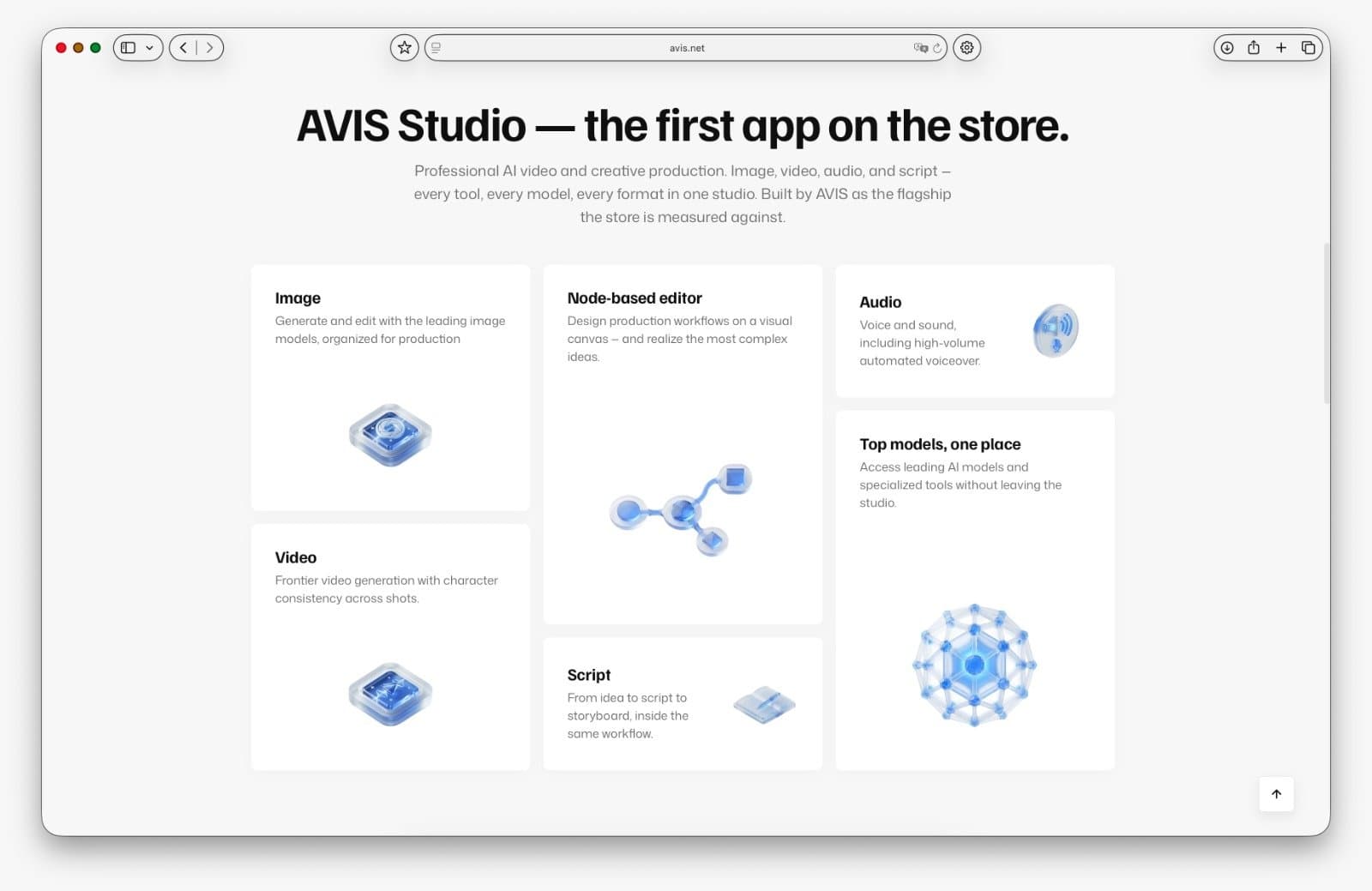
About this app
AVIS positions itself as the operating system for AI applications, offering a unified gateway to every major AI model and a marketplace for distribution. I spent some time exploring the platform, and it's clear that AVIS is designed to solve two major headaches for AI builders: fragmented access to models and the challenge of reaching users. The AVIS Gateway lets you connect once and switch between frontier models like Claude Opus, GPT-5.5, and Qwen3.7 Max without rewriting your integration. That's a huge time-saver. On the other side, the AVIS App Store provides a distribution channel where your AI app can be discovered by real users. The network effects are baked in: as more builders join, the ecosystem becomes more valuable for everyone. The platform also emphasizes that it doesn't compete with the apps built on top; it's purely an operating layer. If you're building AI applications and tired of juggling API keys and marketing your app alone, AVIS could be a game-changer. The pri...
Key features
- 1AVIS Gateway: single integration to frontier models (Claude Opus, GPT-5.5, Qwen3.7 Max) with model switching and cost control
- 2AVIS App Store: marketplace distribution channel for AI apps built on the platform
- 3Transparent per-second pricing across 400+ models, filterable by modality (video, image, text, audio, embedding)
Target customer profile
Drawn from the product itself, not from a survey.
Demographic
AI developers and engineers
Pain points
Managing multiple AI model APIs, high integration overhead
Primary needs
Unified API access, easy model switching, cost control
Demographic
AI startups and indie builders
Pain points
Limited distribution, difficulty reaching users, marketing burden
Primary needs
Marketplace exposure, user acquisition, network effects
Demographic
Enterprise AI teams
Pain points
Vendor lock-in, scaling challenges, compliance
Primary needs
Flexible model integration, enterprise-grade support, distribution
Scout Review
Written by AI from measured evidence, scored out of 100.
AVIS wants to be the operating layer for AI apps: one gateway to every frontier model, one marketplace to distribute what you build. The idea is coherent and the problem is real. Execution is where it stumbles. The homepage hero renders as an empty black panel with no headline or CTA, mobile Lighthouse performance is 31/100 with a 20-second LCP, and security headers cover only half the standard checklist with no compliance claims for the enterprise buyers the copy targets. Pricing is transparent and the model catalogue is deep, which is a genuine strength. But for a product selling reduced friction, the front door is the friction.
Measure by measure
Usability
48Nav is scannable and the pricing table exposes 400+ models with modality filters, but there's no trial, demo, or onboarding cue — the homepage gives a visitor nothing to click toward value.
Design
30Live homepage hero renders as near-empty black with a faint blue streak — no headline, CTA, or product UI. Nav and Studio card grid are clean, but the landing page fails its one job.
Speed
33Lighthouse mobile 31/100 with a 20-second LCP and 2.0s TBT; desktop 57/100. That LCP is not a slow page, it's a hostage situation.
Security
52HTTPS and HSTS enforced, SPF and DMARC present, but no CSP, frame protection, or content-type sniffing headers, and no SOC 2, ISO, or pen-test claim anywhere on the site.
Accessibility
70Lighthouse a11y 94/100 with only contrast and heading-order failures — solid automated baseline, but no WCAG statement or keyboard/screen-reader documentation to back it up.
Growth
58Real problem (model fragmentation + distribution), clear wedge (one gateway + one marketplace), but the App Store side has no visible user base yet to make the network-effects pitch land.
Improvement areas
- Homepage hero renders empty — no headline, value proposition, or CTA visible above the fold
- Mobile Lighthouse performance 31/100 with a 20-second LCP; desktop 57/100
- Only 6/12 security headers present and no SOC 2, ISO, or pen-test claim for enterprise buyers
Design & Usability
AVIS sells itself as the operating system for AI apps, and the nav backs that up — Gateway, App Store, Pricing, Docs, Enterprise, all one click away. The problem is what's under the nav. The live homepage hero is a black void with a faint blue streak; no headline, no CTA, no product shot. The Studio card grid further down is the only place with real information density, and it's a promo card, not the product. Usability-wise the pricing page is the strongest surface: 400+ models, filterable by modality, per-second VND billing. But there's no trial, no demo, no 'start here' path for a developer who landed cold. For a product whose entire pitch is reducing integration friction, the front door has more friction than the API.
Speed & Security
Speed is the headline problem. Lighthouse mobile scores 31/100 with a 20-second LCP and 2.0s total blocking time; desktop is 57/100. For a developer-facing gateway, that's a bad first impression before anyone even reads the model list. Security is middling: HTTPS and HSTS are enforced, SPF and DMARC are set, which covers the basics. But CSP, frame protection, X-Content-Type-Options, Referrer-Policy, and Permissions-Policy are all absent — 6 of 12 checklist points. There's no SOC 2, ISO 27001, or pen-test claim on the site, which matters for the enterprise AI teams the copy explicitly targets. Nothing here is broken, but nothing here is reassuring either.
Accessibility & Growth
Accessibility scores 94/100 on Lighthouse, with only two failing audits: insufficient contrast and non-sequential heading order. That's a strong automated baseline, though the absence of a WCAG statement or keyboard-navigation docs keeps it from being a claim you can point at in procurement. Growth is the more interesting question. The problem AVIS names is real — juggling API keys across Claude, GPT, and Qwen is genuinely annoying, and distribution for AI apps is genuinely hard. The wedge is clear: one gateway in, one marketplace out, and an explicit promise not to compete with the apps on top. But the marketplace half of the pitch depends on users existing, and nothing in the fetched material shows them. Against OpenRouter, Hugging Face, and Replicate, the gateway side is a crowded fight and the App Store side is unproven.
Conclusion
AVIS is aiming at a real pain point — model fragmentation and distribution — and the gateway-plus-marketplace framing is a legitimate wedge. Whether it works depends on two things the current site doesn't demonstrate: a fast, clear onboarding path for developers, and an App Store with actual users in it. Fix the hero, fix the LCP, publish a security page, and the pitch starts matching the product. Until then, it reads as a strong idea behind a weak front door.
Suggestions for improvement
- Replace the empty black hero with a real headline, value prop, and CTA — the current render shows no content above the fold
- Fix mobile performance: 20s LCP and 31/100 Lighthouse score will lose developers before they read the model list
- Add the missing security headers (CSP, frame protection, X-Content-Type-Options, Referrer-Policy) and publish a security/compliance page
- Surface a free trial, sandbox, or interactive demo so visitors can reach value without signing up blind
Alternatives comparison
Named competitors, point by point. Nobody paid to appear here or to be left out.
 AVIS AVIS |  OpenRouter OpenRouter |  Hugging Face Hugging Face |  Replicate Replicate | |
|---|---|---|---|---|
| Unified API access to multiple frontier models | Yes — AVIS Gateway connects once to Claude Opus, GPT-5.5, Qwen3.7 Max and 400+ models | Yes — single API across hundreds of models, the category standard | Partial — Inference API covers hosted models, but not a unified frontier-model gateway | Yes — cloud API for open-source models, narrower frontier coverage |
| Marketplace / distribution channel for built apps | Yes — AVIS App Store is the core distribution pitch, though no visible user base yet | No — gateway only, no app marketplace | Yes — Spaces and model hub provide discovery and hosting | Partial — public model gallery, not an app store for end users |
| Transparent per-model pricing | Yes — per-second VND pricing listed for 400+ models with modality filters | Yes — per-token USD pricing listed per model | Partial — pricing varies by provider and endpoint | Yes — per-second pricing listed per model |
| Free trial or sandbox access | Not visible — no trial, demo, or sandbox cue on the site | Yes — free tier models and pay-as-you-go from the start | Yes — free tier with hosted inference credits | Yes — free credits on signup, pay-per-use after |
| Published security / compliance posture | Weak — 6/12 headers, no SOC 2, ISO, or pen-test claim found | Not verified in this review | Not verified in this review | Not verified in this review |
OpenRouter
A unified interface for LLMs, providing access to many models via a single API.
Hugging Face
A platform for sharing and deploying AI models, with a model hub and inference API.
Replicate
Run open-source models via a cloud API, with a focus on simplicity.
Comparing options? See AVIS alternatives, scored side by side
More Development & Engineering apps
View all Development & Engineering
Vibe Coding Agent Skills
92A free, open-source platform offering 110 AI agent skills...

CreateMyCoin
92A no-code Solana token creator that deploys SPL tokens in...

CC Switch
91Open-source desktop app for switching AI coding providers...

TaxID
90Fast EU VAT validation API for developers, covering 27 EU...

ButterKit
82macOS app for App Store screenshots: 3D mockups, auto-tra...

PERM Processing Time: Current DOL Queue & History
88PERM Processing Time is an independent data analysis platform that helps users navigate the U.S. Department of Labor’s permanent labor certification process.

DataHabibi
88AI-powered Dubai real estate data platform with 12M+ DLD ...

BeartIMAGE
88BeartIMAGE is a free, web-based image processing platform engineered for fast, bulk photo editing and conversion directly in your browser.

Claw Messenger
88Claw Messenger is an iMessage API service that gives AI a...

Credyt
87Real-time monetization infrastructure for AI products tha...

ProcessSpy
87A native macOS process explorer and advanced monitor that...

StockFit API
87A developer-first financial data API providing structured...


A platform dedicated to providing unbiased reviews of newly launched applications, analyzing everything from their features to their full potential.
info@scoutforge.net© 2026 Scoutforge. All rights reserved.