Cycling through all six. Tap any point to stop.
Measured on six things
AI-powered GPU failure diagnosis for distributed ML training
Usability
68No-signup free diagnosis with sample-failure chips and a paste fallback lowers the barrier well, and docs promise first diagnosis under 5 minutes across 87 pages. The 30-day Team form buries value under legal and eligibility copy.
Screenshots
1 / 2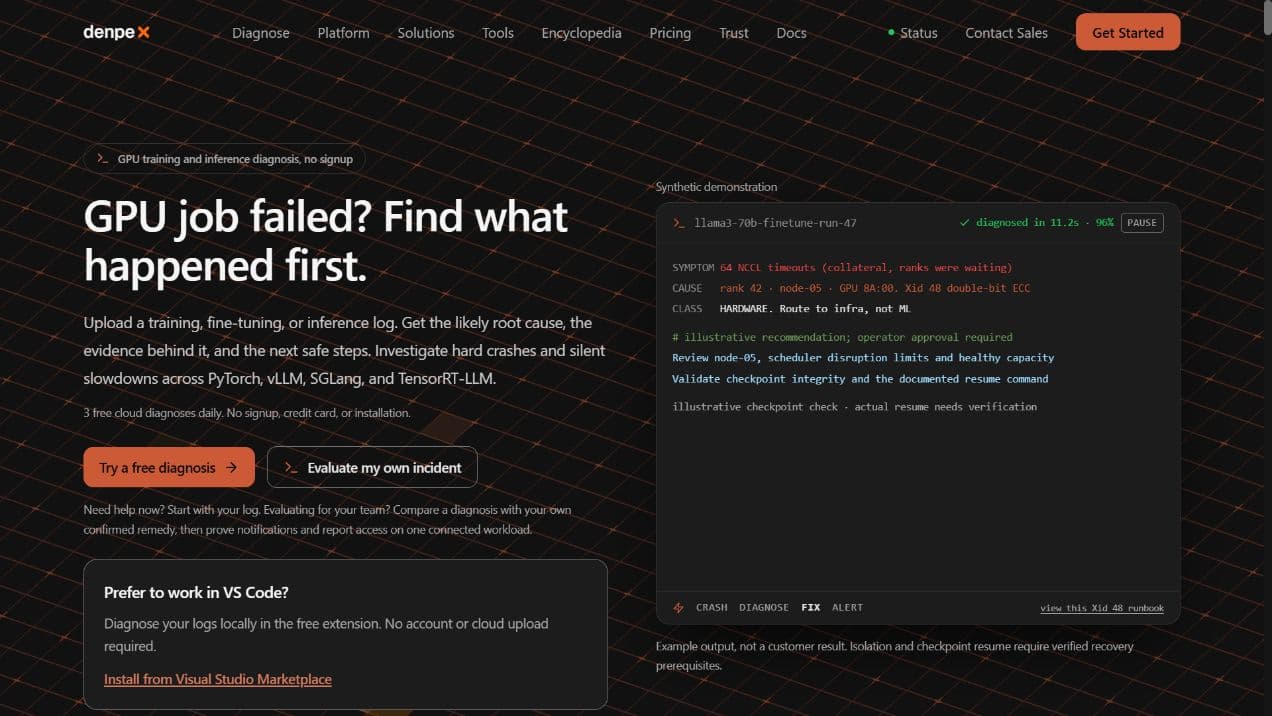
About this app
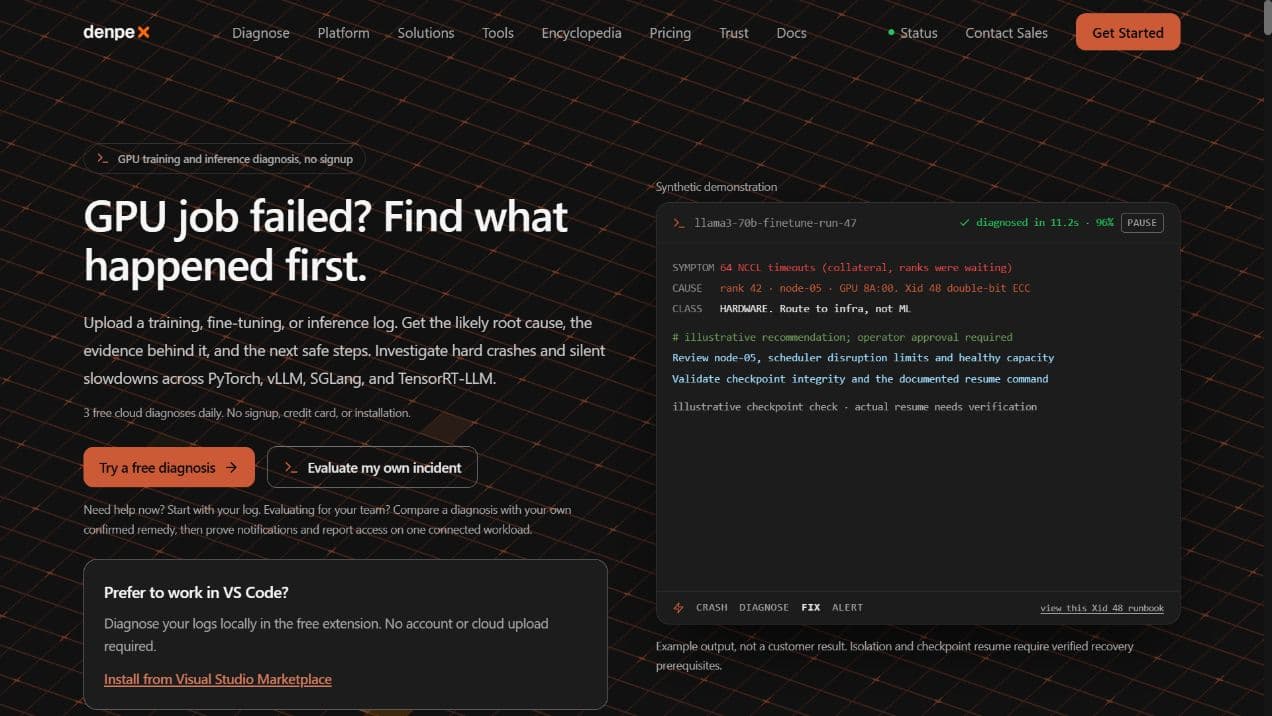
Denpex is a diagnostic platform that automatically identifies root causes of GPU training failures - CUDA OOM, NCCL timeouts, silent data corruption, and 16,400+ other signatures - with evidence-backed next actions. Built for distributed GPU training at scale, it separates initiating faults from cascades, attributes the failing rank, and routes ownership to the right team. It supports PyTorch, vLLM, SGLang, TensorRT-LLM, and more, offering a free tier with 3 daily cloud diagnoses, an in-VPC agent for privacy, and a VS Code extension for local log analysis. With pricing tied to GPU-hours and a focus on deterministic pattern-first analysis (AI-last), Denpex helps ML infrastructure teams cut downtime and engineering time wasted on manual log triage.
Key features
- 1Deterministic diagnosis engine with 10,800+ matcher rules and retrieval over 700+ Failure Encyclopedia entries, plus AI fallback for novel errors.
- 2Cross-rank cascade reconstruction with clock-drift correction that separates the initiating fault from collateral timeouts and names the failing rank.
- 3Free tier with 3 daily cloud diagnoses (no signup), a free offline VS Code extension, and GPU-hour-based paid plans from $415/mo.
Target customer profile
Drawn from the product itself, not from a survey.
Demographic
ML Infrastructure Engineers & SREs at AI startups
Pain points
Hours lost manually parsing logs; generic NCCL timeouts hide root cause; blame games between ML and infra teams
Primary needs
Fast root cause identification, evidence-backed next actions, and clear ownership routing
Demographic
AI Researchers & Data Scientists at enterprise AI teams
Pain points
Distributed training hangs and OOMs disrupt experiments; lack of visibility into rank-level failures
Primary needs
Automated diagnosis of CUDA OOM, NaN loss, and silent hangs with actionable fixes and checkpoint resume guidance
Demographic
GPU Cloud Providers & Platform Buyers (Director of AI Infra, CTO)
Pain points
High GPU downtime costs; need white-label diagnosis for customers; compliance and data privacy concerns
Primary needs
Scalable diagnosis up to 16,384 GPUs, in-VPC agent for data privacy, and integration with existing monitoring
Scout Review
Written by AI from measured evidence, scored out of 100.
Denpex is a focused diagnostic tool for a genuinely painful problem: distributed GPU training failures where the log line you see (NCCL timeout) is not the fault you have (rank 42, Xid 48 ECC error). The product's strongest asset is its evidence-first positioning — deterministic matcher rules and a Failure Encyclopedia rather than an AI guess — and the site communicates that with a hero terminal card that shows the actual output format. Measured performance is excellent (mobile Lighthouse 96, LCP 1.1s) and security headers are complete, though third-party compliance proof is absent. Design is polished but dense, with low-contrast secondary copy and a crowded hero. Usability is good on the free path and weaker on the Team trial form. Accessibility is strong on automated checks with a legibility caveat. Growth potential is real because the wedge is specific and the category is underserved by general observability tools, but the product is early and must earn a second line item in already-crowded infra budgets.
Measure by measure
Usability
68No-signup free diagnosis with sample-failure chips and a paste fallback lowers the barrier well, and docs promise first diagnosis under 5 minutes across 87 pages. The 30-day Team form buries value under legal and eligibility copy.
Design
71Dark, disciplined palette with one orange accent and a hero terminal card that shows real diagnostic output instead of describing it. Docked for small low-contrast body copy and a crowded hero with competing CTAs.
Speed
88Lighthouse mobile 96/100 with 1.1s LCP, zero CLS, and 165ms TBT; desktop 90/100. The marketing site is lean and snappy, and no lag complaints surfaced in the collected evidence.
Security
76Full header hygiene (HSTS, CSP, frame protection, Referrer-Policy, Permissions-Policy) plus SPF and DMARC, 12/12 on the probe. Claims HIPAA BAA and in-VPC anonymized-signature agent, but no SOC 2 or public audit found.
Accessibility
80Lighthouse accessibility 100/100 with only one failing audit (visible text labels lacking matching accessible names). Counterweight: the visual audit flagged small, low-contrast grey body copy, and no WCAG statement was found.
Growth
68Real, specific pain — NCCL timeouts hiding the true initiating rank — with a deterministic 10,800-rule engine and GPU-hour pricing that maps to the waste it removes. Category has headroom; wedge is credible.
Improvement areas
- No public SOC 2, ISO 27001, or pen-test report despite HIPAA BAA and log-ingestion claims.
- Small, low-contrast secondary body copy and a crowded hero with competing CTAs.
- Team trial form front-loads legal and domain-eligibility copy before the user sees value.
- No accessibility statement or WCAG conformance claim beyond the automated Lighthouse pass.
Design & Usability
Denpex's homepage does the hardest thing in dev-tool marketing well: it shows the output. The hero terminal card renders a fake-but-credible diagnosis — SYMPTOM, CAUSE, CLASS, a green Fix state — so you understand the product before reading a word of copy. The dark palette with a single orange accent stays disciplined, and the 'Your logs say NCCL timeout. The timeline says rank 17' section is a genuinely clever visual argument. Where it slips: secondary copy is small and low-contrast against near-black, lower sections pile on microcopy (ecosystem tags, persona lists, fine print), and the hero asks you to choose between two CTAs plus a VS Code card. Usability is stronger — no-signup, no-card free diagnosis with sample-failure chips and a paste fallback is a low-friction path to value, and the docs promise a first diagnosis in under five minutes across 87 pages. The 30-day Team evaluation form is the weak link, front-loading legal and domain-eligibility copy before the user has seen anything work.
Speed & Security
Speed is the standout measured result: Lighthouse mobile 96/100 with a 1.1s LCP, zero cumulative layout shift, and 165ms total blocking time; desktop lands at 90/100. The marketing site is lean, and nothing in the collected evidence suggests lag complaints. Security is solid on the transport and header layer — HTTPS enforced, HSTS, CSP, frame protection, X-Content-Type-Options, Referrer-Policy, Permissions-Policy, plus SPF and DMARC, a clean 12/12 on the probe. The product also claims a HIPAA BAA on Data Center, configurable PHI masking, audit logs, and an in-VPC agent that ships anonymized signatures only, which is the right architecture for privacy-sensitive ML teams. What's missing is third-party proof: no SOC 2, ISO 27001, pen-test summary, or bug bounty surfaced in the collected content. For a tool that ingests training logs, that gap is the difference between 'we take security seriously' and 'here's the report.'
Accessibility & Growth
Accessibility scores a perfect 100/100 on Lighthouse with a single failing audit about visible text labels lacking matching accessible names — a narrow, fixable issue. The honest caveat is that automated checks cover only part of WCAG: the visual audit independently flagged small, low-contrast grey body copy on near-black, and no accessibility statement or WCAG conformance claim appears in the collected content, so keyboard and screen-reader behavior beyond the audit is unverified. Growth is a judgment on the idea, not traction. The problem Denpex names is real and expensive: distributed GPU training failures where the visible NCCL timeout is collateral and the true initiator is a single rank's ECC error. The wedge is concrete — 10,800+ deterministic matcher rules, retrieval over 700+ Failure Encyclopedia entries, cross-rank cascade reconstruction with clock-drift correction, and rank-level attribution that routes ownership to infra versus ML. GPU-hour pricing (Team at $415/mo with 25k GPU-hours included) aligns cost with the compute waste it removes, which is a smarter story than per-seat. The category has headroom: Datadog and Prometheus+Grafana show metrics but not ML-specific root cause, and W&B tracks experiments rather than diagnosing failures. The limit is adoption friction — convincing a team already paying for observability to add a specialized second tool — and the domain is only ~0.4 years old, so the idea is unproven at scale.
Conclusion
If you run multi-node GPU training and have ever spent an afternoon reading NCCL timeouts that turned out to be one bad GPU, Denpex is aimed directly at you, and the free tier costs nothing but a log paste to test. The pitch is credible because the product shows its work: ranked candidates, an evidence trail, the originating rank, and a concrete next action rather than an essay. The risks are the usual early-stage ones — no public audit, a young domain, and the hard sell of adding a specialized tool beside Datadog or Grafana. Try it on an incident you already understand, as the site itself suggests, and judge the diagnosis against your team's confirmed cause. If it nails the rank and the class, the GPU-hour pricing math writes itself.
Suggestions for improvement
- Publish a SOC 2 Type II report or pen-test summary; the HIPAA BAA claim needs third-party backing to close enterprise deals.
- Simplify the 30-day Team evaluation form — move domain-eligibility and legal copy below the fold so value comes first.
- Raise contrast on secondary body copy and checklist sublines; the visual audit flagged grey-on-near-black legibility.
- Add an accessibility statement and verify keyboard/screen-reader behavior beyond the automated Lighthouse pass.
Alternatives comparison
Named competitors, point by point. Nobody paid to appear here or to be left out.
 Denpex |  Datadog |  Weights & Biases | Prometheus + Grafana | |
|---|---|---|---|---|
| ML-specific root cause diagnosis (rank attribution, cascade analysis) | Yes — 10,800+ matcher rules, cross-rank cascade, originating rank and failure class | No — GPU metrics via DCGM, no ML failure root cause analysis | Partial — experiment tracking with some failure monitoring, not deep diagnosis | No — metrics and alerting only, manual setup, no ML-specific diagnosis |
| Free tier / entry cost | Free forever: 3 daily diagnoses no signup, 10 for accounts, free offline VS Code extension | Free tier for limited hosts; GPU monitoring typically on paid plans | Free personal tier; team and enterprise paid | Open source, free; cost is setup and maintenance labor |
| Pricing model | GPU-hours based: Team $415/mo with 25k GPU-hrs included, $0.06/GPU-hr overage | Per-host and per-metric usage-based pricing | Per-seat / usage tiers | Free software; infrastructure and engineering cost |
| Data privacy / in-VPC deployment | In-VPC agent ships anonymized signatures only; HIPAA BAA on Data Center; PHI masking | SaaS with on-prem options on enterprise plans; SOC 2 certified | SaaS and self-managed options; SOC 2 certified | Self-hosted by default; data stays in your infrastructure |
| Alerting and integrations | Slack, PagerDuty, SMS, webhooks; W&B, MLflow, TensorBoard, SLURM, Kubernetes | Extensive alerting and 700+ integrations | Alerts on runs and metrics; integrations with major ML frameworks | Alertmanager plus broad exporter ecosystem |
Datadog
General-purpose monitoring and observability platform with GPU metrics via DCGM, but lacks specialized ML failure diagnosis and root cause analysis.
Weights & Biases
Experiment tracking and model management platform with some failure monitoring, but not focused on deep diagnosis of distributed training errors.
Prometheus + Grafana
Open-source monitoring stack often used for GPU clusters, but requires manual setup and lacks automated ML-specific failure diagnosis.
Comparing options? See Denpex alternatives, scored side by side
More Development & Engineering apps
View all Development & Engineering
Vibe Coding Agent Skills
92A free, open-source platform offering 110 AI agent skills...

CreateMyCoin
92A no-code Solana token creator that deploys SPL tokens in...

CC Switch
91Open-source desktop app for switching AI coding providers...

TaxID
90Fast EU VAT validation API for developers, covering 27 EU...

DemoVexa
90Turn your code into professional product demo videos with AI-generated scripts, animated UI, and natural voiceovers.

FontPlop
89Browser-based font viewer & tester for TTF, OTF, WOFF, WO...

Webfetch
89Web scraping API that turns any URL into HTML, text, Mark...

deed.page
89Permanent web hosting for AI agents, no human step

BeartIMAGE
88BeartIMAGE is a free, web-based image processing platform engineered for fast, bulk photo editing and conversion directly in your browser.

Claw Messenger
88Claw Messenger is an iMessage API service that gives AI a...

DataHabibi
88AI-powered Dubai real estate data platform with 12M+ DLD ...

Cachely
88Managed remote cache for monorepos to slash CI time.


A platform dedicated to providing unbiased reviews of newly launched applications, analyzing everything from their features to their full potential.
info@scoutforge.net© 2026 Scoutforge. All rights reserved.
