Cycling through all six. Tap any point to stop.
Measured on six things
Turn your code into professional product demo videos with AI-generated scripts, animated UI, and natural voiceovers.
Growth
68Sharp wedge: demos rebuilt from code instead of re-recorded, with a real reason to pick it over Loom or Synthesia. Named segments and tiered pricing show focus. Very early (domain 2026, v0.4.2).
Screenshots
1 / 1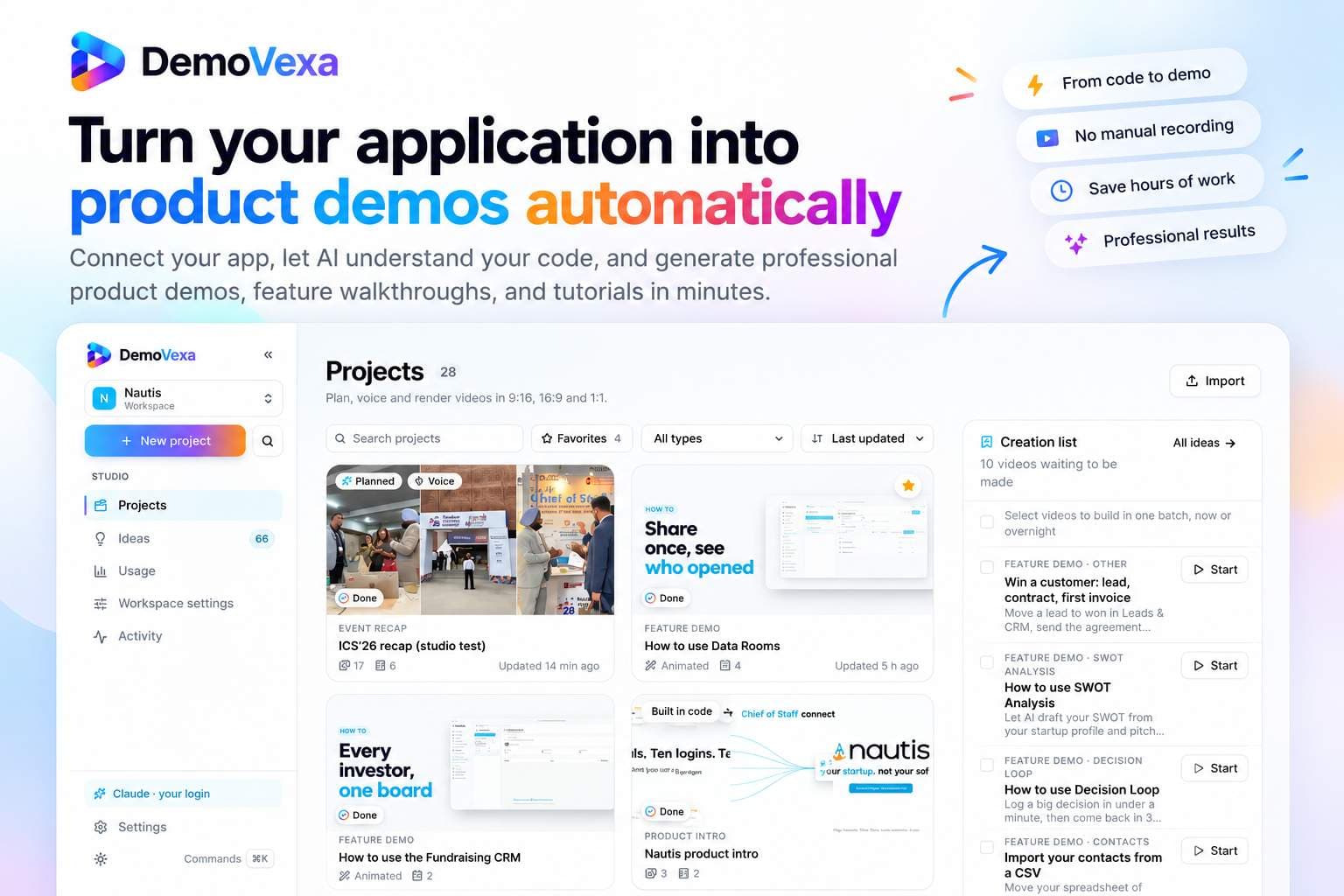
About this app
DemoVexa is an AI-powered desktop application that transforms your software codebase into professional product demo videos. Built for SaaS founders, developers, product marketers, and agencies, DemoVexa analyzes your code and documentation, generates demo scripts, creates animated UI walkthroughs, and adds natural AI voiceovers. Unlike traditional screen recording tools, DemoVexa generates code-driven animations, helping teams create polished, consistent product demonstrations without manually recording every interaction. When your product UI changes, you can update your demos through code instead of starting the entire recording process again. With support for multiple video formats, including 16:9, 9:16, and 1:1, DemoVexa helps you create product launch videos, feature announcements, onboarding tutorials, social media content, and marketing demos. Its desktop-first workflow keeps your source code on your computer while you create videos using your configured AI tools.
Key features
- 1Code-aware demo generation: reads your repo, docs and navigation to build animated UI walkthroughs with AI voiceover in 85 languages.
- 2Rebuild-on-change workflow: when the UI ships, regenerate the demo from current code instead of re-recording.
- 3Multi-format export (16:9, 9:16, 1:1) with covers and ready-to-post copy for LinkedIn, X, YouTube, Instagram and blogs.
Target customer profile
Drawn from the product itself, not from a survey.
Demographic
SaaS founders and indie hackers
Pain points
Demos go stale with every release; no time or budget for editing
Primary needs
Fast, on-brand demo videos rebuilt from code
Demographic
Product marketing and DevRel teams
Pain points
Release cadence outpaces video production; voiceover and editing bottlenecks
Primary needs
Batch, multilingual videos with covers and post copy
Demographic
Agencies serving multiple clients
Pain points
Re-recording per client; juggling many workspaces and languages
Primary needs
Unlimited workspaces, exportable projects, multi-client output
Demographic
Customer education and support teams
Pain points
Help articles lack visual guides; screen recordings leak data
Primary needs
Clean, accurate how-to and onboarding videos
Scout Review
Written by AI from measured evidence, scored out of 100.
DemoVexa is an ambitious, well-executed early-access product with a genuinely differentiated idea: turn your codebase into narrated product demo videos, and rebuild them when the UI changes instead of re-recording. The execution on the marketing site is strong (Lighthouse 96 mobile, 100 accessibility, 12/12 security headers), the docs are unusually deep for a v0.4.2 product, and the five-step workflow with approval gates is a sensible design. The weaknesses are structural rather than sloppy: setup requires wiring up multiple AI accounts before value appears, the landing page repeats its card pattern, and there's no compliance paperwork yet. The pricing model — pay for the app, bring your own AI — is honest but makes total cost hard to predict, which will slow adoption with the indie founders it targets first. A promising product that needs to prove the wedge in the wild.
Measure by measure
Usability
74Deep, searchable docs covering install through troubleshooting, a 14-day no-card trial, and a five-step guided workflow with approval gates. Onboarding path is clear; the AI-provider setup adds friction.
Design
71Polished, modern landing page with a realistic app mockup in the hero, consistent iconography and clean typography. Long repetitive sections and a crowded dashboard screenshot keep it from the top of the band.
Speed
88Lighthouse mobile 96/100 and desktop 97/100, with LCP 2.8s, CLS 0.002 and TBT 51ms. The marketing site is genuinely snappy; no user complaints about lag found.
Security
76Full security header suite (HSTS, CSP, frame protection, Referrer-Policy, Permissions-Policy), SPF and DMARC configured — 12/12 on the probe. Local-first code handling and BYO AI keys reduce data exposure. No published audits yet.
Accessibility
79Lighthouse accessibility 100/100 on automated checks, plus 85 output languages for video content. No public WCAG statement or accessibility page, and docs are English-only.
Growth
68Sharp wedge: demos rebuilt from code instead of re-recorded, with a real reason to pick it over Loom or Synthesia. Named segments and tiered pricing show focus. Very early (domain 2026, v0.4.2).
Improvement areas
- Setup friction: requires a Claude/OpenAI/Copilot account and optionally ElevenLabs before the first video exists.
- Variable total cost: DemoVexa subscription plus BYO AI and voice bills make per-video spend hard to predict.
- No published compliance artifacts (SOC 2, ISO, pen-test) or accessibility statement yet.
Design & Usability
DemoVexa's site is a cut above the typical indie SaaS landing page — the hero embeds an actual macOS window mockup of the app with sidebar, timeline and a live invoice chart, not a stock illustration. Typography is disciplined, icons are consistent, and the gradient headline lands. The weakness is repetition: 'How it works' and 'What you can make' both lean on the same icon-title-checklist card pattern, and the dashboard screenshot is dense enough to squint at. Usability is where the product earns its keep — the docs are genuinely deep (Getting Started, Workspaces, Making Videos, Do More, Account, App Settings, Help) with ⌘K search, and the five-step workflow (Connect, Brief, Script, Voice, Animate, Export) has approval gates so you're not handing the whole thing to an agent. The 14-day no-card trial is fair. The friction is setup: you need a Claude Pro/Max plan or Anthropic API key, plus optionally ElevenLabs, before your first video exists.
Speed & Security
Speed is a genuine strength. Lighthouse mobile scored 96/100 with LCP 2.8s, CLS 0.002 and TBT 51ms; desktop hit 97/100. The marketing site is lightweight and snappy, and no user complaints about lag surfaced in the collected evidence. Security is solid for the stage: the HTTP probe found HTTPS enforced with HSTS, CSP, frame protection, X-Content-Type-Options, Referrer-Policy and Permissions-Policy all present, plus SPF and DMARC — 12/12 checklist points. Architecturally, the desktop-first model keeps your source code on your machine, and AI runs on your own Claude/OpenAI/Copilot accounts rather than being proxied through DemoVexa, which meaningfully reduces data exposure. What's missing is the enterprise paperwork: no SOC 2, ISO 27001, pen-test summary or bug bounty page in the site content. For a v0.4.2 early-access product that's normal, but it caps the score below the top of the band.
Accessibility & Growth
Accessibility scored a perfect 100/100 on Lighthouse's automated axe-core checks, which is a strong baseline — but automated checks only cover part of WCAG. There's no public accessibility statement, no WCAG conformance claim, and the docs are English-only in the fetched content (though the product outputs video in 85 languages, which is a real accessibility win for non-English audiences). Growth is the most interesting dimension. The problem DemoVexa names is real and specific: product demos go stale with every release, and Loom-style recording means re-recording from scratch. The wedge — read the codebase, generate a script, animate the real UI, re-render when the UI changes — is a genuine structural advantage over Loom (manual), Synthesia (avatar video, not your real UI), Navattic (clickable tours, not rendered video) and Remotion (you write the animation code yourself). The segments are named and priced separately (Solo $29, Team $79, Agency $199), which shows focus. The honest limit: the BYO-AI-account model means the buyer pays DemoVexa *plus* Claude *plus* ElevenLabs, and the total cost per video is variable and hard to predict — a real adoption barrier for the indie-hacker segment it targets first.
Conclusion
If you're a SaaS founder or DevRel lead shipping frequently and dreading the re-record cycle, DemoVexa is worth the 14-day trial — the code-driven rebuild is the real feature, not the AI voiceover. Go in expecting an afternoon of setup (Claude account, optionally ElevenLabs) and a variable per-video bill. If you need enterprise compliance today, wait. If you're an agency juggling client demos, the $199 Agency tier with unlimited workspaces and batch builds is the most compelling offer on the page. The idea is right; the next twelve months will decide whether the execution keeps up.
Suggestions for improvement
- Publish a clear cost-per-video calculator or example so buyers can estimate total spend (DemoVexa + Claude + ElevenLabs) before committing.
- Add a one-click demo mode that works without connecting an AI account, so the trial delivers value in the first five minutes.
- Break up the repetitive 'How it works' and 'What you can make' sections with a real video example or interactive before/after.
- Publish a security/trust page with data-handling details and a roadmap toward SOC 2 for enterprise buyers.
Alternatives comparison
Named competitors, point by point. Nobody paid to appear here or to be left out.
 DemoVexa |  Remotion |  Synthesia |  Loom |  Navattic | |
|---|---|---|---|---|---|
| Generates demo video from your actual codebase | Yes — reads repo, docs and navigation | No — you write the animation code | No — AI avatar video, not your UI | No — manual screen recording | No — clickable web tours |
| Rebuilds demo automatically when product UI changes | Yes — regenerate from current code | Partial — code-driven but manual | No — avatar video, not UI | No — re-record required | Partial — tours update, video doesn't |
| AI voiceover in multiple languages | 85 languages via ElevenLabs/Sarvam/Deepgram | No built-in voiceover | Yes — 140+ languages | No — your own voice | No — text-based tours |
| Output format | Rendered MP4 (16:9, 9:16, 1:1) | Rendered MP4 via React | Rendered MP4 with avatar | Screen recording video | Interactive web tour |
| Pricing model | $29–$199/mo + BYO AI/voice accounts | Free open source + paid company license | Subscription, credits-based | Free tier + paid plans | Free tier + paid plans |
Remotion
A React-based framework for programmatic video creation, but you write the animation code yourself with no code-reading AI layer.
Synthesia
AI avatar video generation for training and marketing, but it doesn't rebuild your real product UI from code.
Loom
Quick screen recording and sharing tool, which requires manual re-recording after each product change.
Navattic
Interactive product demo builder for web tours, focused on clickable walkthroughs rather than rendered narrated videos.
Comparing options? See DemoVexa alternatives, scored side by side
More AI Generations apps
View all AI Generations
Uni-1 by Luma AI
92Uni-1 is an advanced multimodal text-to-image AI model th...

LTX 2.3 AI Video Generator
91Fast, open-source AI video generator with 4K support, mul...

IraVoice
88Private on-device dictation for Apple-silicon Macs.

OBVELO
88Privacy gateway that masks personal data in LLM traffic

tradutor de mangá com IA
88O tradutor de mangá com IA traduz capítulos em lote, personaliza textos e oferece edição visual para estúdios.

Pixelimg
88A free online AI-powered tool that instantly converts ima...

HeyVid AI
88HeyVid AI is a free all-in-one AI video and image generat...

RestorePhotosApp
88An AI-powered photo restoration app that brings old, blur...

Mygom SEO
87MygomSEO is an AI marketing agent that audits your site, writes SEO content, publishes to 12+ CMS platforms, posts to social, and monitors rankings 24/7.

pause.do
87A privacy-first browser extension that inserts gentle pau...

DeepSwapAI
87AI face swap online with no subscription, pay per use.

ContentIQ
87AI writer that fact-checks before writing, with real sour...


A platform dedicated to providing unbiased reviews of newly launched applications, analyzing everything from their features to their full potential.
info@scoutforge.net© 2026 Scoutforge. All rights reserved.
