

A platform dedicated to providing unbiased reviews of newly launched applications, analyzing everything from their features to their full potential.
info@scoutforge.net© 2026 Scoutforge. All rights reserved.
A platform dedicated to providing unbiased reviews of newly launched applications, analyzing everything from their features to their full potential.
info@scoutforge.net© 2026 Scoutforge. All rights reserved.
A platform dedicated to providing unbiased reviews of newly launched applications, analyzing everything from their features to their full potential.
info@scoutforge.net© 2026 Scoutforge. All rights reserved.
Cycling through all six. Tap any point to stop.
Measured on six things
Open-source observability platform built on OpenTelemetry.
No HTTPS enforcement, no HSTS, no CSP, no frame protection — only SPF and DMARC pass. Open-source and self-hosting are pluses, but basic security headers are missing.
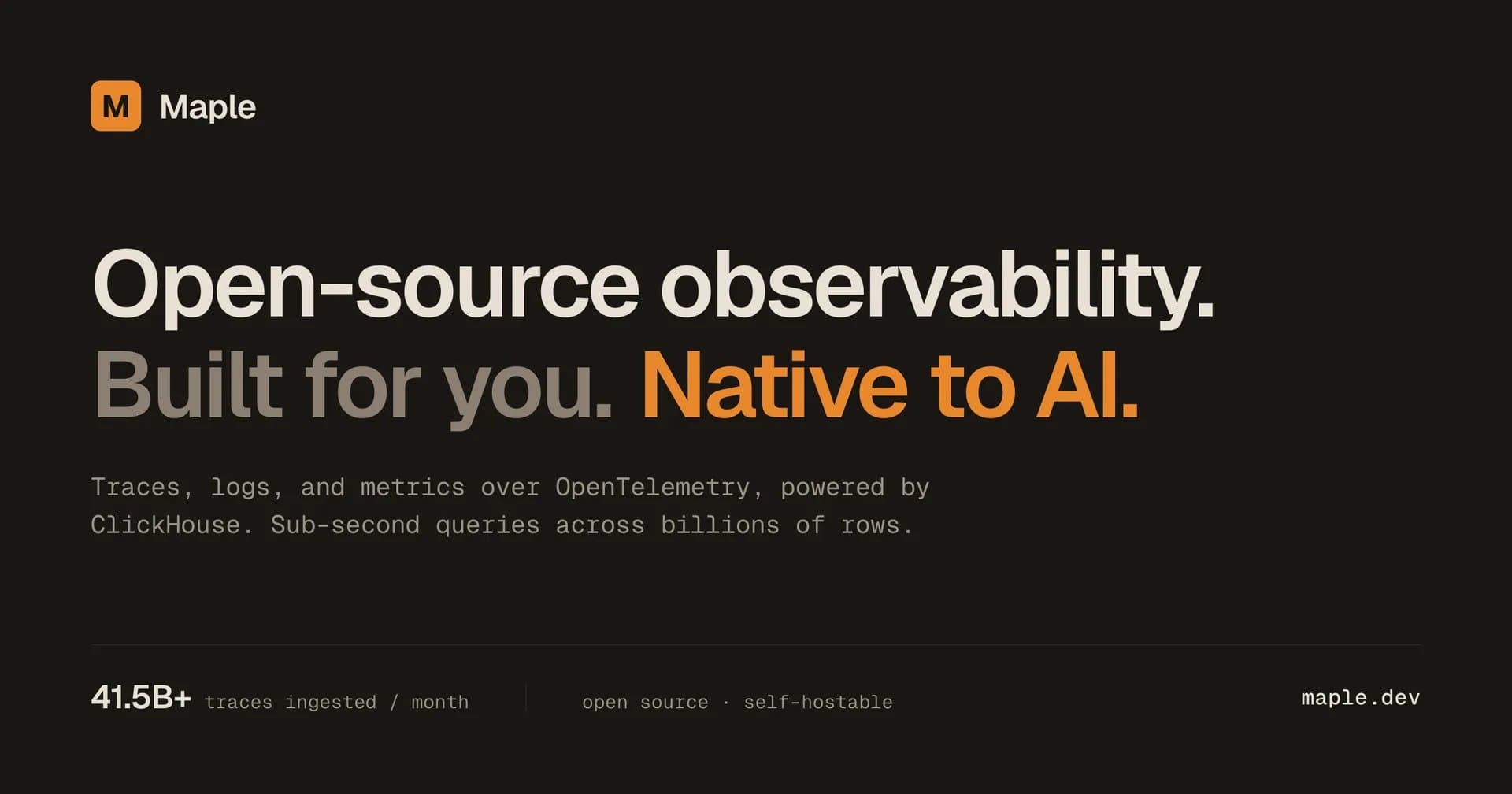
Maple is an open-source observability platform built natively on OpenTelemetry. It unifies distributed tracing, log management, metrics dashboards, error tracking, browser session replay, and alerting in a single interface. Logs correlate to traces automatically, a live service map surfaces bottlenecks, and an AI/MCP integration lets you query your telemetry in natural language. Flat per-GB pricing, no proprietary agents, and you can read the source.
Drawn from the product itself, not from a survey.
Demographic
Developers and SREs at startups (10-100 employees)
Pain points
High costs of traditional observability tools, complex setup, lack of granular data, difficulty correlating logs/traces/metrics.
Primary needs
Affordable, easy-to-deploy observability with deep context to debug quickly and efficiently.
Demographic
Platform engineering teams in mid-sized companies (100-1000 employees)
Pain points
Vendor lock-in, proprietary agents, data privacy concerns, limited AI integration.
Primary needs
An open, OpenTelemetry-native solution that allows self-hosting, integrates with Kubernetes, and lets AI agents assist in incident response.
Demographic
Tech leads and CTOs evaluating cost-effective observability solutions
Pain points
Complex pricing models, hidden costs, spending more on observability than necessary.
Primary needs
Transparent pricing, predictable billing, and a tool that offers both cloud and self-hosted options.
Written by AI from measured evidence, scored out of 100.
Maple is a promising open-source observability platform that leverages OpenTelemetry and ClickHouse for fast queries, with a strong focus on AI integration and transparent pricing. The design is polished, and usability is solid with good documentation. However, mobile performance and security headers need improvement. Accessibility is decent but has room for refinement. With a clear differentiator in AI/MCP and a competitive pricing model, Maple has good growth potential, but it must address these gaps to compete effectively with established players.
Clear CTAs, intuitive sidebar navigation, and a solid docs site with search and language guides. Onboarding via free trial and local binary lowers friction.
Polished dark theme with orange accents, real product screenshots, but empty black rectangles in feature sections and zero-value dashboard previews undercut the visual impact.
Desktop performance is excellent (97/100), but mobile LCP of 5.5s is sluggish. ClickHouse backend promises sub-second queries, but site load on mobile needs work.
No HTTPS enforcement, no HSTS, no CSP, no frame protection — only SPF and DMARC pass. Open-source and self-hosting are pluses, but basic security headers are missing.
Lighthouse score 88/100, but fails on contrast, heading order, missing main landmark, and accessible names. No a11y statement, but site is keyboard-navigable and responsive.
OpenTelemetry-native with AI/MCP integration, flat pricing, and self-hosting options. Targets cost-conscious startups and SREs, with a clear wedge against expensive incumbents.
Maple presents a cohesive dark-themed design with a strong orange accent, and the dashboard preview shows real product UI with metric cards and graphs, which builds credibility. However, the use of empty black rectangles as placeholders in feature sections detracts from the overall polish. Usability is a highlight: the primary CTA is prominently placed, the sidebar navigation is intuitive, and the docs are comprehensive with search and per-language guides. The free trial and local binary lower the barrier to entry, making it easy for developers to get started quickly.
Performance is a mixed bag: desktop scores a near-perfect 97/100, but mobile lags with an LCP of 5.5 seconds, which could frustrate on-the-go users. The ClickHouse backend promises sub-second queries, which is a strong selling point for large datasets. Security, however, is a concern: the site lacks HTTPS enforcement, HSTS, CSP, and frame protection, leaving it vulnerable to common attacks. While the open-source nature and self-hosting option are positive, the missing security headers are a significant gap for a platform handling sensitive telemetry data.
Accessibility is decent with an 88/100 Lighthouse score, but fails on contrast, heading order, and missing main landmark, which could hinder screen reader users. No accessibility statement is provided, but the site is keyboard-navigable and responsive. Growth potential is promising: Maple's OpenTelemetry-native approach and AI/MCP integration differentiate it from competitors like Datadog and Grafana Cloud. The flat pricing and self-hosting options appeal to cost-conscious startups and SREs. However, the market is crowded, and Maple must prove its AI features are more than a gimmick to sustain growth.
Conclusion
Overall, Maple is a solid choice for startups and SREs looking for an affordable, open-source observability solution. Its OpenTelemetry-native approach and AI integration are forward-thinking, and the pricing is refreshingly transparent. However, the security headers and mobile performance need attention. If you can overlook these issues, Maple offers a compelling alternative to the expensive incumbents. Give it a try with the free trial and see if it fits your stack.
Named competitors, point by point. Nobody paid to appear here or to be left out.
 Maple Maple |  Datadog Datadog |  Grafana Cloud Grafana Cloud |  New Relic New Relic |  Dash0 Dash0 | |
|---|---|---|---|---|---|
| Pricing model | $39/mo for 100 GB per signal, then $0.30/GB, no per-host or per-seat fees | Per-host and per-feature pricing, often expensive | Usage-based with complex tiering, free tier available | Usage-based with per-user and per-GB costs | Usage-based, simpler but less transparent |
| OpenTelemetry support | Native OTLP ingest, no proprietary agents | Supports OTel but requires proprietary agents for full features | OTel-native with Grafana Agent | Supports OTel but with proprietary APM agents | OTel-native, simplified setup |
| AI integration | MCP server for natural language queries and AI-assisted debugging | AI features like Watchdog, but not MCP-based | Limited AI features, no MCP | AI features like New Relic AI, but not MCP | No AI-native features |
| Self-hosting | Open-source, self-hostable with ClickHouse | No self-hosting, SaaS only | Self-hosting available with Grafana OSS | No self-hosting, SaaS only | No self-hosting, SaaS only |
Datadog
A popular comprehensive observability platform with extensive integrations, but notoriously expensive and proprietary.
Grafana Cloud
A managed observability stack based on Grafana, offering metrics, logs, and traces, but with limited AI-native features and a more complex pricing model.
New Relic
An established observability platform with strong APM capabilities, but often criticized for high costs and a complex user interface.
Dash0
A newer OpenTelemetry-based observability platform that offers a simplified experience, but lacks the AI-powered diagnostics that Maple provides.
Comparing options? See Maple alternatives, scored side by side

A free, open-source platform offering 110 AI agent skills...

A no-code Solana token creator that deploys SPL tokens in...

Open-source desktop app for switching AI coding providers...

Fast EU VAT validation API for developers, covering 27 EU...

macOS app for App Store screenshots: 3D mockups, auto-tra...

PERM Processing Time is an independent data analysis platform that helps users navigate the U.S. Department of Labor’s permanent labor certification process.

AI-powered Dubai real estate data platform with 12M+ DLD ...

BeartIMAGE is a free, web-based image processing platform engineered for fast, bulk photo editing and conversion directly in your browser.

Claw Messenger is an iMessage API service that gives AI a...

Real-time monetization infrastructure for AI products tha...

A native macOS process explorer and advanced monitor that...

A developer-first financial data API providing structured...
A platform dedicated to providing unbiased reviews of newly launched applications, analyzing everything from their features to their full potential.
info@scoutforge.net© 2026 Scoutforge. All rights reserved.