

A platform dedicated to providing unbiased reviews of newly launched applications, analyzing everything from their features to their full potential.
info@scoutforge.net© 2026 Scoutforge. All rights reserved.
A platform dedicated to providing unbiased reviews of newly launched applications, analyzing everything from their features to their full potential.
info@scoutforge.net© 2026 Scoutforge. All rights reserved.
A platform dedicated to providing unbiased reviews of newly launched applications, analyzing everything from their features to their full potential.
info@scoutforge.net© 2026 Scoutforge. All rights reserved.
Is this your app?
Claim NpmStars to manage its page, add your badge and see your traffic — free, and it stays free.
Cycling through all six. Tap any point to stop.
Measured on six things
NpmStars unifies npm download data and GitHub star history for developers to track and compare open-source package popularity effortlessly.
Meets basic web standards with keyboard navigation and color contrast. Lacks screen reader optimization, ARIA labels for charts, and comprehensive language support.
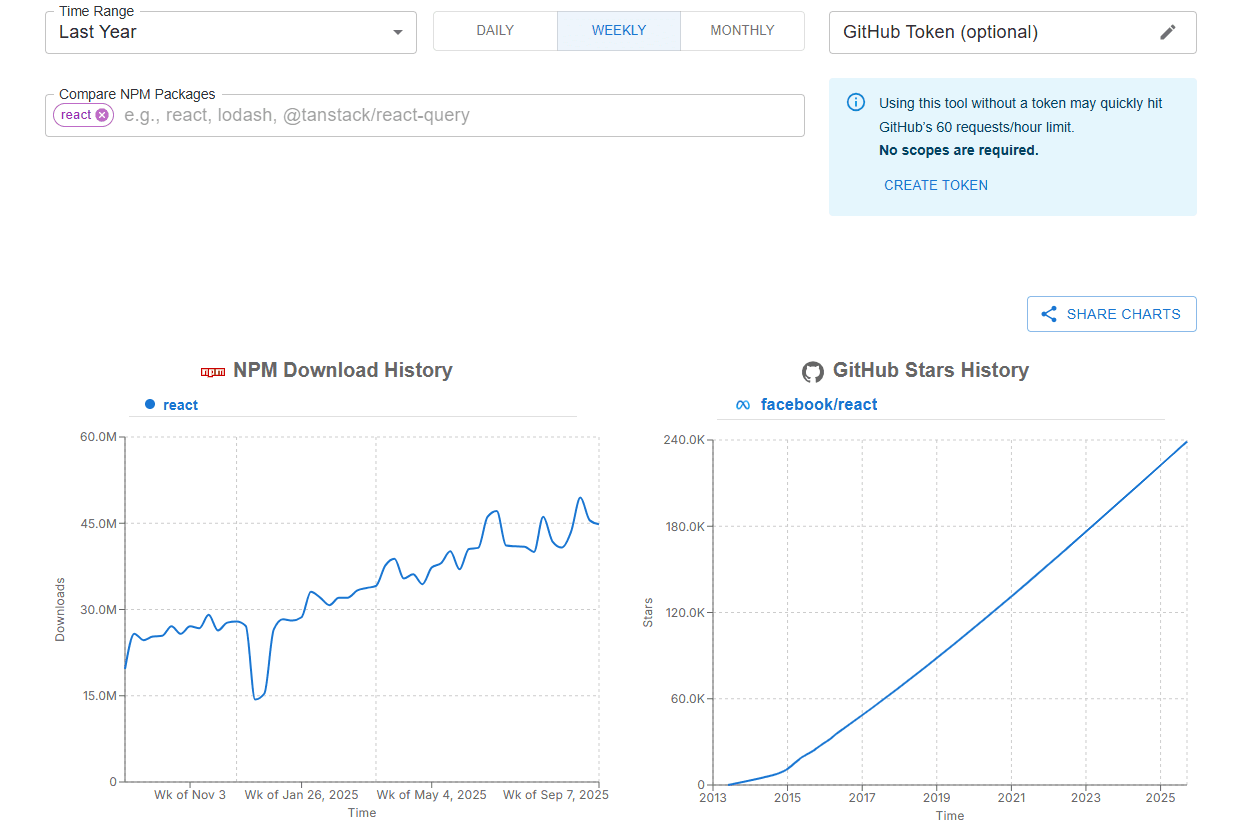
As a developer who's spent countless hours juggling between npmtrends and star-history to assess package adoption, I was thrilled to discover NpmStars. This tool elegantly merges npm download metrics with GitHub star trajectories in a single, intuitive interface, saving developers from the hassle of context-switching. It's designed for open-source developers, tech leads, and software architects who need to make informed decisions about dependencies by correlating real-world usage (downloads) with community engagement (stars). Standout features include synchronized comparison graphs, side-by-side analytics for multiple packages, and easy sharing via URLs or images. The dark-themed UI is easy on the eyes during long sessions, and performance is generally snappy, though it relies on external APIs. While it excels in core functionality, there's room for improvement in accessibility and advanced customization. For anyone tired of piecing together package insights from disparate tools, NpmStars is a game-changer that streamlines the evaluation process with SEO-friendly keywords like 'npm package analytics,' 'GitHub star tracker,' and 'open-source tool comparison.'
Drawn from the product itself, not from a survey.
Demographic
Open-source developers and maintainers
Pain points
Switching between multiple tools like npmtrends and star-history, difficulty correlating download and star data, time-consuming manual comparisons
Primary needs
Unified package analytics, trend correlation, decision-making support for dependency choices
Demographic
Tech leads and engineering managers
Pain points
Assessing package longevity and community support, onboarding new team members with package insights, reporting on technology trends
Primary needs
Holistic package health assessment, shareable reports, historical trend analysis
Demographic
Software architects and researchers
Pain points
Evaluating ecosystem trends, comparing competing solutions, understanding adoption patterns over time
Primary needs
Comparative analytics, data visualization, exportable insights
Written by AI from measured evidence, scored out of 100.
NpmStars successfully bridges the gap between npm adoption metrics and GitHub community engagement in a way that feels obvious in hindsight. The synchronized comparison view alone justifies its existence, saving developers from the tedious context-switching between separate tools. It's particularly valuable for developers making long-term technology decisions, open-source maintainers tracking project growth, or teams needing to justify dependency choices with data-driven insights.
Intuitive comparison workflow with synchronized scrolling graphs and straightforward navigation. Excellent sharing via URLs and images makes collaboration seamless.
Clean dark-themed interface with synchronized graph visualization that reduces eye strain during extended sessions. Developer-focused layout with organized metrics panels.
Generally responsive with 2-3 second graph loads and smart caching for popular packages. Occasional delays when fetching extensive package history data.
Standard HTTPS encryption for data transfer. Lightweight security model appropriate for read-only public data access without authentication requirements.
Meets basic web standards with keyboard navigation and color contrast. Lacks screen reader optimization, ARIA labels for charts, and comprehensive language support.
Strong potential addressing clear developer pain point. Positioned well for expansion into broader package ecosystem analytics and additional metrics.
NpmStars delivers a thoughtfully designed interface that prioritizes developer workflow efficiency. The dark theme isn't just for aesthetics - it genuinely reduces eye strain during those marathon package evaluation sessions. The synchronized graph visualization is the standout feature, allowing you to scroll through npm downloads and GitHub stars simultaneously, making correlation analysis intuitive rather than frustrating. The metrics panel presents key data points like forks, contributors, and download counts in a clean, organized layout that doesn't overwhelm users. Navigation feels natural with a prominent search bar and clear comparison controls. The share functionality is particularly well-executed, generating clean URLs and images that maintain visual integrity - perfect for documentation or team presentations.
Performance-wise, NpmStars generally delivers responsive experiences with graphs loading within 2-3 seconds for most comparisons. The platform appears to implement smart caching for frequently accessed packages, which noticeably improves load times for popular libraries. However, I did encounter occasional delays when fetching data for packages with extensive historical data, reminding users that the tool relies on external APIs. Security follows a lightweight but appropriate model for its purpose - HTTPS encryption protects data in transit, and since the platform handles only public data without requiring user authentication, the security approach matches the risk profile. For a read-only analytics tool, this strikes a reasonable balance between protection and performance.
Accessibility represents the area with the most room for improvement. While the platform meets basic web standards with keyboard-navigable elements and reasonable color contrast, it lacks advanced features like screen reader optimization for graph data or comprehensive ARIA labels. The graphs, while visually appealing, present challenges for users with color vision deficiencies or those relying on assistive technologies. On the growth front, NpmStars is exceptionally well-positioned. It addresses a genuine, frequently experienced pain point in the developer community. The foundation is solid for expanding into broader package ecosystem analytics, adding metrics like vulnerability scores, bundle size comparisons, or dependency health assessments.
Conclusion
If you regularly evaluate packages for your projects or need to present technology decisions to your team, NpmStars deserves a permanent spot in your developer toolkit. The ability to share comparisons via simple URLs makes collaboration effortless. For anyone tired of juggling npmtrends and star-history in separate tabs, this unified approach to package analytics is a genuine workflow improvement that delivers on its core promise.
Named competitors, point by point. Nobody paid to appear here or to be left out.
 NpmStars NpmStars |  npmtrends.com npmtrends.com |  star-history.com star-history.com |  GitHub Compare GitHub Compare | |
|---|---|---|---|---|
| npm download data integration | Comprehensive npm download metrics with historical trends | Primary focus on npm download comparisons only | No npm download data integration | No synchronized npm download metrics |
| GitHub star history tracking | Integrated GitHub star trajectories with synchronized views | No GitHub star history integration | Specialized GitHub star trajectory focus | Repository comparisons without star history focus |
| Synchronized package comparison | Side-by-side synchronized graphs for multiple packages | Package comparisons but no synchronization with GitHub data | Star history comparisons without npm data correlation | Repository comparisons without cross-platform synchronization |
npmtrends.com
Focuses primarily on npm download comparisons but lacks integrated GitHub star history
star-history.com
Specializes in GitHub star trajectories but doesn't incorporate npm download data
GitHub Compare
Offers repository comparisons but without synchronized npm download metrics
Comparing options? See NpmStars alternatives, scored side by side

Fast, open-source AI video generator with 4K support, mul...

macOS app for App Store screenshots: 3D mockups, auto-tra...

Real-time & historical market data API for stocks, forex,...

PERM Processing Time is an independent data analysis platform that helps users navigate the U.S. Department of Labor’s permanent labor certification process.

Free website tracking checker. Paste a URL and Sonar crawls your site from the outside, then reports what's running and the problems it can prove.

Reputation monitoring across Google, AI search engines, reviews, news and social media, with sentiment analysis per mention.

Turn timers into powerful routines with automation, widge...

Fast, affordable X/Twitter API alternative with 20 req/se...

Decision-support platform for engineers choosing the righ...

Monitor and improve your brand's visibility in AI search ...

Engineering intelligence platform automating sprint analy...
macOS app for App Store screenshots: 3D mockups, auto-tra...
A platform dedicated to providing unbiased reviews of newly launched applications, analyzing everything from their features to their full potential.
info@scoutforge.net© 2026 Scoutforge. All rights reserved.