Cycling through all six. Tap any point to stop.
Measured on six things
Professional networking without manual search. Powered by AI
Growth
58A real problem — discovery depends on who you already know — with a concrete wedge: chat-derived context instead of search or swiping. Specific segment, but the moat is thin and LinkedIn is a wall.
Screenshots
1 / 3
About this app
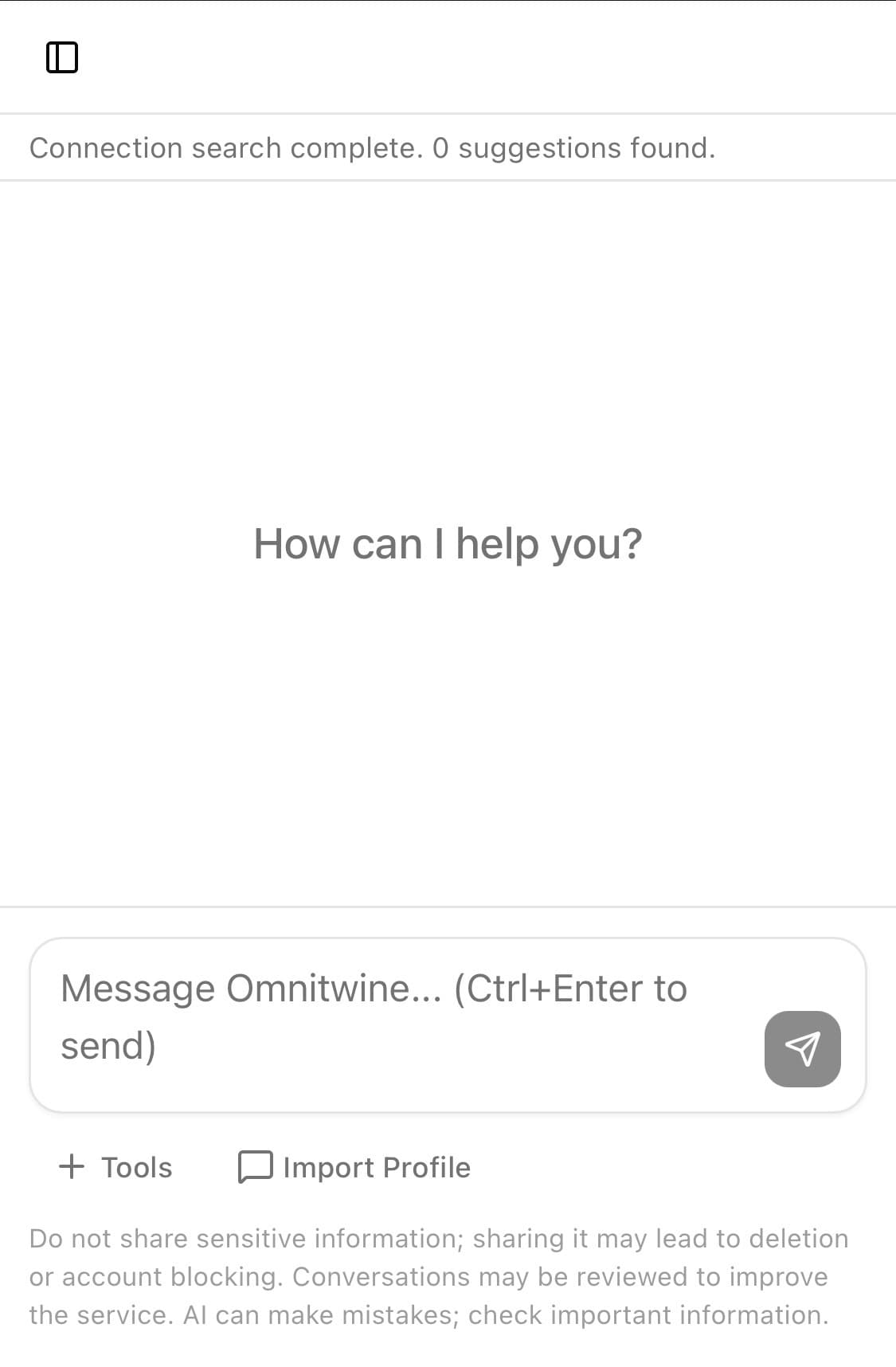
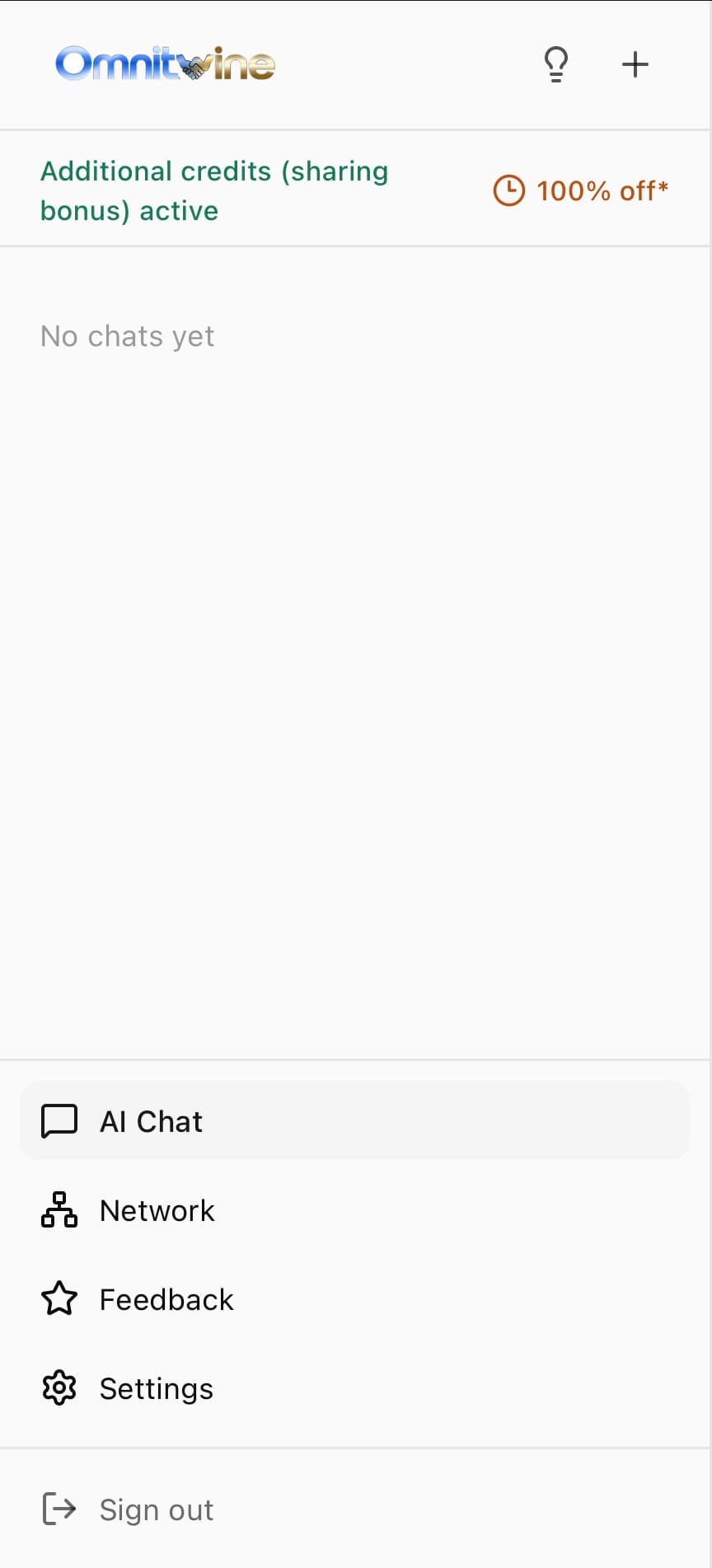
Omnitwine is an AI-powered professional networking platform that helps people discover meaningful professional connections. By analyzing information users choose to share, including AI conversations, professional profiles, interests, experience and ambitions, Omnitwine develops a deeper understanding of each individual and identifies people they may benefit from knowing. It can help founders find cofounders, businesses discover talent, professionals find collaborators and researchers connect with relevant experts. Rather than relying on manual searches, feeds or unsolicited messages, Omnitwine automates discovery and leaves the decision to connect entirely to the people involved. AI does the discovery; users decide.
Key features
- 1AI chat that builds a professional context profile from what you choose to share
- 2Network → Suggestions with per-side 'connection reason' explanations
- 3Directory with on-demand 'Why connect?' explanations that don't notify the other member
- 4'No profile impact' toggle to keep a conversation out of matching without deleting it
- 5Import Profile via AI tool to bootstrap your profile from existing material
- 6Free to use today, with a freemium plan announced for later
Target customer profile
Drawn from the product itself, not from a survey.
Demographic
Early-stage technical founders and indie builders
Pain points
Can build the product but can't find first customers or commercial partners
Primary needs
A cofounder or advisor with go-to-market and sales experience
Demographic
Freelancers and solo consultants (designers, developers)
Pain points
Relying on cold outreach and existing circles for new clients
Primary needs
Discovery of founders and teams who actually need their expertise
Demographic
Job seekers and career switchers in tech
Pain points
Job boards are noisy and networking feels transactional and awkward
Primary needs
Meaningful, context-aware introductions to relevant professionals
Demographic
First-time mentors and experienced advisors
Pain points
Hard to identify founders whose exact challenges match their experience
Primary needs
Matched connections where their background genuinely helps
Scout Review
Written by AI from measured evidence, scored out of 100.
Omnitwine is a well-executed early bet on a real problem. The site is fast (100/100 Lighthouse), visually disciplined, and unusually honest about how your chats are processed. The core idea — let an AI that already knows your work surface people you'd never think to search for — is a genuine differentiator against LinkedIn, Polywork and Shapr. The weaknesses are the ones that matter at this stage: a demo hidden behind an accordion, caption text that fails contrast, no third-party security validation, and a network that needs density before the matching is worth anything. It's a promising product with a thin moat and a countdown-clock business model.
Measure by measure
Usability
63Clear single CTA and a free, no-card signup keep friction low, but the actual product walkthrough hides behind an accordion and the 'Explain' nav link is ambiguous next to 'About'.
Design
71Editorial, disciplined layout with a real product mockup in the hero and consistent eyebrow/headline rhythm. Held back by tiny low-contrast captions and a logo card that clashes with the site wordmark.
Speed
88Lighthouse 100/100 on both mobile and desktop: LCP 1.1s, CLS 0, TBT 0ms. About as fast as a marketing site gets, with no lag complaints in the evidence.
Security
74Full header suite (HSTS, CSP, frame protection, Permissions-Policy), SPF and DMARC, 12/12 probe points, plus honest disclosure of Azure/OpenAI processing. No published audit or bug bounty found.
Accessibility
79Lighthouse 97/100 with one real failure: insufficient contrast on the small grey caption text, which the visual audit independently flagged. No WCAG statement or a11y page found.
Growth
58A real problem — discovery depends on who you already know — with a concrete wedge: chat-derived context instead of search or swiping. Specific segment, but the moat is thin and LinkedIn is a wall.
Improvement areas
- Demo walkthrough hidden behind an accordion; open it by default
- Low-contrast small grey caption text fails Lighthouse accessibility audit
- No published security page, SOC 2/ISO claim, pen-test or bug bounty
- Ambiguous 'Explain' nav link adjacent to 'About'
Design & Usability
Omnitwine's homepage is genuinely well-crafted: a two-tone hero headline, a dark chat mockup that explains the entire loop in one frame, and a consistent eyebrow/headline/body system carried through every section. The numbered discovery list and persona grid use hairline rules to feel editorial rather than templated. Usability is nearly as strong — one solid blue 'Get started' button, free signup with no card, and a three-step strip that orients you fast. The friction is in the details: the product walkthrough sits behind a 'See how it works' accordion, the 'Explain' nav link is ambiguous next to 'About', and the persona example lines are so small and low-contrast they read as fine print. Fix the caption legibility and open the demo by default and this jumps a tier.
Speed & Security
Speed is the standout: Lighthouse scores 100/100 on both mobile and desktop, with LCP at 1.1s, CLS at 0 and TBT at 0ms. There is nothing to complain about and no lag reports in the evidence. Security is above average for an early-stage product — HTTPS enforced, HSTS, CSP, frame protection, X-Content-Type-Options, Referrer-Policy and Permissions-Policy all present, SPF and DMARC configured, 12/12 on the header probe. The privacy copy is unusually candid: it names Microsoft Azure and OpenAI as processors, discloses that Microsoft may retain prompts for abuse monitoring, and admits authorized staff may review conversations for support or safety. It also states chats are not currently used to train models. What's missing is third-party validation — no SOC 2, ISO 27001, pen-test summary or bug bounty was found — which is normal at this stage but keeps the score out of the top band.
Accessibility & Growth
Accessibility lands at 97/100 on Lighthouse with a single failing audit: insufficient contrast between background and foreground colors. That failure is real and matches the visual audit's note about tiny grey caption text in the persona examples and mockups — the one place a reader most needs clarity. There is no accessibility statement or WCAG conformance claim on the site, and no evidence of multi-language support. Growth is the more interesting question. The problem Omnitwine names is legitimate: professional discovery depends on knowing who exists, profiles are incomplete, and your existing network shapes who you find. The wedge — using everyday AI conversations as context instead of search queries or swipe gestures — is concrete and distinguishes it from LinkedIn's search, Polywork's self-promotion and Shapr's proximity swiping. The target segments are specific: technical founders who need GTM partners, freelancers hunting clients, advisors matching founders' exact challenges. But the moat is thin. Chat context is copyable, the network is empty until it has density, and 'free now, freemium later' leaves the monetization unproven. The domain is 0.2 years old with only a LinkedIn profile listed — early, not disqualifying.
Conclusion
If you're a technical founder who can build but can't find the commercial partner, Omnitwine is worth ten minutes — it's free, it's fast, and the connection-reason concept is smarter than another cold DM. Go in with clear eyes: the network is young, the freemium plan is coming, and the AI's suggestions are a starting point, not a guarantee. The product's own copy says that, which is more honesty than most networking tools offer. Watch whether the matching quality holds as the user base grows; that, not the landing page, is what decides if this becomes a habit or a curiosity.
Suggestions for improvement
- Open the 'See how it works' walkthrough by default or make it a scrollable section — the demo is your best asset and it's behind a click.
- Raise the contrast and size of persona example lines and mockup captions; they currently fail Lighthouse's contrast audit.
- Publish a security page with your data-handling model, subprocessors and any planned audit or pen-test timeline.
- Clarify the 'Explain' nav link or merge it with 'About' — two adjacent links with unclear destinations cost you clicks.
Alternatives comparison
Named competitors, point by point. Nobody paid to appear here or to be left out.
 Omnitwine |  LinkedIn | Polywork |  Shapr | |
|---|---|---|---|---|
| Primary discovery mechanism | AI infers context from your chats and suggests relevant people | Manual search, feed and existing connections | Manual browsing of profiles and 'open to' status | Swipe-based matching on industry or proximity |
| Explanation of why a match is suggested | Per-side 'connection reason' card; Directory 'Why connect?' is private to you | No match reasoning; 'People you may know' is opaque | Self-declared interests, no algorithmic reason | Minimal context; swipe decision is user-driven |
| Pricing model | Free now; freemium planned, no card required | Free tier plus Premium subscription | Free with paid Pro tier | Free with premium subscription |
| Cold outreach required | No — suggestions surface first; user decides to connect | Yes — InMail and connection requests to strangers | Mostly — relies on self-promotion and browsing | Reduced — mutual swipe required before messaging |
| Data transparency on AI processing | Names Azure/OpenAI, discloses retention and staff review, no-training statement | Broad AI usage disclosed in privacy policy; less granular | Standard privacy policy; limited AI disclosure | Standard privacy policy; limited AI disclosure |
LinkedIn
The incumbent professional network—great for profiles and reach, but discovery depends on search and existing connections rather than AI-driven context matching.
Polywork
A profile-centered collaboration network that lets you showcase what you're open to, but still relies largely on manual browsing and self-promotion.
Shapr
Swipe-based networking app for meeting professionals nearby or in your industry; more lightweight but less personalized than chat-informed AI matching.
Comparing options? See Omnitwine alternatives, scored side by side
More AI Chatbots apps
View all AI Chatbots
Notion
92All-in-one AI workspace for docs, projects, and knowledge...

Gerty
91Private, local AI assistant for Mac that runs offline

Claw Messenger
88Claw Messenger is an iMessage API service that gives AI a...

Evoriqa
88White-label AI customer service agent for small businesse...

MindMarks
88A free browser extension that organizes AI conversations ...

Speakuma
88Speakuma is an AI-powered English conversation practice app for Japanese adults — the interface is in Japanese, the conversation practice is in English.

robodocxs.ai
87AI-agents work right inside your systems. You decide what they handle on their own and what your team approves.

Nautis
87Nautis is an AI-native operating system that helps founders manage finance, fundraising, sales, teams, and operations with an AI Chief of Staff.

Cedric
87Cedric is the AI teammate for startups. He attends your meetings, presents your slides and handles the recurring work in 3,000+ tools.

Plori
87Cloud AI agents with persistent disk, memory, and real CL...

Assay
87AI agent that answers, scores, and books every call.

UncensoredLabs
87Uncensored language models through an OpenAI-compatible API.


A platform dedicated to providing unbiased reviews of newly launched applications, analyzing everything from their features to their full potential.
info@scoutforge.net© 2026 Scoutforge. All rights reserved.
