Cycling through all six. Tap any point to stop.
Measured on six things
Open-source AI coding agent for GitHub Issues
Design
57Dark, confident landing page with a genuinely good demo card showing Issue → PR → Release. But the hero is a near-empty black rectangle and the stats sit flat with no hierarchy.
Screenshots
1 / 1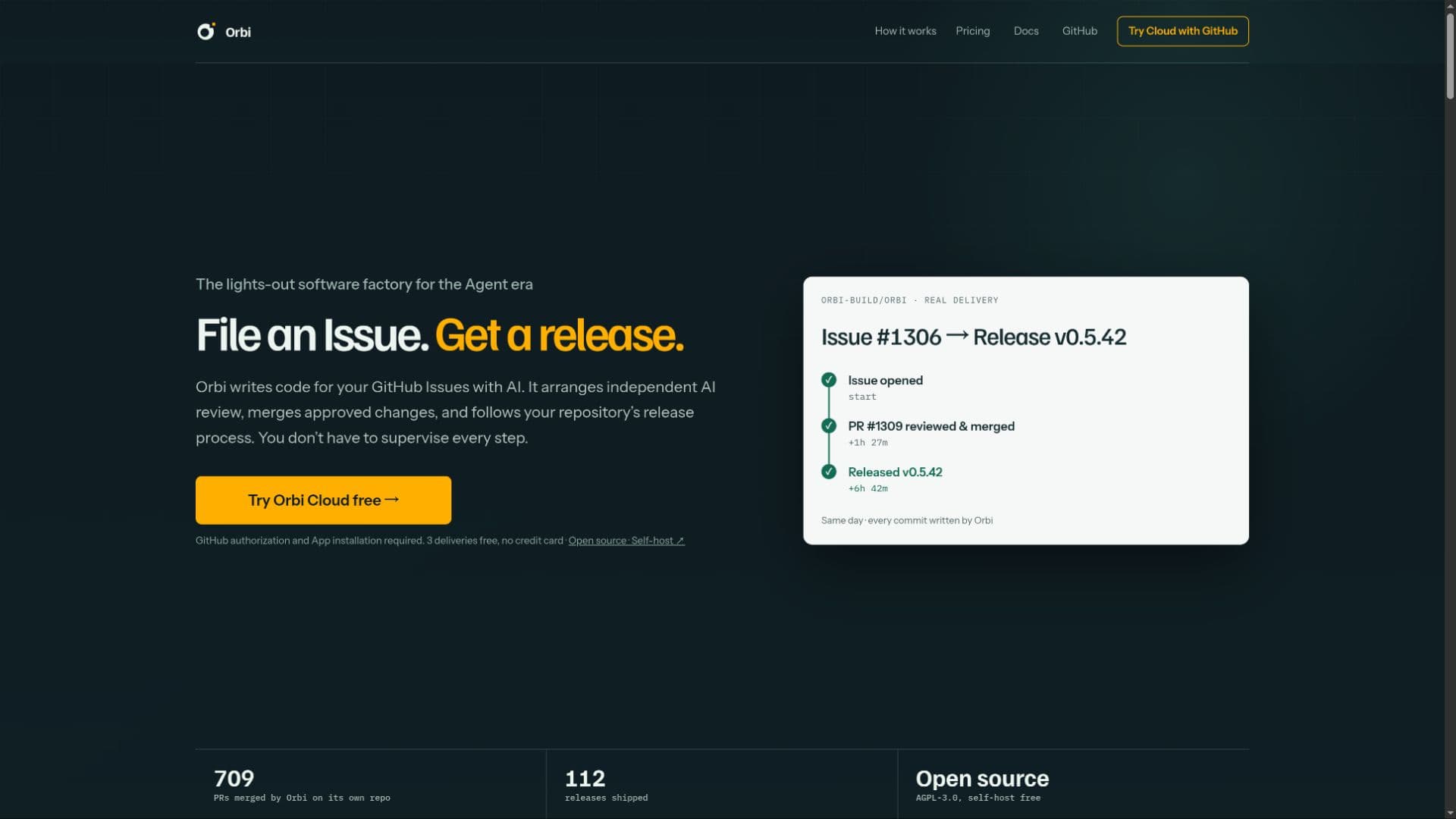
About this app
Orbi is an open-source AI coding agent for developers who manage work in GitHub Issues. It implements tasks, runs tests, and uses a separate AI review before merging changes. Orbi publishes releases when maintainers request them. Deployment and debugging requests also start as GitHub Issues. The engine is licensed under AGPL-3.0 and can be self-hosted on your own infrastructure. Orbi Cloud is the hosted option, with three free merged pull requests to start. Website: https://orbi.build/?ref=dir-scoutforge Source: https://github.com/orbi-build/orbi
Key features
- 1GitHub Issue as the unit of work: label ai-ready, get a reviewed and merged PR, then a tagged release
- 2Independent AI review session checks the PR against acceptance criteria and fixes what fails before merge
- 3Open source AGPL-3.0 core, self-hostable; Orbi Cloud hosted at $29/$79 with token allowances and BYO model
Target customer profile
Drawn from the product itself, not from a survey.
Demographic
GitHub repository maintainers and small development teams
Pain points
Manual implementation, review and release coordination for GitHub Issues
Primary needs
An AI coding workflow with testing and independent review before merging.
Scout Review
Written by AI from measured evidence, scored out of 100.
Orbi is an open-source AI coding agent that treats the GitHub Issue as the unit of work: label it ai-ready, get a reviewed and merged PR, then a tagged release. The differentiator is the review step — a separate AI session checks the PR against acceptance criteria and fixes what fails before merge. Self-host is free under AGPL-3.0; Cloud starts at $29/mo with three free merged deliveries. The site is fast on desktop (100/100) and light (TBT 0ms), security headers are solid at 10/13, and accessibility audits at 97. The weak spots are a hero that renders as an empty dark rectangle above the fold, a 4.8s mobile LCP, missing CSP and Permissions-Policy, and no published compliance or a11y documentation. The idea is well-positioned against OpenHands and the broader agent crowd — narrower, more opinionated, and honest about what it does.
Measure by measure
Usability
63Onboarding is gated behind GitHub App install, but the self-host path is spelled out in copy-paste commands and the docs run ten sections deep on review rounds and merge gates.
Design
57Dark, confident landing page with a genuinely good demo card showing Issue → PR → Release. But the hero is a near-empty black rectangle and the stats sit flat with no hierarchy.
Speed
71Desktop Lighthouse 100/100 and mobile 80/100 with TBT 0ms and CLS 0 — a genuinely light page. The 4.8s mobile LCP is the one real drag.
Security
76Strong header hygiene — HSTS, frame protection, secure cookies, SPF and DMARC all present, 10/13 checks. Missing CSP and Permissions-Policy, and no published audit or SOC 2.
Accessibility
80Lighthouse accessibility 97/100 with only two failing audits — a contrast issue and mismatched accessible names. No WCAG statement or a11y docs published.
Growth
62Real wedge: the GitHub Issue as the unit of work, with independent AI review and a merge gate before release. OpenHands is broader; Orbi is narrower and more opinionated.
Improvement areas
- Hero section renders as a near-empty dark rectangle — headline and value prop sit below the fold
- Missing CSP and Permissions-Policy headers; no published SOC 2, pen-test, or bug bounty
- Two Lighthouse accessibility failures (contrast, accessible names) and no WCAG statement or a11y docs
Design & Usability
The landing page has one genuinely strong asset: a white demo card on dark navy showing Issue #1306 → PR #1309 reviewed & merged → Release v0.5.42 with timestamps. That single card explains the product better than the headline does. The problem is everything around it. The hero is a near-empty dark rectangle — no headline, no illustration, no value prop in the first viewport — so the actual pitch ('File an Issue. Get a release.') lives below the fold. The bottom stats (716 PRs, 116 releases) sit flat on the background with no containers. Usability is stronger: the self-host path is spelled out in copy-paste commands, and the docs page is a real ten-section reference covering review rounds, the merge gate, labels and run ids. The gate is GitHub App authorization before any value, which is fair for the category but slows first-touch.
Speed & Security
Speed is measured, not vibes: desktop Lighthouse 100/100, mobile 80/100, TBT 0ms, CLS 0, FCP 1.4s. The page is light and static-feeling. The one blemish is mobile LCP at 4.8s, which is slow enough to matter on a phone. Security is above the category median for an indie tool: HTTPS enforced, HSTS, frame protection, X-Content-Type-Options, Referrer-Policy, secure cookies, SPF and DMARC all present — 10 of 13 checklist points. The gaps are CSP and Permissions-Policy, both absent. There is no published SOC 2, ISO, pen-test or bug bounty, which is normal at this stage but keeps the score out of the 80s. The AGPL-3.0 source and the explicit 'self-hosted: code never leaves your machine' claim are real trust signals that offset some of that.
Accessibility & Growth
Accessibility scores 97/100 on the Lighthouse audit with only two failing items: a color-contrast issue and visible text labels without matching accessible names. Both are fixable in an afternoon. There is no WCAG statement, no a11y docs page, and no multi-language support mentioned — so the automated score is good but the published commitment is thin. Growth is the interesting one. The category is crowded — OpenHands, Devin, Copilot Workspace, Aider — and most of them pitch model quality. Orbi pitches workflow: label an issue ai-ready, an isolated worktree writes the code, a second session reviews the exact diff and fixes what fails, only the reviewed commit merges, then a release issue tags the version. That is a specific, defensible wedge aimed at maintainers who already run on GitHub Issues. The limit is that the wedge is copyable and the category is loud. Domain registered 2026-08-29 and 224 stars claimed on the site are context, not the score.
Conclusion
If you maintain a GitHub repo and already live in Issues, Orbi is worth the three free deliveries — the review-before-merge gate is the part most agents skip, and it is the part that matters when an AI is pushing to your main branch. If you need SOC 2, published audits, or a polished marketing site, look elsewhere for now. The product is early (domain registered late August 2026) but the docs are unusually deep for its age, and the self-host path is real. Start with the free tier, watch what it does to one low-stakes issue, and judge it on the diff it produces.
Suggestions for improvement
- Fix the hero: put the headline and a value prop in the first viewport instead of a near-empty dark rectangle.
- Add CSP and Permissions-Policy headers to close the two remaining gaps in the security checklist.
- Fix the two Lighthouse accessibility failures — contrast ratio and accessible name mismatches — they are quick wins.
- Publish a short accessibility statement and a security page with data-handling details for Cloud runners.
Alternatives comparison
Named competitors, point by point. Nobody paid to appear here or to be left out.
 Orbi |  OpenHands | |
|---|---|---|
| Open source license | AGPL-3.0, self-hostable | MIT-licensed open source |
| Primary workflow entry point | GitHub Issue labeled ai-ready | General-purpose agent platform, task-driven |
| Independent AI review before merge | Yes — separate session reviews diff and fixes failures | Not a built-in merge gate; agent produces changes |
| Hosted cloud pricing | $29/mo Solo, $79/mo Pro; 3 free merged deliveries | Open source self-host; cloud offering varies |
| Release automation | Release Issue triggers tagged release after merge | Not a core feature; agent-focused |
Comparing options? See Orbi alternatives, scored side by side
More Development & Engineering apps
View all Development & Engineering
CreateMyCoin
92A no-code Solana token creator that deploys SPL tokens in...

Vibe Coding Agent Skills
92A free, open-source platform offering 110 AI agent skills...

CC Switch
91Open-source desktop app for switching AI coding providers...

TaxID
90Fast EU VAT validation API for developers, covering 27 EU...

BeartIMAGE
88BeartIMAGE is a free, web-based image processing platform engineered for fast, bulk photo editing and conversion directly in your browser.

Claw Messenger
88Claw Messenger is an iMessage API service that gives AI a...

DataHabibi
88AI-powered Dubai real estate data platform with 12M+ DLD ...

ButterKit
82macOS app for App Store screenshots: 3D mockups, auto-tra...

PERM Processing Time: Current DOL Queue & History
88PERM Processing Time is an independent data analysis platform that helps users navigate the U.S. Department of Labor’s permanent labor certification process.

StockFit API
87A developer-first financial data API providing structured...

ProcessSpy
87A native macOS process explorer and advanced monitor that...

Credyt
87Real-time monetization infrastructure for AI products tha...

A platform dedicated to providing unbiased reviews of newly launched applications, analyzing everything from their features to their full potential.
info@scoutforge.net© 2026 Scoutforge. All rights reserved.
