Cycling through all six. Tap any point to stop.
Measured on six things
A UULE-powered local rank tracker for SEO agencies, offer...
Accessibility
82Interactive heatmaps, exportable reports (PDF, XLSX, PNG), embeddable widgets, and white-label client portals improve communication. Strong visual data presentation aids non-technical stakeholders.
Screenshots
1 / 2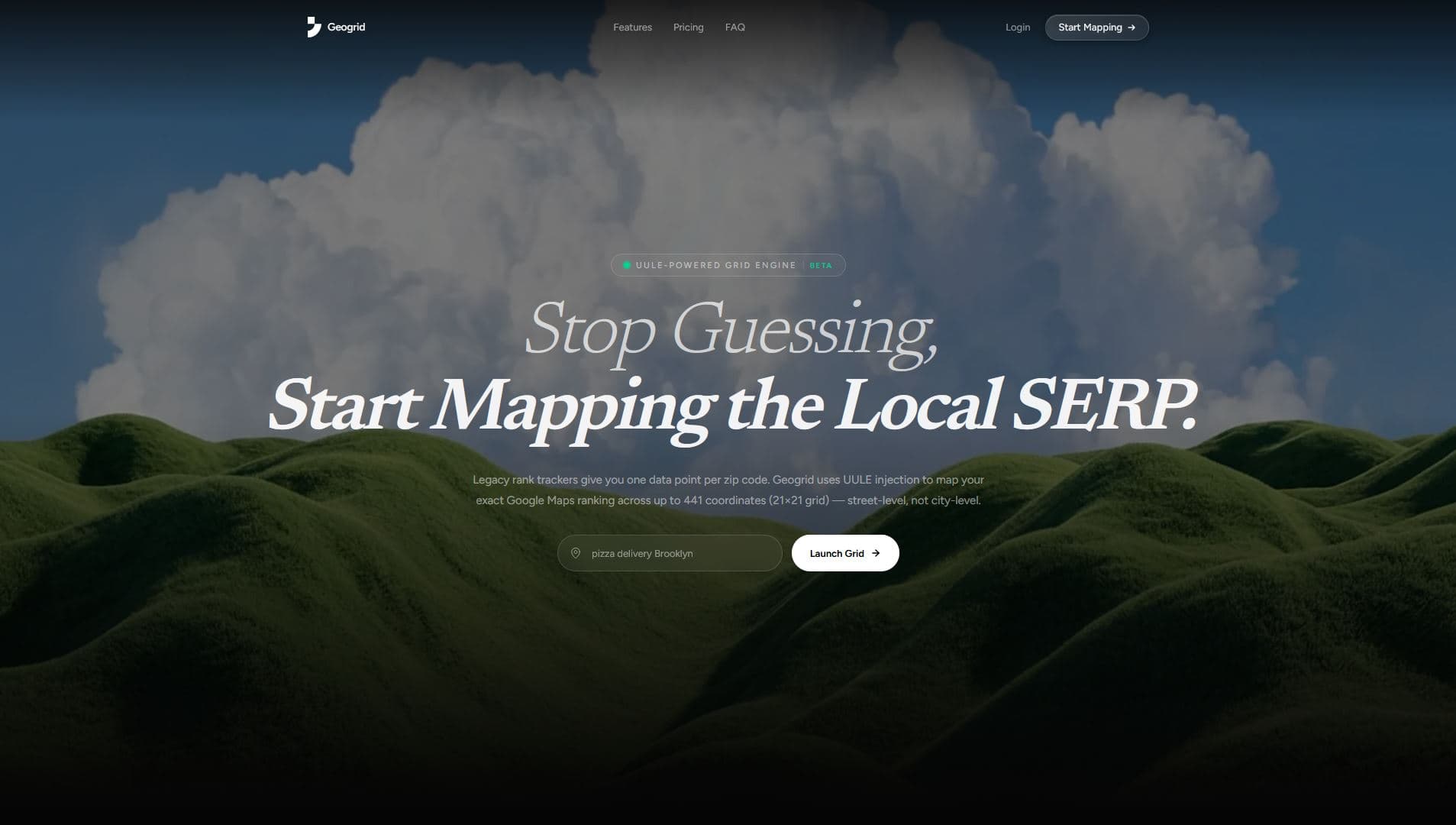
About this app
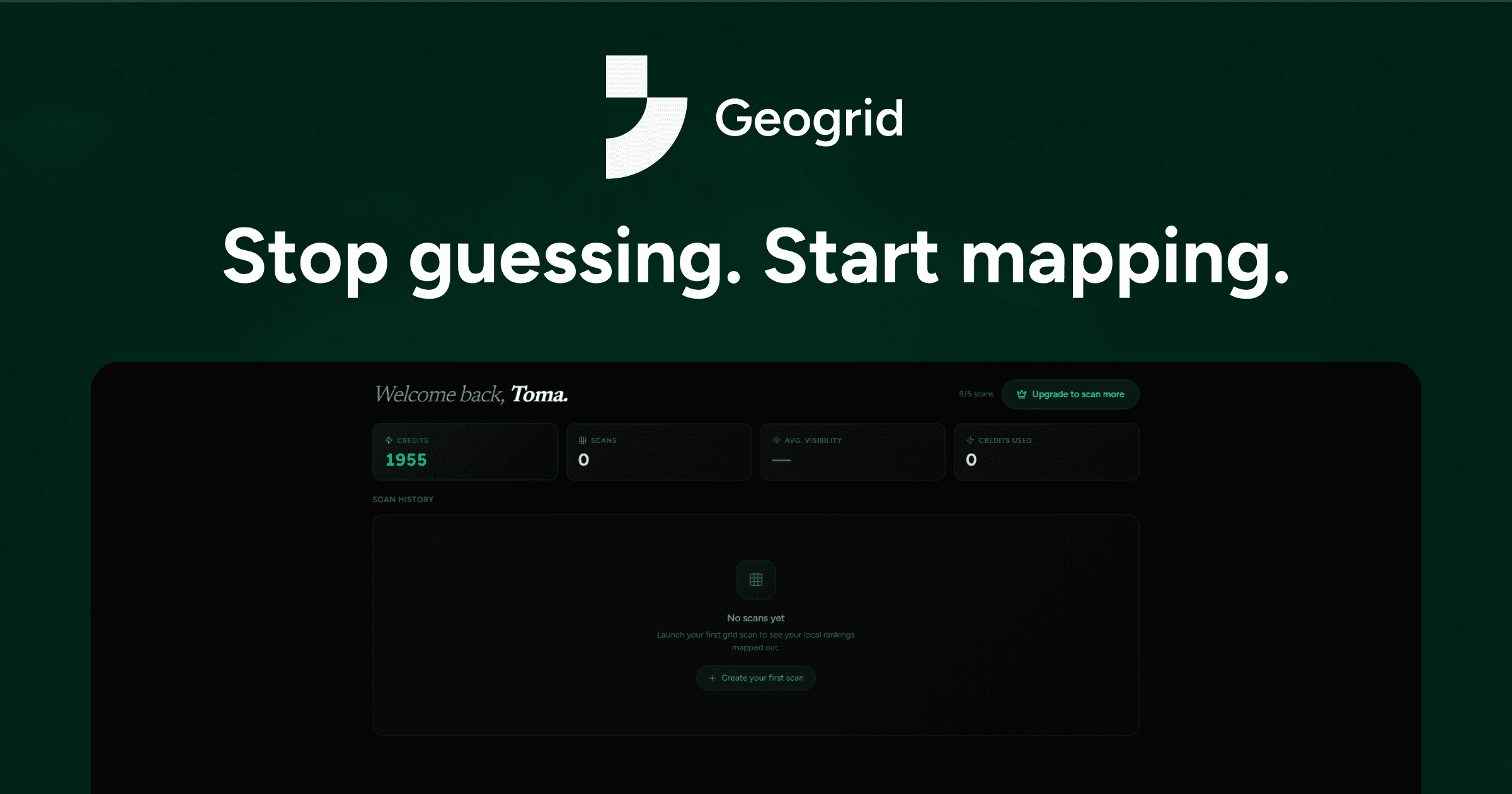
Geogrid is a game-changing local SEO tool that transforms how agencies track Google Maps rankings. Unlike traditional rank trackers that provide a single data point per zip code, Geogrid uses Google's internal UULE parameter to simulate real searches across a dense grid—up to 21×21 coordinates (441 points)—delivering street-level accuracy. This means you can see exactly where your clients rank block by block, revealing the true impact of Google's proximity factor. The platform generates interactive heatmaps, AI-powered insights, competitor intelligence, and white-label reports, all in under 90 seconds per scan. With a free tier offering 200 credits to start and scalable pricing for freelancers to enterprises, Geogrid is built for SEO professionals who need precise, actionable data to prove ROI and dominate local search.
Key features
- 1True street-level accuracy using Google's UULE parameter across up to 21×21 (441) grid points instead of one data point per zip code
- 2Interactive heatmaps, AI-powered insights, competitor threat levels, share-of-visibility metrics, and scan comparisons delivered in <90 seconds
- 3White-label reports, PDF/XLSX/PNG exports, scheduled rescans, email alerts, embeddable widgets, and REST API with webhooks
Target customer profile
Drawn from the product itself, not from a survey.
Demographic
SEO agencies and digital marketing firms
Pain points
Relying on legacy trackers with city-level data that miss local ranking variations, struggling to prove ROI to clients with flat reports, and lacking insights into competitor dominance in specific areas.
Primary needs
Street-level precision for accurate local SEO tracking, visual heatmaps to easily communicate results to clients, and automated reporting to save time and enhance credibility.
Demographic
Freelance SEO consultants and solo practitioners
Pain points
Limited budgets for expensive tools, manual data collection for local rankings, and difficulty competing with larger agencies on data depth and presentation.
Primary needs
Affordable access to advanced tracking (starting free), quick setup and scans under 90 seconds, and exportable reports (PDF, XLSX) to showcase value to small business clients.
Demographic
In-house marketing teams for multi-location businesses (e.g., retail chains, service providers)
Pain points
Inconsistent visibility across different neighborhoods, lack of tools to optimize local listings for each location, and inefficient manual tracking of competitors in various zones.
Primary needs
Grid-level analysis to identify high and low-performing areas, competitor intelligence to benchmark against local rivals, and API integration for custom dashboards and automated monitoring.
Scout Review
Written by AI from measured evidence, scored out of 100.
Geogrid stands out as one of the most precise local SEO tools available by leveraging Google's UULE parameter for true street-level ranking intelligence across dense 21×21 grids. It delivers fast, visual, actionable insights that legacy city-level trackers simply cannot match. Heatmaps, AI insights, competitor analysis, and professional reporting make it easy to demonstrate value to clients. The credit system and beta status are the main caveats, but for agencies and consultants serious about dominating Google Maps results, the depth and speed provide a genuine competitive edge. Strong scores across the board reflect a tool built by people who understand local SEO realities.
Measure by measure
Usability
93Scans complete in under 90 seconds with one-click heatmaps, AI insights, scheduled monitoring, and easy PDF/XLSX/white-label exports. Simple enough for freelancers yet powerful for enterprise API users.
Design
89Clean, modern interface with interactive color-coded heatmaps that make street-level ranking data instantly understandable. Demo scans and visual grid overlays give it a professional, data-rich feel tailored for agencies.
Speed
95Delivers full 21×21 (441-point) grids in <90 seconds — claimed 10× faster than competitors. Real-time UULE injection avoids proxies and keeps data fresh without delays.
Security
85Uses Google's own UULE parameter for authentic simulation instead of risky IP proxies or spoofing. Enterprise API with rate limits, webhooks, and scheduled scans shows solid architecture.
Accessibility
82Interactive heatmaps, exportable reports (PDF, XLSX, PNG), embeddable widgets, and white-label client portals improve communication. Strong visual data presentation aids non-technical stakeholders.
Growth
88Free tier with 200 credits, scalable plans from $49/mo (Freelance, 5k credits) to Enterprise API. 500+ agencies reportedly switched; adaptive grids, competitor intelligence, and B2B lead widgets support rapid adoption and retention.
Improvement areas
- Public case studies and independent benchmarks against established grid tools like Local Falcon
- Softer credit consumption or clearer unlimited options for high-volume agency users
- Enhanced accessibility features (colorblind modes, better export accessibility)
- More detailed public API documentation and native integrations with popular BI tools
Design & Usability
Geogrid nails the visual storytelling agencies desperately need. Traditional rank trackers spit out a single city-wide number that ignores Google's brutal proximity bias. Here, a dense 21×21 UULE grid reveals exactly which blocks convert and which don't. Interactive heatmaps turn complex data into client-friendly visuals, while AI-generated insights and action plans reduce analysis time. White-label portals and one-click exports (PDF, XLSX, PNG) make reporting painless. The interface feels purpose-built for local SEO pros — quick scans, competitor threat levels, share-of-visibility metrics, and scheduled rescans all contribute to high usability. Minor learning curve around credits and grid configuration, but overall it's a massive leap from legacy tools.
Speed & Security
Speed is a standout: full 441-point scans finish in under 90 seconds, reportedly 10× faster than competitors, thanks to direct UULE injection instead of proxy networks. This keeps data real-time and avoids common detection issues. Security-wise, simulating genuine Google searches via UULE is smarter and less risky than IP spoofing. Enterprise plans offer REST API, webhooks, rate limiting (250 req/min), and multi-location dashboards. Data freshness is strong, with email alerts on ranking drops. The beta tag on the grid engine introduces some uncertainty, but performance claims are backed by technical methodology explanations. For agencies running frequent scans across many clients, the speed advantage directly translates to more campaigns and faster client wins.
Accessibility & Growth
Visual heatmaps, competitor overlays, and embeddable 3×3 widgets make complex local data accessible to business owners who don't speak SEO. White-label client portals and automated reports build credibility and save hours. Growth is supported by a generous free 200-credit starter, clear tiering (Freelance $49/mo for 5k credits, Agency $149/mo for 20k, Enterprise $499/mo for 100k), and referral rewards. Adaptive IDW grids (Agency+) and unlimited scheduled scans at the top tier show the roadmap is built around agency scaling. Competitor intelligence features help prove ROI, while API access opens custom dashboard possibilities. The tool directly addresses pain points for in-house teams managing multi-location footprints and freelancers competing with bigger agencies on data depth.
Conclusion
If you're still reporting average rankings from one zip code center, you're lying to your clients. Geogrid gives you the block-by-block truth — and the visuals to prove it. Worth trying the free credits to see the difference for yourself.
Suggestions for improvement
- Add more public case studies and independent accuracy benchmarks comparing against Local Falcon, BrightLocal, and Whitespark.
- Introduce usage-based pricing alongside credits to reduce friction for high-volume agencies.
- Expand accessibility with colorblind-friendly heatmap modes and better keyboard navigation.
- Release a full public API documentation hub and more integration examples (Google Data Studio/Looker, Slack alerts).
Alternatives comparison
Named competitors, point by point. Nobody paid to appear here or to be left out.
 Geogrid |  BrightLocal |  Whitespark | |
|---|---|---|---|
| Max Grid Points (Precision) | 441 (21×21) | 225 (15×15) | 225 (flexible) |
| Scan Speed (Full Grid) | <90 seconds | Slower (multi-minute) | Moderate |
| Core Technology | UULE parameter injection | Standard location simulation | Grid-based simulation |
| All-in-One Local SEO (Citations/Reviews) | Focused on ranking grids + insights | Full suite (strong citations & reviews) | Strong citations + ranking grids |
| White-Label & Reporting | Portals, PDF, XLSX, PNG | Strong white-label reports | Good reports, some white-label |
| Starting Price / Free Tier | Free 200 credits, then $49/mo | Subscription from ~$29/mo | From $10-14/mo (modular) |
BrightLocal
A comprehensive local SEO platform offering rank tracking, citation building, and review management, but with less granular street-level precision compared to Geogrid's UULE-based grids.
Whitespark
Focuses on local citation building and rank tracking, providing tools for local SEO audits and competitor analysis, though it may not match Geogrid's adaptive grid heatmaps for micro-location insights.
Comparing options? See Geogrid alternatives, scored side by side
Sources
What the review was written against. A verdict with no sources is an opinion.
More Marketing & Sales apps
View all Marketing & Sales
Puzzly – B2B Lead Generation & Sales Intelligence Platform
92Puzzly is an all-in-one B2B lead generation platform that...

EmbedMyReviews
92White-label reputation management software for agencies s...

Vibe Coding Agent Skills
92A free, open-source platform offering 110 AI agent skills...

QRBliss
91Branded QR codes with AI Brand Sync, 15 free dynamic code...

WAButton
90WhatsApp website leads, forms and contact routing

DemoVexa
90Turn your code into professional product demo videos with AI-generated scripts, animated UI, and natural voiceovers.

PitchWhip
90AI cold call scripts & direct dials from LinkedIn

ThumbnailMaker
90AI YouTube thumbnail maker: paste a video link, get the brief, the thumbnail, and a check at feed size.

BACKLNK
90Backlnk is a free SEO and AI visibility website: 15 website checks, a full audit as a PDF report, and guides to get found in search and AI answers.

What the GIF
89Frame-perfect video-to-GIF maker that runs entirely in yo...

FontPlop
89Browser-based font viewer & tester for TTF, OTF, WOFF, WO...

AuditCloser
89White-label website audits that close deals for digital a...


A platform dedicated to providing unbiased reviews of newly launched applications, analyzing everything from their features to their full potential.
info@scoutforge.net© 2026 Scoutforge. All rights reserved.
