Cycling through all six. Tap any point to stop.
Measured on six things
Transform your website into an AI-powered knowledge engine with instant, context-aware answers.
Security
52HTTPS enforced with HSTS, SPF and DMARC present. But CSP, frame protection, X-Content-Type-Options, Referrer-Policy and Permissions-Policy are all absent (6/12). No SOC 2, ISO or pen-test page found.
Screenshots
1 / 1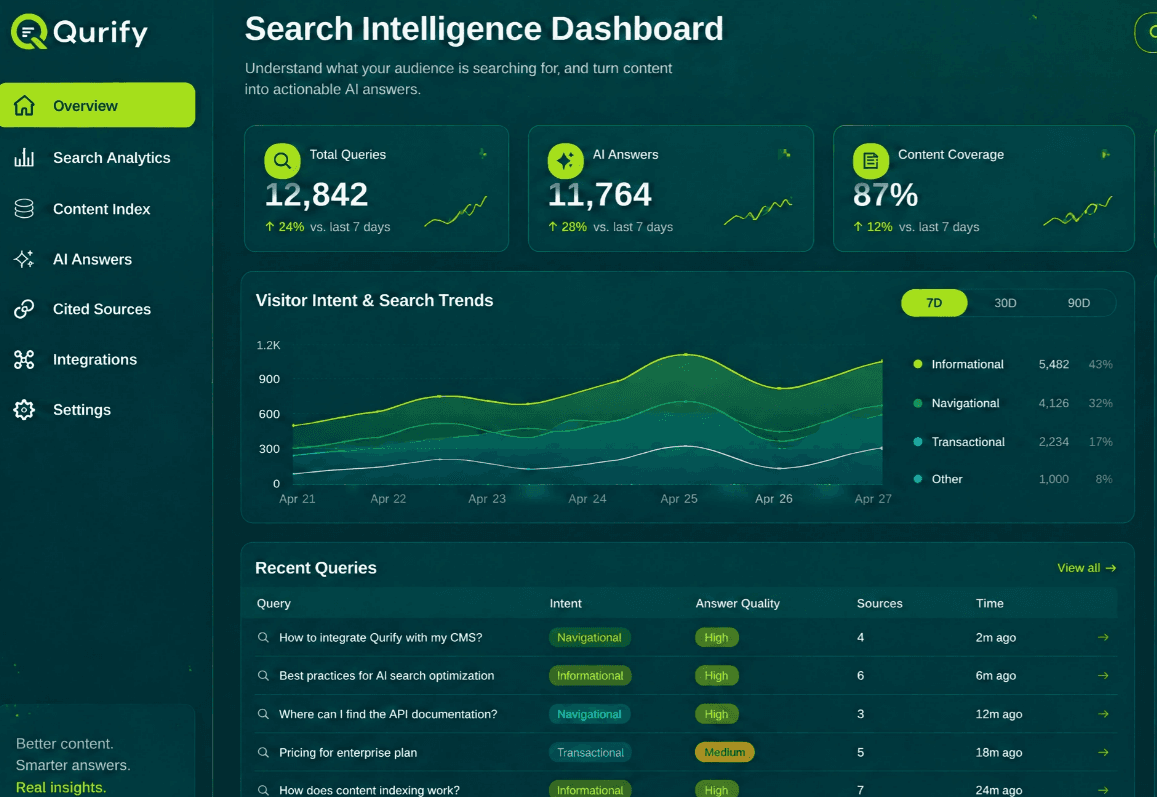
About this app
Qurify is a revolutionary AI-powered internal search engine designed to transform user experience on content-heavy websites. Traditional keyword-based site search often frustrates users with irrelevant results. Qurify solves this by reading and understanding every article, guide, and page on your platform. Instead of basic links, it delivers precise, context-aware answers to user queries, functioning like an intelligent virtual assistant. Compatible with any CMS and embeddable in minutes, Qurify helps businesses boost user retention, improve content discoverability, and reduce support tickets.
Key features
- 1AI site search that reads every page and answers visitor questions with cited source links.
- 2Query analytics and content-gap insight that turn site search into a live map of audience demand.
- 3One-snippet embed that works on any CMS (WordPress, Webflow, Ghost, custom stacks) with no engineering.
- 4Tiered pricing from $29 to $299/mo with a 14-day free trial, no credit card required.
Target customer profile
Drawn from the product itself, not from a survey.
Scout Review
Written by AI from measured evidence, scored out of 100.
Qurify is a well-positioned AI site search tool with a clean, cohesive brand and a genuinely useful core idea: read the whole site, answer visitor questions directly, and cite the source page. The pricing is transparent ($29/$79/$299 with a 14-day no-card trial), the capability table is honest about limits, and the accessibility score of 98/100 shows real engineering discipline. Where it stumbles is in the details that signal maturity: a broken 'Real|' artifact in the hero headline, duplicated integration logos, a mobile LCP of 3.6s, and a security header posture that's missing CSP, frame protection, and the rest of the standard set. None of these are fatal — they're the fingerprints of an early product moving fast. The bigger question is positioning: in a category filling up with AI search tools, 'we cite our sources' is no longer a differentiator, and the query-analytics feature that could be one is buried. Qurify has the bones of something good. It needs to sharpen the story and tighten the edges.
Measure by measure
Usability
66Clear paths: 14-day no-card trial, Book a Demo, and a pricing page with a real capability table. FAQ covers CMS support and sourcing. Onboarding depth beyond signup is unverified.
Design
68Cohesive dark theme with a consistent lime accent and a well-structured pricing section. Undercut by a broken 'Real|' artifact in the hero headline and duplicated integration logos.
Speed
68Lighthouse mobile 85/100 and desktop 87/100, with CLS near zero (0.001) and TBT 166ms. LCP 3.6s on mobile is the drag — above the 2.5s 'good' line, likely hero imagery.
Security
52HTTPS enforced with HSTS, SPF and DMARC present. But CSP, frame protection, X-Content-Type-Options, Referrer-Policy and Permissions-Policy are all absent (6/12). No SOC 2, ISO or pen-test page found.
Accessibility
78Lighthouse a11y 98/100 — strong. Two real gaps: no main landmark and visible-text labels without matching accessible names. Enterprise lists multilingual support; no public a11y statement found.
Growth
62Real, named problem (dead-end keyword search) with a concrete wedge: cited-source AI answers plus query analytics, one-snippet install. Transparent $29/$79/$299 pricing. Early-stage, no traction signals beyond socials.
Improvement areas
- Fix the 'Real|' artifact in the hero headline and de-duplicate the integration logo wall.
- Add missing security headers (CSP, frame protection, X-Content-Type-Options, Referrer-Policy) and publish a security page.
- Improve mobile LCP (3.6s) — optimize hero imagery and gradient rendering.
- Add a <main> landmark and resolve accessible-name mismatches to push a11y from 98 to 100.
Design & Usability
Qurify's design is cohesive and confident: dark green gradient, consistent lime accent, a pricing section with genuine hierarchy, and a dashboard mockup that shows real intent/quality tags on queries. It reads as a product, not a template. The problems are small but visible — the hero headline literally renders 'AI Site Search Real|' with a stray cursor bar, and the integration logo wall lists Google Drive and HubSpot twice, which undercuts the polish. Usability is where the product earns its keep: a 14-day trial with no credit card, a Book a Demo path, and a pricing page that publishes an actual capability table (search credits, indexed pages, sync frequency, CMS support, API access) rather than vague tiers. The FAQ answers the questions buyers actually ask — which CMSes, whether it hallucinates, what happens when you outgrow a plan. What I can't verify from the outside is the onboarding itself: 'setup in minutes' is a claim, and the depth of docs beyond the marketing site isn't visible in what I collected.
Speed & Security
Speed is decent but not clean. Lighthouse gives mobile 85/100 and desktop 87/100, with a near-perfect CLS of 0.001 and a TBT of 166ms — the page doesn't jump and the main thread isn't choking. The weak spot is mobile LCP at 3.6s, comfortably above the 2.5s 'good' threshold, which is almost certainly the hero mockup and gradient doing the damage. For a product whose entire pitch is instant answers, a three-and-a-half-second first paint on mobile is an awkward first impression. Security is the softer flank. HTTPS is enforced, HSTS is on, SPF and DMARC are configured — the basics are there. But the header probe scores 6/12: no Content-Security-Policy, no frame protection, no X-Content-Type-Options, no Referrer-Policy, no Permissions-Policy. For a tool that ingests a customer's entire site content and serves answers to their visitors, that's a thin defensive posture. The site claims 'private and secure by design' and Enterprise lists SSO and SLA, but there's no SOC 2, ISO, or pen-test page in what I found — so the security story is asserted, not evidenced.
Accessibility & Growth
Accessibility is a genuine strength: Lighthouse scores 98/100, which is rare and reflects real care. Two failures remain — the document has no main landmark, and some elements with visible text labels don't have matching accessible names. Both are quick fixes, and neither is a systemic problem. Enterprise lists multilingual support, which matters for the multi-site buyers it targets, though there's no public accessibility statement. Growth is a judgement on the idea, not the traction. The problem Qurify names is real: keyword site search frustrates visitors and buries content, and 'AI answers with cited sources' is a legitimate fix. The wedge is specific — one embed snippet on any CMS, answers drawn only from your own content, plus query analytics that surface content gaps. That last piece is the most interesting and the least emphasized. The honest limit: 'AI search for your site' is a crowded, fast-filling category, and citing sources is now table stakes rather than differentiation. Qurify can win on price and simplicity for small-to-mid content sites, but it needs the analytics angle to become the headline, not a bullet.
Conclusion
If you run a content-heavy site and your current search box is a graveyard of dead-end results, Qurify is worth the 14-day trial — the no-credit-card part means the cost of finding out is an afternoon. Go in with clear eyes: you're adopting an early-stage product with a thin security page and a hero headline that still has a cursor in it. But the core loop — ingest, answer, cite, analyze — is the right one, and the analytics layer is where the real value will compound if they lean into it. Watch the roadmap, ask about SOC 2 before you put it in front of enterprise buyers, and check whether the sync frequency on your tier matches how often you publish. Do that, and Qurify is a reasonable bet.
Suggestions for improvement
- Fix the 'Real|' artifact in the hero headline and de-duplicate the integration logo wall — these are the first things a buyer sees.
- Publish a security page with SOC 2 status, data handling, and a subprocessor list; add CSP, frame protection, and X-Content-Type-Options headers.
- Add a <main> landmark and fix the accessible-name mismatches — you're two fixes away from a perfect automated a11y score.
- Elevate query analytics and content-gap insight from a bullet to the headline; it's the most defensible part of the product.
Alternatives comparison
Named competitors, point by point. Nobody paid to appear here or to be left out.
 Qurify Qurify | ||
|---|---|---|
| Pricing model | $29 / $79 / $299 per month, 14-day free trial, no credit card required | Not provided |
| Core search approach | AI answers with cited source pages, drawn only from your own content | Not provided |
| Analytics and insights | Query tracking, answer delivery, and content-gap insight (Professional and above) | Not provided |
| CMS and platform support | One embed snippet; WordPress, Webflow, Ghost, help centers, custom stacks | Not provided |
| Security and compliance | HTTPS + HSTS; SSO and SLA on Enterprise; no SOC 2/ISO page found | Not provided |
| Free trial | 14 days, no credit card required | Not provided |
Comparing options? See Qurify alternatives, scored side by side
More Analytics apps
View all Analytics
LTX 2.3 AI Video Generator
91Fast, open-source AI video generator with 4K support, mul...

ButterKit
82macOS app for App Store screenshots: 3D mockups, auto-tra...

SiftingIO - Market Data API
88Real-time & historical market data API for stocks, forex,...

PERM Processing Time: Current DOL Queue & History
88PERM Processing Time is an independent data analysis platform that helps users navigate the U.S. Department of Labor’s permanent labor certification process.

Sonar
87Free website tracking checker. Paste a URL and Sonar crawls your site from the outside, then reports what's running and the problems it can prove.

Reptor
85Reputation monitoring across Google, AI search engines, reviews, news and social media, with sentiment analysis per mention.

Timix - A Modern Timer
84Turn timers into powerful routines with automation, widge...

Activity Racoon
82Engineering intelligence platform automating sprint analy...

LLM Reference
82Decision-support platform for engineers choosing the righ...

AEO Mantis
82Monitor and improve your brand's visibility in AI search ...

Sorsa API
82Fast, affordable X/Twitter API alternative with 20 req/se...
ButterKit
82macOS app for App Store screenshots: 3D mockups, auto-tra...


A platform dedicated to providing unbiased reviews of newly launched applications, analyzing everything from their features to their full potential.
info@scoutforge.net© 2026 Scoutforge. All rights reserved.