Cycling through all six. Tap any point to stop.
Measured on six things
From git push to published release notes — zero manual work. ReleasePad watches your GitHub repo, uses AI to turn commits into user-friendly changelogs, and serves them inside your app.
Security
52HTTPS enforced with X-Content-Type-Options, Referrer-Policy, SPF and DMARC present, but no HSTS, CSP, frame protection or Permissions-Policy (6/12 checklist). No SOC 2/ISO/security page found.
Screenshots
1 / 3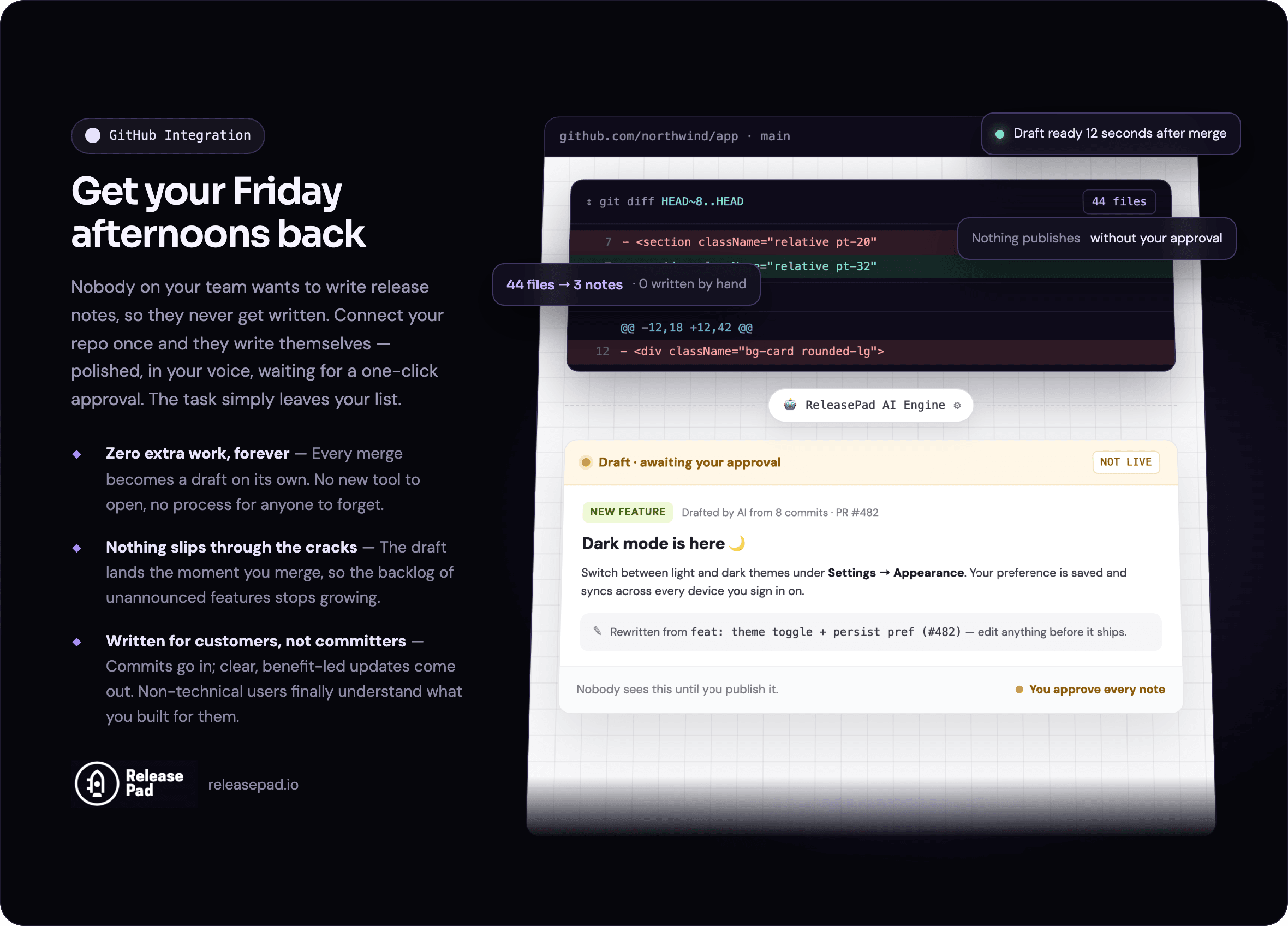
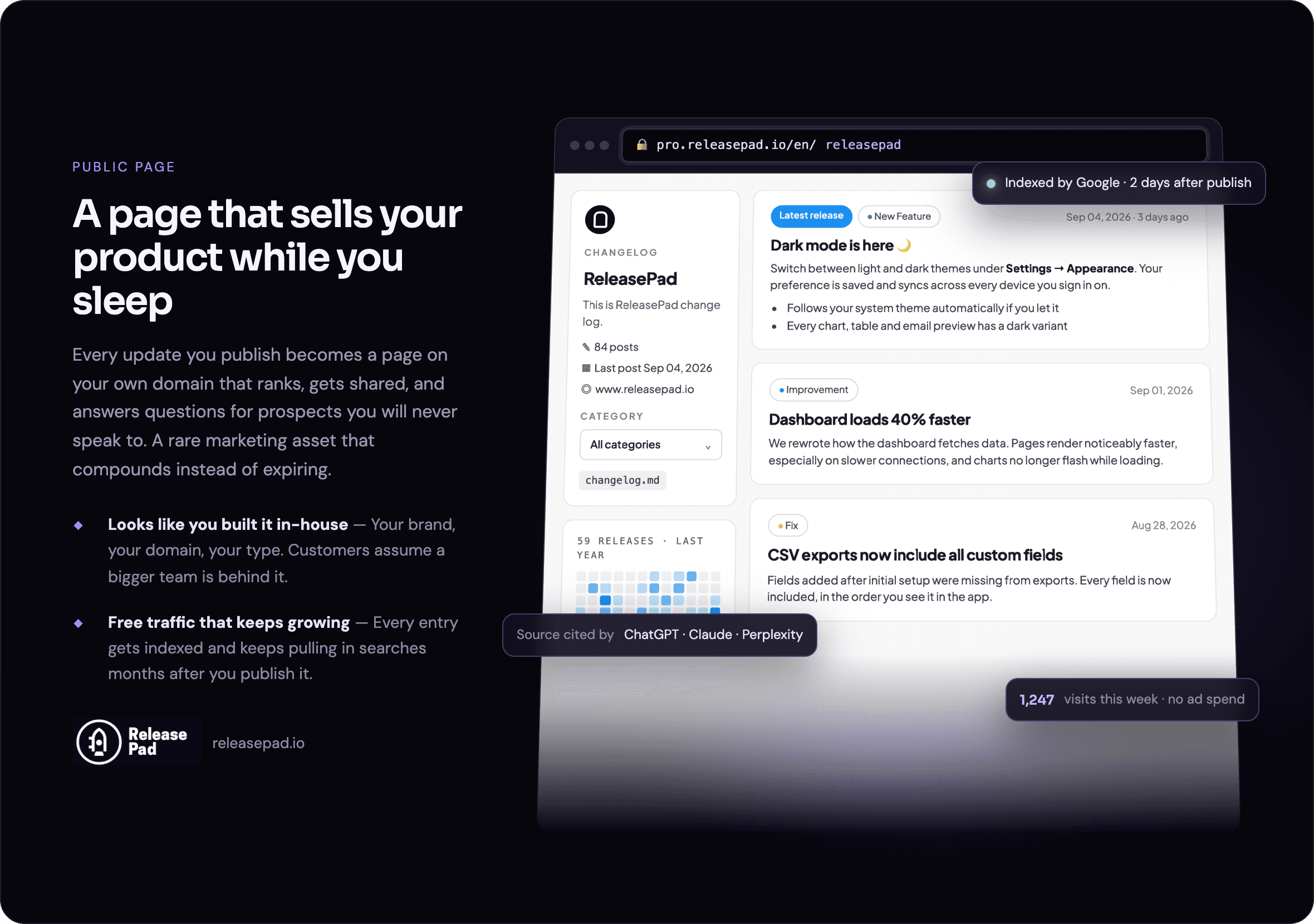
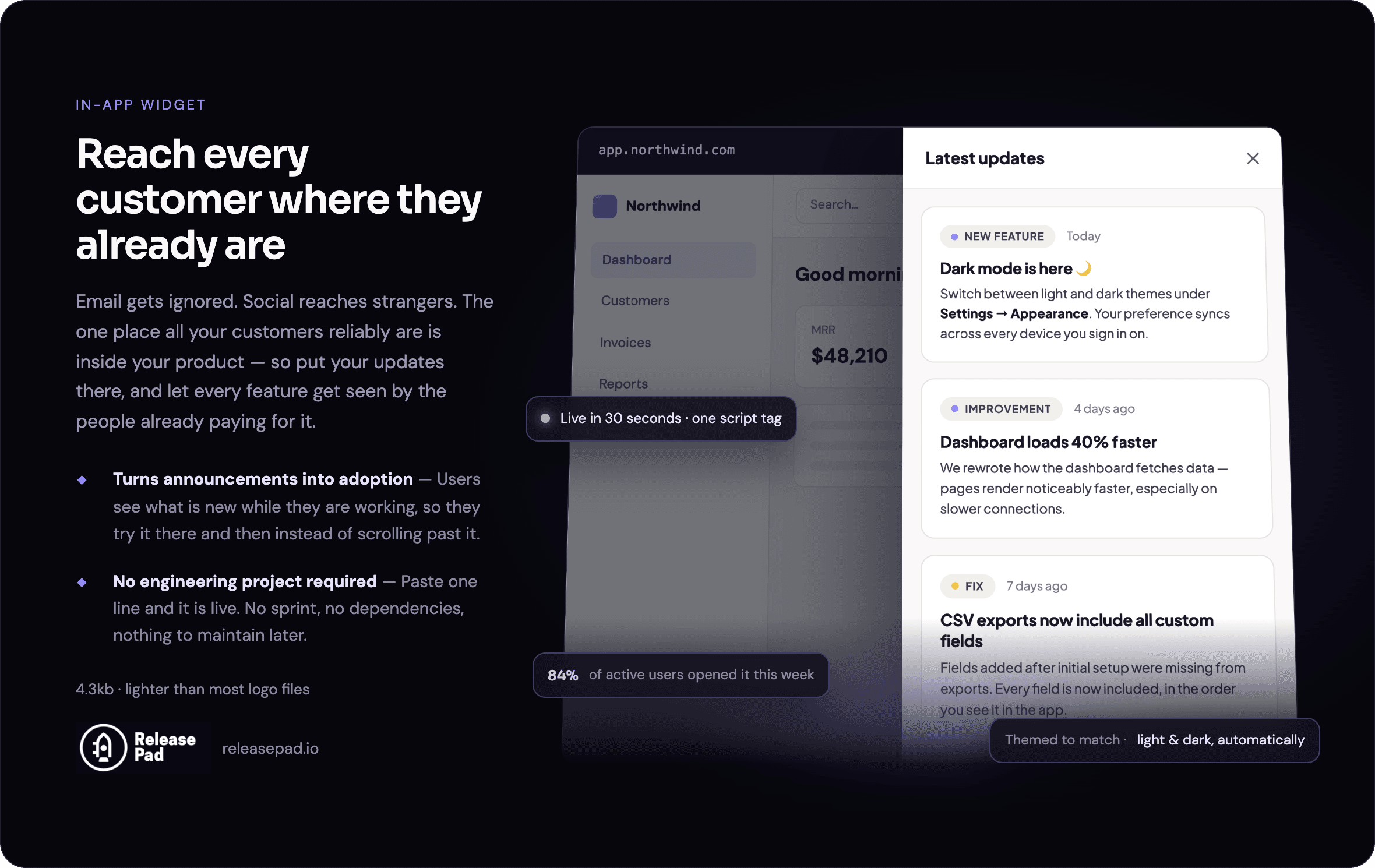
About this app
ReleasePad is a changelog tool that turns your GitHub commits into release notes automatically. Connect a repo, and AI reads every change you ship and writes clear, human-friendly release notes. No templates, no writing, no process to adopt. Commits in, release notes out. Review, tweak if you want, and publish everywhere at once: a hosted changelog page your users can bookmark, and an in-app widget so they see what's new inside your product. It also offers an API, an MCP server and webhooks. It works with messy repos, inconsistent commit messages, and the kind of chaotic history real teams actually have. No strict formats required. Free plan with up to 20 posts; Pro is $35 per month per product.
Key features
- 1AI turns messy GitHub commits into human-friendly release notes with no strict commit format required.
- 2Hosted public changelog page on your own domain, plus a 4.3kb in-app widget styled to match.
- 3REST API, webhooks, MCP server, and LLM-ready Markdown output for AI assistants.
- 4Flat $35/month per product with unlimited team members — no per-seat or MAU scaling.
Target customer profile
Drawn from the product itself, not from a survey.
Demographic
Software developers and indie developers shipping on GitHub
Pain points
Writing release notes by hand takes time, so shipped updates go uncommunicated
Primary needs
Release notes generated automatically from GitHub commits
Demographic
Startups and marketing teams announcing product updates
Pain points
Users miss new features and open support tickets for problems already fixed
Primary needs
A public changelog page and an in-app widget showing what's new
Scout Review
Written by AI from measured evidence, scored out of 100.
ReleasePad is a focused changelog tool with a clear thesis: commits in, human-friendly release notes out, published to a hosted page and an in-app widget. The site sells it well — real diff-to-draft mockups, a live embedded changelog, a documented three-step flow, and a flat $35/product price that undercuts Beamer's MAU-scaled tiers. The measured profile is uneven but honest: strong accessibility (96), solid design (70), competent usability (66), a mobile LCP problem (10.6s) dragging speed to 57, a half-finished security header set (6/12, no HSTS/CSP), and a differentiated idea with a copyable moat. It's a competent, clearly positioned early-stage product with a few cheap fixes standing between it and 'good'.
Measure by measure
Usability
66Short scannable nav, one dominant CTA, free plan with no card, and a documented 3-step GitHub-to-publish flow plus a live embedded changelog demo. First-visit hero clarity unverified.
Design
70Cohesive dark UI with a single blue accent and monospace technical labels; promo cards show real diff-to-draft product states. Held back by overlapping callouts and tiny mockup text.
Speed
57Lighthouse mobile 70/100 (desktop 85) but LCP 10.6s on mobile — the hero takes over ten seconds to paint. CLS 0.001 and TBT 193ms are fine; the big image is the problem.
Security
52HTTPS enforced with X-Content-Type-Options, Referrer-Policy, SPF and DMARC present, but no HSTS, CSP, frame protection or Permissions-Policy (6/12 checklist). No SOC 2/ISO/security page found.
Accessibility
80Lighthouse accessibility 96/100 with one failing audit — insufficient color contrast. Responsive dark UI with clear hierarchy; no WCAG statement or multi-language support found.
Growth
68Real, specific pain (silent shipping, support tickets for fixed bugs) with a demonstrable wedge: commit-to-notes AI, 4.3kb widget, LLM-ready Markdown, MCP, and flat $35/product vs Beamer's MAU pricing.
Improvement areas
- Mobile LCP of 10.6s — the hero image needs compression and lazy-loading.
- Security headers at 6/12: missing HSTS, CSP, frame protection, Permissions-Policy; no security page.
- One failing contrast audit and no accessibility statement or multi-language support.
- Homepage hero/social proof not verifiable from render; first-visit clarity needs strengthening.
Design & Usability
The design language is deliberate: near-black surfaces, one blue accent, monospace for technical metadata, and promo cards that show the actual workflow — a red/green code diff flowing into a 'NOT LIVE' draft card. That's a product showing its work instead of stock illustrations. Usability is similarly thought through: a four-item nav, one dominant 'Start free' CTA, a free plan with no credit card, and a documented three-step flow from GitHub commit to published note, backed by a live embedded changelog you can scroll. The gaps are execution-level: floating callouts overlap the mockup frames, mockup text is too small at thumbnail scale, and the homepage render gave no hero copy or social proof to judge first-visit clarity.
Speed & Security
Speed is a tale of two metrics. Lighthouse mobile scores 70/100 and desktop 85, with excellent CLS (0.001) and acceptable TBT (193ms) — but LCP is 10.6 seconds on mobile, meaning the hero takes over ten seconds to paint on a phone. The product's own 4.3kb widget is genuinely light; the marketing page selling it is not. Security is middling: HTTPS is enforced and X-Content-Type-Options, Referrer-Policy, SPF and DMARC are present, but there's no HSTS, CSP, frame protection or Permissions-Policy (6/12 on the header checklist), and no SOC 2, ISO, pen-test or security page surfaced in the fetched content. For an early-stage tool handling repo access, a security page and HSTS would be cheap, credible wins.
Accessibility & Growth
Accessibility is a genuine strength: Lighthouse scores 96/100 with a single failing audit — insufficient color contrast — on an otherwise responsive, well-structured dark UI. The caveat is that automated checks cover only part of WCAG; there's no accessibility statement or multi-language support mentioned, and keyboard/screen-reader behavior wasn't independently verified. Growth is the more interesting story. ReleasePad names a real, specific pain — features ship and nobody hears, so support answers questions about bugs fixed weeks ago — and backs it with a demonstrable wedge: AI that turns messy GitHub commits into release notes, a 4.3kb in-app widget, LLM-ready Markdown, an MCP server, and flat $35/product pricing against Beamer's $59 MAU-scaled Starter. The target customer (indie/GitHub teams) is specific and the category has headroom as AI accelerates shipping. The limit: the wedge is copyable, and the moat is workflow habit, not lock-in.
Conclusion
What would move the needle most: fix the 10.6s mobile LCP (compress and lazy-load the hero), add HSTS and a CSP plus a short security page, and resolve the one contrast failure. None of those are hard, and all of them are visible to a technical buyer who will check. The product's real bet is that AI-generated release notes plus a featherweight widget become a habit — and the flat pricing gives it room to win the indie/GitHub segment Beamer prices out. Ship the fixes, keep the changelog honest, and this is a tool worth bookmarking.
Suggestions for improvement
- Cut mobile LCP from 10.6s: compress/lazy-load the hero image and serve modern formats — it's the single biggest speed win.
- Add HSTS, a Content-Security-Policy and frame protection, and publish a short security page to lift the 6/12 header score.
- Fix the one failing contrast audit (muted text on near-black) and add a brief accessibility statement.
- Add a hero section with social proof and a 30-second demo above the fold — the render gave no first-visit clarity.
Alternatives comparison
Named competitors, point by point. Nobody paid to appear here or to be left out.
 ReleasePad | Beamer |  Canny | |
|---|---|---|---|
| Pricing model | $35/mo flat per product, unlimited team members | $59/mo Starter, scales with MAU | Tiered plans, scales with users/features |
| AI release notes from GitHub commits | Built-in, no strict commit format required | Manual entry | Manual entry |
| In-app changelog widget | 4.3kb, zero deps, light/dark themed | Yes, larger embed | Changelog module within feedback board |
| Public changelog page + custom domain | Included on Pro, free TLS, SEO-ready | Yes, custom domain on paid plans | Yes, changelog hosted page |
| API / webhooks / MCP for AI assistants | REST API, webhooks, MCP server, LLM-ready Markdown | API on higher tiers | API available |
| Free tier | Yes, up to 20 posts, no time limit, no card | 14-day trial | Limited free plan |
Beamer
In-app announcement and changelog widget.
Canny
Feedback board and roadmap platform with a changelog module.
Comparing options? See ReleasePad alternatives, scored side by side
More Development & Engineering apps
View all Development & Engineering
Vibe Coding Agent Skills
92A free, open-source platform offering 110 AI agent skills...

CreateMyCoin
92A no-code Solana token creator that deploys SPL tokens in...

CC Switch
91Open-source desktop app for switching AI coding providers...

DemoVexa
90Turn your code into professional product demo videos with AI-generated scripts, animated UI, and natural voiceovers.

TaxID
90Fast EU VAT validation API for developers, covering 27 EU...

FontPlop
89Browser-based font viewer & tester for TTF, OTF, WOFF, WO...

Denpex
89AI-powered GPU failure diagnosis for distributed ML training

deed.page
89Permanent web hosting for AI agents, no human step

Webfetch
89Web scraping API that turns any URL into HTML, text, Mark...

Claw Messenger
88Claw Messenger is an iMessage API service that gives AI a...

PERM Processing Time: Current DOL Queue & History
88PERM Processing Time is an independent data analysis platform that helps users navigate the U.S. Department of Labor’s permanent labor certification process.

DataHabibi
88AI-powered Dubai real estate data platform with 12M+ DLD ...


A platform dedicated to providing unbiased reviews of newly launched applications, analyzing everything from their features to their full potential.
info@scoutforge.net© 2026 Scoutforge. All rights reserved.
