Cycling through all six. Tap any point to stop.
Measured on six things
Design-forward shadcn/ui platform with MCP fluency for agents
Accessibility
55No Lighthouse a11y measurement available this run. RTL support is documented, but the product's own dark UI shows small low-contrast secondary text and no WCAG statement was found.
Screenshots
1 / 1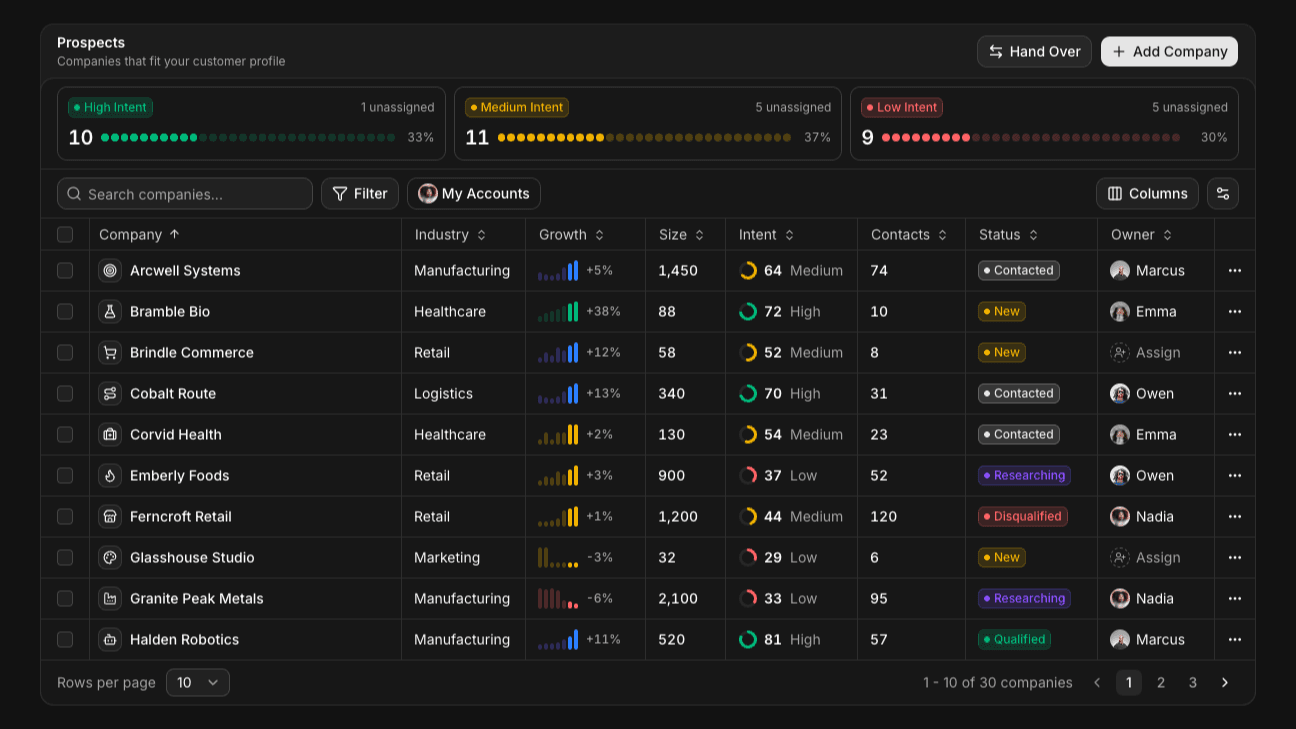
About this app
Skip the AI grind. ReUI is crafted by senior design engineers and proven in real production apps. Production-ready app shells, layouts, dashboards, and data grids you drop straight in. Hand-crafted, animated icons for shadcn/ui in 4 styles, tuned for real interfaces. Complete multi-page templates for Next.js, Vite, TanStack Start, Astro, and Laravel with Inertia, built from the same blocks and components. Free components stay free forever. Compare plans to unlock every block, icon, and template with a single license.
Key features
- 11265 free shadcn/ui component examples and 27 primitives, no account required
- 2678 pro blocks across 7 groups plus 2668 icons in 4 styles and 20 full-page templates
- 3MCP server and Agent Skills documented for 16 coding clients, serving the same catalogue to agents
- 4One-time pricing: $249 Pro, $499 Ultimate, unlimited commercial use, lifetime updates
Target customer profile
Drawn from the product itself, not from a survey.
Scout Review
Written by AI from measured evidence, scored out of 100.
ReUI is a shadcn/ui registry with an unusually clear thesis: 1265 free components and 27 primitives with no auth wall, then 678 pro blocks, 2668 icons and 20 full-page templates behind a one-time $249 or $499 payment. The agent angle is the differentiator — an MCP server and Agent Skills documented for sixteen clients, so the catalogue is served to coding agents as well as humans. Documentation is genuinely deep, security headers are near-complete at 11/12, and the design work visible in the catalogue is disciplined. The gaps are honest ones: no performance or accessibility measurement exists, no compliance certifications are published, and the UI has contrast and legend issues of its own.
Measure by measure
Usability
72Docs sidebar covers setup, registry, MCP, RTL, changelog; 1265 free components with no auth wall; MCP documented for 16 clients. Onboarding-to-value is genuinely short for a dev tool.
Design
68Catalogue dashboards show real craft: intent summary cards, consistent toolbar, dense-but-legible 10-column table, stage-coded status pills. Docked for unlabeled sparkline colors and low-contrast secondary text.
Speed
58No Lighthouse run completed this run, so no performance measurement exists. Scored in the category-typical band from indirect signals only; no lag complaints found in collected evidence.
Security
74Probe shows HTTPS enforced with HSTS, CSP, frame protection, Referrer-Policy and Permissions-Policy — 11/12 checklist points. SPF missing; no SOC 2 or pen-test claims published.
Accessibility
55No Lighthouse a11y measurement available this run. RTL support is documented, but the product's own dark UI shows small low-contrast secondary text and no WCAG statement was found.
Growth
70Real wedge: an agent-ready shadcn registry with MCP + Agent Skills, endorsed by shadcn's creator. Differentiated from plain component libraries, though the paid tier competes on scope, not lock-in.
Improvement areas
- No published SOC 2, ISO 27001 or penetration-test evidence; SPF record missing
- No WCAG conformance statement, and the product's own UI has low-contrast secondary text
- No performance or accessibility measurement available; no published benchmarks
- Sparkline colors lack a legend, and the dense table competes for attention across columns
Design & Usability
Design is judged from maker-supplied catalogue images since the homepage didn't render this run. What's visible is competent: intent summary cards with status pills and segmented bars, a consistently grouped toolbar, and a ten-column table that stays legible through row height and thin dividers rather than heavy borders. Weaknesses are real but small — sparkline colors with no legend, and secondary labels like '1 unassigned' rendered too faint on dark. Usability is the stronger half: the docs sidebar covers Get Started, License Setup, Registry, MCP Server, Agent Skills, llms.txt, RTL and a changelog, and the free tier needs no account at all. 1265 free components and 27 primitives with copy-ready CLI installs is a short path from landing to value, and MCP setup is documented for sixteen different clients.
Speed & Security
Speed is unmeasured — the Lighthouse run did not complete, so there is no LCP, CLS or TBT figure to cite, and no published benchmarks or lag complaints turned up in the collected material. The score sits in the category-typical band on indirect signals alone. Security is the better-documented dimension: the HTTP probe confirms HTTPS enforced with HSTS, a Content-Security-Policy, frame protection, X-Content-Type-Options, Referrer-Policy and Permissions-Policy, for 11 of 12 checklist points. The one gap is a missing SPF record. Beyond headers, the site publishes no SOC 2, ISO 27001 or penetration-test claims, and there's no visible security page or bug bounty — normal for a product at this stage, but it caps how high this can honestly go.
Accessibility & Growth
Accessibility has no measurement behind it this run, so the score reflects indirect signals: RTL is documented, which is more than most component libraries bother with, but the product's own dark dashboard shows small, low-contrast secondary text and there is no WCAG conformance statement anywhere in the fetched pages. Growth is the interesting one. The category is crowded — shadcn/ui itself is free, and every component marketplace competes on volume — but ReUI's wedge is specific: the same catalogue served to humans and to agents through an MCP server and Agent Skills, so the code an agent installs is the code a developer browsed. The quoted endorsement from shadcn/ui's creator is a real credibility signal. The limit is that one-time pricing at $249/$499 monetizes scope rather than lock-in, so growth depends on staying ahead of a fast-moving free ecosystem.
Conclusion
If you're building on shadcn/ui and you use a coding agent, this is one of the few registries with a real answer to 'why not just copy from the free docs' — the MCP layer and the block/template ladder. The free tier costs nothing to evaluate and needs no account, so start there and only pay when you hit a block you actually need. Skip it if you need published SOC 2 or WCAG conformance for procurement; neither exists here yet.
Suggestions for improvement
- Add a legend or tooltip to the growth sparklines so the four colors actually mean something.
- Raise contrast on secondary text like '1 unassigned' and 'Assign' placeholders to meet WCAG AA.
- Publish an accessibility statement and a security page, even a short one, to close the trust gap.
- Add an SPF record to complete the email authentication setup alongside the existing DMARC.
Alternatives comparison
Named competitors, point by point. Nobody paid to appear here or to be left out.
 ReUI |  | |
|---|---|---|
| Free component catalogue | 1265 free examples + 27 primitives, no auth wall | Not specified in provided details |
| Paid tier scope | 678 blocks, 2668 icons, 20 templates | Not specified in provided details |
| Pricing model | One-time $249 Pro / $499 Ultimate, lifetime updates | Not specified in provided details |
| AI agent integration (MCP) | MCP server + Agent Skills, 16 documented clients | Not specified in provided details |
| Framework templates | Next.js, Vite, TanStack Start, Astro, Laravel/Inertia | Not specified in provided details |
Comparing options? See ReUI alternatives, scored side by side
More Development & Engineering apps
View all Development & Engineering
Vibe Coding Agent Skills
92A free, open-source platform offering 110 AI agent skills...

CreateMyCoin
92A no-code Solana token creator that deploys SPL tokens in...

CC Switch
91Open-source desktop app for switching AI coding providers...

DemoVexa
90Turn your code into professional product demo videos with AI-generated scripts, animated UI, and natural voiceovers.

TaxID
90Fast EU VAT validation API for developers, covering 27 EU...

FontPlop
89Browser-based font viewer & tester for TTF, OTF, WOFF, WO...

Denpex
89AI-powered GPU failure diagnosis for distributed ML training

deed.page
89Permanent web hosting for AI agents, no human step

Webfetch
89Web scraping API that turns any URL into HTML, text, Mark...

Claw Messenger
88Claw Messenger is an iMessage API service that gives AI a...

PERM Processing Time: Current DOL Queue & History
88PERM Processing Time is an independent data analysis platform that helps users navigate the U.S. Department of Labor’s permanent labor certification process.

DataHabibi
88AI-powered Dubai real estate data platform with 12M+ DLD ...


A platform dedicated to providing unbiased reviews of newly launched applications, analyzing everything from their features to their full potential.
info@scoutforge.net© 2026 Scoutforge. All rights reserved.
