Is this your app?
Claim SelfDB to manage its page, add your badge and see your traffic — free, and it stays free.
Cycling through all six. Tap any point to stop.
Measured on six things
An open-source, self-hosted backend solution offering full data control as an alternative to Firebase and Supabase.
Accessibility
50Limited accessibility features, no screen reader optimization, English-only interface, requires terminal proficiency
Screenshots
1 / 1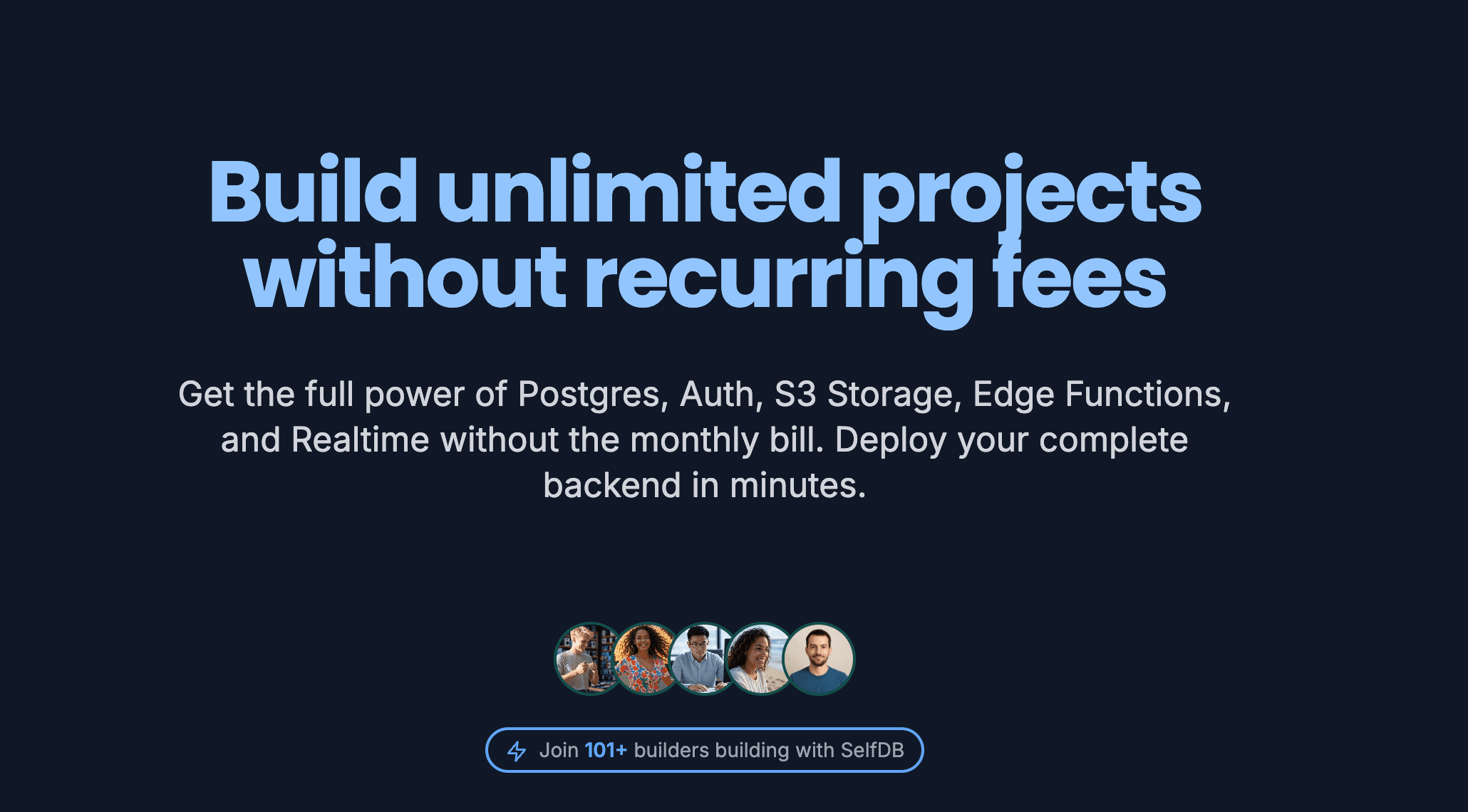
About this app
SelfDB is a powerful open-source backend-as-a-service (BaaS) that enables developers to host their own backend infrastructure, providing essential features like real-time databases, authentication, and file storage without vendor lock-in. It's designed for tech-savvy users who prioritize data sovereignty, cost efficiency, and customization, making it ideal for indie developers, enterprise teams with compliance needs, and open-source advocates. With a lightweight Go architecture, it ensures high performance and security, though it requires some DevOps expertise for setup and lacks advanced accessibility features.
Key features
- 1Lightweight Go architecture with sub-200ms response times and under 100MB RAM idle usage for excellent performance.
- 2Full control over encryption standards and self-hosted infrastructure, providing top-notch security when properly configured.
- 3Clean left sidebar navigation and Monaco-based editor, intuitive for developers with BaaS experience and VS Code familiarity.
Target customer profile
Drawn from the product itself, not from a survey.
Demographic
Indie developers and small tech teams
Pain points
Vendor lock-in, rising Firebase costs, privacy concerns
Primary needs
Full data control, cost efficiency, high customization
Demographic
Enterprise IT departments
Pain points
Compliance requirements, data residency issues, security audits
Primary needs
On-premises hosting, GDPR compliance, robust security protocols
Demographic
Open-source advocates
Pain points
Proprietary cloud services, lack of transparency, limited extensibility
Primary needs
Community-driven development, extensibility, no black-box solutions
Scout Review
Written by AI from measured evidence, scored out of 100.
SelfDB delivers exactly what it promises: a robust, self-hosted backend solution for developers prioritizing data sovereignty and cost control over convenience. It's particularly valuable for indie developers tired of Firebase's pricing surprises, enterprise teams with strict compliance requirements, and open-source advocates seeking transparency. The trade-offs are clear - you gain complete control but must bring your own DevOps expertise. The performance is excellent, security is top-notch when properly configured, and the growth potential in today's privacy-conscious market is significant.
Measure by measure
Usability
80Clean left sidebar navigation, familiar Monaco editor for VS Code users, intuitive for developers with BaaS experience
Design
70Minimal terminal-inspired dark theme with green accents, functional but prioritizes utility over visual polish
Speed
90Lightweight Go architecture with sub-200ms response times, idles under 100MB RAM, excellent local performance
Security
90Full control over encryption standards and access policies, self-hosted infrastructure, clear security documentation
Accessibility
50Limited accessibility features, no screen reader optimization, English-only interface, requires terminal proficiency
Growth
90Growing demand for self-hosted alternatives, privacy-conscious market expansion, open-source community potential
Improvement areas
- Limited accessibility features, including no screen reader optimization, high-contrast modes, or multi-language support beyond English.
- High setup complexity requiring DevOps expertise for SSL/TLS, firewalls, and infrastructure configuration.
- Intimidating for beginners due to terminal-inspired design and lack of visual polish or guided tutorials.
Design & Usability
SelfDB's interface embraces a developer-first philosophy with its terminal-inspired dark theme and green accent colors. The navigation is straightforward with a clean left sidebar organizing database, authentication, and storage functions. While it lacks the visual polish of competitors like Supabase, the Monaco-based query editor will feel instantly familiar to VS Code users. Real-time data sync works reliably during testing, with changes reflecting instantly across connected clients. The design clearly prioritizes functionality over aesthetics, making it intuitive for technical users but potentially intimidating for beginners or non-developers.
Speed & Security
Built on a lightweight Go architecture, SelfDB delivers impressive performance with sub-200ms response times during concurrent connection testing and idles at under 100MB RAM. The self-hosting model is where security truly shines - you maintain complete control over encryption standards, access policies, and infrastructure security. While you'll need to configure SSL/TLS and firewalls yourself, the documentation provides clear guidance on securing Redis and PostgreSQL connections. This isn't a zero-config solution, but the trade-off is unparalleled security control for teams with the expertise to implement it properly.
Accessibility & Growth
Accessibility is SelfDB's weakest area, with limited features for diverse user needs. There's no screen reader optimization, high-contrast modes, or multi-language support beyond English. The CLI tools require terminal proficiency, creating barriers for less technical users. However, the growth potential is substantial given the increasing demand for self-hosted, privacy-focused alternatives to major cloud providers. The open-source nature and community-driven development model position it well for expansion as more developers seek to avoid vendor lock-in and rising cloud costs.
Conclusion
If you're a developer or team ready to trade managed convenience for complete infrastructure control, SelfDB is an exceptional choice. It's perfect for those with DevOps skills who want to escape vendor lock-in while maintaining Firebase-like functionality. The learning curve is real, but the payoff in data sovereignty and long-term cost savings makes it worthwhile. For privacy-focused projects or regulated industries, this might be the backend solution you've been searching for.
Suggestions for improvement
- Add basic high-contrast theme and screen reader support to improve accessibility.
- Develop guided deployment scripts for common cloud platforms to reduce setup complexity.
- Expand documentation with real-world architecture examples and use cases.
- Implement granular user role management for enterprise teams with multiple stakeholders.
- Create a community plugin system to extend functionality without bloating the core platform.
- Consider adding basic multi-language support to reach non-English speaking developers.
Alternatives comparison
Named competitors, point by point. Nobody paid to appear here or to be left out.
 SelfDB |  Firebase |  Supabase |  Appwrite | |
|---|---|---|---|---|
| Hosting Model | Self-hosted, full infrastructure control | Google-managed cloud, vendor lock-in | Cloud-first with some self-host options | Self-hosted but heavier resource requirements |
| Database Technology | Custom implementation with Redis/PostgreSQL | Proprietary real-time database | PostgreSQL-based with real-time capabilities | Multiple database support |
| Resource Efficiency | Lightweight Go architecture (<100MB RAM) | Managed, variable resource usage | Moderate resource requirements | Heavier resource needs |
| Setup Complexity | High (requires DevOps expertise) | Low (managed service) | Medium (cloud-first but some self-host) | Medium (self-hosted with guides) |
| Cost Structure | Self-hosted (infrastructure costs only) | Usage-based pricing (can be expensive) | Freemium cloud with enterprise options | Open-source with paid hosting options |
Firebase
Google's managed BaaS with real-time database but involves vendor lock-in and potential cost issues.
Supabase
An open-source Firebase alternative based on PostgreSQL, but it is cloud-first and may not offer the same level of self-hosting control.
Appwrite
A self-hosted backend solution with a more polished UI but requires heavier resources and may not be as lightweight as SelfDB.
Comparing options? See SelfDB alternatives, scored side by side
More Development & Engineering apps
View all Development & Engineering
Vibe Coding Agent Skills
92A free, open-source platform offering 110 AI agent skills...

CreateMyCoin
92A no-code Solana token creator that deploys SPL tokens in...

CC Switch
91Open-source desktop app for switching AI coding providers...

DemoVexa
90Turn your code into professional product demo videos with AI-generated scripts, animated UI, and natural voiceovers.

TaxID
90Fast EU VAT validation API for developers, covering 27 EU...

FontPlop
89Browser-based font viewer & tester for TTF, OTF, WOFF, WO...

deed.page
89Permanent web hosting for AI agents, no human step

Webfetch
89Web scraping API that turns any URL into HTML, text, Mark...

Claw Messenger
88Claw Messenger is an iMessage API service that gives AI a...

PERM Processing Time: Current DOL Queue & History
88PERM Processing Time is an independent data analysis platform that helps users navigate the U.S. Department of Labor’s permanent labor certification process.

DataHabibi
88AI-powered Dubai real estate data platform with 12M+ DLD ...

BeartIMAGE
88BeartIMAGE is a free, web-based image processing platform engineered for fast, bulk photo editing and conversion directly in your browser.


A platform dedicated to providing unbiased reviews of newly launched applications, analyzing everything from their features to their full potential.
info@scoutforge.net© 2026 Scoutforge. All rights reserved.
