Cycling through all six. Tap any point to stop.
Measured on six things
One prepaid API for AI chat, images, video and audio
Growth
58Real problem — juggling a dozen provider accounts and bills — with a specific wedge: prepaid-only, per-key caps, visible per-request cost. But OpenRouter and Together AI already own this category and the domain is brand new.
Screenshots
1 / 1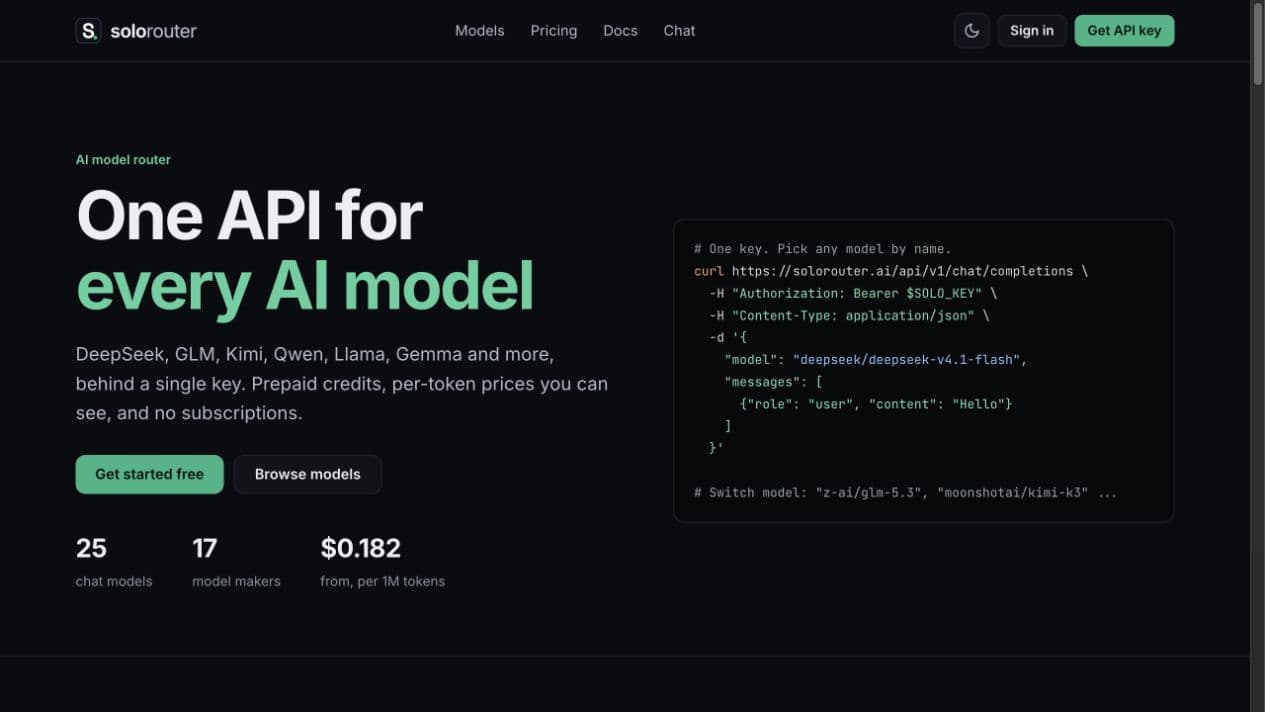
About this app
Solo Router gives developers one API key and prepaid balance for AI models from DeepSeek, GLM, Kimi, Qwen, Llama, Gemma and other providers. Build chatbots, coding agents and retrieval workflows using standard chat-completions requests, streaming, tool calling, JSON mode and reasoning output. The API also supports images, video, speech, music, embeddings and reranking. Browser chat uses the same balance. Free starter credit lets developers try the service; paid top-ups start at $5 with usage-based pricing and no subscription. Per-key spending limits and visible usage costs help control budgets.
Key features
- 1One API key and prepaid balance for 25+ chat models from DeepSeek, Z.ai, Moonshot, Alibaba, Meta, Google, and MiniMax.
- 2Standard chat-completions format with drop-in base-URL swap for LangChain, Cline, Continue, Open WebUI, and LibreChat.
- 3Per-key spending caps with pre-reserved max cost per request, plus usage.cost in every response.
- 4Multimodal endpoints: images (FLUX, SD3.5), video (Wan 2.2), speech (Qwen TTS, ElevenLabs), music, embeddings, reranking.
- 5Streaming, tool calling, JSON mode, and reasoning output passed through on supporting models.
Target customer profile
Drawn from the product itself, not from a survey.
Demographic
AI developers and engineers building coding agents
Pain points
Managing multiple AI provider integrations and accounts.
Primary needs
Standard chat-completions requests with one API key.
Demographic
Startups and small teams integrating AI features into products
Pain points
Keeping API spending visible while testing AI features.
Primary needs
Prepaid usage, per-key spending limits and visible costs.
Demographic
AI enthusiasts and researchers exploring multiple models
Pain points
Comparing model choices through a consistent API.
Primary needs
A choice of AI models with transparent usage pricing.
Demographic
Product teams adding multimodal AI (image, video, audio) to apps
Pain points
Integrating multiple AI modalities into one product.
Primary needs
Image, video, speech, music, embeddings and reranking endpoints.
Scout Review
Written by AI from measured evidence, scored out of 100.
Solo Router is a clean, competent AI model router with a genuinely useful angle: prepaid-only billing, per-key spending caps, and per-request cost reporting that makes runaway API bills structurally harder. The site is fast (Lighthouse 89 mobile), accessible (98/100), and the docs are the kind developers actually want — working curl, Python, and JS in the first scroll. Security headers are mostly in place at 10/13. The honest limits: it's entering a category OpenRouter and Together AI already dominate, there's no SOC 2 or audit to reassure buyers, and the design is competent rather than memorable. For a solo dev or small team that wants to try DeepSeek, GLM, Kimi, and Qwen without opening four accounts, the $0.25 free credit and $5 minimum top-up make it a low-risk experiment. For anyone who needs enterprise procurement sign-off, it's not there yet.
Measure by measure
Usability
68Quickstart covers curl, Python, and JS plus streaming, images, video, and TTS in one page. Google sign-in provisions a key immediately with $0.25 free credit. Drop-in base-URL swap for LangChain, Cline, Continue, and Open WebUI is the real selling point.
Design
71Dark, code-first landing page that leads with a working curl example instead of stock hero art. Pricing table is dense but legible. Polished for an early-stage dev tool, though it leans on the same dark-mode template most AI infra sites use.
Speed
74Lighthouse mobile 89/100 with LCP 2.7s and TBT 111ms; desktop 85/100. Marketing and docs pages are lightweight and load cleanly. No user complaints about API latency surfaced in the collected evidence.
Security
72HTTPS enforced with HSTS, frame protection, X-Content-Type-Options, Referrer-Policy, secure cookies, SPF and DMARC — 10/13 probe points. Missing CSP and Permissions-Policy. Claims prompts aren't stored, only token counts and cost. No SOC 2 or audit published.
Accessibility
79Lighthouse accessibility 98/100 with only two failing audits: non-sequential heading order and a visible label without a matching accessible name. No WCAG statement or a11y page published. Strong automated score for an early-stage dev tool.
Growth
58Real problem — juggling a dozen provider accounts and bills — with a specific wedge: prepaid-only, per-key caps, visible per-request cost. But OpenRouter and Together AI already own this category and the domain is brand new.
Improvement areas
- No SOC 2, ISO 27001, or published pen-test — the missing piece for team and enterprise adoption.
- Missing CSP and Permissions-Policy headers per the HTTP probe.
- Two accessibility audit failures: heading order and a visible label without a matching accessible name.
- Browser chat is mentioned in one line with no screenshot or demo on the marketing site.
Design & Usability
Solo Router's site is built for developers who already know what they want: the hero is a curl command, the pricing table lists 39 models with per-1M-token input and output prices, and the docs page hands you working Python and JavaScript snippets instead of a 'contact sales' form. Google sign-in provisions a key and $0.25 of credit immediately, and the drop-in base-URL swap means LangChain, Cline, Continue, and Open WebUI users can point at solorouter.ai/api/v1 without rewriting anything. The design is competent rather than distinctive — dark mode, monospace accents, the same template most AI infra startups ship — but it doesn't get in the way. Where it's thinner: no interactive playground on the marketing site, no comparison tool for picking between models, and the browser chat is mentioned in one line with no screenshot or demo.
Speed & Security
Measured Lighthouse puts mobile performance at 89/100 (LCP 2.7s, TBT 111ms, CLS 0.088) and desktop at 85/100 — solid for a marketing-plus-docs surface, and there's no evidence of API latency complaints in what we could collect. Security is the more interesting story: the HTTP probe found 10 of 13 checklist items in place, including enforced HTTPS, HSTS, frame protection, X-Content-Type-Options, Referrer-Policy, secure cookies, SPF, and DMARC. The two gaps are CSP and Permissions-Policy, both commonly skipped because they're fiddly. The site claims prompts and responses are never stored — only token counts and cost — and per-key spending caps pre-reserve the maximum cost of each request so a runaway agent can't drain the balance. What's missing is third-party validation: no SOC 2, no ISO 27001, no published pen-test, no bug bounty. For a prepaid router handling API keys and billing, that's the gap to close before enterprise teams will look twice.
Accessibility & Growth
Accessibility scores 98/100 on the Lighthouse axe audit, with only two failures: heading elements out of sequential order and a visible text label without a matching accessible name. Both are quick fixes, and neither suggests a systemic problem. What's absent is a published accessibility statement or WCAG conformance claim — normal for an early-stage dev tool, but worth adding if enterprise procurement ever comes knocking. Growth is the harder call. The problem Solo Router names is real: developers genuinely hate managing a dozen provider accounts, reconciling separate bills, and discovering a runaway agent burned $400 overnight. The wedge — prepaid-only billing, per-key spending caps, and per-request cost visible in every response — is specific and defensible against the 'just use OpenRouter' reflex. But OpenRouter and Together AI already own this category, both with broader model catalogs and years of community trust, and the domain was registered in late 2026. The idea has room; the execution window is narrow.
Conclusion
The pitch is narrow and honest: one key, prepaid balance, visible costs, no subscription. That's a real answer to a real annoyance, and the execution backs it up with fast pages, working docs, and sane security defaults. Whether it grows past 'nice alternative to OpenRouter' depends on whether the spending-cap angle resonates with teams burned by surprise bills — and whether the model catalog keeps pace. Worth a $5 test if you're already juggling provider accounts; worth waiting if you need compliance paperwork.
Suggestions for improvement
- Publish a security page with SOC 2 status or a pen-test summary — the missing piece for team adoption.
- Add CSP and Permissions-Policy headers to close the two probe gaps.
- Fix the two accessibility audit failures: heading order and the mismatched accessible label.
- Show the browser chat with a screenshot or short demo — it's mentioned in one line and never shown.
Alternatives comparison
Named competitors, point by point. Nobody paid to appear here or to be left out.
 Solo Router |  OpenRouter |  Together AI | |
|---|---|---|---|
| Unified API for multiple AI models | Yes — 25 chat models across 17 makers, plus image/video/audio/embeddings | Yes — broad catalog of hundreds of models from many providers | Yes — curated set of open-source models |
| Pricing model | Prepaid credits only, top up from $5, 5% card fee, no subscription | Pay-as-you-go with credit purchase; some free models | Pay-as-you-go and reserved capacity tiers |
| Per-key spending limits | Yes — per-key caps with pre-reserved max cost per request | Credit limits and key-level controls available | Team billing controls; per-key caps less emphasized |
| Multimodal endpoints (image, video, audio) | Yes — FLUX, SD3.5, Wan 2.2 video, Qwen TTS, ElevenLabs, Stable Audio | Primarily chat/image; video and audio coverage varies | Image generation and embeddings; video/audio limited |
| Published compliance / audit | None published — no SOC 2, ISO, or pen-test found | SOC 2 Type II reported | SOC 2 Type II and HIPAA options reported |
| Free tier / starter credit | $0.25 free credit on Google sign-in, one per person | Free models available; credit-based paid usage | Free trial credits for new accounts |
OpenRouter
A popular AI model router offering a unified API for many models, with a focus on community and provider diversity.
Together AI
Provides API access to a curated set of open-source models with a focus on performance and scalability.
Comparing options? See Solo Router alternatives, scored side by side
More Development & Engineering apps
View all Development & Engineering
CreateMyCoin
92A no-code Solana token creator that deploys SPL tokens in...

Vibe Coding Agent Skills
92A free, open-source platform offering 110 AI agent skills...

CC Switch
91Open-source desktop app for switching AI coding providers...

TaxID
90Fast EU VAT validation API for developers, covering 27 EU...

DemoVexa
90Turn your code into professional product demo videos with AI-generated scripts, animated UI, and natural voiceovers.

deed.page
89Permanent web hosting for AI agents, no human step

BeartIMAGE
88BeartIMAGE is a free, web-based image processing platform engineered for fast, bulk photo editing and conversion directly in your browser.

Claw Messenger
88Claw Messenger is an iMessage API service that gives AI a...

DataHabibi
88AI-powered Dubai real estate data platform with 12M+ DLD ...

ButterKit
82macOS app for App Store screenshots: 3D mockups, auto-tra...

PERM Processing Time: Current DOL Queue & History
88PERM Processing Time is an independent data analysis platform that helps users navigate the U.S. Department of Labor’s permanent labor certification process.

StockFit API
87A developer-first financial data API providing structured...


A platform dedicated to providing unbiased reviews of newly launched applications, analyzing everything from their features to their full potential.
info@scoutforge.net© 2026 Scoutforge. All rights reserved.
