Cycling through all six. Tap any point to stop.
Measured on six things
AI SaaS starter kit for web, mobile & desktop
Growth
63Real, named pain (rewiring auth/billing/deploy per idea) with a specific wedge: bundled Expo + Tauri + MCP/.ai rules + 8-gateway billing. Crowded category, but the multi-platform + agent-native angle is a genuine differentiator.
Screenshots
1 / 1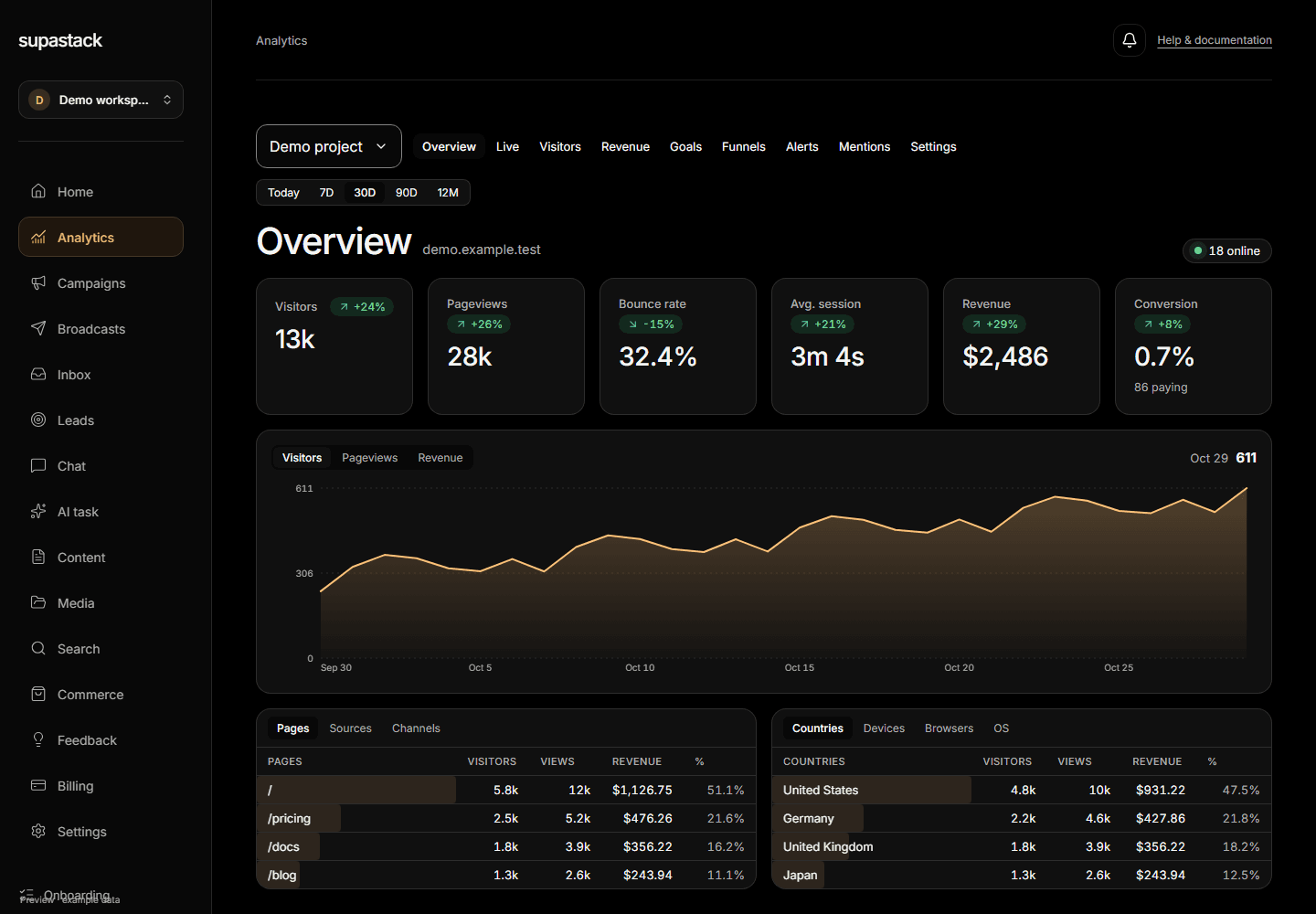
About this app
Supastack is a production-ready AI SaaS starter kit that bundles web, mobile, and desktop apps into a single TypeScript monorepo. Built on Next.js or TanStack Start for the web, Expo for iOS/Android, and Tauri for macOS/Windows/Linux, it ships pre-wired authentication (Better Auth with social and magic-link logins), multi-provider billing (Stripe, Lemon Squeezy, Paddle, Polar, and more), AI chat with provider routing and per-workspace spending budgets, background jobs, transactional email, S3-compatible storage, i18n across 13 locales, and observability—all governed by one typed environment schema and Drizzle/Postgres data layer. What really sets it apart is that it's designed for AI coding agents: it ships with .ai rule files and a built-in MCP server so tools like Claude Code, Cursor, or Copilot can extend the codebase without breaking its conventions. You get lifetime updates, unlimited commercial projects, and no vendor lock-in for a one-time price starting around $199. Founded ...
Key features
- 1One TypeScript monorepo covering Next.js/TanStack web, Expo mobile and Tauri desktop with shared auth and billing.
- 2Agent-native tooling: .ai rule files and a built-in MCP server for Claude Code, Cursor and Copilot.
- 3Eight payment providers (Stripe, Lemon Squeezy, Paddle, Polar and more) plus AI routing with per-workspace spend budgets.
Target customer profile
Drawn from the product itself, not from a survey.
Demographic
Solo indie hackers & bootstrapped SaaS founders
Pain points
Rewiring auth, billing, and deployment for every new idea wastes weeks before real product work begins
Primary needs
A proven, reusable foundation they can vibe-code on top of and ship to web, mobile, and desktop fast
Demographic
Small dev agencies & freelance product builders
Pain points
Client projects demand multi-platform delivery, reliable billing, and white-label handoff on tight timelines
Primary needs
Multi-seat licensing, unlimited client projects, and a single codebase that covers every app surface
Demographic
Non-technical founders & marketers using AI coding tools
Pain points
AI agents generate brittle code when scaffolding setup from scratch, and non-coders struggle with backend wiring
Primary needs
Pre-built AI agent rules, MCP integration, and readable documentation that make Claude Code or Cursor productive immediately
Demographic
Full-stack developers launching AI-powered products
Pain points
Managing multiple AI providers, spend caps, encrypted keys, and eight payment gateways is tedious to build safely
Primary needs
Built-in AI routing with usage budgets, secure key storage, and ready-to-charge billing with mobile in-app purchases
Scout Review
Written by AI from measured evidence, scored out of 100.
Supastack is a production-ready AI SaaS starter kit bundling web, mobile and desktop into one TypeScript monorepo, with Better Auth, eight payment providers, AI routing with spend budgets, background jobs, S3 storage, i18n across 13 locales and observability — all governed by one typed env schema and Drizzle/Postgres. The differentiator is agent-native tooling: .ai rule files and a built-in MCP server so Claude Code, Cursor or Copilot can extend the codebase without breaking conventions. At $199 one-time with lifetime updates and unlimited commercial projects, it undercuts the per-project math of building from scratch. The landing page is genuinely well-crafted, the docs are agent-readable, and the security surface is clean. Weaknesses: mobile LCP of 5.3s, no published compliance audits, and a dense calculator section that buries the value.
Measure by measure
Usability
74Live tabbed demo across four frameworks, a 5-minute docs quickstart with exact Windows/macOS commands, and /llms.txt + /skill.md for agents. Onboarding is genuinely fast; the calculator and monorepo sections get dense and grey.
Design
71Editorial serif headlines, a single disciplined orange accent, and a live framework/flow switcher showing real repo screens. Distinctive and premium for a dev-tool lander; the near-invisible logo strip and overlapping screenshot labels cost it polish points.
Speed
68Desktop Lighthouse 96/100 is excellent, but mobile lands at 79 with a 5.3s LCP — well past the 2.5s 'good' line. CLS 0 and TBT 30ms show the page is stable and not JS-thrashing; the hero media is the weight.
Security
7613/13 on the header/DNS probe: HSTS, CSP, frame protection, Permissions-Policy, secure cookies, SPF and DMARC all present. No SOC 2, ISO, pen-test or bug-bounty claim surfaced, so the score reflects a clean surface rather than audited depth.
Accessibility
82Lighthouse a11y 97/100 with only two minor fails (list markup, label/name mismatch). Ships 13 locales and 30+ themes. No WCAG statement or a11y page found, so the score sits high on automated evidence, not on documented commitment.
Growth
63Real, named pain (rewiring auth/billing/deploy per idea) with a specific wedge: bundled Expo + Tauri + MCP/.ai rules + 8-gateway billing. Crowded category, but the multi-platform + agent-native angle is a genuine differentiator.
Improvement areas
- Mobile Lighthouse LCP of 5.3s — hero media needs compression or lazy-loading.
- No published SOC 2, ISO, pen-test or bug-bounty evidence despite handling payments and API keys.
- Two accessibility fails (list markup, label/name mismatch) and no WCAG statement despite 13 locales.
Design & Usability
Supastack's landing page is a cut above the boilerplate category. Serif display type over a dark palette with one orange accent gives it an editorial voice most dev-tool sites lack, and the 'Real screens from the repo' switcher — Next.js, TanStack Start, Expo, Tauri, with flows for sign-in, onboarding, commerce and AI chat — shows the product instead of describing it. Usability backs that up: a live demo, a 5-minute quickstart with exact Windows and macOS commands, and /llms.txt plus /skill.md so agents can read the docs directly. The friction is density — the build-vs-buy calculator and monorepo tree pile on small grey labels that are hard to scan, and the framework logo strip is nearly invisible.
Speed & Security
Speed is split down the middle: desktop Lighthouse 96/100 is genuinely fast, but mobile lands at 79 with a 5.3s LCP — the hero media is carrying too much weight for a phone. CLS 0 and TBT 30ms confirm the page is stable and not JS-bound, so the fix is asset optimization, not architecture. Security is the cleanest dimension on paper: 13/13 on the header and DNS probe, with HSTS, CSP, frame protection, Permissions-Policy, secure cookies, SPF and DMARC all present. What's missing is depth — no SOC 2, ISO, pen-test or bug-bounty claim surfaced, which for a kit wiring eight payment gateways is a gap worth closing.
Accessibility & Growth
Accessibility scores 97/100 on Lighthouse with only two minor fails — list markup containing non-<li> elements and some visible-text labels without matching accessible names. The site ships 13 locales and 30+ themes, which is more internationalization than most competitors bother with, though there's no WCAG statement or dedicated a11y page. Growth is a judgement on the idea: the pain is real and specific (rewiring auth, billing and deployment for every new SaaS), and the wedge against Supastarter, ShipFast, MakerKit and TurboStarter is concrete — bundled Expo mobile and Tauri desktop, an MCP server with .ai rule files, eight payment gateways, and per-workspace AI spend budgets. The category is crowded, but the multi-platform plus agent-native angle is a defensible position for indie hackers and small agencies.
Conclusion
If you're a solo founder or small agency who has rebuilt auth and billing one too many times, Supastack's pitch is aimed squarely at you — and the multi-platform plus MCP angle is a real reason to pick it over ShipFast or Supastarter. The $199 one-time price with unlimited commercial projects is the kind of offer that pays for itself on the first client engagement. What would move this from good to excellent: fix the mobile LCP, publish a security page with at least a pen-test summary, and add an accessibility statement to match the 97 Lighthouse score. The foundation is solid; the polish is what separates it from the pack.
Suggestions for improvement
- Cut mobile LCP from 5.3s — compress or lazy-load the hero media; desktop is already at 96.
- Publish a security page with pen-test summary or SOC 2 roadmap; eight payment gateways deserve more than headers.
- Add an accessibility statement and fix the two Lighthouse fails (list markup, label/name mismatch).
- Simplify the build-vs-buy calculator — fewer grey labels, clearer hierarchy, or collapse it behind a toggle.
Alternatives comparison
Named competitors, point by point. Nobody paid to appear here or to be left out.
 Supastack |  Supastarter |  ShipFast |  MakerKit | TurboStarter | |
|---|---|---|---|---|---|
| Platform coverage (web / mobile / desktop) | Web (Next.js or TanStack Start) + Expo mobile + Tauri desktop in one monorepo | Web only (Next.js / Nuxt); no native mobile or desktop | Web only (Next.js) | Web only (Next.js, Remix, Angular) | Web only (Turborepo template) |
| AI agent tooling (MCP / .ai rules) | Built-in MCP server, .ai rule files, /llms.txt and /skill.md docs | Not advertised | Not advertised | Not advertised | No dedicated MCP workflow |
| Payment provider support | Eight providers (Stripe, Lemon Squeezy, Paddle, Polar and more) | Stripe and Lemon Squeezy | Stripe | Stripe and Lemon Squeezy | Stripe and Lemon Squeezy |
| AI usage budgets / provider routing | Multi-provider routing with per-workspace spending caps and cost tracking | Not built in | Not built in | Not built in | No dedicated AI router |
| Pricing model | $199 one-time, lifetime updates, unlimited commercial projects | One-time license, tiered by project count | One-time license, tiered | One-time license, tiered | One-time license, tiered |
Supastarter
A popular Next.js and Nuxt SaaS boilerplate with auth, payments, and i18n, but lacks native mobile, desktop, and MCP-first AI agent tooling.
ShipFast
A lean Next.js SaaS boilerplate focused on rapid web launches with Stripe and auth, without mobile/desktop apps or multi-provider billing.
MakerKit
A modular SaaS starter kit for Next.js, Remix, and Angular with strong auth and billing, though it doesn't bundle Expo, Tauri, or built-in AI usage budgets.
TurboStarter
A Turborepo-based SaaS template with auth and payments, but narrower platform coverage and no dedicated AI router or MCP workflow.
Comparing options? See Supastack alternatives, scored side by side
More Development & Engineering apps
View all Development & Engineering
Vibe Coding Agent Skills
92A free, open-source platform offering 110 AI agent skills...

CreateMyCoin
92A no-code Solana token creator that deploys SPL tokens in...

CC Switch
91Open-source desktop app for switching AI coding providers...

DemoVexa
90Turn your code into professional product demo videos with AI-generated scripts, animated UI, and natural voiceovers.

TaxID
90Fast EU VAT validation API for developers, covering 27 EU...

FontPlop
89Browser-based font viewer & tester for TTF, OTF, WOFF, WO...

Denpex
89AI-powered GPU failure diagnosis for distributed ML training

deed.page
89Permanent web hosting for AI agents, no human step

Webfetch
89Web scraping API that turns any URL into HTML, text, Mark...

Claw Messenger
88Claw Messenger is an iMessage API service that gives AI a...

PERM Processing Time: Current DOL Queue & History
88PERM Processing Time is an independent data analysis platform that helps users navigate the U.S. Department of Labor’s permanent labor certification process.

DataHabibi
88AI-powered Dubai real estate data platform with 12M+ DLD ...


A platform dedicated to providing unbiased reviews of newly launched applications, analyzing everything from their features to their full potential.
info@scoutforge.net© 2026 Scoutforge. All rights reserved.
