Cycling through all six. Tap any point to stop.
Measured on six things
AI chat that builds production-ready business apps with d...
Security
52HTTPS, SPF, and DMARC are in place, and Enterprise advertises SSO/SCIM and self-hosting. But HSTS, CSP, frame protection, and Referrer-Policy are all missing — 4/12 header checks. No SOC 2 or ISO claim visible.
Screenshots
1 / 3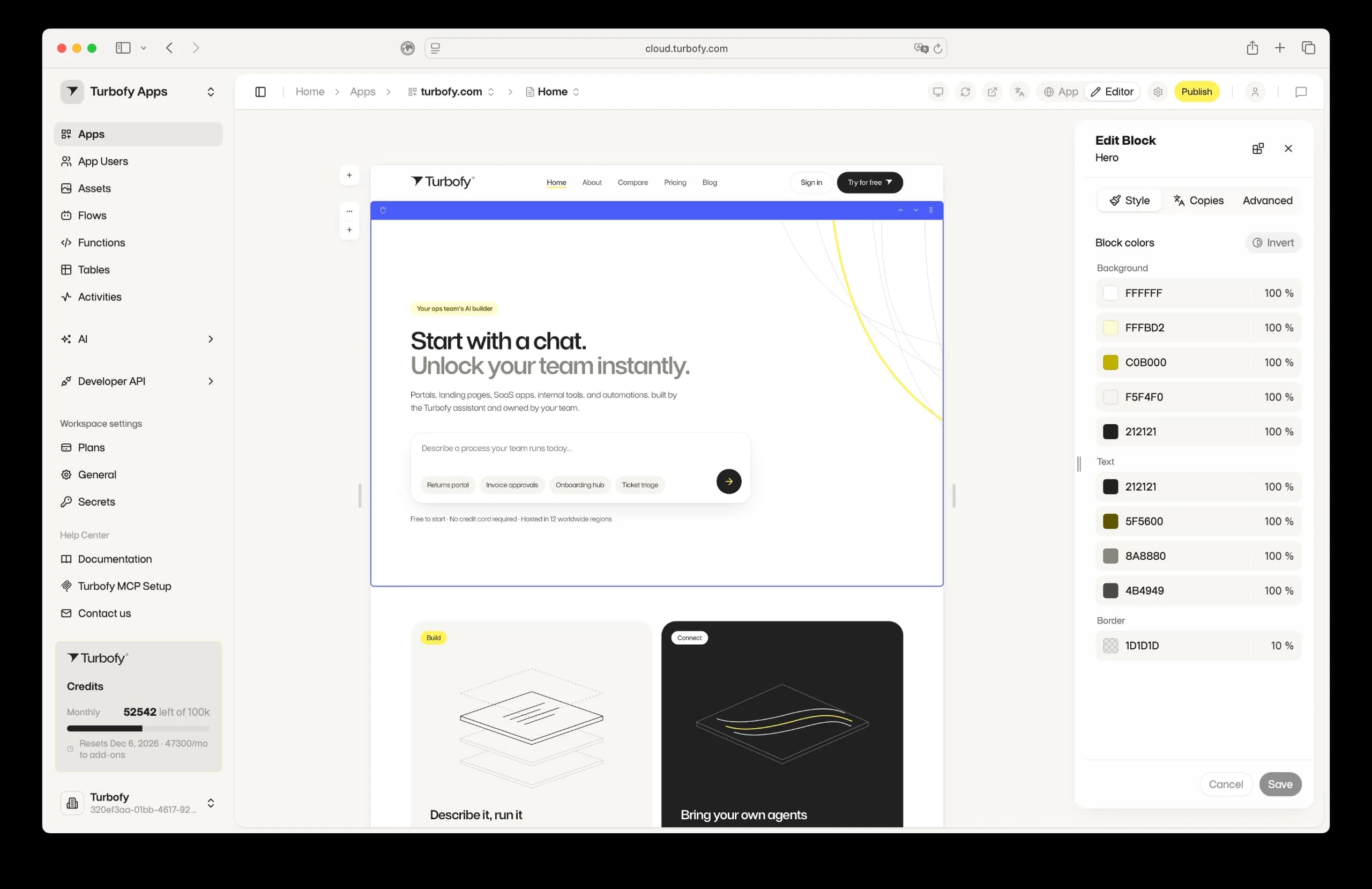
About this app
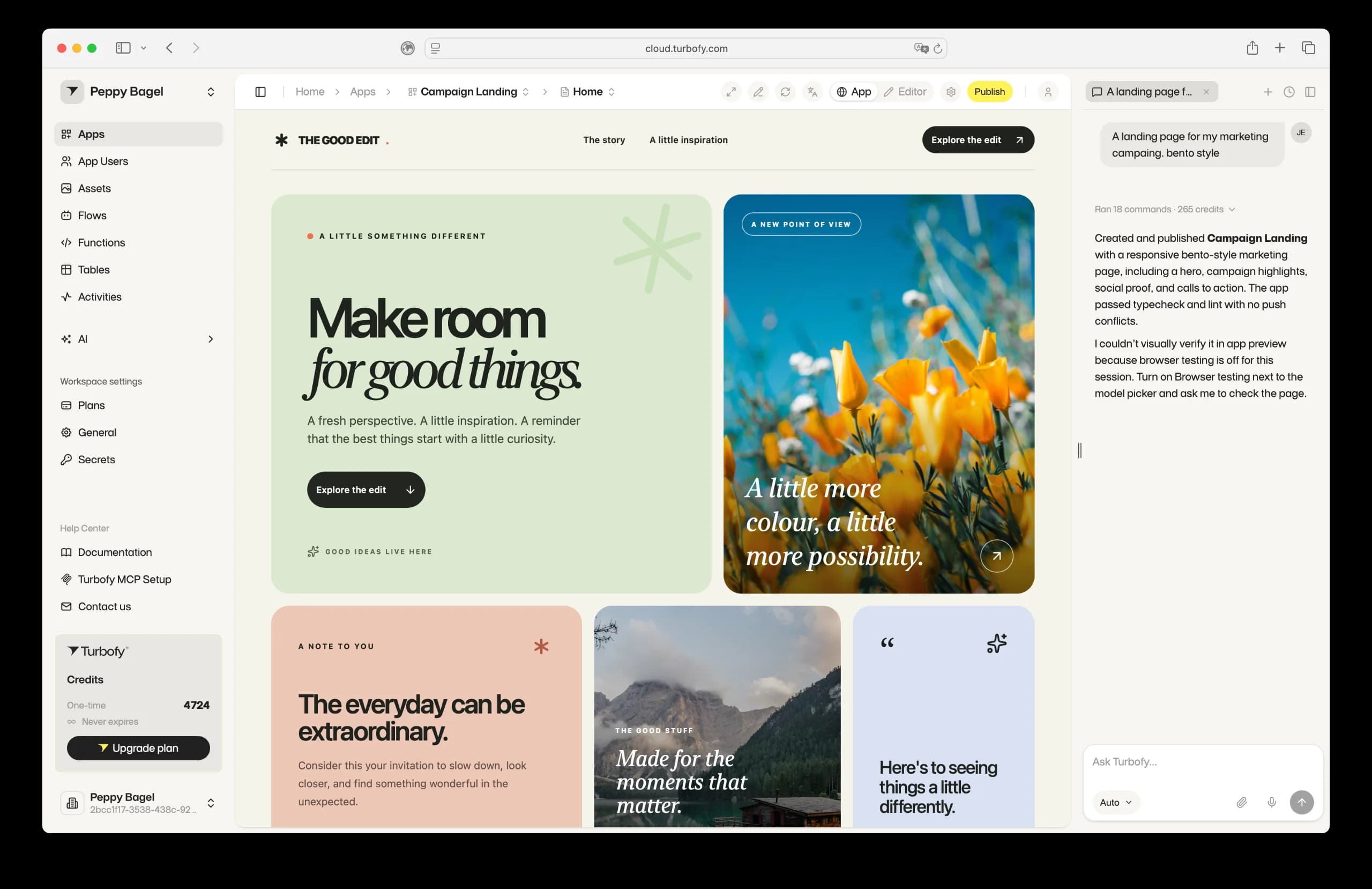
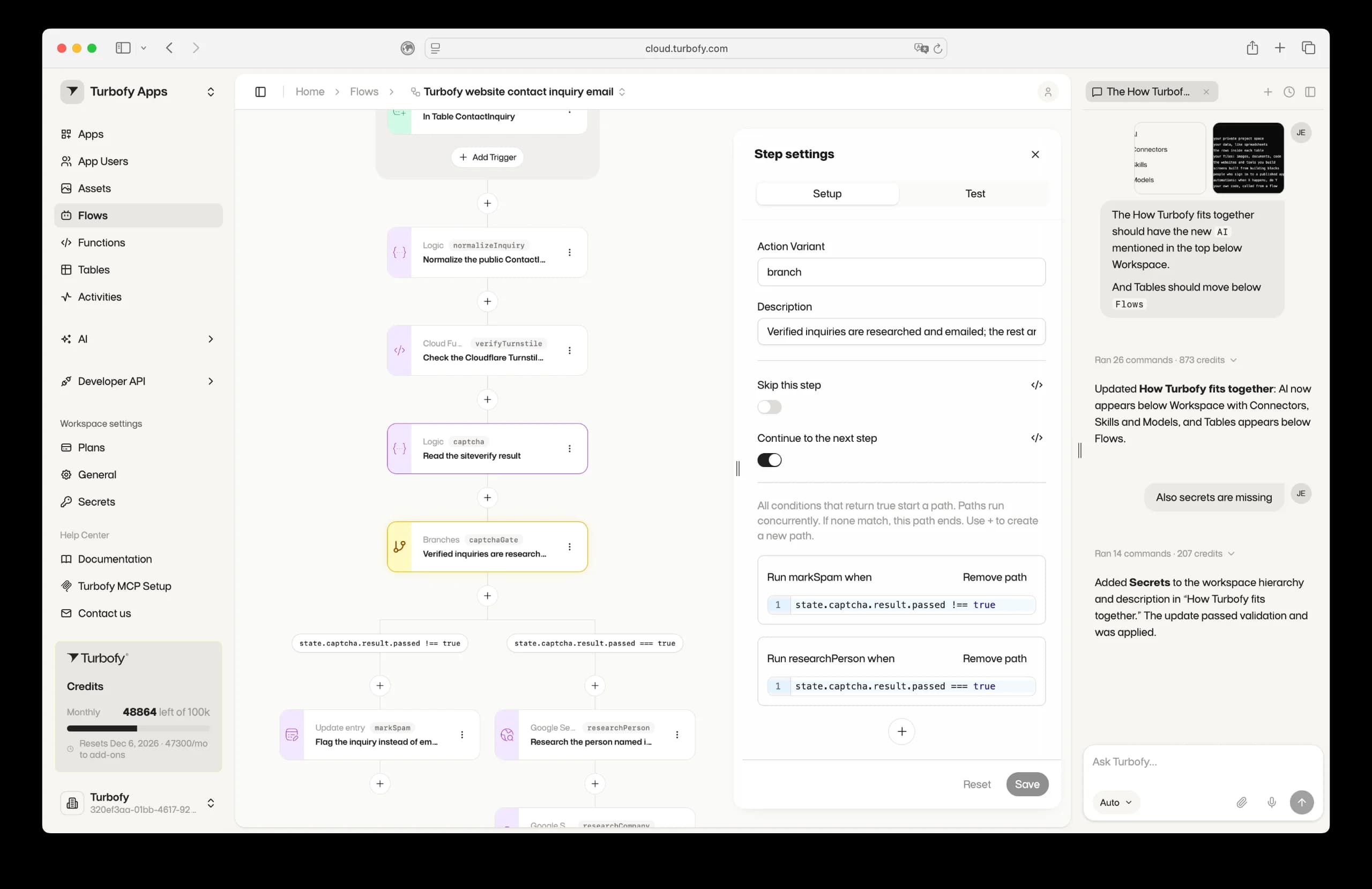
Turbofy is an AI-powered app builder that promises to turn a single conversation into a live, production-ready business application — not just a disposable prototype. What caught my eye is its dual approach: you can either describe the app you need in plain English and let the Turbofy assistant generate the interface, data models, and automations, or connect your own AI coding agent like Claude Code, OpenAI Codex, OpenCode, or Cursor through the Turbofy MCP. That second option is a smart move because it lets developers keep their preferred toolchain while still leveraging Turbofy's built-in hosting, authentication, and data layer. The platform is clearly positioned for operations teams and non-technical builders — I saw real customer stories from a product team shipping weekly features that used to take six months, and a B2B commerce company running a high-performance shop with non-programmers at the helm. Turbofy handles the infrastructure side with hosting across 12 worldwide regi...
Key features
- 1Chat-to-app builder: describe a process in plain English and get interface, data models, and automations
- 2Turbofy MCP connects Claude Code, OpenAI Codex, OpenCode, or Cursor to a governed backend with hosting, auth, and data
- 3Hosting across 12 worldwide regions with custom domains, workspace secrets, and add-ons on paid tiers
Target customer profile
Drawn from the product itself, not from a survey.
Demographic
Operations managers and non-technical team leads
Pain points
Dependent on dev backlog for internal tools; too many spreadsheets
Primary needs
Build portals and approval workflows without writing code
Demographic
Small business owners and startup founders
Pain points
Prototypes that can't scale; high cost of custom software
Primary needs
Affordable production apps that go live and stay live
Demographic
Professional developers using AI coding agents
Pain points
Wiring data, auth, and hosting after AI generates the code
Primary needs
A governed backend their agent tool can plug into via MCP
Scout Review
Written by AI from measured evidence, scored out of 100.
Turbofy is a well-designed, genuinely fast AI app builder with a smart dual strategy: chat-to-app for ops teams, and an MCP that lets developers keep their own coding agents while Turbofy handles hosting, auth, and data. The marketing site is polished, the free tier is real (no credit card), and the speed numbers are excellent. The gaps are security hardening (missing HSTS, CSP, and most headers), no published compliance certifications, and a builder UI that may fight the non-technical users it targets. Growth potential is real if the MCP wedge holds.
Measure by measure
Usability
63Free tier with no card, a hero prompt with example chips, and a builder that surfaces credits and publish in view make the first step easy. Dense small type in the builder's sidebar will slow non-technical users down.
Design
71Tight two-tone hero, disciplined cream/black/yellow palette, and a prompt-first layout that shows the product's action immediately. Proof screenshots are unreadable thumbnails and blog/video art looks like stock template filler.
Speed
82Lighthouse desktop 94/100 with LCP 303ms, CLS 0, and TBT 32ms — genuinely fast. Hosting across 12 regions backs it up. No lag complaints surfaced in the collected evidence.
Security
52HTTPS, SPF, and DMARC are in place, and Enterprise advertises SSO/SCIM and self-hosting. But HSTS, CSP, frame protection, and Referrer-Policy are all missing — 4/12 header checks. No SOC 2 or ISO claim visible.
Accessibility
76Lighthouse accessibility 98/100 with only a missing main landmark failing. Multi-language site and responsive layout. No published WCAG statement or accessibility page, so the score sits mid-band rather than higher.
Growth
68Real problem (ops teams stuck on dev backlog), specific customer (non-technical ops leads), and a genuine dual wedge: chat-to-app plus MCP for developers keeping their own agents. Category has headroom.
Improvement areas
- Security headers incomplete (4/12): missing HSTS, CSP, frame protection, Referrer-Policy, Permissions-Policy
- No published SOC 2, ISO, or pen-test evidence despite 'production-ready' positioning and Enterprise SSO/SCIM claims
- Customer proof screenshots unreadable and blog/video art looks like generic stock content-marketing templates
Design & Usability
Turbofy's marketing site is one of the tighter executions in the AI-builder category: a two-tone hero that puts the prompt field front and center, example chips that kill the blank-page problem, and a cream/black/yellow palette that carries cleanly into the builder UI. The weak spots are downstream — customer proof screenshots shrunk to unreadable thumbnails, and blog/video art that looks like stock template filler next to the otherwise disciplined type. Usability is solid at the entry point: free tier, no credit card, clear CTA. The friction shows up inside the builder, where dense small type in the sidebar and property panel will slow the non-technical ops managers the product is explicitly pitched at.
Speed & Security
Speed is the standout measured dimension: Lighthouse desktop 94/100, LCP 303ms, CLS 0, TBT 32ms — genuinely fast, backed by hosting across 12 regions. Security is the weak link. HTTPS, SPF, and DMARC are present, but HSTS, CSP, frame protection, X-Content-Type-Options, Referrer-Policy, and Permissions-Policy are all missing — 4/12 on header checks. The Enterprise tier advertises SSO/SCIM, dedicated AWS, and self-hosting, which is the right direction, but no SOC 2, ISO, or pen-test claim appears on the site. For a product selling 'production-ready' apps to businesses, that gap matters.
Accessibility & Growth
Accessibility scores well on automated checks — 98/100 with only a missing main landmark failing — and the site is multi-language and responsive. What's missing is the human layer: no WCAG conformance statement, no accessibility page, no keyboard-navigation documentation. Growth is the more interesting story. Turbofy names a real problem (ops teams dependent on dev backlog), a specific customer (non-technical team leads), and a genuine differentiator: the MCP that lets Claude Code, Codex, OpenCode, or Cursor plug into a governed backend. That's a wedge Lovable and Bubble can't easily copy, and it gives the product two on-ramps — chat for non-coders, MCP for developers. The limit is credibility: 'production-ready' is a big claim in a category where most output is still prototype-grade.
Conclusion
If you're an ops lead tired of waiting on the dev backlog, or a developer who wants Claude Code to write into a governed backend instead of a throwaway prototype, Turbofy is worth a serious look — the free tier costs nothing to test. Go in with eyes open on security: ask sales directly about SOC 2 status, header hardening, and data residency before you put anything sensitive on it. The product's ambition is bigger than its current compliance paperwork, and that gap is the thing to close before you call it production-ready.
Suggestions for improvement
- Ship HSTS, CSP, frame protection, and Referrer-Policy headers — the 4/12 score is an easy fix that signals seriousness to enterprise buyers.
- Publish a security page with SOC 2 status, pen-test cadence, and data-residency details; Enterprise buyers will ask for it anyway.
- Enlarge customer proof screenshots so they're actually legible — the Typograph and RM Components stories are strong and currently wasted.
- Add an accessibility statement and fix the missing main landmark; also consider a 'simple mode' toggle in the builder for non-technical users.
Alternatives comparison
Named competitors, point by point. Nobody paid to appear here or to be left out.
 Turbofy |  Lovable |  Bubble | Retool |  Replit Agent | |
|---|---|---|---|---|---|
| Primary build method | Chat-to-app assistant plus MCP for external AI coding agents | Prompt-to-full-stack-app via chat | Visual drag-and-drop no-code editor with workflow logic | Low-code internal tool builder on existing data sources | AI coding agent inside Replit with built-in hosting |
| Bring-your-own AI agent (MCP) | Yes — Claude Code, Codex, OpenCode, Cursor via Turbofy MCP | No native MCP for external agents | No | Limited; Retool AI is built-in, not external-agent MCP | No external-agent MCP |
| Free tier | Yes — €0, 5,000 one-time credits, no credit card | Yes — limited daily credits | Yes — free plan with Bubble branding | Yes — free tier for small teams | Yes — limited free usage |
| Paid entry price | €19/month Professional (annual) | ~$25/month entry paid tier | ~$32/month Starter | ~$10/user/month Team | ~$25/month Core |
| Enterprise self-hosting / dedicated infra | Yes — dedicated AWS account, self-host in existing AWS | No self-host; enterprise plan available | Enterprise plan; no self-host | Yes — self-hosted Retool available | Enterprise plan; no self-host |
| Target user | Ops teams and non-technical builders, plus devs using AI agents | Founders and makers prototyping SaaS | Non-programmers building web apps | Ops and engineering teams building internal tools | Developers and learners coding with AI |
Lovable
AI app builder that turns prompts into full-stack web apps, popular for rapid prototyping and small SaaS launches.
Bubble
Visual no-code development platform for building web apps with database and workflow logic, strong for non-programmers.
Retool
Low-code platform for building internal tools on top of existing data sources, widely used by ops and engineering teams.
Replit Agent
AI coding agent inside Replit that generates and deploys full apps from prompts, with built-in hosting.
Comparing options? See Turbofy alternatives, scored side by side
More Development & Engineering apps
View all Development & Engineering
Vibe Coding Agent Skills
92A free, open-source platform offering 110 AI agent skills...

CreateMyCoin
92A no-code Solana token creator that deploys SPL tokens in...

CC Switch
91Open-source desktop app for switching AI coding providers...

DemoVexa
90Turn your code into professional product demo videos with AI-generated scripts, animated UI, and natural voiceovers.

TaxID
90Fast EU VAT validation API for developers, covering 27 EU...

FontPlop
89Browser-based font viewer & tester for TTF, OTF, WOFF, WO...

Denpex
89AI-powered GPU failure diagnosis for distributed ML training

deed.page
89Permanent web hosting for AI agents, no human step

Webfetch
89Web scraping API that turns any URL into HTML, text, Mark...

Claw Messenger
88Claw Messenger is an iMessage API service that gives AI a...

PERM Processing Time: Current DOL Queue & History
88PERM Processing Time is an independent data analysis platform that helps users navigate the U.S. Department of Labor’s permanent labor certification process.

DataHabibi
88AI-powered Dubai real estate data platform with 12M+ DLD ...


A platform dedicated to providing unbiased reviews of newly launched applications, analyzing everything from their features to their full potential.
info@scoutforge.net© 2026 Scoutforge. All rights reserved.
