Cycling through all six. Tap any point to stop.
Measured on six things
Engineering and token intelligence to optimize the SDLC. Weave shows you the ROI of every AI dollar, benchmarked against thousands of orgs.
Design
30Sparse landing page with empty whitespace, clashing yarn-ball mascot vs engineering category. Chart in maker media is clean and color-coded, but overall presentation feels unfinished.
Screenshots
1 / 1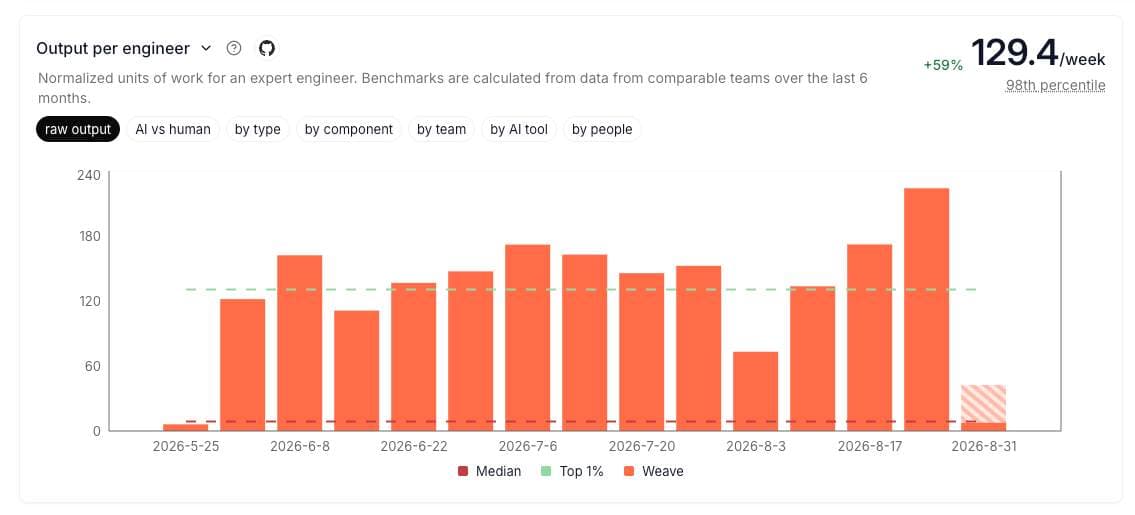
About this app
Weave connects to your GitHub and your AI coding tools and turns both into one picture of how your engineering org actually works. On the output side, Weave normalizes work into comparable units so you can see output per engineer, per team, and per component, then benchmark it against thousands of comparable orgs instead of against your own gut feel. On the cost side, Weave captures token spend from Claude Code, Codex, Cursor, and any AI gateway, then breaks it down by engineer and by model. Line by line AI attribution shows how much code came from a person and how much came from a tool, so cost per unit of output becomes a number you track rather than a number you guess at. Weave also includes Wooly, a research agent with access to your data and our docs, an MCP server and API for pulling metrics into your own workflows, and a router that sends simpler prompts to cheaper models and reports exactly what you saved.
Key features
- 1Engineering intelligence: measures SDLC from prompt to production with DORA, SPACE metrics, and novel AI metrics
- 2Token intelligence: tracks spend across Claude Code, Codex, Cursor, and AI gateways, broken down by engineer and model
- 3Prompt Router: routes simpler prompts to cheaper models, reporting exact savings with quality-per-token scoring
- 4Agent Wooly: research agent with access to org data and docs, available in-app or via MCP server
- 5AI attribution: line-by-line analysis showing human vs AI-generated code per engineer
Target customer profile
Drawn from the product itself, not from a survey.
Demographic
Engineering Leaders & CTOs at tech companies
Pain points
Difficulty in quantifying AI's impact on productivity and code quality; lack of visibility into AI tool ROI; challenges in optimizing token spend.
Primary needs
Need a single dashboard to measure engineering performance, track AI adoption, and make data-driven decisions to improve delivery.
Demographic
AI Engineering Teams & Platform Teams
Pain points
Managing multiple AI models and tools; inefficient token usage and high costs; difficulty in integrating AI measurement into existing workflows.
Primary needs
Need a tool that provides token intelligence, model routing, and seamless integration to reduce costs and improve efficiency.
Demographic
VPs of Engineering & Engineering Managers
Pain points
Limited insight into individual engineer performance; challenges in balancing speed and code quality; struggling to align engineering efforts with business goals.
Primary needs
Need per-engineer analytics and metrics like DORA and SPACE to assess performance, identify bottlenecks, and foster a culture of continuous improvement.
Scout Review
Written by AI from measured evidence, scored out of 100.
Weave tackles a timely, real problem: quantifying AI's impact on engineering productivity and controlling token spend. The product concept is strong — combining engineering intelligence with token intelligence, per-engineer AI attribution, and a cost-optimizing prompt router addresses gaps that traditional SDLC analytics tools miss. However, execution is uneven. The landing page feels unfinished with sparse content and a mismatched mascot, performance is poor at 31/100 Lighthouse, and accessibility has five documented failures. Security claims are impressive on paper (SOC 2 Type II, GDPR, HIPAA) but missing HTTP headers and unverified certifications temper enthusiasm. For engineering leaders drowning in AI tool costs, Weave's value proposition is compelling — if the product delivers what the marketing promises. The 2026 dates on the demo chart and the '500+ organizations' claim warrant scrutiny. Worth a demo, but verify before committing.
Measure by measure
Usability
58Clear feature sections once you scroll, but landing page gives zero context for CTAs. Chart readability decent but missing labels. Router setup appears straightforward with npx command.
Design
30Sparse landing page with empty whitespace, clashing yarn-ball mascot vs engineering category. Chart in maker media is clean and color-coded, but overall presentation feels unfinished.
Speed
31Lighthouse mobile performance 31/100 with LCP 9.5s and TBT 10.7s. CLS is excellent at 0.017, but load times are painful. Heavy interactive elements likely causing the bottleneck.
Security
68SOC 2 Type II, GDPR, HIPAA claims with SSO/SAML/OIDC and SCIM. HTTPS/HSTS present but missing CSP, frame protection, and Permissions-Policy headers. Claims need third-party verification.
Accessibility
56Lighthouse 85/100 with 5 failing audits: color contrast, heading order, link names, touch targets, missing main landmark. No WCAG statement found. Multi-language support not evident.
Growth
72Strong differentiators: prompt router with cost savings, AI attribution per engineer, benchmarking against 1000+ orgs. Category has real headroom as AI coding adoption explodes and token costs become a board-level concern.
Improvement areas
- Landing page needs product value proposition and demo visible above the fold — current design is sparse and unfinished
- Performance optimization critical: LCP 9.5s and TBT 10.7s on mobile will lose enterprise prospects
- Fix accessibility failures: heading hierarchy, link names, touch targets, main landmark, color contrast
- Verify and publish security certifications — missing CSP header and unverifiable SOC 2 claims raise enterprise concerns
Design & Usability
Weave's landing page is a study in contrast: a $13.5M Series A funding banner sits atop a page that's mostly empty off-white space. The yarn-ball mascot feels like it belongs to a different product entirely — playful branding for what's positioned as serious engineering intelligence. Once you scroll past the void, the feature sections are clearly organized: Engineering Intelligence, Token Intelligence, Prompt Router, and Agent Wooly each get dedicated blocks. The maker media chart showing 'Output per engineer' with percentile benchmarks is genuinely informative, though the 2026 dates and missing axis labels undercut its credibility. The primary CTA lacks context — 'Get Started for Free' floats without explaining what setup entails or what the free tier includes. For a product targeting CTOs and engineering leaders, the information architecture works once you commit to scrolling, but the initial impression is more art gallery than analytics platform.
Speed & Security
Performance is the weakest link: Lighthouse scores 31/100 mobile with LCP at 9.5 seconds and TBT at 10.7 seconds — painful for a B2B tool where decision-makers expect snappy demos. The CLS of 0.017 shows the page at least doesn't shift around during load, but that's cold comfort when users wait nearly 10 seconds for content. Security posture is stronger: the site claims SOC 2 Type II certification, GDPR and HIPAA compliance, with SSO (SAML & OIDC) and SCIM provisioning mentioned. HTTP headers show HTTPS with HSTS and X-Content-Type-Options properly set, but CSP, frame protection, and Permissions-Policy are missing — gaps that a serious enterprise buyer would flag in a security review. The compliance claims need third-party verification, but if accurate, they position Weave well for enterprise procurement.
Accessibility & Growth
Accessibility sits at 56/100 — the Lighthouse audit found five specific failures: insufficient color contrast, non-sequential heading order, links without discernible names, undersized touch targets, and a missing main landmark. No WCAG statement or multi-language support is evident. For a product courting Fortune 100 companies, these are fixable but notable gaps. Growth potential is the strongest dimension: Weave addresses a genuinely new problem — measuring AI coding tool ROI and token spend — that incumbents like LinearB, Jellyfish, and Swarmia don't fully cover. The prompt router with cost savings, per-engineer AI attribution, and benchmarking against 1000+ orgs are concrete differentiators. The category has headroom as AI coding adoption explodes and token costs become a board-level concern. The $13.5M Series A and claimed 500+ orgs suggest early traction, though these need verification.
Conclusion
Weave is a promising product in a category that's about to explode — every CTO with AI coding tools is asking 'what am I actually getting for this spend?' The prompt router, per-engineer AI attribution, and benchmarking against thousands of orgs are genuinely differentiated features that LinearB, Jellyfish, and Swarmia don't offer. But the presentation needs work: the landing page undersells the product, performance is a drag, and accessibility gaps could exclude enterprise buyers with compliance requirements. If the SOC 2 Type II and compliance claims hold up under scrutiny, and the product delivers on its metrics promise, Weave could become the default choice for AI-era engineering intelligence. For now, it's a strong idea with execution gaps — worth watching, worth trialing, and worth pushing on the details before you commit your org's data and budget.
Suggestions for improvement
- Replace the yarn-ball mascot with professional branding that matches the engineering intelligence category
- Add a product demo video or interactive walkthrough to the landing page above the fold
- Fix Lighthouse accessibility failures: proper heading hierarchy, named links, larger touch targets, main landmark
- Optimize page performance — target LCP under 2.5s by lazy-loading charts and reducing JavaScript
Alternatives comparison
Named competitors, point by point. Nobody paid to appear here or to be left out.
 Weave Weave |  LinearB LinearB |  Jellyfish Jellyfish |  Swarmia Swarmia | |
|---|---|---|---|---|
| AI coding tool ROI measurement | Dedicated token intelligence tracking spend across Claude Code, Codex, Cursor with per-engineer AI attribution | Focuses on software delivery metrics, no specific AI token spend tracking | Engineering management insights, limited AI-specific cost measurement | Flow and focus analytics, no token intelligence or AI attribution features |
| Prompt routing for cost optimization | Built-in router that classifies prompts and sends to cost-efficient models, reports savings | No prompt routing capability | No prompt routing capability | No prompt routing capability |
| Benchmarking against industry peers | Benchmarks against 1000+ orgs with percentile rankings for output and token spend | Offers benchmarking but primarily against internal historical data | Value stream insights, limited external benchmarking | Flow metrics with some team comparison, not org-level benchmarking |
| Per-engineer AI usage attribution | Line-by-line AI attribution showing human vs AI code per engineer with AI scores | Tracks individual delivery metrics but not AI-specific attribution | Individual performance insights, no AI code attribution | Individual flow metrics, no AI usage tracking |
| Compliance certifications | Claims SOC 2 Type II, GDPR, HIPAA compliance with SSO/SAML/OIDC and SCIM | SOC 2 Type II certified, GDPR compliant | SOC 2 Type II certified, GDPR compliant | SOC 2 Type II certified, GDPR compliant |
LinearB
A software delivery intelligence platform that uses metrics to optimize engineering efficiency.
Jellyfish
An engineering management platform that provides insights into team performance and value streams.
Swarmia
A product development analytics tool that helps engineering teams improve flow and focus.
Comparing options? See Weave alternatives, scored side by side
More Development & Engineering apps
View all Development & Engineering
Vibe Coding Agent Skills
92A free, open-source platform offering 110 AI agent skills...

CreateMyCoin
92A no-code Solana token creator that deploys SPL tokens in...

CC Switch
91Open-source desktop app for switching AI coding providers...

TaxID
90Fast EU VAT validation API for developers, covering 27 EU...

Claw Messenger
88Claw Messenger is an iMessage API service that gives AI a...

PERM Processing Time: Current DOL Queue & History
88PERM Processing Time is an independent data analysis platform that helps users navigate the U.S. Department of Labor’s permanent labor certification process.

DataHabibi
88AI-powered Dubai real estate data platform with 12M+ DLD ...

BeartIMAGE
88BeartIMAGE is a free, web-based image processing platform engineered for fast, bulk photo editing and conversion directly in your browser.

ButterKit
82macOS app for App Store screenshots: 3D mockups, auto-tra...

Credyt
87Real-time monetization infrastructure for AI products tha...

StockFit API
87A developer-first financial data API providing structured...

ProcessSpy
87A native macOS process explorer and advanced monitor that...


A platform dedicated to providing unbiased reviews of newly launched applications, analyzing everything from their features to their full potential.
info@scoutforge.net© 2026 Scoutforge. All rights reserved.