Cycling through all six. Tap any point to stop.
Measured on six things
Unified, pay-as-you-go gateway for the cheapest AI model ...
Accessibility
55No Lighthouse accessibility measurement was available this run. Site content is English-only with no language switcher, and no accessibility statement, WCAG claim or keyboard-navigation notes appear anywhere in the collected content. Scored in the category-typical band on absent measurement.
Screenshots
1 / 3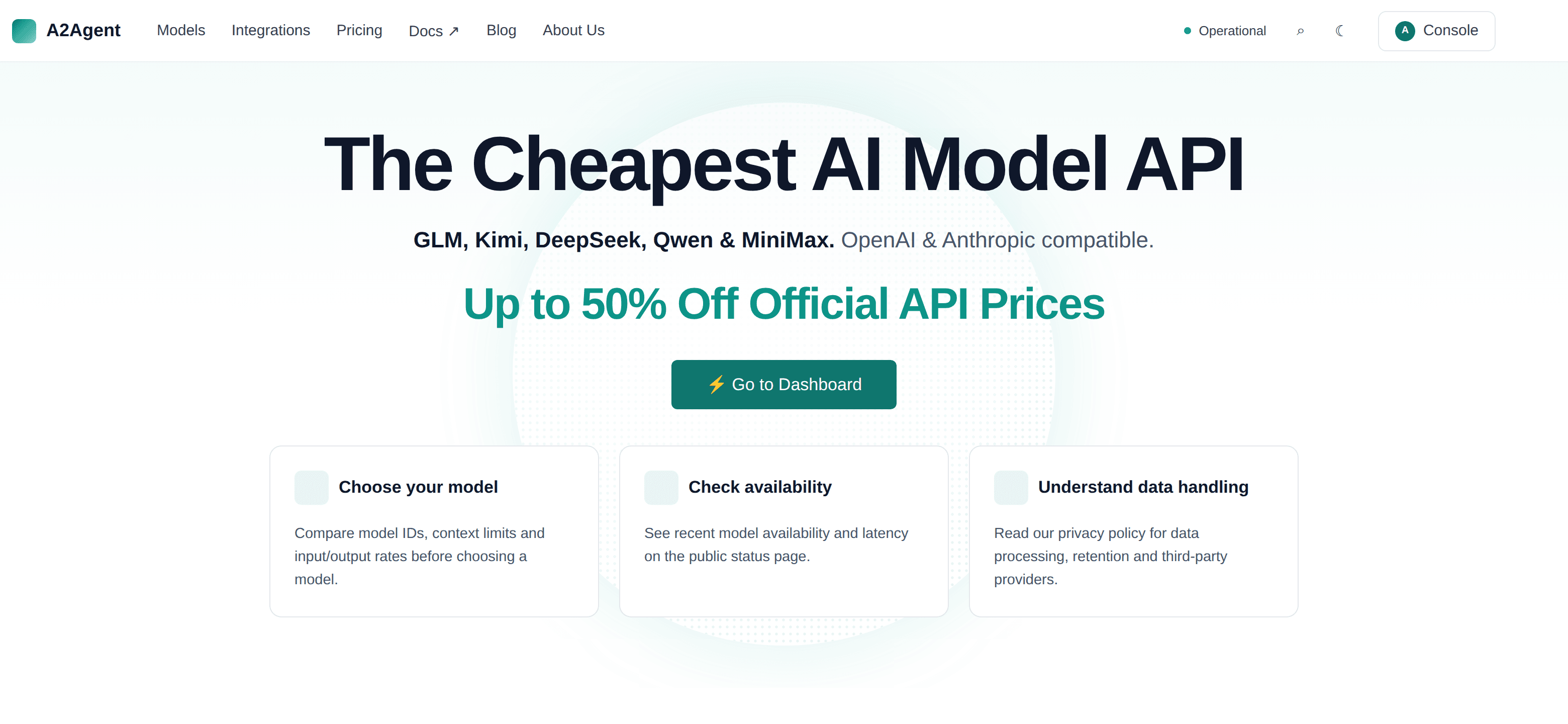
About this app
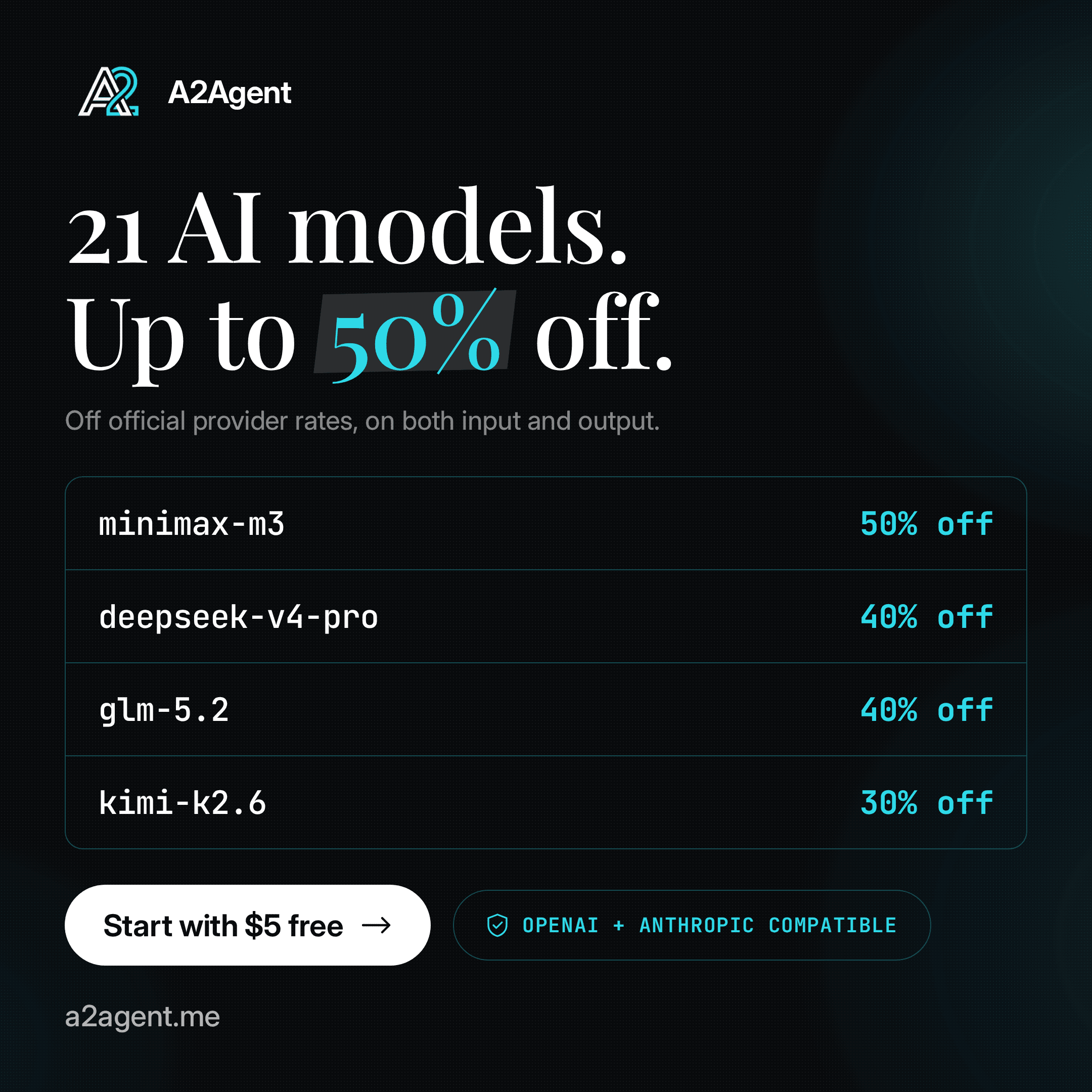
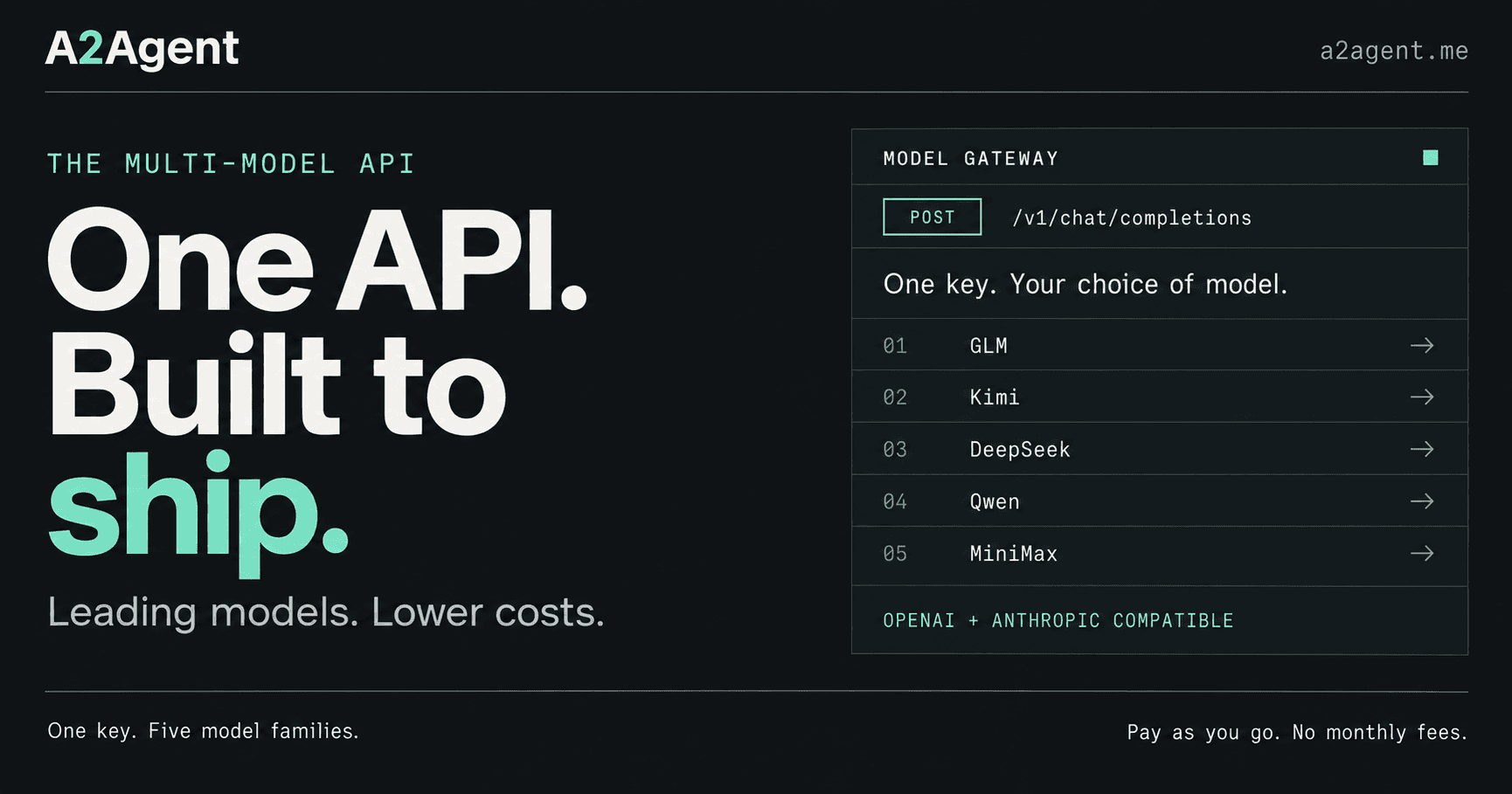
A2Agent is a unified AI model API gateway that bundles access to some of the cheapest and most sought-after large language models — GLM, Kimi, DeepSeek, Qwen, and MiniMax — behind a single API key. Instead of juggling separate accounts, billing dashboards, and SDK quirks for each provider, developers just point their existing OpenAI or Anthropic base URL at A2Agent and swap the model name to switch between families. The platform leans hard into OpenAI and Anthropic compatibility, so existing code, SDKs, and popular coding clients keep working with minimal changes. Onboarding is refreshingly simple: sign up, pick a model, generate an API key, add credits, and fire off your first request. Pricing is purely pay-as-you-go with no monthly fee, per-token metering, and a balance that never expires — a big draw for indie devs, students, and small teams who hate commitment. An enterprise tier adds volume discounts, dedicated concurrency, and higher request-per-minute limits. There's also a p...
Key features
- 1One API key for GLM, Kimi, DeepSeek, Qwen and MiniMax, with model switching by changing the model name.
- 2OpenAI and Anthropic compatible base URLs, so existing SDKs and coding clients work with minimal code changes.
- 3Pay-as-you-go per-token billing with no monthly fee and a balance that never expires; enterprise tier adds volume discounts and dedicated concurrency.
Target customer profile
Drawn from the product itself, not from a survey.
Demographic
Indie developers and solo builders shipping AI features on a budget.
Pain points
Managing multiple provider accounts and unpredictable API costs.
Primary needs
Cheap per-token access to several top models via one key.
Demographic
Small SaaS teams and startups building coding agents or chat apps.
Pain points
Vendor lock-in and code rewrites when switching LLM providers.
Primary needs
OpenAI/Anthropic-compatible endpoints with easy model swapping.
Demographic
Students and AI hobbyists experimenting with reasoning and long-context models.
Pain points
High upfront costs and expiring credits on major platforms.
Primary needs
Low minimum top-ups and a balance that never expires.
Demographic
Enterprise engineering teams scaling production AI workloads.
Pain points
Rate limits and lack of concurrency headroom under heavy traffic.
Primary needs
Volume discounts, dedicated limits, and reliable availability.
Scout Review
Written by AI from measured evidence, scored out of 100.
A2Agent is a multi-model API gateway that bundles GLM, Kimi, DeepSeek, Qwen and MiniMax behind one OpenAI/Anthropic-compatible endpoint. The pitch is real and the onboarding is genuinely simple: four steps, a copy-paste base URL, and a pay-as-you-go model with no monthly fee and a non-expiring balance. The pricing page is unusually transparent, listing per-million-token rates with discount columns and a worked cost comparison against OpenRouter. Security headers are strong at 10/12. Where it falls short is verification: no Lighthouse data for speed or accessibility, no SOC 2 or pen-test evidence, no published latency benchmarks, and support that runs through Discord rather than a help center. It is a competent, clearly positioned indie gateway — not yet a category leader.
Measure by measure
Usability
63Four-step onboarding is clearly spelled out, and the OpenAI/Anthropic base URLs sit right on the homepage for copy-paste migration. Docs, Integrations and a worked OpenRouter cost comparison exist. Community support runs through Telegram and Discord rather than a formal help center.
Design
58No homepage render was captured this run, so no visual verdict is possible. From site content, the layout is a conventional dev-tool marketing page: hero with base-URL snippet, four-step flow, tier cards, FAQ. Functional, not distinctive.
Speed
58No Lighthouse measurement was available this run, so no performance data exists. The homepage ships a live 'Loading model usage…' rankings widget that fetches client-side, and no published latency benchmarks were found. Scored in the category-typical band on absent measurement.
Security
74HTTP probe shows HTTPS enforced, HSTS, CSP, frame protection, X-Content-Type-Options, Referrer-Policy and DMARC — 10/12 checklist points. Missing Permissions-Policy and SPF. Site links a privacy policy covering retention. No SOC 2, ISO or pen-test evidence found.
Accessibility
55No Lighthouse accessibility measurement was available this run. Site content is English-only with no language switcher, and no accessibility statement, WCAG claim or keyboard-navigation notes appear anywhere in the collected content. Scored in the category-typical band on absent measurement.
Growth
62Real, named pain — juggling five provider accounts and billing dashboards. Curated cheap-model bundle plus OpenAI/Anthropic compatibility is a concrete wedge against OpenRouter's broad marketplace and Together/DeepInfra's raw hosting. Pay-as-you-go with non-expiring balance targets indie devs and students specifically.
Improvement areas
- No published latency or throughput benchmarks — critical for an API gateway where speed is the core value proposition.
- No SOC 2, ISO 27001 or pen-test evidence; support runs through Discord and Telegram rather than a structured help center.
- No accessibility statement, WCAG claim or language support; site is English-only with no a11y documentation.
Design & Usability
Design can't be judged this run — the homepage render failed, so the only visuals available were two maker-supplied promo cards, which is not enough to grade a product interface. From the site content, the layout reads as a standard dev-tool marketing page: hero with a copy-paste base URL, a four-step onboarding flow, two pricing tiers, an FAQ, and a model rankings widget. Usability is the stronger half. Onboarding is genuinely simple — sign up, pick a model, generate a key, add credits — and the OpenAI and Anthropic base URLs sit right on the homepage so migration is a two-line change. Docs, Integrations and a worked OpenRouter cost comparison are all present. The weak spot is support: community help runs through Telegram and Discord rather than a structured help center, which is fine for hobbyists and thin for anyone shipping production traffic.
Speed & Security
Speed is unmeasured — the Lighthouse run did not complete, so there is no performance or accessibility data for this product, and I will not invent any. What the site content does show is a live 'Loading model usage…' rankings widget on the homepage, which means client-side fetching on the landing page, and no published latency or throughput benchmarks anywhere. For an API gateway, that is a notable gap: latency is the product. Security is the strongest measured dimension. The HTTP probe returned 10 of 12 checklist points — HTTPS enforced, HSTS, CSP, frame protection, X-Content-Type-Options, Referrer-Policy and DMARC all present. Missing are Permissions-Policy and an SPF record. The site links a privacy policy covering data processing and retention exceptions. What is absent is third-party assurance: no SOC 2, no ISO 27001, no pen-test report, no bug bounty. For an indie-stage gateway that is normal, but it caps how far the score can go.
Accessibility & Growth
Accessibility is unmeasured — no Lighthouse a11y run completed, so there is no contrast, keyboard or screen-reader data. From the site content, the product is English-only with no language switcher, and there is no accessibility statement, WCAG conformance claim or keyboard-navigation documentation anywhere. That is not a flaw so much as an absence, and it is common at this stage, so the score sits in the category-typical band rather than being punished for it. Growth is a judgement on the idea. The problem A2Agent names is real: developers genuinely hate maintaining five provider accounts, five billing dashboards and five SDK quirks. The wedge is a curated bundle of cheap, in-demand model families — GLM, Kimi, DeepSeek, Qwen, MiniMax — behind one OpenAI/Anthropic-compatible key, with pay-as-you-go pricing and a balance that never expires. That is a specific, defensible position against OpenRouter's broad marketplace and Together/DeepInfra's raw open-model hosting. The limit is that the moat is thin: discount tables and compatibility shims are copyable, and OpenRouter already has the model breadth and the user base. The idea can grow, but it needs a wedge the incumbents structurally cannot copy.
Conclusion
If you are an indie dev or a small team who wants cheap access to the current crop of reasoning and coding models without maintaining five provider accounts, A2Agent is worth a look — the compatibility story is the real selling point, and the non-expiring balance removes the usual credit anxiety. If you are shipping production traffic and need latency guarantees, compliance paperwork or an SLA, this is not there yet: no benchmarks, no audits, no formal support tier beyond 'contact sales.' The honest read is that A2Agent is a well-executed indie gateway with a clear wedge and a thin moat. It earns a try, not a migration.
Suggestions for improvement
- Publish real latency and throughput benchmarks per model — for an API gateway, speed is the product and there is currently no data.
- Add a structured help center or knowledge base instead of routing all support through Telegram and Discord.
- Pursue at least a SOC 2 Type I or a third-party pen-test report to give production teams something to point at.
- Add an accessibility statement and run a WCAG audit — the site is English-only with no a11y documentation at all.
Alternatives comparison
Named competitors, point by point. Nobody paid to appear here or to be left out.
 A2Agent |  OpenRouter |  Together AI |  DeepInfra | |
|---|---|---|---|---|
| Model coverage | Curated bundle: GLM, Kimi, DeepSeek, Qwen, MiniMax | Hundreds of LLMs across many providers | Open-source and open-weight models | Popular open models, serverless inference |
| API compatibility | OpenAI and Anthropic compatible endpoints | OpenAI-compatible endpoint | OpenAI-compatible plus native SDKs | OpenAI-compatible endpoint |
| Pricing model | Pay-as-you-go per token, no monthly fee, balance never expires | Pass-through provider pricing plus credit purchase fee | Pay-as-you-go per token | Pay-as-you-go per token, competitive rates |
| Coding-client integration guides | Dedicated integration guides for popular coding clients | Broad client support, community docs | General API docs, less client-specific | API docs, limited client-specific guides |
| Enterprise tier | Volume discounts, dedicated concurrency, higher RPM limits | Enterprise plans with higher limits | Dedicated capacity and enterprise support | Enterprise options available |
| Community support | Telegram and Discord community channels | Large Discord community and docs | Discord and forum support | Discord community and docs |
OpenRouter
A multi-model API aggregator offering access to hundreds of LLMs through a single OpenAI-compatible endpoint, but often at higher margin pricing than a lean gateway.
Together AI
A cloud platform focused on hosting and serving open-source and open-weight models with pay-as-you-go billing, though it leans toward raw open models rather than a curated cheap-model bundle.
DeepInfra
Serverless inference provider with competitive per-token pricing on many popular models, but without the same emphasis on coding-client integration guides and community support as A2Agent.
Comparing options? See A2Agent alternatives, scored side by side
More Development & Engineering apps
View all Development & Engineering
Vibe Coding Agent Skills
92A free, open-source platform offering 110 AI agent skills...

CreateMyCoin
92A no-code Solana token creator that deploys SPL tokens in...

CC Switch
91Open-source desktop app for switching AI coding providers...

TaxID
90Fast EU VAT validation API for developers, covering 27 EU...

DemoVexa
90Turn your code into professional product demo videos with AI-generated scripts, animated UI, and natural voiceovers.

FontPlop
89Browser-based font viewer & tester for TTF, OTF, WOFF, WO...

deed.page
89Permanent web hosting for AI agents, no human step

Webfetch
89Web scraping API that turns any URL into HTML, text, Mark...

Denpex
89AI-powered GPU failure diagnosis for distributed ML training

BeartIMAGE
88BeartIMAGE is a free, web-based image processing platform engineered for fast, bulk photo editing and conversion directly in your browser.

Claw Messenger
88Claw Messenger is an iMessage API service that gives AI a...

DataHabibi
88AI-powered Dubai real estate data platform with 12M+ DLD ...


A platform dedicated to providing unbiased reviews of newly launched applications, analyzing everything from their features to their full potential.
info@scoutforge.net© 2026 Scoutforge. All rights reserved.
