

A platform dedicated to providing unbiased reviews of newly launched applications, analyzing everything from their features to their full potential.
info@scoutforge.net© 2026 Scoutforge. All rights reserved.
A platform dedicated to providing unbiased reviews of newly launched applications, analyzing everything from their features to their full potential.
info@scoutforge.net© 2026 Scoutforge. All rights reserved.
A platform dedicated to providing unbiased reviews of newly launched applications, analyzing everything from their features to their full potential.
info@scoutforge.net© 2026 Scoutforge. All rights reserved.
Cycling through all six. Tap any point to stop.
Measured on six things
Hourly GPU rentals for AI developers from a community mar...
Lighthouse mobile 71/100 with a 6.8s LCP is the weak spot; desktop 76/100 is better. CLS 0 and TBT 130ms are clean. Dynamic price tables that render 'Loading prices…' add perceived latency on first paint.
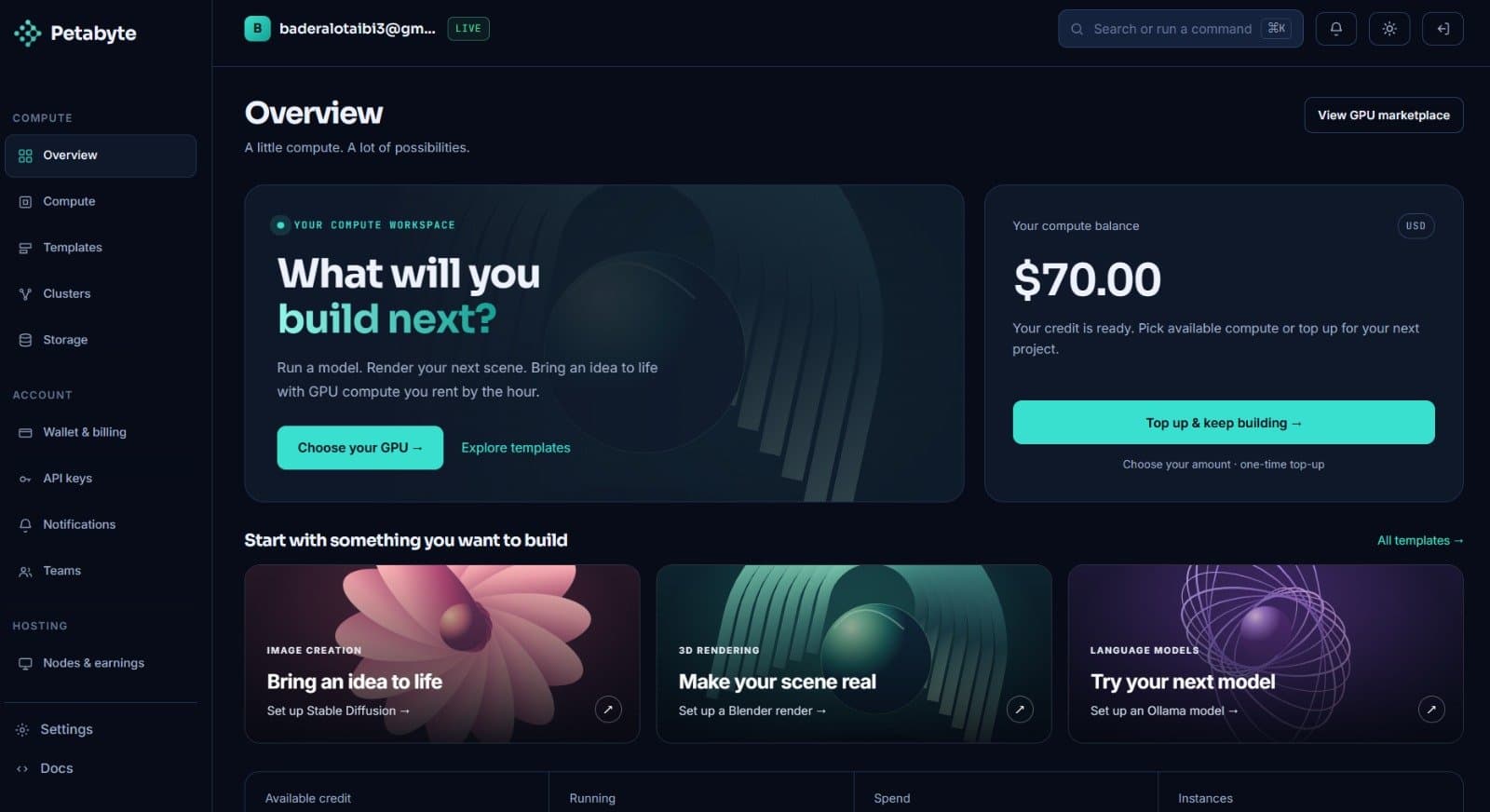
Petabyte is an hourly GPU rental marketplace where AI developers rent compute from independent GPU owners. Whether you're training a model, rendering a 3D scene, or running a game server, Petabyte lets you compare community GPU prices, memory, and availability, and book by the hour with prepayments held in escrow. The platform offers ready-made templates for Stable Diffusion, Blender, Ollama, and Minecraft, so you can start quickly. Sign up with Google, get $10 in free compute credit (no card required), and browse GPUs before committing. One standout feature is the escrow system: your prepayment is held until the work is accepted, giving you peace of mind. However, be aware that on standard hosts, the owner can access your workload data, so it's not suitable for sensitive workloads. Pricing is transparent, with hourly rates set by hosts and unused hours returned at settlement. Petabyte is a solid option for indie developers, researchers, and small teams looking for cost-effective, f...
Drawn from the product itself, not from a survey.
Demographic
AI researchers and data scientists
Pain points
High cost of cloud GPUs, limited access to high-memory GPUs, long wait times for on-premise resources
Primary needs
Affordable, hourly GPU rentals with sufficient VRAM for model training and experimentation
Demographic
3D artists and animators
Pain points
Slow local rendering, expensive render farms, need for scalable GPU power for Blender and other 3D tools
Primary needs
On-demand GPU rendering with easy setup and transparent pricing
Demographic
Indie game developers and gaming communities
Pain points
Costly game server hosting, need for flexible server resources, limited budgets
Primary needs
Hourly game server rentals with simple setup and community GPU options
Written by AI from measured evidence, scored out of 100.
Petabyte is an hourly GPU rental marketplace with a genuinely useful twist: escrow-held prepayments that only release when work is accepted, plus transparent hourly pricing and refunds for unused hours. The design is polished and consistent, the onboarding is low-friction (Google sign-in, $10 no-card credit, browse-before-commit), and the FAQ answers the trust questions most marketplaces dodge. The measured evidence backs this up: Lighthouse accessibility 97/100, full security headers 12/12, and a visual audit calling the homepage 'good.' But the cracks are real. Mobile LCP is 6.8 seconds. There's no SOC 2, ISO, or pen-test published. And the site itself admits that on a standard host, the owner can access your workload data and secrets — confidential execution is 'currently unavailable.' That's honest, but it rules out sensitive workloads entirely. Against Vast.ai, RunPod, and Paperspace, Petabyte competes on escrow and transparency rather than raw scale or compliance. For indie developers running non-sensitive experiments, it's a credible option. For anyone with proprietary data, it's a non-starter until confidential execution ships.
Google sign-in, $10 no-card credit, browse-before-commit, and a 2-minute interactive tour make onboarding genuinely low-friction. FAQ answers the trust questions most marketplaces dodge. Docs depth beyond FAQ is unclear.
Polished, consistent visual language across marketing and console, with a functional hero pricing calculator and scannable template grid. Repetitive dark cards and a dense FAQ wall hold it back from the top of the band.
Lighthouse mobile 71/100 with a 6.8s LCP is the weak spot; desktop 76/100 is better. CLS 0 and TBT 130ms are clean. Dynamic price tables that render 'Loading prices…' add perceived latency on first paint.
Full security-header suite (HSTS, CSP, frame protection, 12/12 probe points) and SPF/DMARC show real hygiene. No SOC 2, ISO, pen-test, or bug bounty published. Site honestly discloses host data-access limits rather than hiding them.
Lighthouse a11y 97/100 with only two failing audits: color contrast and mismatched accessible names on labeled elements. No WCAG statement or multi-language support found. Strong automated score, thin published commitment.
Real problem (cloud GPU costs), specific wedge (escrow-held prepayments, hourly refunds, ready templates), and an honest disclosure that narrows the market to non-sensitive workloads. Differentiated but not defensible.
Petabyte's design is the strongest part of the product. The homepage pairs a bold 'Rent community GPUs by the hour' headline with a live pricing calculator that immediately shows $0.17/hr against an $0.80 cloud reference — that's a real conversion tool, not decoration. The teal accent, numbered how-it-works cards, and matching console UI show genuine consistency between marketing and product. The template grid, however, is 16 near-identical dark cards that blur together, and the FAQ at the bottom is an ungrouped text wall. Usability is close behind: Google sign-in, $10 credit with no card, browse-before-commit, and a 2-minute interactive tour remove almost every excuse not to try it. The FAQ answers the questions competitors bury — escrow scope, host data access, disconnection handling, billing rounding. What's missing is depth beyond the FAQ: no visible API docs, no CLI reference, no troubleshooting guide. For an indie developer evaluating a rental, that gap matters.
Speed is Petabyte's weakest measured dimension. Lighthouse mobile scores 71/100 with a 6.8-second LCP — that's slow enough to lose mobile visitors before the hero renders. Desktop is better at 76/100, and CLS 0 with TBT 130ms shows the layout is stable once it arrives. The dynamic price tables that render 'Loading prices…' add perceived latency on first paint, which is unfortunate given the calculator is the hero's main selling point. Security is a mixed picture. The HTTP probe returns 12/12: HTTPS enforced, HSTS, CSP, frame protection, X-Content-Type-Options, Referrer-Policy, Permissions-Policy, plus SPF and DMARC. That's better hygiene than many early-stage marketplaces. But there's no SOC 2, ISO 27001, pen-test report, or bug bounty published. More importantly, the site itself states that on a standard host, the owner can access workload data and secrets, and confidential execution is 'currently unavailable.' That's an honest disclosure — and a real limitation for anyone with sensitive workloads.
Accessibility scores 97/100 on Lighthouse with only two failing audits: insufficient color contrast and elements with visible text labels lacking matching accessible names. Both are fixable and neither is catastrophic, but the absence of an accessibility statement, WCAG conformance claim, or multi-language support means the commitment is unproven beyond automated checks. Growth is a judgement call on the idea. The problem is real — cloud GPU costs are a genuine pain for indie developers, researchers, and 3D artists. The wedge is specific: escrow-held prepayments that only release when work is accepted, hourly billing with unused hours refunded, and ready-made templates for Stable Diffusion, Blender, Ollama, and Minecraft. That's more differentiation than most GPU marketplaces offer. But the honest disclosure that hosts can access workload data narrows the addressable market to non-sensitive workloads, and the category is crowded with Vast.ai, RunPod, and Paperspace. The domain is under a year old, so traction is unproven. The idea can grow; the question is whether it can grow faster than the incumbents copy the escrow feature.
Conclusion
Petabyte is a well-executed early-stage marketplace with a clear point of view: transparent pricing, escrow-backed payments, and honest disclosure about what the platform can and cannot protect. That honesty is rare and worth something. The design and onboarding are strong enough to convert curious developers into signups, and the template library lowers the barrier for common workloads. But the product is competing in a category where Vast.ai and RunPod already have scale, and Paperspace has enterprise credibility. Petabyte's escrow feature is a real differentiator, but it's also copyable. The 6.8-second mobile LCP is a fixable but currently real problem. The host data-access limitation is a structural constraint that caps the addressable market. If you're an indie developer running non-sensitive experiments and you want transparent hourly pricing with a refund mechanism, Petabyte is worth a look. If you need compliance, confidential execution, or enterprise-grade SLAs, look elsewhere — and the site will tell you the same thing.
Named competitors, point by point. Nobody paid to appear here or to be left out.
 Petabyte Petabyte |  Vast.ai Vast.ai |  RunPod RunPod |  Paperspace Paperspace | |
|---|---|---|---|---|
| Pricing model | Hourly rates set by hosts; 10% platform fee on completed rentals; unused hours refunded at settlement | Hourly rates set by hosts; platform fee varies; interruptible and on-demand pricing tiers | Per-second billing on some tiers; hourly on others; serverless and pod pricing options | Hourly and monthly subscription plans; enterprise pricing available |
| Escrow / payment protection | Prepayment held in escrow until work is accepted; disputed work stays in review | No escrow; payment processed on rental start; disputes handled via support | No escrow; prepaid credits consumed as resources run; refunds case-by-case | No escrow; standard billing with subscription or hourly charges |
| Ready-made templates | Templates for Stable Diffusion, Blender, Ollama, Minecraft, PyTorch, TensorFlow with one-click launch | Docker-based templates and community images; less curated, more flexible | Extensive template library for AI/ML workloads; serverless endpoints | Pre-configured notebooks and VM images for ML frameworks |
| Data privacy / confidential execution | Site states host owner can access workload data and secrets on standard hosts; confidential execution unavailable | Hosts have root access; no confidential computing guarantee; user assumes risk | Secure cloud tier available with isolated environments; community cloud has host access | Enterprise-grade isolation and compliance options; SOC 2 compliant |
| Free trial / starting credit | $10 free compute credit for new accounts; no card required to sign up | No standard free credit; requires deposit to start | Occasional promotional credits; typically requires payment method | Free tier for notebooks with limited GPU hours; paid plans for more |
| Compliance certifications | No SOC 2, ISO, or pen-test published; full security headers (12/12 probe points) | No major compliance certifications publicly listed | SOC 2 Type II compliant; security page with details | SOC 2 compliant; GDPR and HIPAA options for enterprise |
Vast.ai
A marketplace for renting GPU compute from a network of hosts, often at competitive prices.
RunPod
Cloud platform offering GPU rentals with a focus on AI/ML workloads, including serverless options.
Paperspace
Cloud computing platform providing GPU-backed virtual machines and notebooks for developers and researchers.
Comparing options? See Petabyte alternatives, scored side by side

A no-code Solana token creator that deploys SPL tokens in...

A free, open-source platform offering 110 AI agent skills...

Open-source desktop app for switching AI coding providers...

Fast EU VAT validation API for developers, covering 27 EU...

Claw Messenger is an iMessage API service that gives AI a...

PERM Processing Time is an independent data analysis platform that helps users navigate the U.S. Department of Labor’s permanent labor certification process.

AI-powered Dubai real estate data platform with 12M+ DLD ...

BeartIMAGE is a free, web-based image processing platform engineered for fast, bulk photo editing and conversion directly in your browser.

macOS app for App Store screenshots: 3D mockups, auto-tra...

Real-time monetization infrastructure for AI products tha...

A native macOS process explorer and advanced monitor that...

A developer-first financial data API providing structured...
A platform dedicated to providing unbiased reviews of newly launched applications, analyzing everything from their features to their full potential.
info@scoutforge.net© 2026 Scoutforge. All rights reserved.