

A platform dedicated to providing unbiased reviews of newly launched applications, analyzing everything from their features to their full potential.
info@scoutforge.net© 2026 Scoutforge. All rights reserved.
A platform dedicated to providing unbiased reviews of newly launched applications, analyzing everything from their features to their full potential.
info@scoutforge.net© 2026 Scoutforge. All rights reserved.
A platform dedicated to providing unbiased reviews of newly launched applications, analyzing everything from their features to their full potential.
info@scoutforge.net© 2026 Scoutforge. All rights reserved.
Cycling through all six. Tap any point to stop.
Measured on six things
Turn stories into cinematic short dramas with AI.
HTTPS, HSTS, SPF and DMARC are all in place and card data is handled by third-party processors, but there's no CSP, no frame protection, no Referrer-Policy and no published audit or security page.
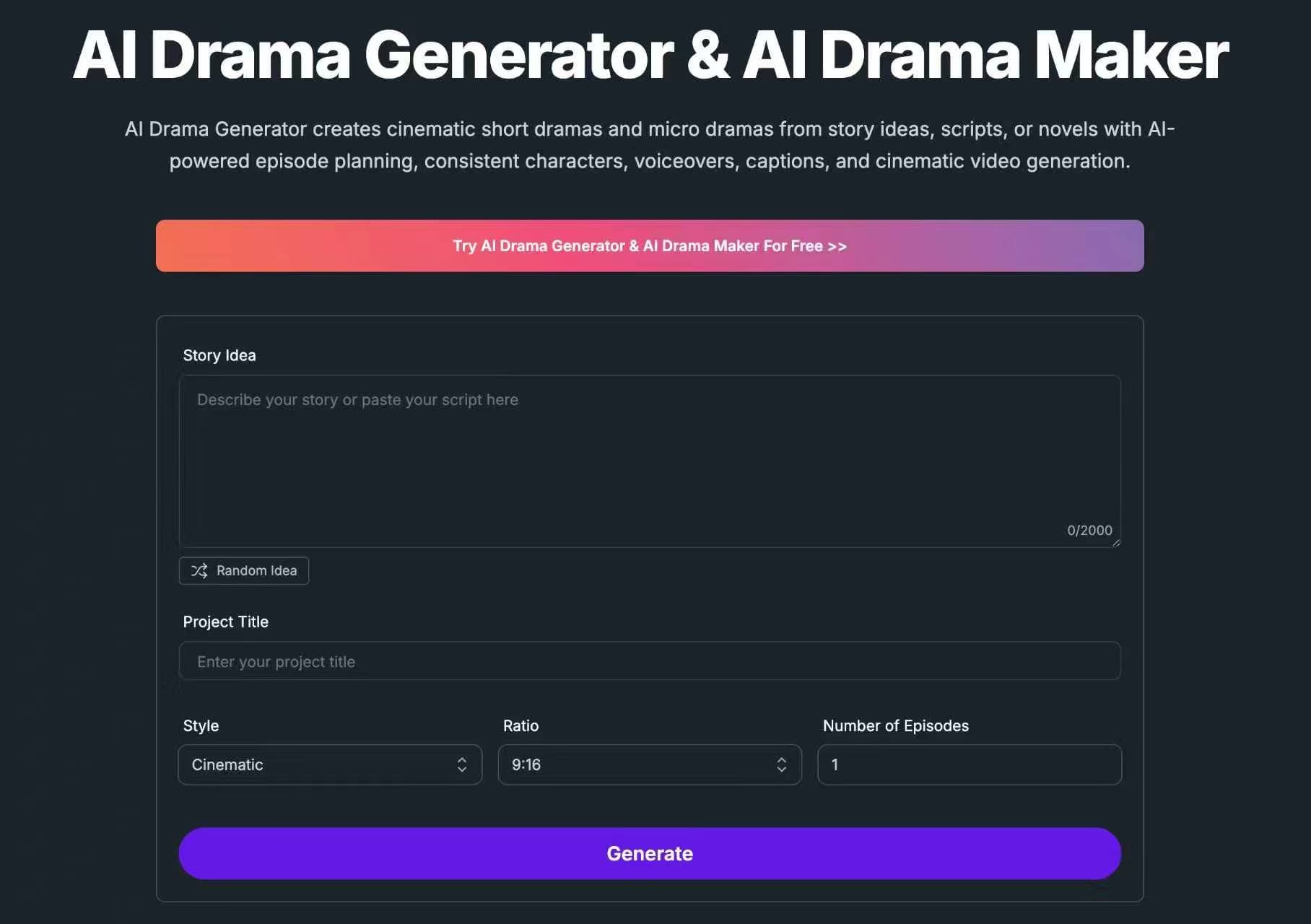
AI Drama Generator is an end-to-end, web-based AI drama maker that transforms story ideas, scripts, or novel chapters into serialized short dramas and micro dramas. Unlike a generic AI video generator, it handles the entire production chain: it expands your input into episode outlines, scene breakdowns, dialogue, and cliffhanger endings; creates visually and emotionally consistent AI characters across episodes using reference images or reusable profiles; generates multi-panel storyboards; and renders vertical 9:16 videos with cinematic styles, AI voiceovers, synchronized lip sync, and auto captions. It supports romance, revenge, fantasy, horror, werewolf, time-travel and many other genres, auto-adapting lighting, pacing, and tone. The editing controls are the real highlight: you can refine dialogue, camera angles, scene order, pacing, and emotional beats before final rendering, which makes it genuinely usable for serialized storytelling rather than one-off clips. It is aimed at shor...
Drawn from the product itself, not from a survey.
Demographic
TikTok / Reels short-form creators & influencers (18–35)
Pain points
Slow, expensive manual editing; inconsistent characters across episodes
Primary needs
Fast serialized micro dramas; auto captions & vertical export
Demographic
Novelists & web-fiction writers adapting IP to video
Pain points
No film budget or crew; hard to visualize characters consistently
Primary needs
Convert chapters into episodes; visual character consistency
Demographic
Short-drama studios & MCNs producing at scale
Pain points
High actor/location costs; slow production pipelines
Primary needs
Multi-genre batch production; reusable story assets
Demographic
Marketing teams & brands running branded storytelling
Pain points
Ad fatigue; static ads drive low engagement
Primary needs
Story-driven vertical micro dramas; quick prototyping
Written by AI from measured evidence, scored out of 100.
AI Drama Generator is aiming at a real and growing niche: serialized vertical micro-dramas for TikTok, Reels and Shorts, with a workflow that goes from story idea to episode outlines, consistent characters, storyboards, voiceover, lip sync and captions. That end-to-end framing is the product's best asset, and it's a genuine differentiator against Runway, Synthesia and InVideo AI, none of which market episodic drama planning. The execution, though, is uneven. The homepage is visually coherent but shows four empty black video players instead of finished dramas, and repeats the same generator form across multiple sections. There's no sample output, no demo, and no published per-episode credit cost, so the value proposition stays abstract right up to the paywall. Speed is solid on desktop (95/100) but mobile LCP sits at 5.4s. Security is basic — HTTPS, HSTS, SPF, DMARC, but no CSP, no frame protection, no audit. Accessibility is 88/100 with contrast, labeling and touch-target failures. The idea has room; the proof doesn't exist yet on the page.
The hero form is clear and well-labeled with a character counter and sensible settings, but there's no sample drama, demo video, or per-episode credit math to tell you what a generation actually costs or looks like.
Consistent dark navy theme with disciplined purple accents and readable type hierarchy, but the homepage leans on four identical black video placeholders and repeated generator forms that make it feel unfinished.
Desktop Lighthouse lands at 95/100 and mobile at 78/100 with zero layout shift and no blocking time, though a 5.4s mobile LCP means the first paint on a phone is noticeably slow.
HTTPS, HSTS, SPF and DMARC are all in place and card data is handled by third-party processors, but there's no CSP, no frame protection, no Referrer-Policy and no published audit or security page.
Lighthouse scores 88/100 with clean structure, but contrast failures, unlabeled form elements and undersized touch targets are exactly the issues that hit mobile users hardest.
Serialized micro-drama is a real, growing format and the episodic-planning plus character-consistency wedge is genuinely distinct from Runway, Synthesia and InVideo AI — but the moat is thin.
The homepage is competently built: dark navy canvas, disciplined purple accents, a readable type hierarchy, and a hero form that puts Story Idea, Style, Ratio, Language and episode count right where you'd want them. The problem is what surrounds it. Four identical black video players sit in a 2x2 grid showing nothing but a timeline and 0:01/0:10, and the same generator form reappears section after section with near-identical purple CTAs. For a product whose entire pitch is 'look at the cinematic dramas we make,' showing zero finished frames is a self-inflicted wound. Usability follows the same pattern — the input side is clear and well-labeled with a character counter, but the output side is invisible. There's no sample episode, no demo video, no before/after, and the pricing FAQ explains that credits vary by model, duration and options without ever publishing what one episode costs. You're asked to commit a story idea and a subscription before seeing a single second of what comes out.
Speed is the strongest measured dimension here. Desktop Lighthouse lands at 95/100, mobile at 78/100, with CLS at 0 and total blocking time at 0ms — the page is structurally light and doesn't jank. The one real blemish is a 5.4s mobile LCP, which is slow enough that a phone user stares at a blank-ish screen before the hero form appears; for a product whose customers film vertical video on phones, that's the metric that matters most. Security is middling. HTTPS is enforced, HSTS is on, and SPF and DMARC records exist, which covers the basics. But the probe found no Content-Security-Policy, no frame protection, no X-Content-Type-Options, no Referrer-Policy and no Permissions-Policy — six of twelve checklist points. There's no security page, no SOC 2 or ISO claim, no bug bounty, and no published data-handling detail beyond a pricing FAQ line saying payments go through third-party processors and full card numbers aren't stored. For an early-stage tool that's not alarming, but it's clearly behind what a paid subscription product should show.
Accessibility scores 88/100 on Lighthouse, which sounds better than it is. The failing audits are the ones that actually bite: insufficient color contrast (a real risk on that dark navy with purple accents), form elements without associated labels (the core interaction of the entire product), and touch targets that are too small or too tightly spaced. There's an EN language dropdown, but no accessibility statement, no WCAG reference, and no evidence of keyboard or screen-reader testing. Growth is the more interesting question. Serialized vertical micro-drama is a genuinely hot format, and the product's wedge — episode outlines, cliffhangers, reusable character profiles for cross-episode consistency, and storyboard editing before render — is meaningfully different from Runway (standalone clips), Synthesia (corporate avatars) and InVideo AI (social promos). None of those three markets episodic narrative planning. That's a real gap. The limit is defensibility: character consistency and storyboard editing are features, not moats, and the incumbents have the compute, distribution and brand to bolt them on. The domain was registered in August 2026, so this is very early — the idea has room, the execution hasn't proven it can hold the room.
Conclusion
The honest read is that AI Drama Generator has picked a smart lane and built the plumbing for it, but hasn't yet shown anyone the water running. A product that sells cinematic output needs cinematic output on its own homepage — a real 30-second episode, a before/after of the same character across three episodes, and a plain-English credit cost per episode. Those three things would do more for conversion than another repeated generator form. The pricing tiers ($17.50 to $140/month yearly) are aggressive for a tool with no visible sample, and the free tier's 20 credits won't tell a creator much. If the team can ship a public gallery of finished dramas and tighten the mobile LCP, the underlying idea is strong enough to compete. Until then, it's a well-organized promise with an empty showreel.
Named competitors, point by point. Nobody paid to appear here or to be left out.
 AI Drama Generator AI Drama Generator |  Runway Runway |  Synthesia Synthesia |  InVideo AI InVideo AI | |
|---|---|---|---|---|
| Episodic drama planning (outlines, cliffhangers, multi-episode structure) | Yes — auto-expands ideas into episode outlines, scene breakdowns and cliffhanger endings | No — built for standalone clips, no serialized episode planning | No — avatar video for corporate/training content, not episodic narrative | No — text-to-video for social promos, no multi-episode drama planning |
| Character consistency across multiple videos/episodes | Yes — reference images or reusable character profiles keep faces, outfits and personalities consistent | Partial — character reference tools exist but not framed around series continuity | Yes for avatars — consistent presenter avatars, but not narrative characters | Limited — no dedicated cross-episode character consistency system |
| Storyboard and pre-render scene editing | Yes — multi-panel storyboards with editable dialogue, camera angles, pacing and emotional beats | Yes — strong timeline and clip editing, but per-clip rather than storyboard-driven | No — script and scene editing only, no storyboard generation | Partial — scene templates and editing, no generated multi-panel storyboards |
| Vertical 9:16 output with voiceover, lip sync and auto captions | Yes — 9:16 render with AI voiceovers, synchronized lip sync and automatic subtitles | Yes for 9:16 and audio; lip sync available, captions not a core feature | Yes — 9:16, voiceover and lip-synced avatars with captions | Yes — vertical export with AI voiceover and auto captions |
| Pricing model and entry cost | Free tier 20 credits/mo; paid from $17.50/mo yearly (Basic) up to $140/mo (Pro) | Free tier with limited credits; paid plans start around $12-15/mo | Free demo tier; paid plans start around $18-29/mo | Free tier with watermark; paid plans start around $20-25/mo |
Runway
Advanced AI video generation and editing suite, but built for standalone clips rather than serialized drama workflows.
Synthesia
AI avatar video platform strong for corporate and training content, with less emphasis on episodic narrative drama.
InVideo AI
Text-to-video creator good for social promo content, but lacks consistent-character and multi-episode drama planning.
Comparing options? See AI Drama Generator alternatives, scored side by side

A hold-to-thrust cave flyer with a new daily level, ghost races, and a global leaderboard.

AI face swap for photos, videos, GIFs with free trial.

AI face swap online with no subscription, pay per use.

AI-powered no-code Discord bot maker

Adaptive AI personal trainer that evolves with your progr...

MathIt turns math practice into a daily habit: a personalized plan, 29 mental-math lessons, 113 games, logic puzzles and live multiplayer.

Classic 1984 drug trading game reborn in browser

A comprehensive directory of 380+ football apps, products...

Interactive 48-team World Cup 2026 bracket predictor with...

Free Download TikTok videos without watermark in HD and conver...

Fluidium is an interactive fluid art app for iOS that turns your device into a canvas for dynamic, flowing visuals.

Web-based Rubik’s Cube solver & voice-guided tutor. Scan and learn step-by-step.
A platform dedicated to providing unbiased reviews of newly launched applications, analyzing everything from their features to their full potential.
info@scoutforge.net© 2026 Scoutforge. All rights reserved.