Cycling through all six. Tap any point to stop.
Measured on six things
AI builder: describe a site or app, watch it build, publi...
Speed
58Desktop Lighthouse 96/100, but mobile 69/100 with a 6.6s LCP — more than double the 'good' threshold. CLS 0 and TBT 86ms show the layout and JS are disciplined; the hero payload is the problem.
Screenshots
1 / 1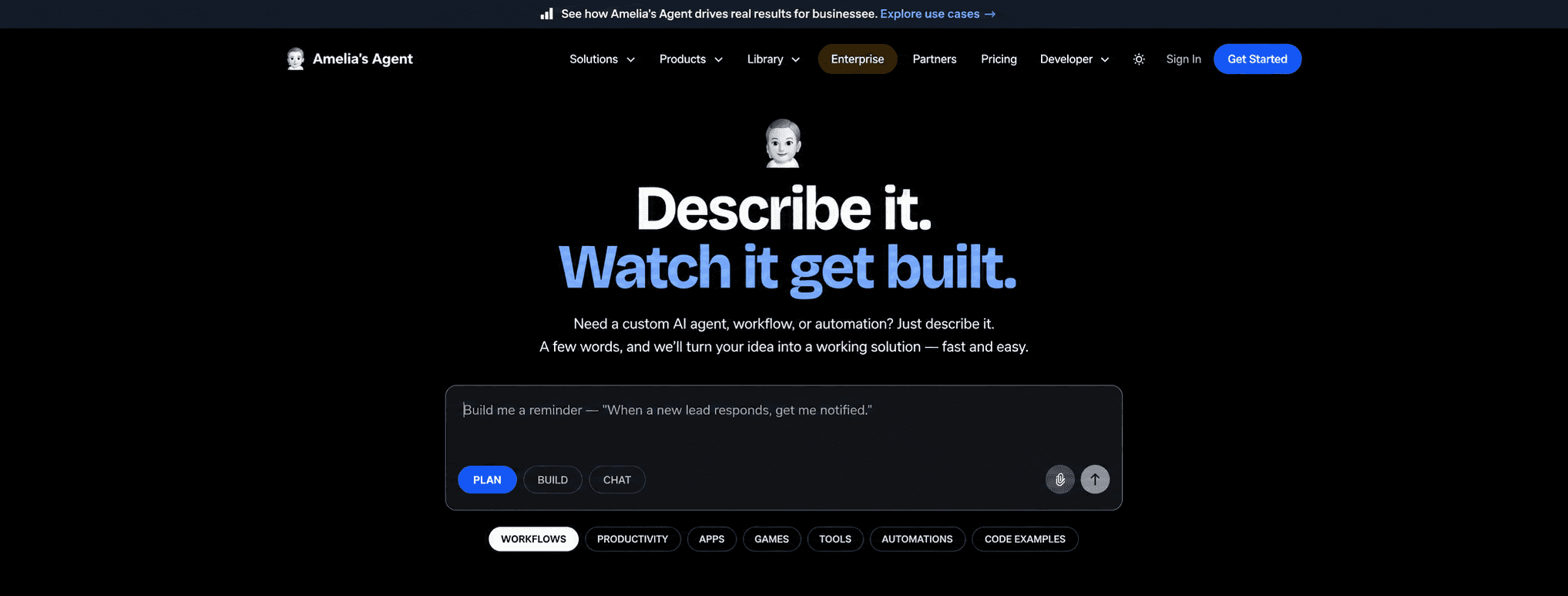
About this app
Amelia's Agent is a conversational AI builder that turns plain-English descriptions into working websites, apps, and automations. You type what you want; it asks clarifying questions, writes a priced plan, and only starts building once you approve. Every project is a real Git repository you own from the first turn—clone it, zip it, or push it to GitHub anytime. The app routes each job across 300+ AI models, showing the cost of every answer before you send and printing the exact price on the response. Build machines run in the cloud (about $0.22/hour) so you can work from a phone with nothing to install, and one click publishes your site to a real HTTPS URL on your own domain. It also imports existing sites and GitHub repos, audits them for leaks, broken links, and speed, then makes changes you approve. A spending limit is on from day one to prevent surprise bills. Pricing is usage-based: free to try, with paid plans from $5.99/month for chat-only up to $119/month flat for enterprise...
Key features
- 1Plain-English planning: asks clarifying questions, writes a priced plan, and waits for approval before building anything.
- 2Real Git repository from the first build — clone, zip, or push to your own GitHub, with no lock-in.
- 3300+ AI models routed by cost, with the price of every answer shown before you send and printed on the response.
- 4Cloud build machines (~$0.22/hour) so you can build from a phone with nothing installed; one-click publish to HTTPS on your own domain.
- 5Spending limit enabled on day one; reaching it stops the next turn rather than generating an invoice.
Target customer profile
Drawn from the product itself, not from a survey.
Demographic
Small business owners and solo founders
Pain points
Paying monthly website builder fees, high design and dev costs, tech overwhelm.
Primary needs
A professional website or online store built quickly from a description, owned outright with no lock-in.
Demographic
Non-technical teams with internal tool needs
Pain points
Spreadsheet chaos, expensive developer quotes, slow IT backlogs for simple apps.
Primary needs
Custom booking forms, portals, or automations built without hiring a developer, with predictable costs.
Demographic
Developers and technical founders
Pain points
AI builders that hide model choice, charge opaque credits, and trap code in proprietary platforms.
Primary needs
Full model control, transparent per-turn pricing, real Git repos, self-hosting options, and the ability to import existing codebases.
Demographic
Enterprise teams and agencies
Pain points
Per-seat pricing that punishes team growth, lack of budget controls, data residency concerns.
Primary needs
Flat-rate enterprise plans with no seat fees, per-person spending limits, and optional self-hosted deployment for data control.
Scout Review
Written by AI from measured evidence, scored out of 100.
Amelia's Agent is a conversational builder that plans, prices, and then builds — with real Git repos, per-turn cost transparency, and a spending limit on from day one. The measured evidence backs the pitch: a perfect accessibility audit, 12/12 security headers, and a 96/100 desktop Lighthouse score. Mobile performance (69/100, 6.6s LCP) is the clearest technical gap. Design is polished but not distinctive, and the nav tries to serve three audiences at once. The pricing model — a plan plus markup on actual model cost — is the most interesting thing here and the hardest thing for competitors to copy without giving up their credit margins.
Measure by measure
Usability
66The prompt box with PLAN/BUILD/CHAT tabs makes the core action unmistakable, and pricing is fully published. The seven-item top nav and dense homepage sections add friction for a first visit.
Design
71Cohesive blue-accented, rounded-card system with real template screenshots and a clear hero hierarchy. Undone by an overlong top banner, ragged feature-card text, and low-contrast text on the dark promo card.
Speed
58Desktop Lighthouse 96/100, but mobile 69/100 with a 6.6s LCP — more than double the 'good' threshold. CLS 0 and TBT 86ms show the layout and JS are disciplined; the hero payload is the problem.
Security
76Full 12/12 header and DNS checklist: HSTS, CSP, frame protection, SPF, DMARC all set. Enterprise tier advertises SSO, SCIM, roles, and audit logs. No published SOC 2, ISO, or pen-test report found.
Accessibility
80Lighthouse accessibility audit scored a perfect 100/100. No WCAG conformance statement or multi-language support found in the collected content, so the automated score is the strongest signal available.
Growth
68Transparent per-turn pricing, real Git ownership, and 300+ model routing are a genuine wedge against credit-based competitors. Three target segments at once dilutes the story, but the category has clear headroom.
Improvement areas
- Mobile Lighthouse performance is 69/100 with a 6.6s LCP — the hero payload needs optimization.
- No published SOC 2, ISO, or pen-test report to back the Enterprise SSO/SCIM/audit-log claims.
- Top navigation has seven top-level items and an overlong banner that competes with the logo.
- No WCAG conformance statement or multi-language support despite a perfect automated accessibility score.
Design & Usability
The homepage is competently designed: a consistent blue accent, rounded cards, a hero with a clear headline and prompt box, and six template cards showing real screenshots rather than stock illustrations. The PLAN/BUILD/CHAT tabs on the composer make the core interaction obvious, and the pricing page publishes every plan with included usage and markup percentages — rare honesty. Where it slips: the top nav banner is a full sentence competing with the logo, feature cards have uneven text lengths, and the dark promo card drops contrast on its sample prompt. The seven-item top nav (Solutions, Product, Library, Templates, Elements, Pricing, Enterprise) is a lot to parse before you've typed anything.
Speed & Security
Lighthouse tells two stories. Desktop scores 96/100 — genuinely fast. Mobile scores 69/100 with an LCP of 6.6 seconds, well past the 2.5s 'good' threshold, though CLS of 0 and TBT of 86ms show the layout and JS are disciplined. The fix is hero payload, not architecture. Security is the strongest measured dimension: 12/12 on the header and DNS probe with HSTS, CSP, frame protection, SPF, and DMARC all set. The Enterprise tier advertises SSO, SCIM, nine roles, per-person budgets, and an audit log. What's missing is third-party proof — no SOC 2, ISO, or pen-test report surfaced in the collected content.
Accessibility & Growth
Accessibility scored a perfect 100/100 on the Lighthouse audit, which covers automated checks only. No WCAG conformance statement, accessibility page, or multi-language support appeared in the fetched content, so the score reflects what the audit could see rather than a documented commitment. Growth is a judgement on the idea: the wedge is real — per-turn pricing with the dollar printed on every answer, real Git repos you own, 300+ models routed by cost, and a spending limit on day one. The listed alternatives (Lovable, Replit, Bolt.new, Base44) all sell credits or flat subscriptions with opaque per-build costs, so transparency is a genuine differentiator. The risk is positioning breadth: solo founders, developers, and enterprise teams are three different sales motions.
Conclusion
If you've been quoted four figures for a booking form or you're tired of buying credits with no exchange rate, this is worth a free trial — no card, and the plan is priced before anything runs. Go in expecting to read the pricing table carefully: the $4.99 tier is chat-only, and hosting a real site starts at the $10 Pro plan. The mobile load time will annoy you on a phone, which is ironic given 'build from anywhere' is a headline feature. Fix the LCP, publish a security page, and this moves up a tier.
Suggestions for improvement
- Cut the hero image payload to bring mobile LCP under 2.5s — desktop already proves the architecture is fine.
- Publish a security page with SOC 2 status, data handling, and subprocessor list to back the Enterprise SSO/SCIM claims.
- Shorten the top nav banner to a single CTA and consolidate the seven-item menu into three or four groups.
- Add a WCAG conformance statement and keyboard-navigation notes to convert the 100/100 audit into a documented commitment.
Alternatives comparison
Named competitors, point by point. Nobody paid to appear here or to be left out.
 Amelia's Agent |  Lovable |  Replit |  Bolt.new | Base44 | |
|---|---|---|---|---|---|
| Pricing model transparency | Plan + markup on actual model cost; every answer prints its price; no credits | Credit-based; model choice and per-build cost not exposed | Subscription plus usage credits; per-build pricing not published | Token-based; limited transparency on model selection and cost per build | Message credits rather than direct build costs |
| Code ownership / Git repo | Real Git repo in your name from first build; clone, zip, or push to GitHub | GitHub sync available; repo ownership depends on plan | Git integration available; projects live in Replit workspace | Export/download code; GitHub push supported | No Git repo ownership by default |
| Model choice | 300+ models with price shown against each before you spend | Model not user-selectable | Limited model selection | Model selection not exposed | Model not user-selectable |
| Spending controls | Spending limit on from day one; per-person budgets on Enterprise | Credit balance acts as a cap | Usage-based; budget controls limited | Token balance acts as a cap | Message credit balance acts as a cap |
| Enterprise / self-hosting | Flat $99-119/mo, no seat fee, SSO/SCIM, custom self-hosted option | Team plans; self-hosting not offered | Enterprise plans; self-hosting not offered | Team plans; self-hosting not offered | Team plans; self-hosting not offered |
Lovable
AI app builder with a visual editor; uses credit-based pricing and does not expose model choice or per-build costs.
Replit
Cloud IDE with AI assistance; charges a subscription plus usage credits, and pricing is not published per build.
Bolt.new
AI-powered full-stack app builder; token-based pricing and less transparency on model selection and cost per build.
Base44
No-code AI app builder; uses message credits rather than showing direct build costs, and no Git repo ownership by default.
Comparing options? See Amelia's Agent alternatives, scored side by side
More Development & Engineering apps
View all Development & Engineering
CreateMyCoin
92A no-code Solana token creator that deploys SPL tokens in...

Vibe Coding Agent Skills
92A free, open-source platform offering 110 AI agent skills...

CC Switch
91Open-source desktop app for switching AI coding providers...

DemoVexa
90Turn your code into professional product demo videos with AI-generated scripts, animated UI, and natural voiceovers.

TaxID
90Fast EU VAT validation API for developers, covering 27 EU...

BeartIMAGE
88BeartIMAGE is a free, web-based image processing platform engineered for fast, bulk photo editing and conversion directly in your browser.

Claw Messenger
88Claw Messenger is an iMessage API service that gives AI a...

DataHabibi
88AI-powered Dubai real estate data platform with 12M+ DLD ...

ButterKit
82macOS app for App Store screenshots: 3D mockups, auto-tra...

PERM Processing Time: Current DOL Queue & History
88PERM Processing Time is an independent data analysis platform that helps users navigate the U.S. Department of Labor’s permanent labor certification process.

StockFit API
87A developer-first financial data API providing structured...

ProcessSpy
87A native macOS process explorer and advanced monitor that...


A platform dedicated to providing unbiased reviews of newly launched applications, analyzing everything from their features to their full potential.
info@scoutforge.net© 2026 Scoutforge. All rights reserved.
