Cycling through all six. Tap any point to stop.
Measured on six things
Monitor and control AI API costs with real-time guardrails.
Speed
46Lighthouse mobile 48/100 with a 7.3s LCP and 4.9s FCP; desktop 68/100. The animated particle hero and long page are heavy, and mobile visitors wait a long time for first paint.
Screenshots
1 / 3

About this app
AtlasBurn is an AI API cost monitoring and guardrail tool built for teams running LLM-powered applications. It tracks spend per feature across 13 AI providers, including OpenAI, Anthropic, and Google Gemini, and provides a Monte Carlo forecast of your month-end bill. But what sets it apart is its runtime guardrails: it can detect agent loops, retry storms, and runaway context growth, then slow down or block the offending feature before costs spiral. The SDK is open-source and auto-detects calls from most major providers, while an edge proxy supports any language via a base URL and header. AtlasBurn never stores prompts or outputs—only usage metadata—and fails open to avoid disrupting your app. Currently in free beta, it offers a generous free tier and affordable paid plans, making it a compelling choice for startups and enterprises alike.
Key features
- 1Runtime guardrails that detect agent loops, retry storms and runaway context growth, then throttle or block the offending feature.
- 2Spend tracking across 13 AI providers with per-feature cost attribution.
- 3Monte Carlo month-end bill forecasting with probabilistic ranges.
- 4Open-source SDK with auto-detection plus an edge proxy for any language via base URL and header.
- 5Metadata-only storage (no prompts or outputs) with fail-open behaviour.
Target customer profile
Drawn from the product itself, not from a survey.
Demographic
AI/ML Engineers and Engineering Managers
Pain points
Unexpectedly high AI API bills, lack of visibility into which feature drives costs, difficulty catching runaway agent loops in real-time.
Primary needs
Real-time cost monitoring, automated guardrails to prevent overspend, and integration with existing AI SDKs.
Demographic
CTOs and Finance Teams at AI Startups
Pain points
Forecasting inaccuracies, budget overruns, and inability to attribute AI costs to specific products or features.
Primary needs
Accurate forecasting with probabilistic ranges, cost attribution by feature, and proactive alerts to avoid surprises.
Demographic
DevOps and Platform Engineers
Pain points
Complexity of building custom cost-tracking solutions, ensuring reliability, and avoiding application downtime due to cost controls.
Primary needs
Easy setup, fail-open mechanisms, and granular control over which features to throttle or block without affecting the entire app.
Scout Review
Written by AI from measured evidence, scored out of 100.
AtlasBurn is a cost-monitoring and guardrail tool for teams running LLM apps, tracking spend across 13 providers with Monte Carlo month-end forecasting and — the real differentiator — runtime detection of agent loops, retry storms and context growth that can throttle or block a runaway feature before costs spiral. The site is one of the better dev-tool landing pages out there: a concept-driven hero, a credible incident-card grid, sourced real-world cost disasters, and an interactive simulator. The SDK is open-source, an edge proxy covers any language, and the product claims metadata-only storage with fail-open behaviour. Weaknesses are execution detail: a 7.3s mobile LCP, thin security headers, contrast failures on secondary type, and an unfinished code block. Free during beta with no credit card makes it easy to try.
Measure by measure
Usability
66Clear above-the-fold CTA with 'free during beta, no credit card', a story-driven page with obvious waypoints, and an interactive simulator. Carousel affordances and dim micro-type cost it.
Design
70Disciplined dark palette with one blue accent, and a hero that visualises the guardrail concept instead of decorating it. Undermined by tiny low-contrast secondary type and an unfinished-looking code block.
Speed
46Lighthouse mobile 48/100 with a 7.3s LCP and 4.9s FCP; desktop 68/100. The animated particle hero and long page are heavy, and mobile visitors wait a long time for first paint.
Security
54HTTPS enforced, X-Content-Type-Options, Referrer-Policy, SPF and DMARC all present, and the product claims metadata-only storage with fail-open behaviour. No HSTS, CSP, frame protection, or published audit.
Accessibility
70Lighthouse accessibility 94/100, but two real failures: prohibited ARIA attributes and insufficient color contrast. The visual audit independently flags small, dim secondary type across hero captions and simulator rows.
Growth
68Sharp wedge: runtime guardrails that throttle or block a runaway feature, not just dashboards. Real documented pain, specific buyer, and a category with obvious headroom as agentic apps multiply.
Improvement areas
- Mobile performance: 7.3s LCP and 48/100 Lighthouse score need real work.
- Security headers: missing HSTS, CSP, frame protection and Permissions-Policy.
- Accessibility: contrast failures and prohibited ARIA attributes on secondary type.
- No published security page, audit, or bug bounty to back the metadata-only claim.
Design & Usability
AtlasBurn's site is a cut above the average dev-tool landing page. The dark palette is disciplined, the single blue accent is used with intent, and the hero — request streams converging on a vertical guardrail line labelled 'RETRY CASCADE' and 'AGENT LOOP DETECTS' — explains the product in one glance rather than showing a stock dashboard. The problem section uses a 3x3 grid of incident cards ('3,800 calls to the same model in 6 minutes', 'I set max_retries to 50 so it never fails') that reads like real Slack alerts, and the honest 'Illustrative examples, not customer data' footnote builds trust. Usability is solid: the CTA and 'free during beta, no credit card' sit above the fold, the page has clear waypoints, and the interactive simulator lets you feel the product before signing up. What drags both scores down is execution detail — tiny low-contrast mono labels throughout, an unfinished-looking code block with a dead empty zone, and a receipts carousel with no visible scroll affordance.
Speed & Security
Speed is the weak spot. Lighthouse mobile scores 48/100 with a 7.3s LCP and 4.9s FCP; desktop is 68/100. The animated particle hero and long story-driven page are heavy, and mobile visitors stare at a slow first paint before the concept lands. CLS is a clean zero, so at least the layout is stable. Security sits in the middle: HTTPS is enforced, X-Content-Type-Options and Referrer-Policy are set, and SPF and DMARC are configured — but HSTS, CSP, frame protection and Permissions-Policy are all missing, for a 6/12 checklist. The product's own claim that it never stores prompts or outputs, only usage metadata, and fails open is the right posture for a cost-control tool, but there's no published audit, security page, or bug bounty to back it up. For a tool that sits in the request path of production AI apps, that's a gap worth closing.
Accessibility & Growth
Accessibility scores well on automation — Lighthouse 94/100 — but two real failures matter: prohibited ARIA attributes and insufficient color contrast. The visual audit independently flags the same problem, with hero captions, incident-card mono labels and simulator rows all too small and dim on near-black. That's the most fixable bug in web design and it's shipping anyway. Growth is the strongest dimension. The category is crowded with observability platforms — Helicone and Langfuse both log requests and track cost — but AtlasBurn's wedge is different: it detects agent loops, retry storms and runaway context growth at runtime, then throttles or blocks the offending feature before the bill spirals. The site backs this with a wall of sourced real-world incidents ($82,314 in 48 hours from a stolen Gemini key, ~$47,000 from two agents that never stopped talking), which is exactly the pain its buyer feels. The limit is distribution: observability incumbents already own the integration slot, and guardrails are a narrower sale. The idea has room; the go-to-market is the question.
Conclusion
If you're running agents in production and you've ever had a bill jump $400 overnight with no idea which feature did it, AtlasBurn is aimed squarely at you and the free beta removes the excuse not to look. The wedge — actually stopping the loop, not just charting it — is the right one, and the sourced incident wall shows the team understands the pain. What's missing is the boring stuff: fix the mobile LCP, set HSTS and a CSP, bump the contrast on your micro-type, and publish something that proves the 'we never store prompts' claim. Do that and this moves from interesting to recommended.
Suggestions for improvement
- Fix the 7.3s mobile LCP — lazy-load or simplify the particle hero, and preload the critical font.
- Add HSTS, CSP, frame protection and Permissions-Policy to close the security header gap.
- Raise contrast and font size on hero captions, incident-card mono labels and simulator rows.
- Publish a security page documenting the metadata-only storage claim and fail-open behaviour.
Alternatives comparison
Named competitors, point by point. Nobody paid to appear here or to be left out.
 AtlasBurn |  Helicone |  Langfuse | |
|---|---|---|---|
| Runtime guardrails (loop/retry-storm detection with throttle or block) | Yes — core differentiator, throttles or blocks offending feature | No — observability and logging, not runtime blocking | No — tracing and prompt management, not runtime blocking |
| Cost tracking across AI providers | Yes — 13 providers, per-feature attribution | Yes — cost tracking included | Yes — cost tracking via traces |
| Month-end bill forecasting | Yes — Monte Carlo with probabilistic ranges | Not a headline feature | Not a headline feature |
| Prompt/response logging | No — metadata only by design | Yes — logs requests and responses | Yes — full tracing with prompt management |
| Open-source SDK | Yes — auto-detects major providers | Yes — open-source platform | Yes — open-source platform |
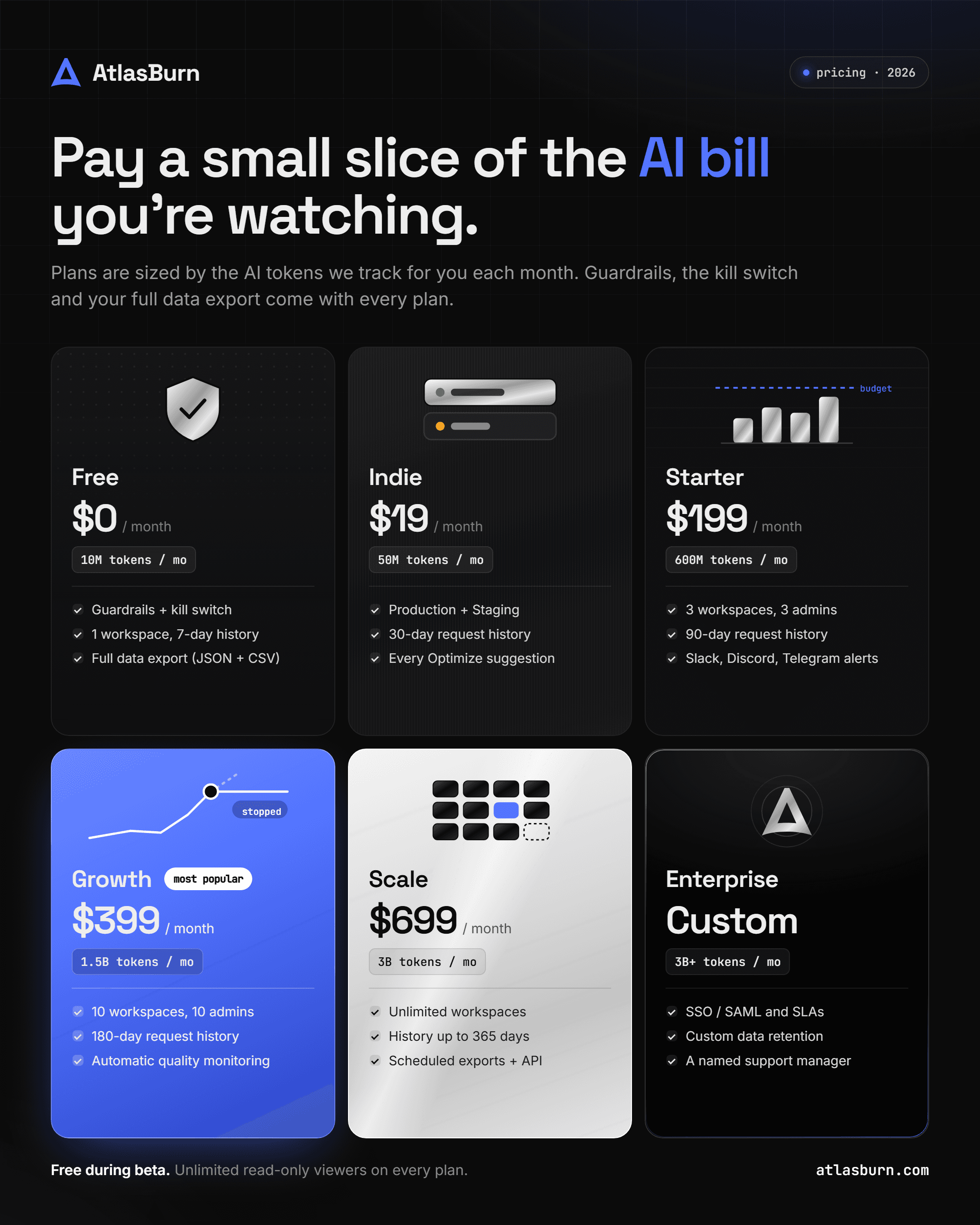
| Pricing model | Free during beta, no credit card | Free tier plus paid plans | Open-source self-host plus cloud plans |
Helicone
Open-source LLM observability platform that logs requests and responses for debugging and evaluation, with cost tracking features.
Langfuse
Open-source LLM engineering platform for observability, metrics, and prompt management, focusing on tracing and debugging.
Comparing options? See AtlasBurn alternatives, scored side by side
More Development & Engineering apps
View all Development & Engineering
Vibe Coding Agent Skills
92A free, open-source platform offering 110 AI agent skills...

CreateMyCoin
92A no-code Solana token creator that deploys SPL tokens in...

CC Switch
91Open-source desktop app for switching AI coding providers...

TaxID
90Fast EU VAT validation API for developers, covering 27 EU...

DemoVexa
90Turn your code into professional product demo videos with AI-generated scripts, animated UI, and natural voiceovers.

FontPlop
89Browser-based font viewer & tester for TTF, OTF, WOFF, WO...

deed.page
89Permanent web hosting for AI agents, no human step

Webfetch
89Web scraping API that turns any URL into HTML, text, Mark...

Denpex
89AI-powered GPU failure diagnosis for distributed ML training

BeartIMAGE
88BeartIMAGE is a free, web-based image processing platform engineered for fast, bulk photo editing and conversion directly in your browser.

Claw Messenger
88Claw Messenger is an iMessage API service that gives AI a...

DataHabibi
88AI-powered Dubai real estate data platform with 12M+ DLD ...


A platform dedicated to providing unbiased reviews of newly launched applications, analyzing everything from their features to their full potential.
info@scoutforge.net© 2026 Scoutforge. All rights reserved.
