

A platform dedicated to providing unbiased reviews of newly launched applications, analyzing everything from their features to their full potential.
info@scoutforge.net© 2026 Scoutforge. All rights reserved.
A platform dedicated to providing unbiased reviews of newly launched applications, analyzing everything from their features to their full potential.
info@scoutforge.net© 2026 Scoutforge. All rights reserved.
A platform dedicated to providing unbiased reviews of newly launched applications, analyzing everything from their features to their full potential.
info@scoutforge.net© 2026 Scoutforge. All rights reserved.
Cycling through all six. Tap any point to stop.
Measured on six things
AI-powered citation verification tool for academic integrity
HTTPS not enforced, no CSP, no frame protection, no DMARC — 5/12 checklist points. Privacy FAQ claims encryption in transit and at rest, but no SOC 2, ISO, or pen-test evidence is published.
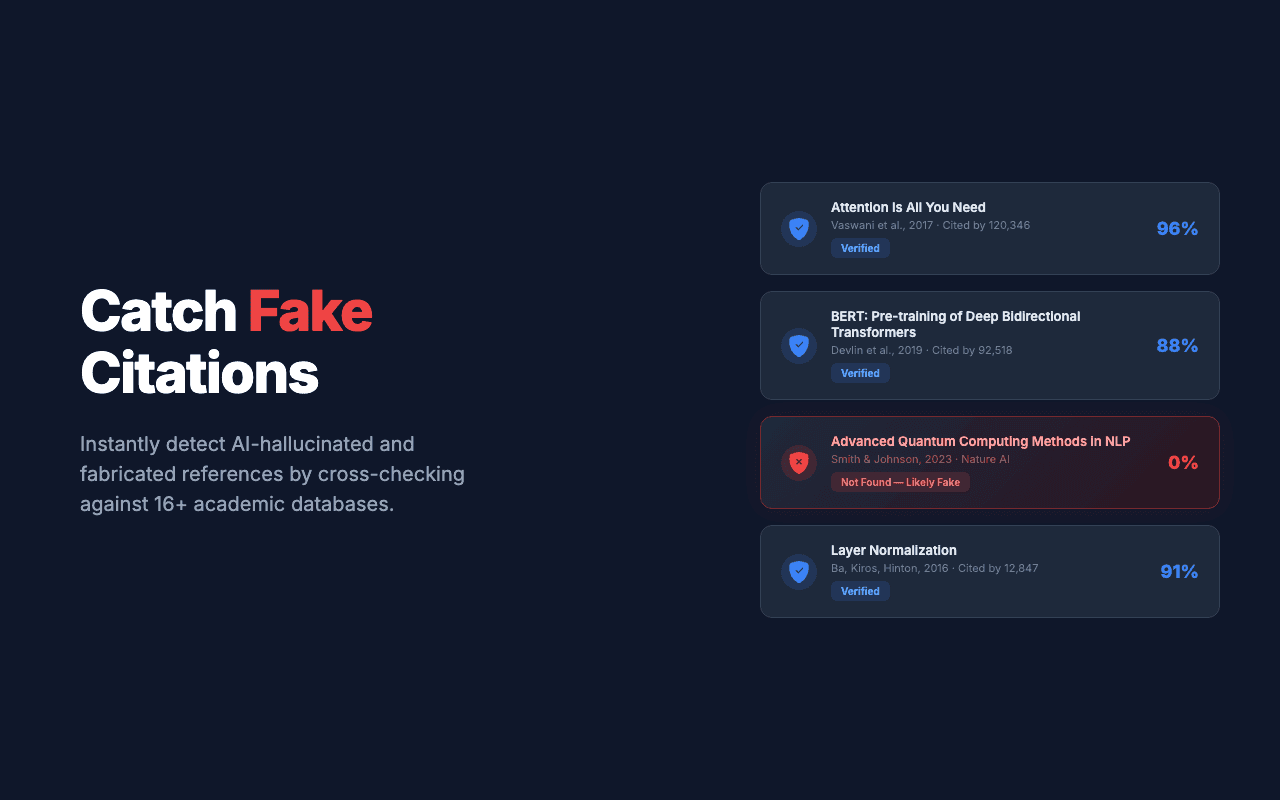
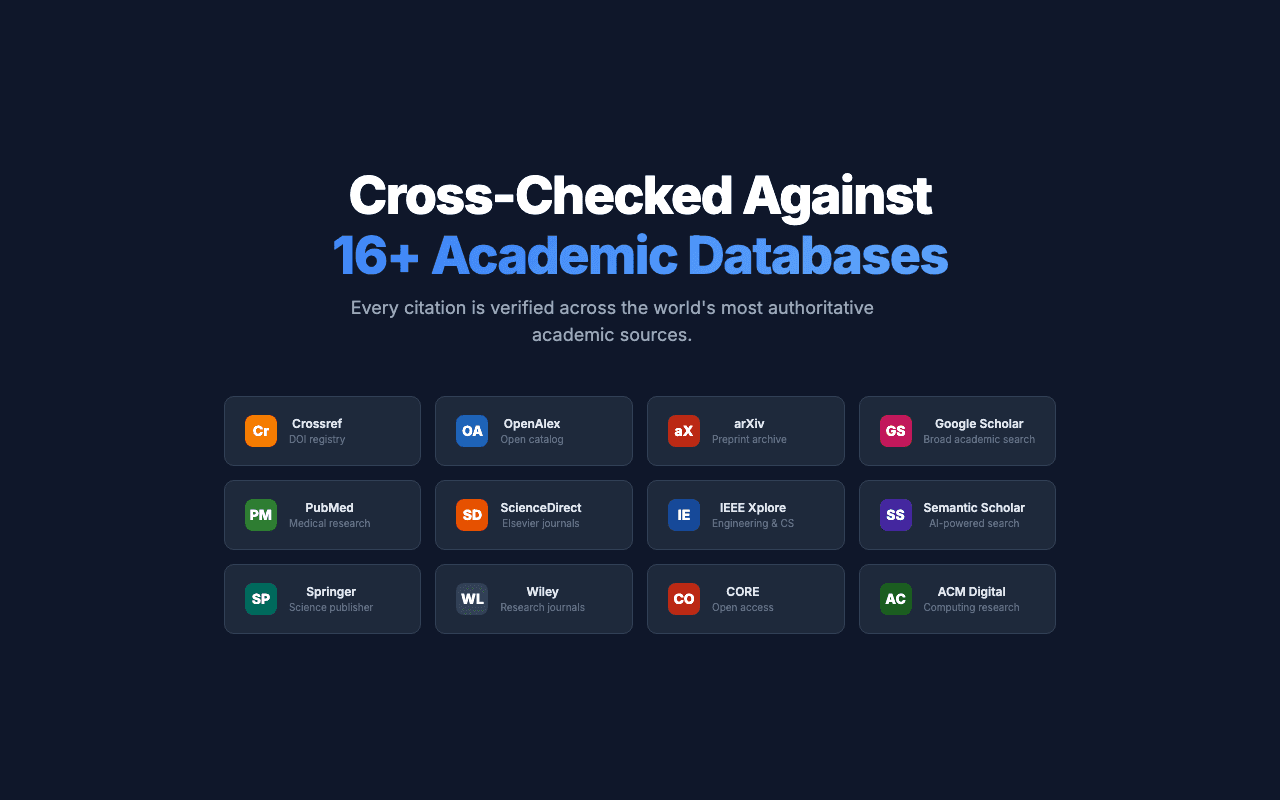
CiteTrue is a free AI-powered citation verification tool that helps researchers, students, and educators ensure their citations are authentic and accurate. By cross-referencing against authoritative academic databases, it flags fake or AI-generated references, providing confidence scores for each citation. The tool checks author names, publication years, journal titles, DOIs, and more, making it essential for maintaining academic integrity in the age of AI-generated content. With a user-friendly interface and batch processing capabilities, CiteTrue streamlines the citation verification process, saving time and preventing costly errors in academic writing.
Drawn from the product itself, not from a survey.
Demographic
Graduate students and early-career researchers
Pain points
Risk of unintentional plagiarism or citing AI-hallucinated references
Primary needs
Affordable, reliable citation verification to ensure paper acceptance
Demographic
Academic journal editors and peer reviewers
Pain points
Difficulty detecting fabricated references in submitted manuscripts
Primary needs
Efficient tool to validate citations and uphold journal standards
Demographic
Professors and educators
Pain points
Students submitting papers with fake citations, undermining academic honesty
Primary needs
Quick verification tool to check student work and teach proper citation practices
Written by AI from measured evidence, scored out of 100.
CiteTrue is a free AI citation checker that cross-references references against academic databases and flags fabricated or AI-hallucinated citations with confidence scores. The app UI is competent — green/red status indicators, authenticity percentages, batch-friendly result cards — and the docs are better than most indie tools manage. The homepage is the weak link: a lonely input box, a Verify button that looks disabled, and a below-the-fold void. Speed is excellent on desktop (99) and mediocre on mobile (LCP 5.3s). Security is the real concern: 5/12 headers, no CSP, no DMARC, HTTPS not enforced, and no published compliance evidence despite a privacy claim. Accessibility lands at 91 with two concrete failures. The idea itself is well-positioned against Turnitin and Zotero, and the free tier is genuinely usable. It works, it's cheap, and it solves a real problem — it just hasn't earned the polish or the trust signals to match the pitch.
Docs cover Getting Started, formats, results, and Deep Verify; 30 free credits/day with no card. Input box gives no format hints or sample data, so first-run is guesswork.
Judging the app UI and store material: results cards with green/red status and authenticity percentages are clean, but the homepage is half-empty and the Verify button reads as disabled.
Desktop Lighthouse 99/100 is genuinely snappy. Mobile 79/100 with a 5.3s LCP drags it down — that's double the 'good' threshold, and it's the device most students actually use.
HTTPS not enforced, no CSP, no frame protection, no DMARC — 5/12 checklist points. Privacy FAQ claims encryption in transit and at rest, but no SOC 2, ISO, or pen-test evidence is published.
Lighthouse a11y 91/100 is solid, but two real failures: unnamed buttons and insufficient color contrast. No WCAG statement, and the app ships in only one language.
Real, growing problem (AI-hallucinated citations), specific wedge (field-by-field verification vs. Turnitin's text-similarity focus), and a free tier that undercuts paid rivals. 30k-user claim is unverified.
CiteTrue's app UI is the stronger half: citation result cards use green checkmarks and red warnings with authenticity percentages, and the results view has expandable 'Report issue' options that support quick scanning of a batch. The homepage is where it falls apart — a centered input box on light gray with a Verify button so flat and gray it reads as permanently disabled, and the section below the fold is essentially empty whitespace. Usability is carried by the docs at /docs/guides, which actually explain Deep Verify, supported formats, and how to read confidence scores, plus a genuinely generous free tier of 30 credits per day with no card required. The gap is onboarding: the input box offers no format hints, no sample citations, and no example of what a good paste looks like, so a first-time user is guessing at the exact moment the product needs to prove itself.
Speed splits hard by device. Desktop Lighthouse lands at 99/100 — the page is genuinely snappy on a laptop. Mobile is 79/100 with an LCP of 5.3 seconds, more than double the 2.5s 'good' threshold, and mobile is exactly where a student pasting references from a phone would live. CLS is 0 and TBT is 120ms, so the layout is stable and the main thread isn't choking — it's the largest contentful paint that's the problem. Security is the weakest measured dimension: the HTTP probe found HTTPS not enforced, no CSP, no frame protection, no Permissions-Policy, and no DMARC, landing at 5/12 checklist points. The pricing FAQ claims 'industry-standard encryption for all data in transit and at rest,' but no SOC 2, ISO 27001, pen-test report, or bug bounty is published anywhere on the site. For a tool that asks users to paste unpublished manuscript references, that's a real gap, not just a missing badge.
Accessibility scores 91/100 on Lighthouse, which is above average, but two failures are real and specific: buttons without accessible names and insufficient color contrast. There's no WCAG conformance statement, no keyboard-navigation documentation, and the iOS app is localized in exactly one language — thin for a tool whose stated audience is global academia. Growth is the more interesting story. The problem CiteTrue names is real and getting worse: the site cites Walters & Wilder (2023) finding >55% of GPT-3.5 citations fabricated, and Nature's 10,000+ retractions in 2023. The wedge against the listed alternatives is clear — Turnitin checks text similarity, Zotero organizes sources you already trust, and neither verifies whether a cited paper actually exists with the right authors and year. Field-by-field checking (title, authors, year, DOI, venue, pages) is a concrete differentiator, and the free tier undercuts paid rivals. The limit: the 30,000-user claim is unverified, the App Store listing has no ratings yet, and the domain is barely a year old. The idea has room; the proof of adoption doesn't exist yet.
Conclusion
If you're a grad student who's ever stared at a reference list wondering whether the AI that helped you draft it invented half those DOIs, CiteTrue is worth the two minutes it takes to paste and check. The free tier of 30 credits a day is enough for a real paper, and the field-by-field breakdown is more useful than a binary real/fake flag. What it isn't yet is a tool you'd hand to a journal editor as your integrity layer — not with HTTPS unenforced, no CSP, and zero published compliance evidence. Use it as a personal sanity check, not an institutional standard. The product is honest about what it does; it just needs to get as serious about security and onboarding as it is about the citation problem itself.
Named competitors, point by point. Nobody paid to appear here or to be left out.
 CiteTrue Citation Checker CiteTrue Citation Checker |  Turnitin Turnitin |  Zotero Zotero | |
|---|---|---|---|
| Primary function | Verifies whether citations are real and accurate against academic databases | Plagiarism detection focused on text similarity, with some citation checking | Reference management and citation formatting; no automated verification |
| Detects AI-hallucinated / fabricated references | Core purpose — flags fake or AI-generated citations with confidence scores | Limited; focuses on text matching, not reference authenticity | No — stores and formats whatever references you enter |
| Free tier | 30 verification credits per day, no credit card required | No free tier for individual users; institutional licensing | Free and open source, unlimited local use |
| Batch processing | Yes — paste multiple references; batch limit 30 on free, 1,000 on paid | Yes — class-wide submission and batch reports | Yes — bulk import and library-wide management |
| Target user | Grad students, early-career researchers, educators, journal editors | Institutions, educators, and publishers checking text originality | Researchers and students managing their own reference libraries |
| Pricing model | Free tier plus subscriptions from $5.99/mo and credit packs | Institutional licensing; no public per-user price | Free; paid cloud storage tiers for sync |
Turnitin
Plagiarism detection service that also checks citation accuracy but focuses more on text similarity.
Zotero
Reference management software that helps organize and cite sources but lacks automated verification against databases.
Comparing options? See CiteTrue Citation Checker alternatives, scored side by side

A weekly newsletter delivering curated tech jobs, intervi...

A unified platform replacing 12-20 disconnected tools for...

A massive collection of free printable coloring pages for...

AI-powered law school study platform with 20,000+ case br...

Custom illustrated children's books created around your c...

All-in-one CIRO exam prep for CIRE and 8 other exams, wit...

Turn timers into powerful routines with automation, widge...

Turn your content into a branded mobile app with home, co...

Free 80-item RAADS-R autism self-assessment for adults, with instant total and domain scores, privacy-first access, and clear non-diagnostic guidance.

Privacy-first OCR for math to editable Word, PDF, LaTeX.

AI humanizer for natural text with best possible human-like result

An AI-powered learning platform for K–5 that sparks curio...
A platform dedicated to providing unbiased reviews of newly launched applications, analyzing everything from their features to their full potential.
info@scoutforge.net© 2026 Scoutforge. All rights reserved.