

A platform dedicated to providing unbiased reviews of newly launched applications, analyzing everything from their features to their full potential.
info@scoutforge.net© 2026 Scoutforge. All rights reserved.
A platform dedicated to providing unbiased reviews of newly launched applications, analyzing everything from their features to their full potential.
info@scoutforge.net© 2026 Scoutforge. All rights reserved.
A platform dedicated to providing unbiased reviews of newly launched applications, analyzing everything from their features to their full potential.
info@scoutforge.net© 2026 Scoutforge. All rights reserved.
Cycling through all six. Tap any point to stop.
Measured on six things
AI teammate that turns Jira tickets into merged PRs, auto...
Targets EMs, PMs, ICs, and CTOs with clear role-specific value props. Works with existing tools so no massive platform migration. Supports both individual local use and team server addon.
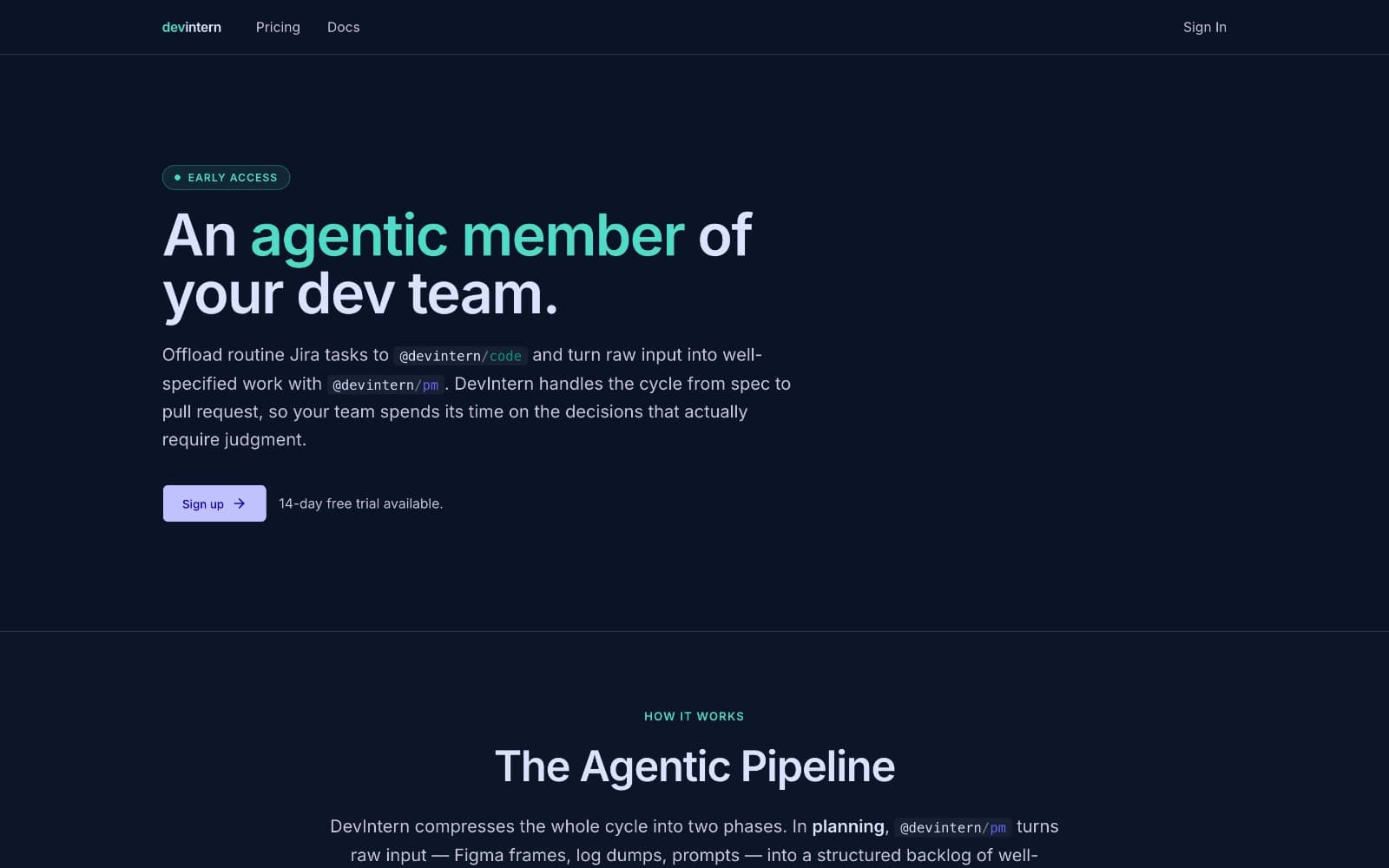
I've been testing DevIntern, and honestly, it's a game-changer for engineering teams bogged down by the grunt work between coding. DevIntern is an agentic development suite that handles the entire cycle from Jira ticket to merged pull request. It consists of two tools: @devintern/pm, which transforms raw inputs like Figma frames, log dumps, or chat messages into well-structured tickets grounded in your codebase, and @devintern/code, which takes those tickets and autonomously writes code, runs tests, self-reviews, and opens PRs. The human stays in the loop only for decisions that matter—reviewing PRs and adjusting specs. The result? A 3x faster median ticket-to-PR time and roughly 16 hours saved per engineer per week. It integrates with existing tools like Jira, GitHub, and Bitbucket, and you bring your own AI provider. Pricing is a one-time perpetual license per seat, with a server addon for 24/7 automation. For a 12-engineer team, that's over $1M recovered annually. If your team is...
Drawn from the product itself, not from a survey.
Demographic
Engineering Managers (EM)
Pain points
Sprints move slowly due to context switching and manual PR creation
Primary needs
Increase throughput, reduce time-to-merge, maintain code quality
Demographic
Product Managers (PM)
Pain points
Spending hours drafting specs from rough ideas
Primary needs
Quickly turn ideas into well-specified, codebase-aware tickets
Demographic
Individual Contributors (IC / Engineers)
Pain points
Routine implementation tasks take time away from complex problem-solving
Primary needs
Automate boilerplate coding, get PRs ready for review, focus on high-value work
Demographic
CTOs / Tech Executives
Pain points
Adopting AI across the org requires long platform migrations
Primary needs
One activation layer for AI-native workflows without rip-and-replace
Written by AI from measured evidence, scored out of 100.
DevIntern is one of the more complete agentic development suites available, genuinely attempting to own the full cycle from raw idea/Figma/log to merged PR while staying within your existing toolchain. The dual PM + Code agent approach, self-review capabilities, and human-in-the-loop only for decisions that matter address real workflow friction better than most competitors. Claims of 16 hours saved per engineer per week and massive ROI are optimistic but directionally correct for teams drowning in boilerplate and context switching. It's not magic — agentic systems still hallucinate and create debt — but this feels like a pragmatic, high-leverage implementation.
Drops into existing Jira/GitHub/Bitbucket workflows with BYO AI keys. Humans only review high-value decisions. Transforms messy inputs (Figma, logs, chats) into structured tickets automatically.
Clean, modern pipeline diagram on the site clearly visualizes the planning-to-execution flow with PM and Code agents. Professional branding focused on engineering teams without unnecessary flair.
Claims 3x faster median ticket-to-PR time and ~16 hours saved per engineer per week. Parallel execution on backlog, autonomous coding + testing + PR opening. Server addon enables 24/7 runs.
Brings your own AI provider and keys. Integrates directly with your existing repos and trackers without data leaving your environment in uncontrolled ways. Perpetual license model reduces ongoing vendor risk.
Targets EMs, PMs, ICs, and CTOs with clear role-specific value props. Works with existing tools so no massive platform migration. Supports both individual local use and team server addon.
One-time perpetual per-seat license (volume discounted, ~$149-179/engineer, cheaper for PMs) plus server addon ($1.2k–$5.9k). Strong ROI story ($1M/year for 12 engineers). Early traction visible on Launch platforms and founder activity.
DevIntern stands out by addressing the entire spec-to-PR pipeline rather than isolated coding assistance. The @devintern/pm tool excels at turning vague Figma frames, log dumps, or chat messages into codebase-grounded, structured Jira tickets — a huge pain point for PMs and EMs who waste hours on spec writing. Then @devintern/code takes over: autonomous implementation, test running, self-review of diffs, feedback loops, and PR creation. This keeps humans focused on meaningful reviews and spec adjustments only. Tight integration with existing Jira, GitHub, and Bitbucket means zero rip-and-replace. The design of the workflow itself is elegant and practical for real engineering teams suffering from context switching. Usability feels mature for an agentic tool.
Speed claims are aggressive but grounded in specific metrics (3x faster ticket-to-PR, 16 hours/engineer/week reclaimed). Parallel backlog processing and 24/7 server option are real differentiators. Security posture is solid with BYO LLM keys and operating within your own infrastructure — critical when agents can modify and merge code. Compared to pure metrics tools or simple autocomplete, this delivers tangible throughput gains while maintaining code quality gates via self-review and human PR approval. The perpetual licensing reduces long-term vendor lock-in risk.
Broad appeal across EMs (faster sprints, less grunt work), PMs (rapid spec creation), ICs (more high-value coding time), and executives (AI adoption without migration pain). The model supports growth from small teams (local install) to larger orgs (server addon). Early market signals are positive with recent launches and founder visibility. At ~$150-180/seat perpetual + optional server, the economics are compelling if the 313x Year 1 ROI holds in practice. Strong positioning in the crowded agentic coding space.
Conclusion
If your engineering team is stuck in ticket hell and your best people are doing janitorial coding, DevIntern is worth testing. The perpetual license shows confidence in the product. Just monitor output quality closely in the beginning — like any powerful intern, it needs good direction and oversight before you trust it unsupervised.
Named competitors, point by point. Nobody paid to appear here or to be left out.
 DevIntern DevIntern |  GitHub Copilot GitHub Copilot |  LinearB LinearB |  Sweep AI Sweep AI | |
|---|---|---|---|---|
| Full ticket-to-PR automation (PM spec gen + autonomous coding) | Complete dual-agent system (@devintern/pm + /code) with self-review and feedback loops | Strong agent mode and task execution but primarily IDE-focused; less structured PM/ticket workflow | Metrics, AI code review, workflow automation; focuses on visibility/ROI rather than full autonomous PR generation | Turns GitHub issues into PRs with similar scope to /code but lacks dedicated PM spec generation from Figma/logs |
| Integration depth with Jira + GitHub/Bitbucket | Deep native integration; works inside existing tools without migration | Excellent GitHub-native; more limited with Jira compared to full pipeline tools | Strong SDLC and DevOps integrations with metrics focus across tools | Primarily GitHub issue-to-PR focused; lighter Jira/PM integration |
| Human oversight model | Human in loop only for high-value decisions (PR review, spec adjustment) | Flexible — from autocomplete to full background agents with approval gates | Metrics-driven visibility + automated workflows with human policy controls | Issue-to-PR with typical human review of generated changes |
| Pricing model | One-time perpetual per seat (~$150-180 eng) + optional server addon | Subscription (Free limited, Pro $10/user/mo, higher tiers) | Enterprise SaaS subscription (metrics + automation focused) | Typically usage or subscription based for GitHub apps |
GitHub Copilot
AI code completion tool that suggests code inline, but doesn't manage the full ticket-to-PR pipeline.
LinearB
Engineering intelligence platform focusing on metrics and workflow optimization, not autonomous PR creation.
Sweep AI
AI that turns GitHub issues into pull requests, similar in scope to DevIntern/code but less integrated with PM tools.
Comparing options? See DevIntern alternatives, scored side by side
What the review was written against. A verdict with no sources is an opinion.

A free, open-source platform offering 110 AI agent skills...

A no-code Solana token creator that deploys SPL tokens in...

Open-source desktop app for switching AI coding providers...

Fast EU VAT validation API for developers, covering 27 EU...

macOS app for App Store screenshots: 3D mockups, auto-tra...

PERM Processing Time is an independent data analysis platform that helps users navigate the U.S. Department of Labor’s permanent labor certification process.

AI-powered Dubai real estate data platform with 12M+ DLD ...

BeartIMAGE is a free, web-based image processing platform engineered for fast, bulk photo editing and conversion directly in your browser.

Claw Messenger is an iMessage API service that gives AI a...

Real-time monetization infrastructure for AI products tha...

A native macOS process explorer and advanced monitor that...

A developer-first financial data API providing structured...
A platform dedicated to providing unbiased reviews of newly launched applications, analyzing everything from their features to their full potential.
info@scoutforge.net© 2026 Scoutforge. All rights reserved.