Cycling through all six. Tap any point to stop.
Measured on six things
An always-on computer for your AI agents
Design
58Dark app-shell hero with a violet accent is coherent and product-as-pitch, but tiny low-contrast sidebar text, unlabeled status chips, and stock-photo promo panels drag it to average.
Screenshots
1 / 1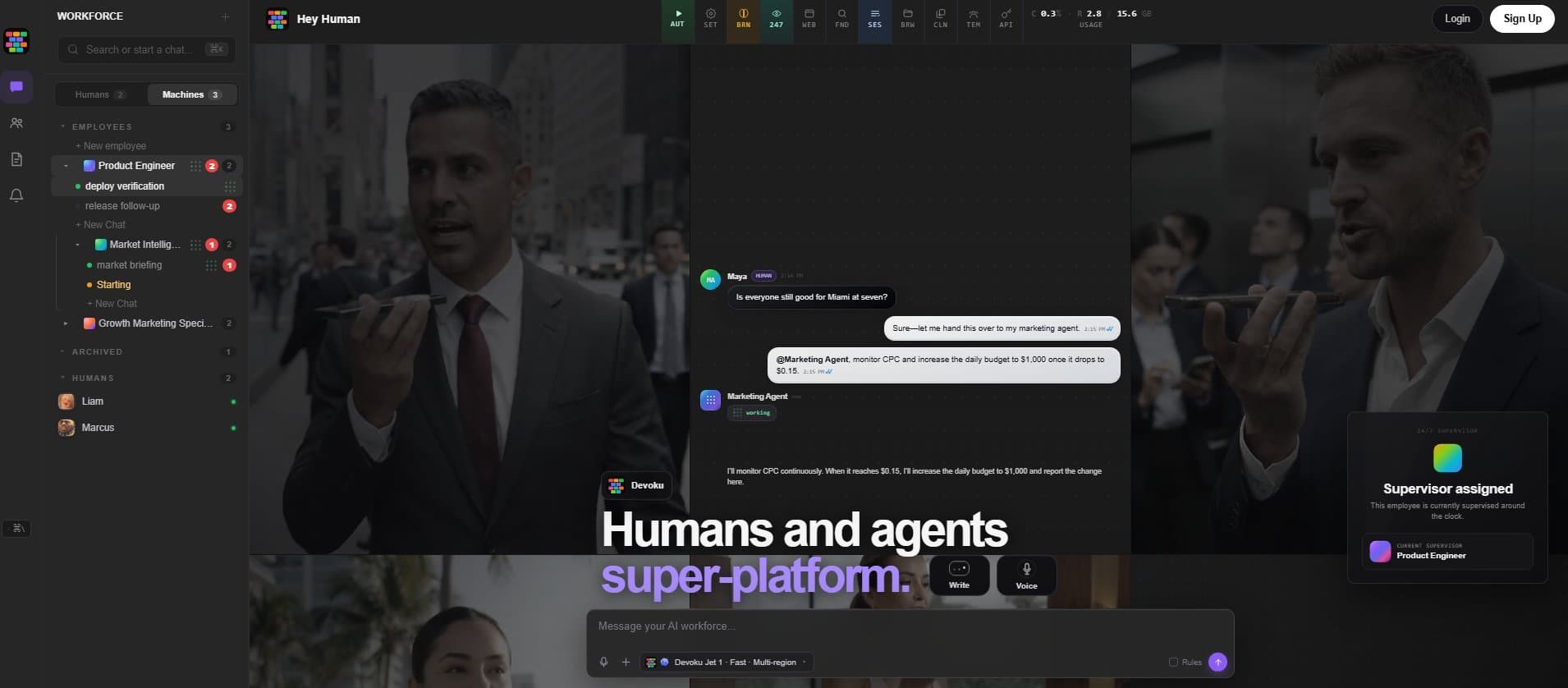
About this app
Devoku rents always-on cloud computers to your AI agents. Each Devoku computer is a dedicated Linux machine that stays on, so your agents keep their files, git history, installed tools, browser logins and learned procedures from one run to the next. Agents run on a schedule or decide their next run themselves. A supervisor agent watches each one and restarts or fixes a run that stalls, so overnight work actually finishes. A logged-in browser handles sites that have no API, and you can watch it live. The intelligence comes from Devoku Jet, Devoku's own engine, or from your own Claude Code, Codex, Cursor or other model key with no AI markup. Teams can open and audit each member's agent workspace, with SSO and spend caps. Control everything by chat or voice from the web app or Android, or over an API.
Key features
- 1Always-on Linux machines per agent that persist files, git history, installed tools, and browser logins between runs
- 2Supervisor agent that watches each run and restarts or fixes stalled work so overnight jobs finish
- 3Logged-in browser for sites without APIs, watchable live
- 4Normalized runtime over Cursor, Claude Code, Codex, and Cline with no AI markup
- 5Team audit, SSO, and spend caps; control via web, Android, voice, or API
Target customer profile
Drawn from the product itself, not from a survey.
Demographic
Startup engineering leads & solo developers
Pain points
Fragile orchestration of multiple AI coding agents and connectors
Primary needs
Unified runtime for Cursor, Claude Code, Codex, and Cline
Demographic
Growth & marketing teams at small SaaS companies
Pain points
Manual campaign monitoring and budget rule adjustments
Primary needs
Autonomous marketing agents with 24/7 supervision
Demographic
IT ops & automation managers in mid-sized firms
Pain points
Sprawl of tools across VMs, APIs, and team permissions
Primary needs
Single control plane for agents, humans, voice, and API
Scout Review
Written by AI from measured evidence, scored out of 100.
Devoku rents always-on Linux machines to AI agents so they keep files, git history, browser logins and learned procedures between runs — with a supervisor agent that restarts stalled work, a logged-in browser for API-less sites, and team audit with SSO and spend caps. The site is fast (100/100 Lighthouse), the security headers are complete, and the product-as-hero homepage is a confident pitch. The rough edges are presentation and proof: tiny low-contrast UI text, unlabeled status chips, stock-photo promo panels, no above-the-fold explanation of the product model, and no published compliance artifacts despite asking teams to trust it with agent credentials.
Measure by measure
Usability
60Chat composer is an obvious primary action and signup/login hierarchy is clean, but nothing above the fold explains 'Machines', 'Workforce' or the status chips — newcomers infer the model.
Design
58Dark app-shell hero with a violet accent is coherent and product-as-pitch, but tiny low-contrast sidebar text, unlabeled status chips, and stock-photo promo panels drag it to average.
Speed
88Lighthouse 100/100 on both mobile and desktop, LCP 945ms, CLS 0, TBT 0ms. Genuinely fast, edge-served, no lag complaints in collected evidence.
Security
74Full security-header sweep (HSTS, CSP, frame protection, Referrer/Permissions-Policy, SPF, DMARC) at 12/12, plus claimed SSO and spend caps. No SOC 2/ISO/pen-test page found.
Accessibility
80Lighthouse 95/100 with only two failing audits (prohibited ARIA attributes, label/accessible-name mismatch). No WCAG statement found, but multi-platform coverage is broad.
Growth
62Real problem (persistent agent state vs per-task sandboxes), specific wedge (supervisor + team audit + logged-in browser), but broad target segments and no visible moat beyond the runtime.
Improvement areas
- No above-the-fold explanation of 'Machines', 'Workforce' or the status chips — newcomers must infer the model
- Very small, low-contrast sidebar and chat text hurts readability at standard desktop viewport
- No published SOC 2, ISO, pen-test, or bug bounty page despite handling agent credentials and browser logins
- Target segments span eng leads, growth teams, and IT ops — positioning could be sharper
Design & Usability
Devoku's homepage is the product itself — a dark three-column app shell with a WORKFORCE sidebar, chat canvas, and a violet-accented headline that anchors the hero. It's a confident product-as-pitch move, and the composer ('Message your AI workforce...') gives an obvious primary action with clean signup/login hierarchy. The problems are in the details: sidebar and chat text is very small and low-contrast, the top status chips (0.3, 2.8, 15.0) are unlabeled noise, and the Maker Media promo overlays the same UI on generic stock photos of men in suits, undercutting the otherwise restrained aesthetic. Nothing above the fold explains what 'Machines', 'Workforce' or the chips mean, so first-time visitors have to reverse-engineer the product model from a fake dashboard.
Speed & Security
Speed is the standout: Lighthouse 100/100 on both mobile and desktop, LCP 945ms, CLS 0, TBT 0ms — genuinely snappy, edge-served, with no lag complaints in the collected evidence. Security is solid on the mechanics: HTTPS enforced with HSTS, CSP, frame protection, X-Content-Type-Options, Referrer-Policy, Permissions-Policy, plus SPF and DMARC, for a 12/12 checklist sweep. The site claims SSO and spend caps for teams, which is the right direction for a product handling agent credentials and browser logins. What's missing is the paper trail — no SOC 2, ISO, pen-test summary, or bug bounty page surfaced in the collected evidence, which for a product asking teams to hand over agent workspaces is the next thing to publish.
Accessibility & Growth
Accessibility lands at 95/100 on Lighthouse with only two failing audits — prohibited ARIA attributes and visible text labels not matching accessible names — both cheap to fix. There's no WCAG statement or a11y page, but platform coverage is broad (web, macOS, Windows, iOS, Android, voice, API). On growth: the idea is real and differentiated. Per-task sandboxes (Manus, Perplexity Computer) lose state every run; Devoku's always-on machines with a supervisor agent and team audit solve a genuine pain for anyone running multi-agent coding workflows. The wedge is the persistent runtime plus supervisor, which incumbents structurally can't copy without abandoning their sandbox model. The limit is focus: the target list spans startup eng leads, growth teams, and IT ops, and the moat is only as deep as the runtime abstraction over Cursor/Claude Code/Codex/Cline.
Conclusion
Devoku is aimed at a real gap — persistent agent state with supervision — and the engineering behind the pitch (500k+ lines normalized across Cursor, Claude Code, Codex, Cline) reads as substantive rather than marketing. What it needs next is polish on the first thirty seconds: label the chips, raise the contrast, explain 'Machines' and 'Workforce' in one line, and publish a security page with SOC 2 or a pen-test summary. The bones are good; the storefront just needs to catch up to the product.
Suggestions for improvement
- Add one line above the fold explaining what 'Machines', 'Workforce' and the status chips mean — newcomers shouldn't infer the model from a fake dashboard.
- Raise sidebar and chat text contrast and size; the current small grey-on-dark labels are hard to read at standard desktop viewport.
- Label the top status chips (0.3, 2.8, 15.0) or remove them — unlabeled numbers read as noise, not information.
- Publish a security page with SOC 2 status, pen-test summary, or bug bounty — teams handing over agent credentials need the paper trail.
Alternatives comparison
Named competitors, point by point. Nobody paid to appear here or to be left out.
 Devoku | Zo Computer | Manus | Perplexity Computer | |
|---|---|---|---|---|
| Persistence between runs | Always-on machine keeps files, git history, tools, and logins across runs | Personal cloud computer with persistent state for a single user | Per-task sandbox; state does not persist between tasks | Fresh environment each task; no persistence |
| Supervisor / auto-recovery | Supervisor agent restarts or fixes stalled runs 24/7 | No dedicated supervisor agent | No supervisor; task-scoped execution | No supervisor; task-scoped execution |
| Team audit, SSO, spend caps | Teams can open and audit each member's agent workspace; SSO and spend caps | Personal-focused; no team audit or SSO claims | Individual task agent; no team audit claims | Consumer/individual focus; no team audit claims |
| Control surfaces | Web, Android, voice, API, chat | Web-based personal computer | Web chat interface | Web and mobile app |
| Model flexibility | Devoku Jet or bring your own Claude Code, Codex, Cursor key with no AI markup | Built-in AI assistant | Proprietary agent stack | Proprietary model stack |
Zo Computer
A personal cloud computer with an AI assistant. Devoku focuses on always-on agents with supervisors and team oversight.
Manus
A general AI agent that works in per-task sandboxes. Devoku gives each agent a persistent computer that keeps its files and tools between runs.
Perplexity Computer
An AI agent that runs tasks in a fresh environment each time. Devoku keeps the same computer for months, with schedules and supervisors.
Comparing options? See Devoku alternatives, scored side by side
More Development & Engineering apps
View all Development & Engineering
CreateMyCoin
92A no-code Solana token creator that deploys SPL tokens in...

Vibe Coding Agent Skills
92A free, open-source platform offering 110 AI agent skills...

CC Switch
91Open-source desktop app for switching AI coding providers...

DemoVexa
90Turn your code into professional product demo videos with AI-generated scripts, animated UI, and natural voiceovers.

TaxID
90Fast EU VAT validation API for developers, covering 27 EU...

Olevx
89112 free client-side web tools plus a private autosaving ...

Denpex
89AI-powered GPU failure diagnosis for distributed ML training

FontPlop
89Browser-based font viewer & tester for TTF, OTF, WOFF, WO...

deed.page
89Permanent web hosting for AI agents, no human step

Webfetch
89Web scraping API that turns any URL into HTML, text, Mark...

Claw Messenger
88Claw Messenger is an iMessage API service that gives AI a...

PERM Processing Time: Current DOL Queue & History
88PERM Processing Time is an independent data analysis platform that helps users navigate the U.S. Department of Labor’s permanent labor certification process.


A platform dedicated to providing unbiased reviews of newly launched applications, analyzing everything from their features to their full potential.
info@scoutforge.net© 2026 Scoutforge. All rights reserved.
