Cycling through all six. Tap any point to stop.
Measured on six things
Rent cloud GPUs by the second at all-in prices, payable i...
Growth
63Specific wedge — per-second all-in pricing, health-check-gated billing, EU regions — aimed at indie researchers and small startups. Crypto-only payment caps the addressable audience.
Screenshots
1 / 1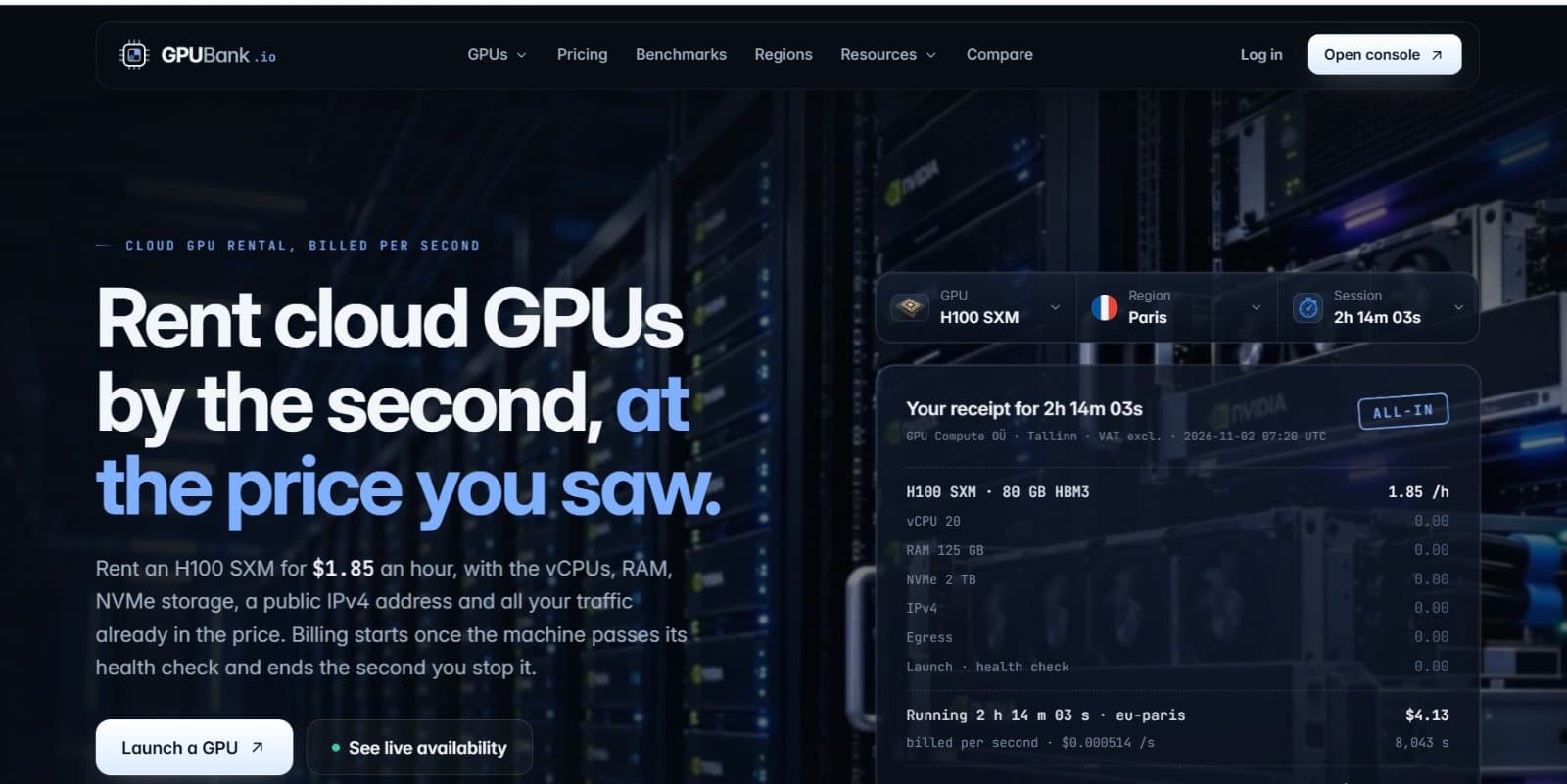
About this app
GPUBank is a cloud GPU rental platform that bills by the second, not the hour, and folds everything a serious AI workload needs into a single hourly price. You pick a card — B200, H200, H100 SXM/PCIe, RTX PRO 6000, A100, L40S, AMD MI300X, RTX 5090 or RTX 4090 — and the quoted rate already covers the vCPUs, RAM, local NVMe scratch disk, a public IPv4 address and unmetered traffic. The only possible extra line is a persistent disk at $0.03/GB-month, which keeps your data alive between runs. Cards are spread across four regions (Paris, Frankfurt, Ashburn and Singapore), with paid launches from H100 down to $1.85/h and RTX 4090 at $0.23/h. Around 25 ready-to-run templates — PyTorch, vLLM, SGLang, ComfyUI, Ollama, Axolotl, Unsloth, JupyterLab and more — come pinned to tested driver and CUDA versions and are re-verified on real GPUs every few days. Billing only starts after a health check passes, so failed launches cost nothing. Payment works off a prepaid balance topped up with crypto (B...
Key features
- 1Per-second billing with all-in pricing: vCPU, RAM, NVMe, IPv4 and egress included in the hourly rate.
- 2Billing starts only after the machine passes its health check — failed launches cost nothing.
- 325 ready-to-run templates (PyTorch, vLLM, SGLang, ComfyUI, Ollama, Axolotl, Unsloth, JupyterLab) re-verified on real GPUs every three days.
Target customer profile
Drawn from the product itself, not from a survey.
Demographic
Indie AI researchers and PhD students
Pain points
Tight grants, hourly minimums, GPU outages wasting budget
Primary needs
Cheap per-second billing, spill-proof disks, spend caps
Demographic
ML engineers at small startups
Pain points
Overpriced hyperscalers, slow provisioning, hidden fees
Primary needs
Fast H100/H200 access, API/CLI automation, transparent bills
Demographic
AI creators and image/video artists
Pain points
Local GPUs too weak for FLUX/ComfyUI, cloud setup is fiddly
Primary needs
Ready templates, 24–96GB cards, persistent model storage
Demographic
EU-based dev teams with data residency needs
Pain points
US-only clouds, GDPR risk, cross-region complexity
Primary needs
EU regions, readable DPA, portable disks across regions
Scout Review
Written by AI from measured evidence, scored out of 100.
GPUBank is a well-executed indie GPU cloud with a clear thesis: all-in per-second pricing, health-check-gated billing, EU regions, and a template library that's actually re-tested on real hardware. The site is fast (Lighthouse 82), the security headers are complete (12/12), and the docs quickstart is better than most funded competitors'. The pricing table is honest and the '45% cheaper than average' claim is at least sourced to a date and a provider count. The two real problems are structural, not cosmetic: crypto-only top-up from $25 shuts out the card-paying academic and startup audience the product explicitly targets, and the missing compliance layer (no SOC 2, ISO, or pen-test disclosure) will slow down any buyer whose procurement team asks. Accessibility is close but has three fixable failures. For an indie researcher who already holds crypto, this is a genuinely good option. For everyone else, it's a great product behind a payment wall that doesn't fit them.
Measure by measure
Usability
68Six-step quickstart with copyable CLI, documented API and auto-filled templates make launch fast. Crypto-only top-up from $25 before any GPU is a real friction point.
Design
72Distinctive receipt-style hero and live availability counter give the site real personality; dense pricing table is functional but heavy. Polished for an indie GPU cloud.
Speed
74Lighthouse desktop 82/100 with LCP 1.3s and near-zero CLS; TBT 269ms is the only blemish. Advertised 48s median launch backs the speed pitch.
Security
76Full security header suite (HSTS, CSP, frame protection, Permissions-Policy) and SPF/DMARC — 12/12 probe points. No SOC 2, ISO or pen-test disclosure found; crypto-only payments add trust friction.
Accessibility
70Lighthouse a11y 94/100 with three real failures: prohibited ARIA, low contrast, and mismatched accessible names. No WCAG statement or a11y page found.
Growth
63Specific wedge — per-second all-in pricing, health-check-gated billing, EU regions — aimed at indie researchers and small startups. Crypto-only payment caps the addressable audience.
Improvement areas
- Crypto-only top-up from $25 excludes card-paying researchers and startups — the stated core audience.
- No SOC 2, ISO 27001, pen-test disclosure or bug bounty page for procurement conversations.
- Three Lighthouse accessibility failures (ARIA, contrast, accessible names) and no WCAG statement.
Design & Usability
GPUBank's site has a point of view — the receipt hero, the live GPU counter, the '45% cheaper than average' bar — that most indie infra tools never bother with. The pricing table is dense but honest: per-hour, per-second and per-month columns, spot and reserved tiers, and every card's region list. Usability is where it gets interesting. The docs quickstart is genuinely good: six numbered steps, copyable CLI, a real `gpubank launch` example with output. Templates auto-fill the launcher. But step two is 'top up from $25 in crypto,' and that single decision gates the entire funnel. For a PhD student on a grant card or a small startup with a corporate Amex, that's a hard stop. The product is easy to use once you're in; getting in is the work.
Speed & Security
Speed is a genuine strength. Lighthouse desktop 82/100, LCP 1.3s, CLS 0.001 — the site loads fast and the advertised 48s median launch (p95 71s) is the kind of number that wins converts from slower clouds. TBT of 269ms is the only soft spot. Security is strong on the wire: 12/12 header checklist points including HSTS, CSP, frame protection and Permissions-Policy, plus SPF and DMARC. Auth is email+password with a six-digit code, or GitHub/Google OAuth. What's missing is the compliance layer enterprise buyers ask for — no SOC 2, no ISO 27001, no pen-test disclosure, no bug bounty. For the indie/small-startup target that's probably fine; for the 'ML engineers at small startups' persona it's a question they'll ask eventually. Crypto-only payments are the bigger trust question.
Accessibility & Growth
Accessibility lands at 94/100 on Lighthouse with three real failures: prohibited ARIA attributes, insufficient color contrast, and visible text labels without matching accessible names. Those are the kinds of bugs that hit screen-reader users specifically, and there's no WCAG statement or a11y page to show the team is tracking them. Growth is the more interesting story. The wedge is real and specific: per-second billing, all-in pricing that folds vCPU/RAM/NVMe/IPv4/egress into one number, billing that only starts after a health check, a $0.03/GB-month persistent disk, and 25 templates re-verified on real GPUs every three days. That's a coherent pitch against Vast.ai (variable reliability), RunPod (per-second but template-light), Lambda (reserved-cluster focus) and CoreWeave (enterprise-only). The EU regions and readable DPA target a segment the US-only clouds underserve. The limit is the crypto-only top-up — it narrows the funnel to a crypto-native slice of an audience that mostly pays with cards and grants.
Conclusion
If you're crypto-native, EU-based, and tired of hyperscaler markups, GPUBank is worth a real look — the per-second billing and health-check-gated meter are the right primitives, and the template library is more than marketing. If you're paying with a grant card or a company Amex, wait for card payments before you build a workflow on it. The product is ready; the payment rail isn't.
Suggestions for improvement
- Add card and invoice payment alongside crypto — the stated audience (PhD students, small startups) mostly can't pay in BTC.
- Publish a SOC 2 Type I roadmap or a third-party pen-test summary; even a self-attestation page would help procurement conversations.
- Fix the three Lighthouse a11y failures (ARIA, contrast, accessible names) and add a short WCAG conformance statement.
- Offer a small free credit or trial tier so researchers can validate launch speed and template quality before committing $25.
Alternatives comparison
Named competitors, point by point. Nobody paid to appear here or to be left out.
 GPUBank |  Vast.ai |  RunPod | Lambda | CoreWeave | |
|---|---|---|---|---|---|
| Billing granularity | Per-second, all-in (vCPU/RAM/NVMe/IPv4/egress included) | Per-second on most hosts; variable by provider | Per-second | Per-minute / per-hour on-demand | Per-hour, reserved-heavy |
| Payment methods | Crypto only (BTC, USDT, ETH, XMR), from $25 | Card and crypto | Card and crypto | Card and invoice | Invoice / enterprise billing |
| Ready-to-run templates | 25 templates, re-verified on real GPUs every 3 days | Docker images, community-provided | Large template library + serverless | Limited; mostly base images | Kubernetes-native, bring your own stack |
| EU regions / data residency | Paris, Frankfurt, Ashburn, Singapore | Global peer hosts, variable | Multiple regions incl. EU | US-centric | US and EU regions |
| Compliance certifications | None disclosed (strong headers, no SOC 2/ISO) | Limited public disclosure | SOC 2 Type II | SOC 2 Type II | SOC 2, ISO 27001, HIPAA |
Vast.ai
Marketplace for renting peer-hosted GPUs at low prices, with variable reliability.
RunPod
Popular GPU cloud with per-second billing, templates and serverless options.
Lambda
AI-focused GPU cloud offering on-demand and reserved H100/A100 clusters.
CoreWeave
Enterprise-grade GPU infrastructure geared to large-scale training.
Comparing options? See GPUBank alternatives, scored side by side
More Development & Engineering apps
View all Development & Engineering
Vibe Coding Agent Skills
92A free, open-source platform offering 110 AI agent skills...

CreateMyCoin
92A no-code Solana token creator that deploys SPL tokens in...

CC Switch
91Open-source desktop app for switching AI coding providers...

DemoVexa
90Turn your code into professional product demo videos with AI-generated scripts, animated UI, and natural voiceovers.

TaxID
90Fast EU VAT validation API for developers, covering 27 EU...

Webfetch
89Web scraping API that turns any URL into HTML, text, Mark...

deed.page
89Permanent web hosting for AI agents, no human step

FontPlop
89Browser-based font viewer & tester for TTF, OTF, WOFF, WO...

BeartIMAGE
88BeartIMAGE is a free, web-based image processing platform engineered for fast, bulk photo editing and conversion directly in your browser.

Claw Messenger
88Claw Messenger is an iMessage API service that gives AI a...

DataHabibi
88AI-powered Dubai real estate data platform with 12M+ DLD ...

ButterKit
82macOS app for App Store screenshots: 3D mockups, auto-tra...


A platform dedicated to providing unbiased reviews of newly launched applications, analyzing everything from their features to their full potential.
info@scoutforge.net© 2026 Scoutforge. All rights reserved.
