Cycling through all six. Tap any point to stop.
Measured on six things
Find the key of any song from a file or the microphone, with DJ key code, tuning and BPM. Free, no ads, no account, works offline.
Speed
46Lighthouse mobile 56/100 with an 8.7s LCP and 678ms TBT drags the score; desktop 89/100 shows the site itself is fine on a real connection. Core detection runs on-device, so app speed is separate from the store page.
Screenshots
1 / 3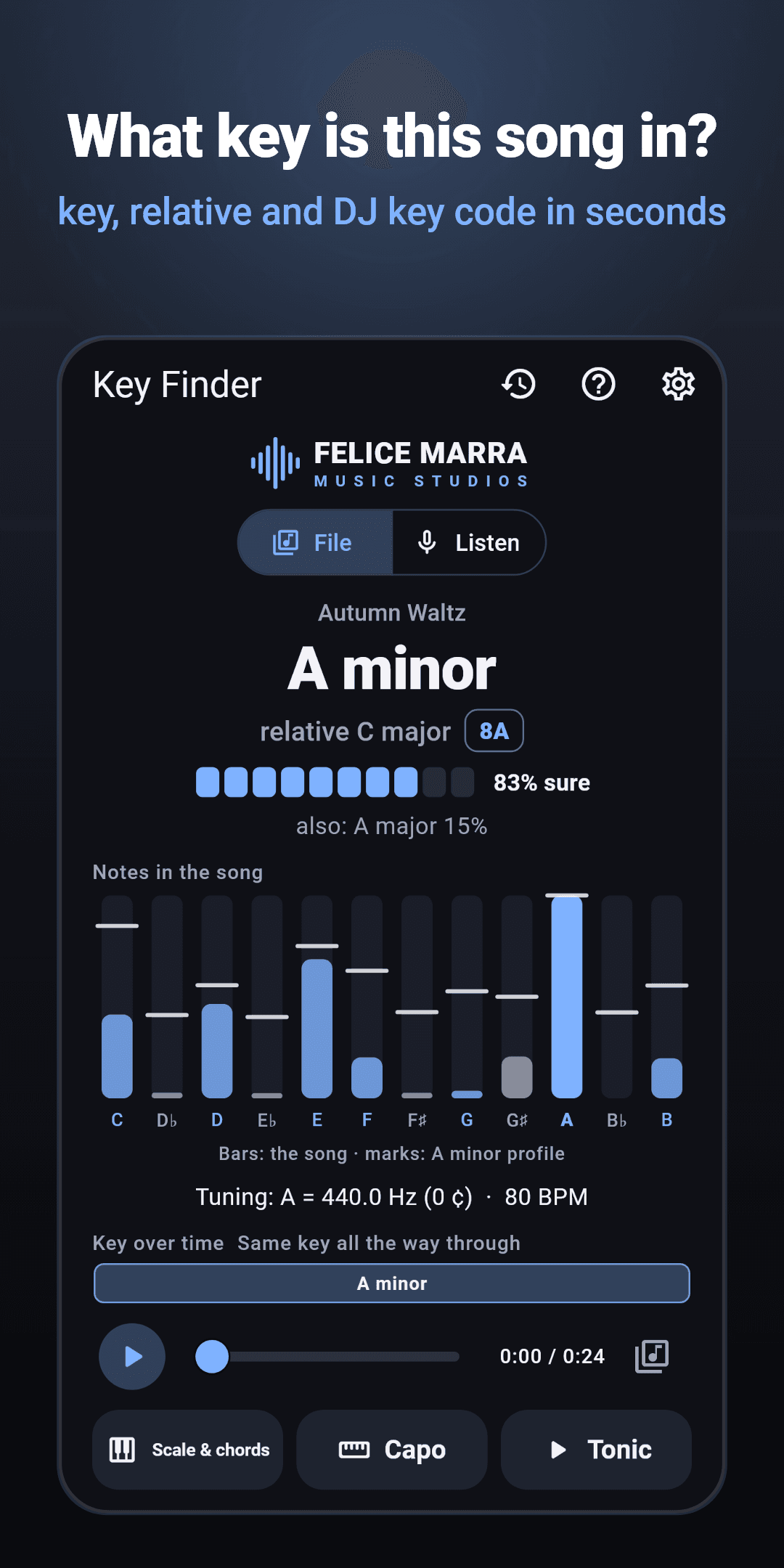
About this app
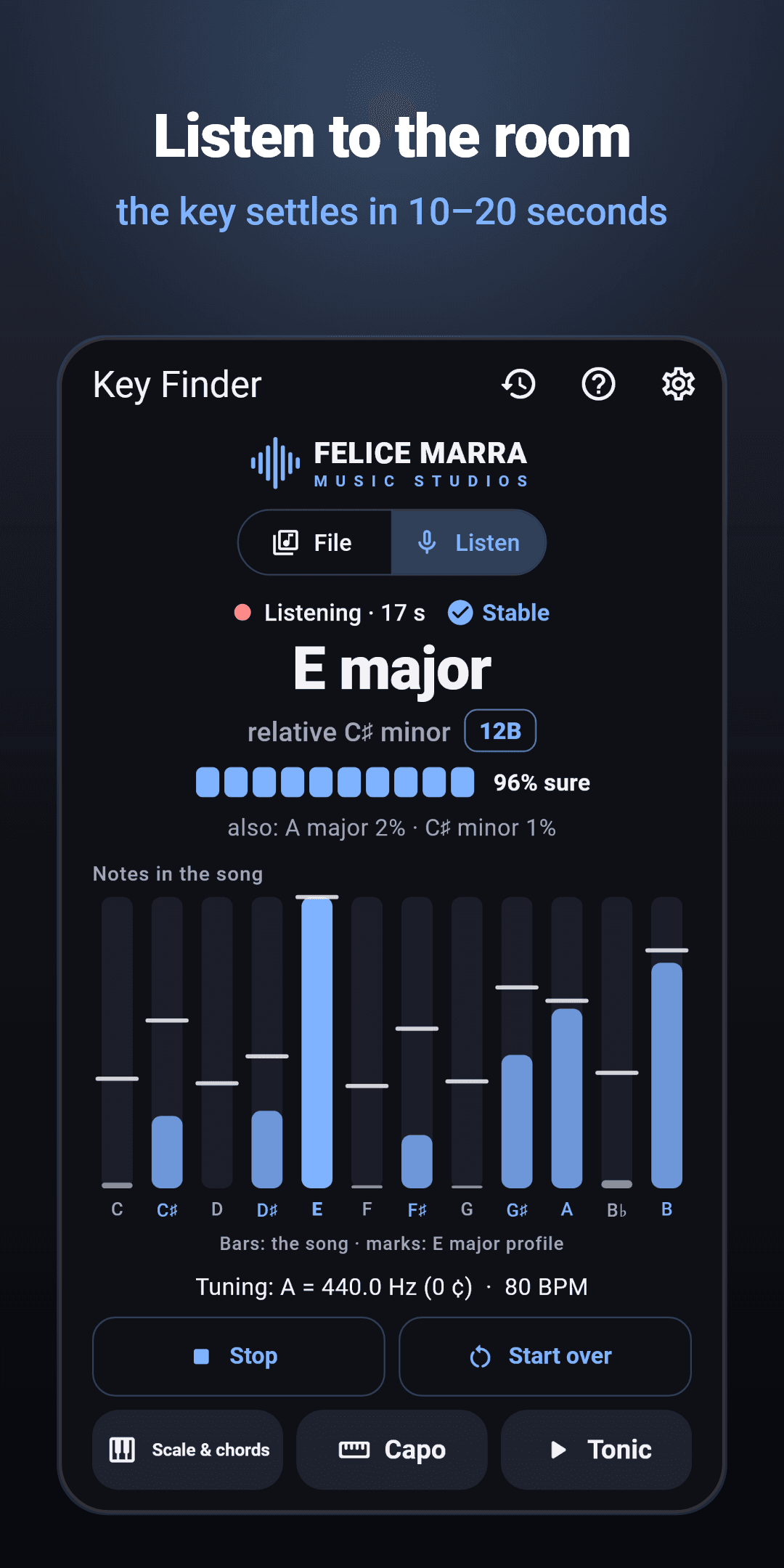
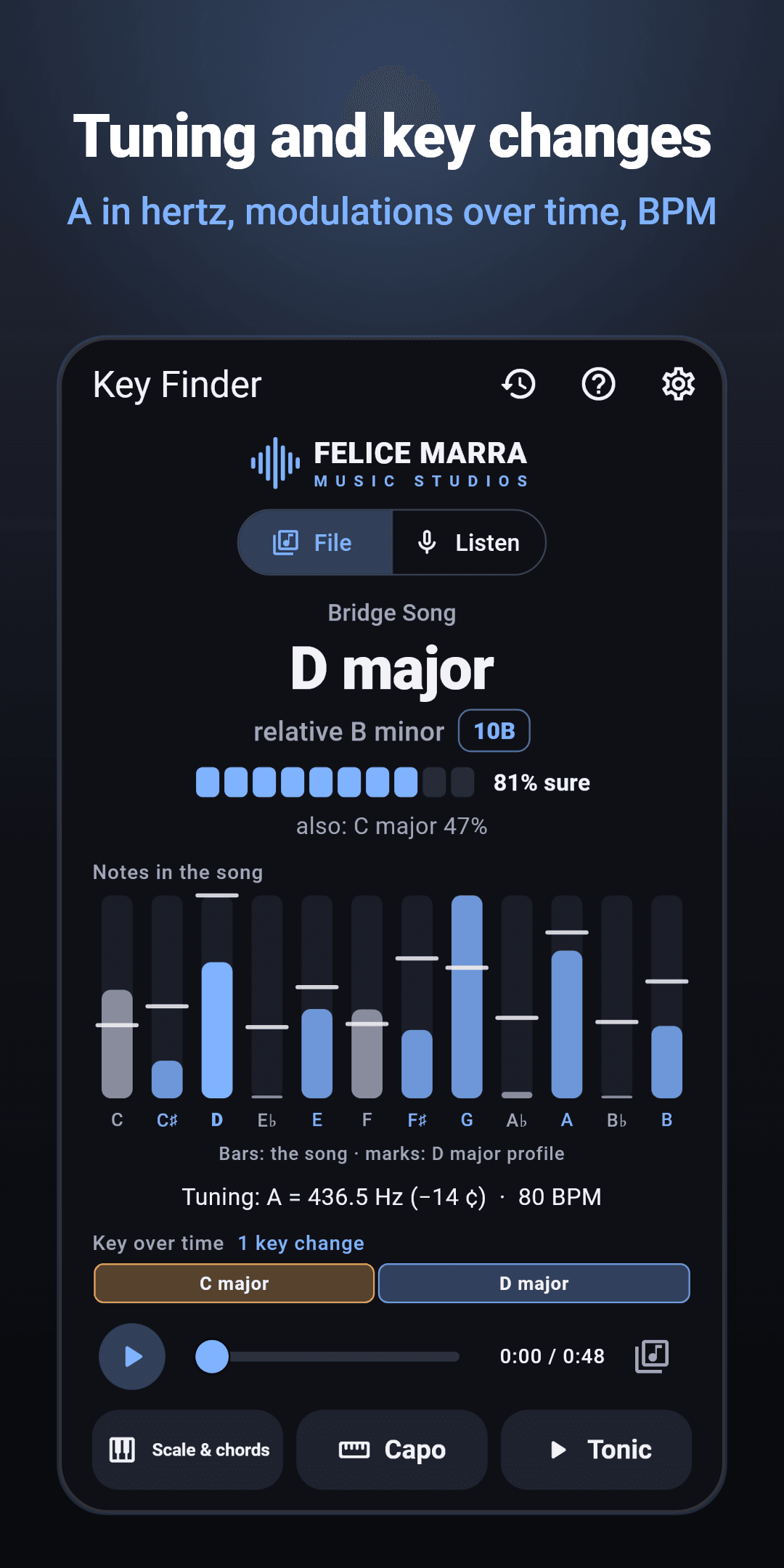
Key Finder detects the musical key of any song, from a file on your phone or from music playing in the room. File: open an MP3, M4A, AAC, WAV, FLAC or OGG song and the whole track is analysed on your phone. Listen: play the music near the phone and the estimate settles in 10 to 20 seconds. The result shows the key and its relative, the DJ key code (8A, 9B...), the confidence in percent and the next most likely keys, a chromagram of the notes the song really uses, the song's tuning in hertz and cents, the tempo in BPM and the key changes along the track. Atonal or purely percussive audio says "No clear key" instead of inventing one. What to play: the scale, the chords of the key with Roman numerals, guitar capo positions and the keys for harmonic mixing. An ear check plays the tonic chord or a drone in the song's own tuning. Free, no ads, no account, no in-app purchases, no subscription. Works offline and collects no data: songs and microphone sound are never recorded or sent.
Key features
- 1File and live microphone key detection, fully on-device and offline, with confidence percent and alternative keys.
- 2DJ key codes (Camelot 1A–12B), harmonic mixing suggestions, tuning in Hz/cents, tempo in BPM and key-over-time.
- 3Scale, chords with Roman numerals, guitar capo positions and an ear-check drone in the song's own tuning.
Target customer profile
Drawn from the product itself, not from a survey.
Demographic
Musicians and singers (amateurs and pros)
Pain points
Looking for a free tool with no ads and no account
Primary needs
Fast, accurate key detection; chords and capo suggestions; offline use
Demographic
DJs
Pain points
Looking for a free tool with no ads and no account
Primary needs
Reliable key detection with DJ key codes; harmonic mixing suggestions; tempo info
Demographic
Music producers and composers
Pain points
Looking for a free tool with no ads and no account
Primary needs
Detailed key analysis; tuning offset; chord progressions; key over time
Scout Review
Written by AI from measured evidence, scored out of 100.
Key Finder is a free, no-account, offline key-detection app for musicians, singers, DJs and producers, shipping as an Android app with a Play Store listing as its front door. The app UI is the strongest part: answer-first hierarchy, disciplined dark palette, and dense musical data kept legible. Usability is close behind, with a clear File/Listen toggle and live listening status, though the primary action gets muddy across modes. Speed is split — desktop Lighthouse 89, mobile 56 with an 8.7s LCP on the store page — but core detection is on-device so the app itself doesn't wait on a server. Security is 8/13 on headers with a strong 'no data collected' Data Safety story compensating. Accessibility is 99/100 with two minor audit failures. Growth is a real wedge in a crowded category, held back by early distribution.
Measure by measure
Usability
68File/Listen toggle with live 'Listening · 17 s' and 'Stable' status is genuinely clear. Primary action gets muddy in Listen mode where Stop/Start over swap the full-width slot, and File mode leans on a small play icon.
Design
70Judging the app UI via store screenshots: answer-first layout, disciplined dark palette with one blue accent, dense data kept legible. Bottom action row and small tuning/BPM text are the weak spots.
Speed
46Lighthouse mobile 56/100 with an 8.7s LCP and 678ms TBT drags the score; desktop 89/100 shows the site itself is fine on a real connection. Core detection runs on-device, so app speed is separate from the store page.
Security
628/13 header checklist: HSTS, CSP, frame protection, X-Content-Type-Options and Permissions-Policy present; Referrer-Policy, DMARC and secure cookies missing, HTTPS not strictly enforced. On-device processing and 'no data collected' Data Safety card are real positives.
Accessibility
82Lighthouse 99/100 with only two failing audits (missing main landmark, label/name mismatches). 71 languages, dark/light theme, and a data-dense UI that stays readable. A11y statement not published, so this sits in the upper band on measured evidence.
Growth
63Real, specific wedge: free, no ads, no account, offline, on-device, with DJ codes, tuning, tempo and capo in one tool. 100+ downloads is early context, not the score. Category is crowded but the 'honest, private, free' angle is defensible.
Improvement areas
- Bottom action row inconsistency: 'Scale & chords' is visually smaller than 'Capo' and 'Tonic'.
- Web security headers incomplete: no DMARC, no Referrer-Policy, no secure cookies, HTTPS not strictly enforced.
- Accessibility audit failures: missing <main> landmark and label/accessible-name mismatches.
- Mobile store page performance: 8.7s LCP and 678ms TBT drag Lighthouse mobile to 56/100.
Design & Usability
The app's own UI is the design story here, and it's a good one: the detected key is the biggest thing on screen, the relative key, Camelot code and confidence sit right under it, and a single blue accent carries the whole palette. Dense data — 12-note chromagram, tuning, BPM — stays legible through disciplined spacing. The cracks are in the details: the bottom action row treats 'Scale & chords' as a second-class citizen next to 'Capo' and 'Tonic', and tuning/BPM are rendered in small grey text that's easy to skim past. Usability is mostly solid — the File/Listen toggle and the live 'Listening · 17 s' / 'Stable' status line make mode and progress obvious — but the primary action gets ambiguous in Listen mode where Stop and Start over swap the full-width slot, and File mode leans on a small play icon to do the job of a real CTA. For a free, no-account app, the onboarding is essentially zero-friction, which is the right call.
Speed & Security
Speed is a tale of two devices. Lighthouse desktop lands at 89/100, but mobile is 56/100 with an 8.7s LCP and 678ms TBT — the Play Store listing itself is heavy on a phone. That's a store-page problem, not an app problem: the core detection runs on-device and offline, so once installed the app doesn't wait on a server. Security is a mixed bag. The header probe shows HSTS, CSP, frame protection, X-Content-Type-Options and Permissions-Policy in place, but Referrer-Policy, DMARC and secure cookies are missing and HTTPS isn't strictly enforced — 8/13 on the checklist. The compensating factor is real: the Play listing's Data Safety card declares 'No data shared' and 'No data collected', and the app's whole pitch is on-device analysis with no account and no ads. For a free indie music tool, that's a defensible privacy posture even if the web headers are sloppy.
Accessibility & Growth
Accessibility scores 99/100 on Lighthouse with only two failing audits — a missing <main> landmark and some label/accessible-name mismatches. Those are real but minor; the bigger picture is a data-dense UI that stays readable, 71 languages, dark/light themes, and no reliance on color alone for the primary answer. No published a11y statement, so this sits in the upper band on measured evidence rather than documentation. Growth is the interesting question. The category — key detection for musicians and DJs — is real and populated: Mixed In Key is the paid DJ incumbent, KeyFinder by Ibrahim Sha'ath is the desktop donationware option. Key Finder's wedge is specific: free, no ads, no account, offline, on-device, with DJ key codes, tuning in cents, tempo and capo suggestions in one screen. That's a genuinely differentiated bundle for singers, guitarists and bedroom DJs who don't want a subscription. The limit is that 'free and private' is a positioning, not a moat — Mixed In Key can add features faster, and the 100+ download count shows the wedge hasn't yet converted into distribution.
Conclusion
What makes Key Finder worth a look isn't any single feature — it's the combination. Most key-detection tools pick one lane: Mixed In Key is a paid DJ tool, KeyFinder is a desktop utility. Key Finder bundles file and live detection, DJ codes, tuning in cents, tempo, chromagram, capo positions and an ear-check drone into one free, ad-free, account-free app that runs entirely on-device. That's a coherent product, not a feature list. The honest limits: the store page is heavy on mobile, the web headers are sloppy, and 100+ downloads means the wedge hasn't converted into distribution yet. But for a singer who wants to know what key a song is in without a subscription, or a DJ who wants a Camelot code without opening a laptop, this is a genuinely useful tool that respects the user. That's rarer than it should be.
Suggestions for improvement
- Fix the bottom action row: give 'Scale & chords' the same label size and icon weight as 'Capo' and 'Tonic'.
- Make tuning and BPM more prominent — bump the text size and contrast so a useful metric isn't skimmed past.
- Add a Referrer-Policy header and enforce HTTPS strictly; add DMARC to the DNS records.
- Add a <main> landmark and fix the label/accessible-name mismatches flagged by Lighthouse.
Alternatives comparison
Named competitors, point by point. Nobody paid to appear here or to be left out.
 Key Finder: Song Key Detector |  Mixed In Key |  KeyFinder (by Ibrahim Sha'ath) | |
|---|---|---|---|
| Price model | Free, no ads, no IAP, no subscription | Paid one-time license (desktop) | Free / donationware (desktop) |
| Platform | Android app | Windows / macOS | Windows / macOS / Linux |
| Live microphone detection | Yes — settles in 10–20 s with stability indicator | No (file analysis only) | No (file analysis only) |
| DJ key codes / harmonic mixing | Yes — Camelot 1A–12B plus harmonic mixing suggestions | Yes — Camelot codes, energy, harmonic mixing (core feature) | Yes — Camelot codes |
| Tuning detection (Hz / cents) | Yes — A in Hz and offset in cents | Limited / not a headline feature | Not a headline feature |
| Account / data collection | No account, no data collected, on-device only | License-based; desktop local processing | No account; desktop local processing |
Mixed In Key
Another app in the same category.
KeyFinder (by Ibrahim Sha'ath)
Another app in the same category.
Comparing options? See Key Finder: Song Key Detector alternatives, scored side by side
More Lifestyle & Entertainment apps
View all Lifestyle & Entertainment
RoomCreator
92An AI-powered interior and exterior design tool that tran...

Factory Direct Mattress Overland Park
92A locally-owned mattress store in Overland Park, KS offer...

Seating Chart Generator
90Free seating chart maker for weddings and events

SheetScroll
90> You play; SheetScroll turns the page. It listens through the microphone or a MIDI piano and holds the page until it's sure where you are.

Hireci
89Save every recipe. Plan every meal.

TUNL - Cave Flyer
89A hold-to-thrust cave flyer with a new daily level, ghost races, and a global leaderboard.

Roami eSIM
88A global travel eSIM app offering instant activation, no ...

Portrait Gift
88AI-powered personalized face swap art platform creating c...

TranscriptYou
88Free YouTube transcript generator with timestamps and AI ...

Random Movie Generator
88Free random movie picker from 142k+ films—no sign-up.

FaceSwapAI
87AI face swap for photos, videos, GIFs with free trial.

youtubetomp3.ink
87Free online YouTube to MP3 converter with no signup or so...


A platform dedicated to providing unbiased reviews of newly launched applications, analyzing everything from their features to their full potential.
info@scoutforge.net© 2026 Scoutforge. All rights reserved.
