Cycling through all six. Tap any point to stop.
Measured on six things
Social media scheduler with client approvals built in
Growth
62Real, named pain (client approvals) with a concrete wedge: per-brand pricing vs. per-seat incumbents, plus API/MCP on every plan. Crowded category limits how far the wedge carries it.
Screenshots
1 / 1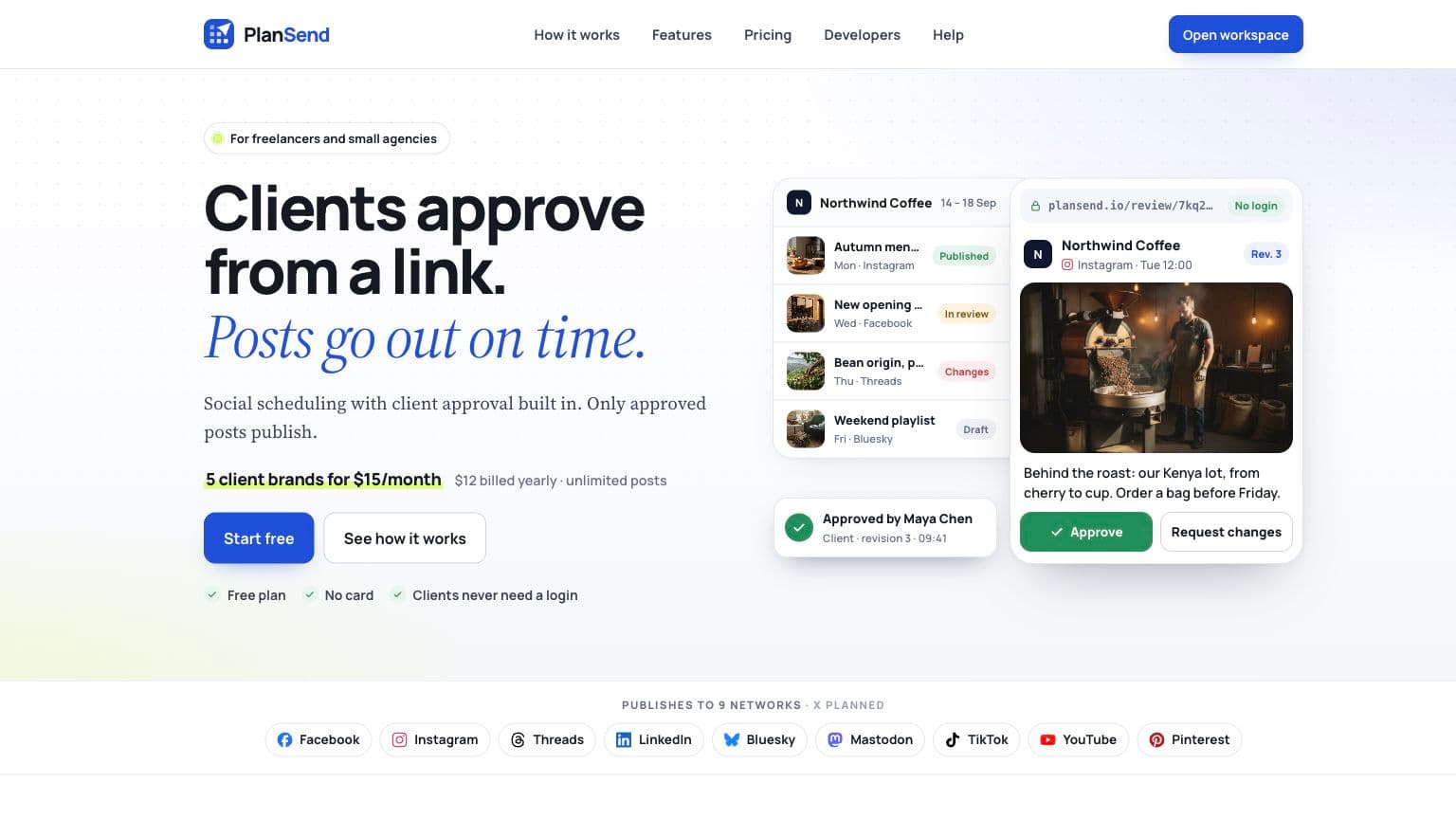
About this app
PlanSend helps agencies and social media teams plan posts, collect client approvals, and publish from one workspace per brand. Share a review link clients can open without an account, collect feedback on the draft, and schedule approved revisions to publish. Teams can customize captions by network and track publishing status. PlanSend also offers a REST API and MCP integration for drafting and managing social content workflows.
Key features
- 1No-login client review links with optional passcode; reviewers are free and unlimited on every plan.
- 2Revision-safe approvals: editing an approved post sends it back to review so only the approved version publishes.
- 3Per-brand workspaces with per-network captions, live limits and AI Assist in brand tone.
- 4REST API and MCP server on every plan including Free, for AI-assisted drafting and approval workflows.
- 5Publishing health with retries and a receipt for every send; supports 9 networks (X planned).
Target customer profile
Drawn from the product itself, not from a survey.
Demographic
Freelance social media managers
Pain points
Chasing client approvals via email or messaging apps; version control confusion
Primary needs
Simple, no-login approval links; clear audit trail; affordable pricing
Demographic
Small marketing agencies (2–10 people)
Pain points
Per-seat pricing inflates costs; managing multiple client calendars in one dashboard
Primary needs
Per-brand pricing; separate workspaces per client; reliable publishing
Demographic
In-house marketing teams with multiple brands
Pain points
Coordinating approvals across stakeholders; ensuring only approved content goes live
Primary needs
Revision-safe approvals; per-network captions; API access for automation
Scout Review
Written by AI from measured evidence, scored out of 100.
PlanSend is a social scheduling tool built around one idea: client approval is the product, not an add-on. Every plan includes no-login review links, revision-safe approvals that send edited posts back to review, per-brand workspaces and a REST API plus MCP server. Pricing is per brand rather than per seat — $15/month for five client brands on the monthly Solo plan, $12 billed yearly — and the site compares that directly against Planable and Hootsuite with dated public list prices. The execution is above average for its stage: a fast site (Lighthouse mobile 99), a disciplined design system, and a hero that shows the actual workflow. The gaps are equally concrete: no published security certifications, a missing DMARC record, one contrast failure, Google-only sign-in, and a crowded category where the differentiator is a pricing model competitors can copy.
Measure by measure
Usability
68Clear path to value: price stated in the hero, CTA repeated three times, five tiers plus a competitor comparison and FAQ. Google-only sign-in and collapsed FAQ answers cost it a few points.
Design
71Deliberate type system (bold grotesque + italic serif) applied consistently, and the hero shows the actual approval workflow. Held back by tiny mockup text and low-contrast code/footnote lines on dark bands.
Speed
88Lighthouse mobile 99/100 (LCP 1.1s, CLS 0, TBT 101ms) and desktop 95/100. A genuinely fast, lightweight marketing site with no lag complaints in the collected evidence.
Security
74HTTPS enforced with HSTS, CSP, frame protection and Referrer-Policy; 10/12 header checklist. Missing Permissions-Policy and DMARC, and no published SOC 2/ISO or security page to verify further.
Accessibility
81Lighthouse accessibility 96/100 with a single failing contrast audit on dark-band text. No a11y statement or WCAG claim published, and the site is English-only, which caps it below the top of the band.
Growth
62Real, named pain (client approvals) with a concrete wedge: per-brand pricing vs. per-seat incumbents, plus API/MCP on every plan. Crowded category limits how far the wedge carries it.
Improvement areas
- No published security page, SOC 2 or ISO claim; DMARC record and Permissions-Policy header are missing.
- Google-only sign-in locks out users without a Google account; no email or magic-link option.
- Hero mockup text and dark-band monospace/footnote text fail readability and contrast checks.
- No accessibility statement or WCAG conformance claim; site is English-only.
Design & Usability
PlanSend's homepage is a cut above the average scheduling-tool landing page. The type system — heavy grotesque headlines with italic serif second lines — is applied with real discipline across every section, and the hero earns its space by showing the actual workflow: a calendar with Published/In review/Changes/Draft chips beside a client review card with Approve and Request changes buttons. You understand the product before reading a paragraph. The three-step explainer cards each carry a mini-illustration of their own step, which is the kind of detail most sites skip. Usability follows the same logic: the price is stated in the hero ('5 client brands for $15/month'), the 'Start free' CTA appears in the nav, hero and closing band, and five pricing tiers plus a competitor comparison panel and FAQ handle objections in order. The deductions are concrete. Hero mockup text and the approval toast are too small to read at desktop size, which weakens the strongest proof on the page. The monospace API log and pricing footnote sit at low contrast on dark navy. The FAQ hides every answer behind a collapsed accordion, and sign-in is Google-only, which is a hard stop for anyone without a Google account.
Speed & Security
Speed is the standout measured result: Lighthouse mobile 99/100 with an LCP of 1.1s, CLS of 0 and TBT of 101ms, and desktop at 95/100. That is a genuinely lightweight marketing site, and nothing in the collected evidence suggests lag complaints. Security is solid but not exceptional. The HTTP probe confirms HTTPS enforced with HSTS, a Content-Security-Policy, frame protection, X-Content-Type-Options and a Referrer-Policy — 10 of 12 checklist points. The two gaps are a missing Permissions-Policy header and no DMARC record on the domain, the latter being the more meaningful omission for anyone worried about spoofed mail from the plansend.io name. Authentication runs through Google OAuth, which is a reasonable choice for a small team, and the site links Terms and Privacy Policy at sign-in. What is absent is any published security page, SOC 2 or ISO claim, or bug bounty — normal for a product at this stage, but it means the compliance story is unverified rather than proven.
Accessibility & Growth
Accessibility scores well on the automated pass: Lighthouse returns 96/100 with a single failing audit, insufficient background/foreground contrast — the same dark-band monospace and footnote text the visual audit flagged. Automated checks cover only part of WCAG, and PlanSend publishes no accessibility statement or WCAG conformance claim, and the site is English-only, so the score sits high in the band rather than at its ceiling. Growth is the more interesting question. The category — social scheduling with client approval — is crowded, with Buffer, Planable and Hootsuite all present. PlanSend's wedge is specific and defensible on paper: per-brand pricing instead of per-seat, so a five-client agency pays $15 rather than Planable's $165 or Hootsuite's $399, and the site makes that comparison explicitly with dated public list prices. The no-login review link and revision-safe approvals address a real, named pain for freelancers and small agencies. The REST API and MCP server on every plan, including Free, is a genuine differentiator against Buffer. What limits the score is that the wedge is a pricing model and a workflow, not a moat — incumbents can copy per-brand billing, and the category has no structural headroom that favors a newcomer beyond being cheaper and simpler.
Conclusion
If you are a freelance social media manager or a small agency currently chasing approvals through email threads and screenshots, PlanSend is aimed squarely at you, and the free plan (one brand, 20 posts a month, no card) is a low-risk way to test whether the review-link workflow actually saves you time. The per-brand pricing genuinely undercuts the per-seat incumbents at agency scale, and the API and MCP access on every tier is unusual generosity. Go in knowing what is not there yet: no SOC 2 or security page to point a cautious client at, no DMARC on the domain, Google-only sign-in, and an accessibility statement that does not exist. None of those are dealbreakers for a small team; all of them are things to ask about before you move a dozen client brands onto it.
Suggestions for improvement
- Publish a security page with your data-handling practices and, when ready, a SOC 2 or pen-test summary — enterprise-adjacent clients will ask.
- Add a DMARC record and a Permissions-Policy header to close the two gaps in an otherwise strong header setup.
- Fix the dark-band contrast failures (API log line, pricing footnote) and enlarge the hero mockup text so the approval card is readable.
- Offer email/password or magic-link sign-in alongside Google so users without a Google account are not locked out.
Alternatives comparison
Named competitors, point by point. Nobody paid to appear here or to be left out.
 PlanSend |  Buffer | |
|---|---|---|
| Pricing model | Per brand: Free, then $12–$79/mo for 5–60 brands; reviewers always free | Per channel/seat tiers; free plan for 3 channels, paid from ~$6/channel/mo |
| Client approval workflow | Built-in: no-login review links, revision-safe approvals, approval history and audit log | No native client approval workflow; relies on shared access or external review |
| Supported networks | Facebook, Instagram, Threads, LinkedIn, Bluesky, Mastodon, TikTok, YouTube, Pinterest (X planned) | Facebook, Instagram, Threads, LinkedIn, TikTok, YouTube, Pinterest, Bluesky, Mastodon, X and more |
| API / automation access | REST API and MCP server included on every plan, even Free | Public API available but limited; no MCP integration |
| Free plan | 1 brand, 3 channels, 20 posts/mo, 10 AI credits, no card | 3 channels, 10 scheduled posts per channel, basic analytics |
Comparing options? See PlanSend alternatives, scored side by side
More Social Media apps
View all Social Media
Voqusa
89Transcribe social media video and audio links into text (free signup, 5 free credits, then pay-as-you-go)

PodRescale
89Every episode becomes two weeks of posts. In your voice. Posted for you.

AI Comment Exporter
88YouTube comment exporter to CSV, Excel and JSON, with AI reports

Evoriqa
88White-label AI customer service agent for small businesse...

TranscriptYou
88Free YouTube transcript generator with timestamps and AI ...

AI Dance Trend
88Turn one photo into a 10-second AI dance video — no app, ...

LurkAPI
88Public social media data as clean JSON, in one request

Kinomo
87The Mac motion studio your AI agent drives.

ZombieTrend AI
87ZombieTrend AI turns two photos into an emotional zombie love story video with a heartfelt hug, memory flashback, sound, no watermark, and a free scene preview.

Outstanding AI Video
87You and 2 friends in the Outstanding Tiny Desk AI meme

TinyDesk-AI.fun
87Tiny Desk AI makes your own version of the viral "Outstanding" Tiny Desk meme. Add a photo to any of the five seats on the stage (lead mic, keys, two backing vocals, sax), from one person to the whole band, and get a fresh 19-second 9:16 720p clip cut like the original post, usually about 10 minutes after paying. $8.99 once, no account, no prompts. The MP4 is silent so you attach the licensed meme sound inside TikTok. Not affiliated with NPR.

AdRate
87TikTok ads automation for multi-account growth


A platform dedicated to providing unbiased reviews of newly launched applications, analyzing everything from their features to their full potential.
info@scoutforge.net© 2026 Scoutforge. All rights reserved.
