Cycling through all six. Tap any point to stop.
Measured on six things
Cited articles for SaaS blogs. Rewritten when they slip.
Security
52HTTPS enforced with SPF and DMARC, and payments run through a reseller that handles tax and receipts. But no HSTS, CSP, frame protection, or Referrer-Policy, and no SOC 2 or pen-test claims.
Screenshots
1 / 1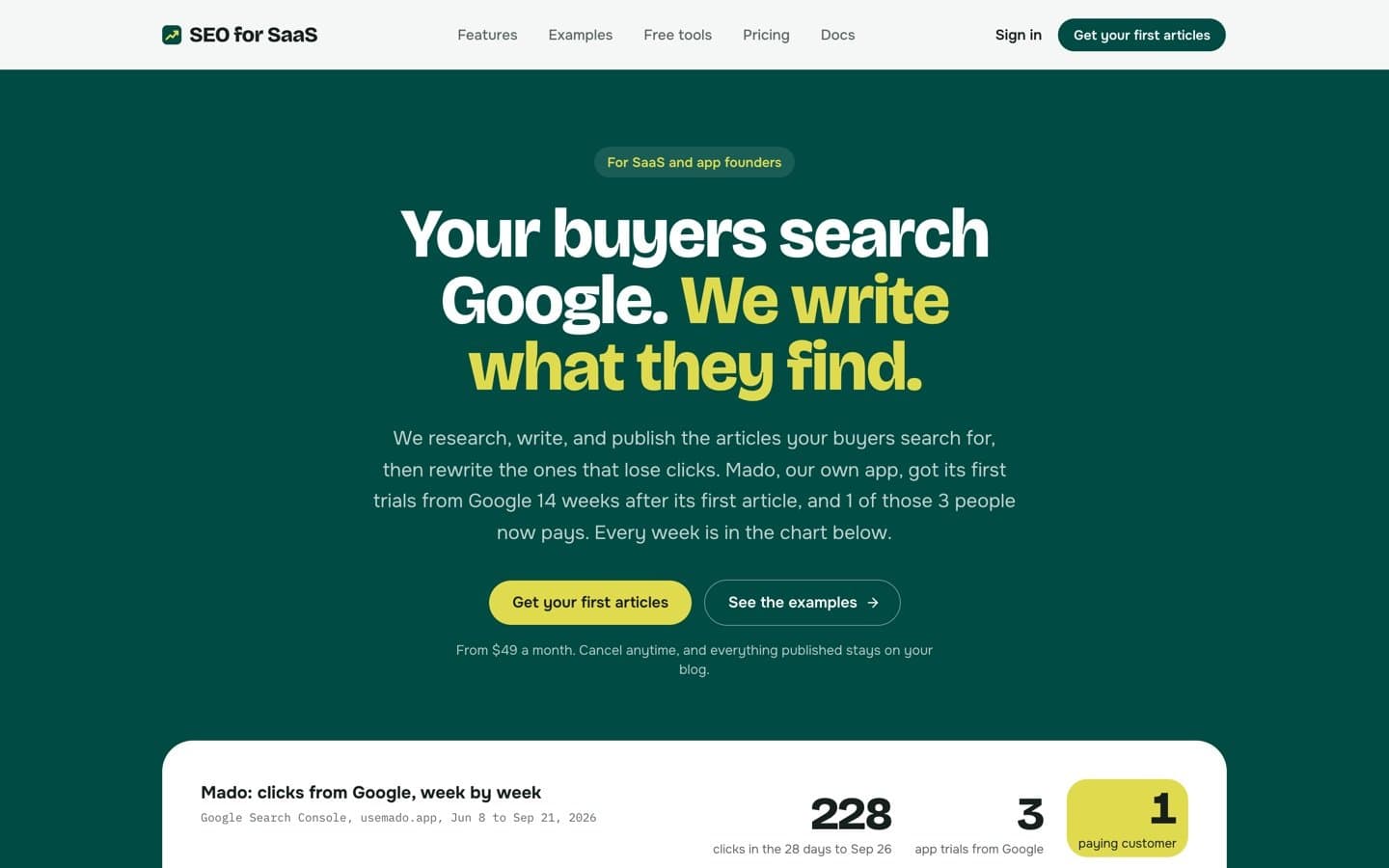
About this app
SEO for SaaS is an AI-powered content engine for SaaS and app founders. It reads your site or App Store listing, picks topics your buyers search for (with extra weight on comparison and alternatives articles), and skips what you already cover. Each article is researched from Google's first page and the web, written, fact-checked, and edited, with citations beside every claim. Articles arrive on your blog as structured blocks through a read-only API and a signed webhook, so they render in your own templates (Next.js and Astro guides included), with schema and internal links. You choose to publish automatically or review every draft first. Site Guard watches Google Search Console and rewrites articles that lose clicks. Plans start at $49 a month; everything published stays on your blog if you cancel.
Key features
- 1AI-researched, cited, fact-checked articles published as structured blocks into your own Next.js or Astro templates via read-only API and signed webhook.
- 2Comparison and alternatives article focus, with Site Guard watching Search Console and rewriting articles that lose clicks on the same URL.
- 3Transparent pricing from $49/mo (12 articles) to $249/mo (90 articles), with per-article economics down to $2.77 and a free first batch per site.
Target customer profile
Drawn from the product itself, not from a survey.
Demographic
SaaS and app founders with early-stage startups
Pain points
Struggle to create consistent SEO content; limited time and budget
Primary needs
Affordable, hands-off SEO article production and publishing
Demographic
B2B SaaS marketing managers
Pain points
Producing high-quality, cited content that drives organic traffic
Primary needs
Scalable content creation that aligns with brand voice
Demographic
Solopreneurs and indie makers
Pain points
Lack SEO expertise; need cost-effective solution to compete
Primary needs
Automated SEO content that brings trial signups
Scout Review
Written by AI from measured evidence, scored out of 100.
SEO for SaaS is a focused, well-executed indie tool with a clear thesis: your buyers search Google, so we'll research, write, cite, and publish the articles they'd find — then rewrite the ones that lose clicks. The strongest signals are measured, not claimed: Lighthouse mobile 92 and desktop 95, accessibility 97, a live example page linking to real articles on real blogs, and a founder who shows his own app's Search Console chart instead of a stock testimonial. The weakest signals are equally concrete: 4 of 12 security checklist points with no HSTS, CSP, or frame protection, no SOC 2 or pen-test claims, and a design that's 90% there but undermined by patchwork stage cards, a low-contrast hero subhead, and 2026 dates on a chart meant to prove real data. Pricing is transparent ($49/$99/$249 with per-article economics down to $2.77) and the no-free-trial-but-free-first-batch model is honest. Against Jasper, Surfer, and Koala, the differentiator is real: articles land in your own templates via API and webhook, not in someone else's editor. Whether that's worth $49/mo over just prompting ChatGPT is the question the product has to answer with rankings, not copy.
Measure by measure
Usability
68Four-step onboarding, a real FAQ, and live example articles you can click before paying. No free trial, but a free first batch per site softens it. Docs are thin beyond the marketing pages.
Design
71Cohesive dark-green/lime palette, strong hierarchy, and a real-data chart card sell the story. The four differently-colored stage cards feel patchwork, and 2026 dates on the chart read as placeholder.
Speed
82Lighthouse mobile 92/100 (LCP 3.3s, CLS 0, TBT 16ms) and desktop 95/100. A genuinely fast, stable marketing site with no layout shift.
Security
52HTTPS enforced with SPF and DMARC, and payments run through a reseller that handles tax and receipts. But no HSTS, CSP, frame protection, or Referrer-Policy, and no SOC 2 or pen-test claims.
Accessibility
80Lighthouse accessibility 97/100 with one contrast failure. Responsive, standard nav, readable structure. No WCAG statement or multi-language support, so automated checks are doing most of the work here.
Growth
62A real problem (founders can't keep up SEO content) with a specific wedge: comparison/alternatives articles plus Site Guard rewrites, published into your own templates. Early-stage, but the idea has room.
Improvement areas
- Security headers: add HSTS, CSP, X-Content-Type-Options, Referrer-Policy, and Permissions-Policy — probe found only 4/12 checklist points.
- Design polish: unify the four stage-card backgrounds, fix the low-contrast hero subhead, and replace 2026 placeholder dates on the Mado chart.
- Trust signals: publish a security/compliance page covering data handling, subprocessors (Link), and any planned SOC 2 or pen-test.
Design & Usability
The homepage is a well-built sales page: dark green hero, a real Search Console chart from the founder's own app (Mado), four stage cards walking you from Day 1 to first paying customer, and live example articles you can click before buying. That last part matters — most AI content tools show you mockups. Here you can open a real article on usemado.app, click a citation, and judge it. Usability is solid: four-step onboarding, a genuinely useful FAQ, and pricing that's honest about having no free trial but giving a free first batch per site. The weak spots are cosmetic but real: the four stage cards use four different background colors with no shared treatment, the hero subhead is light gray on dark green and hard to read at small sizes, and the chart card plots dates in 2026, which makes real data look like placeholder. None of that blocks a purchase, but it undercuts the 'we sweat the details' message the rest of the page is selling.
Speed & Security
Speed is the strongest measured dimension: Lighthouse mobile 92/100 with LCP 3.3s, CLS 0, and TBT 16ms; desktop 95/100. That's a genuinely fast marketing site with no layout shift, and it matches the impression of a lean, well-built page. Security is the weakest: HTTPS is enforced and SPF/DMARC are set, and payments run through a reseller (Link) that handles tax and receipts, which sensibly offloads PCI scope. But the HTTP probe found no HSTS, no CSP, no frame protection, no X-Content-Type-Options, no Referrer-Policy, and no Permissions-Policy — 4 of 12 checklist points. There's no SOC 2, ISO, pen-test, or bug bounty claim anywhere in the site content. For an early-stage indie tool that's not alarming, but it's clearly behind what a B2B buyer comparing against Jasper would expect, and the missing headers are a 20-minute fix.
Accessibility & Growth
Accessibility scores 97/100 on Lighthouse with a single failing audit: insufficient contrast between background and foreground colors — which lines up exactly with the vision model flagging the light-gray hero subhead on dark green. Two independent tools, same complaint, one CSS variable to fix. Beyond that the site is responsive, keyboard-navigable, and structurally clean, but there's no WCAG statement, no accessibility page, and no multi-language support, so the automated score is carrying most of the weight. Growth is a judgment on the idea, not the traction: the problem (founders can't sustain SEO content) is real and the wedge is specific — comparison and alternatives articles, plus Site Guard rewriting articles that lose clicks on the same URL, delivered as structured blocks into your own Next.js or Astro templates via a read-only API and signed webhook. That's a sharper position than Jasper's generic 'AI writes your blog.' The honest limit: the category is crowded (Jasper, Surfer, Koala all adjacent), the moat is workflow not data, and the $49–$249 price band competes directly with just prompting ChatGPT. It can grow, but it has to prove the articles actually rank.
Conclusion
If you're a SaaS founder who knows you should be publishing SEO content and keeps not doing it, this is a credible, honestly-priced option with a genuinely differentiated delivery model — articles in your own templates, citations beside every claim, and a rewrite loop tied to Search Console. Read one of the live examples before you buy; that's the whole test. If you're comparing against Jasper or Surfer, note that this is narrower by design: it's not a content platform, it's a content pipeline for founders who already have a blog and a Next.js or Astro site. The gaps to watch are security posture (thin headers, no compliance claims) and the fact that the entire value prop rests on articles actually ranking — which the founder's own 14-week Mado chart supports but doesn't prove for your site.
Suggestions for improvement
- Add HSTS, CSP, X-Content-Type-Options, Referrer-Policy, and Permissions-Policy headers — the probe found 4/12 and these are quick wins.
- Fix the hero subhead contrast (light gray on dark green) — it's the one thing both Lighthouse and the visual audit flagged.
- Replace the 2026 dates on the Mado chart with real past dates, or label it clearly as projected — right now it reads as placeholder.
- Publish a short security/compliance page stating data handling, subprocessors (Link), and whether a pen-test or SOC 2 is planned.
Alternatives comparison
Named competitors, point by point. Nobody paid to appear here or to be left out.
 SEO for SaaS SEO for SaaS |  Jasper Jasper |  Surfer SEO Surfer SEO |  Koala AI Koala AI | |
|---|---|---|---|---|
| Core approach | AI content engine that researches, writes, cites, and publishes SEO articles into your own blog templates via API/webhook. | Broad AI marketing platform for copy, blog posts, and SEO content across many formats and channels. | SEO content optimization tool that analyzes top-ranking pages and gives data-driven recommendations. | AI SEO platform that writes long-form articles optimized for Google and AI search. |
| Publishing model | Structured blocks delivered to your own templates via read-only API and signed webhook; Next.js and Astro guides included. | Content produced in Jasper's editor; export or integrate to CMS via connectors. | Optimization layer on top of your existing editor/CMS; not a publisher. | Articles generated in Koala's editor; publish to connected CMS. |
| Comparison / alternatives article focus | Explicitly weighted toward comparison and alternatives articles buyers search for. | General-purpose; templates exist but no comparison-article focus. | Optimizes whatever you write; no built-in comparison-article strategy. | General long-form article generation; no comparison-specific wedge. |
| Rewrite loop tied to Search Console | Site Guard watches Search Console and rewrites articles that lose clicks on the same URL. | No automated Search Console rewrite loop. | Provides optimization scores and audits; manual rewrite workflow. | No automated Search Console-driven rewrite loop. |
| Pricing entry point | $49/mo (12 articles), $99/mo (30), $249/mo (90); no free trial, free first batch per site. | Tiered subscription; entry plans typically higher than $49/mo for team seats. | Subscription-based; pricing scales with content volume and seats. | Subscription-based; entry tiers aimed at solo creators. |
Jasper
AI content platform that helps teams create marketing copy, blog posts, and SEO content at scale.
Surfer SEO
SEO content optimization tool that analyzes top-ranking pages and provides data-driven recommendations.
Koala AI
AI SEO platform that writes long-form articles for Google and AI search.
Comparing options? See SEO for SaaS alternatives, scored side by side
More SEO Tools apps
View all SEO Tools
Geogrid
92A UULE-powered local rank tracker for SEO agencies, offer...

Kerbrank
91Local rank tracker for UK businesses with Google Maps heatmaps, ChatGPT visibility checks and a weekly fix list.

AuditCloser
89White-label website audits that close deals for digital a...

CitableReport
89CitableReport is an AI visibility audit:

Mover Marketing AI Local SEO
88Specialized SEO services for moving companies to dominate...

Spek
88Grow your app with self-learning ASO agents

CraftPilot
87AI tools for Etsy sellers — keyword research, listing optimization, and shop insights

Mygom SEO
87MygomSEO is an AI marketing agent that audits your site, writes SEO content, publishes to 12+ CMS platforms, posts to social, and monitors rankings 24/7.

IndexMyWebsite
86Track every indexing step for your owned websites.

Reptor
85Reputation monitoring across Google, AI search engines, reviews, news and social media, with sentiment analysis per mention.

Rext AI
84AI writing tool for agencies and niche site owners, with ...

Glasser
84Pay-as-you-go API access to 1,700+ data tools for AI agents.


A platform dedicated to providing unbiased reviews of newly launched applications, analyzing everything from their features to their full potential.
info@scoutforge.net© 2026 Scoutforge. All rights reserved.