Cycling through all six. Tap any point to stop.
Measured on six things
Pay-as-you-go API access to 1,700+ data tools for AI agents.
Growth
58Real problem (juggling API keys and subscriptions), specific wedge (one balance, per-call pricing, agent-native via Skill/MCP/CLI), and a category with headroom. Differentiation is real but copyable.
Screenshots
1 / 1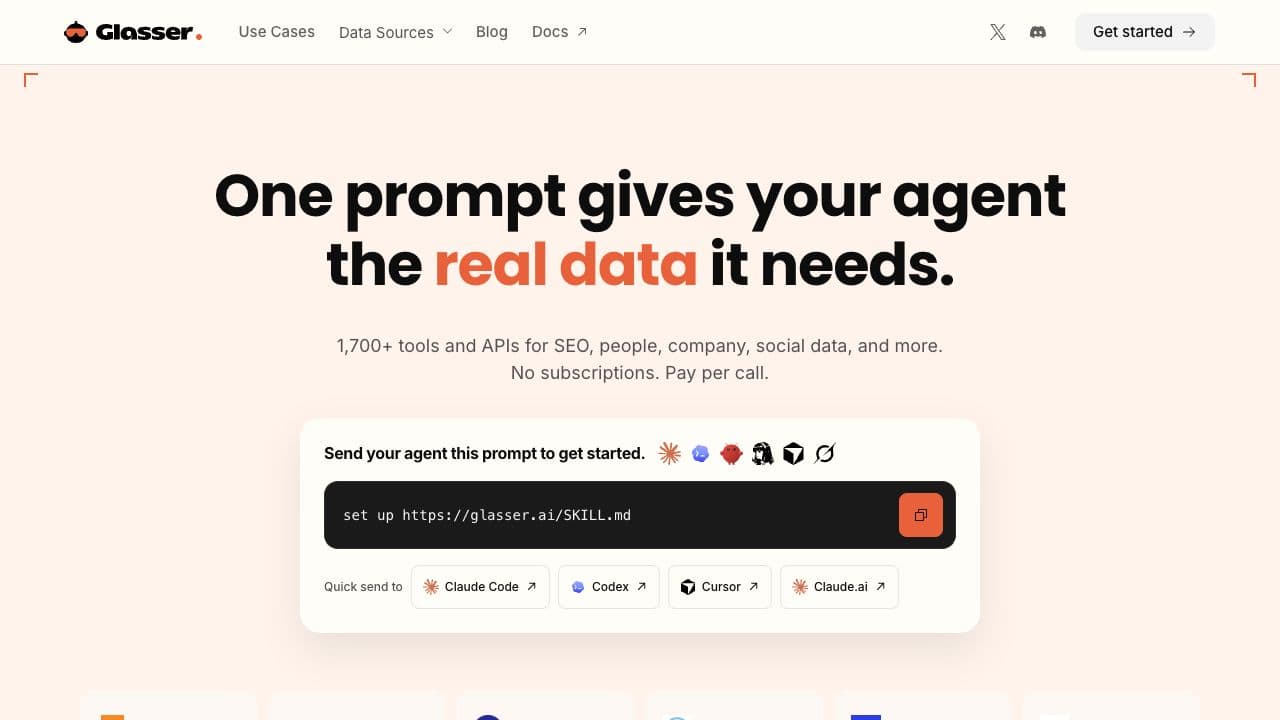
About this app
Glasser gives AI agents access to premium data APIs for SEO, people, companies, web search, social media and more. Connect through Skill, CLI or MCP, use one balance across providers, and see prices before each call. Built for developers and teams working on research, lead generation and automation. No subscription; pay per call.
Key features
- 11,700+ data APIs from Ahrefs, Semrush, Apollo, People Data Labs, DataForSEO and more, unified behind one balance.
- 2Agent-native connection via Skill (one prompt), MCP, or CLI, with quick-send to Claude Code, Codex, Cursor and Claude.ai.
- 3Pay-per-call pricing with no subscription, price visible before each call, and free search and price checks.
Target customer profile
Drawn from the product itself, not from a survey.
Demographic
Developers building AI agents
Pain points
Managing multiple API keys and subscriptions for data access
Primary needs
Unified API with transparent pricing and easy integration
Demographic
Digital marketers and SEO professionals
Pain points
Expensive SEO tools with monthly subscriptions and limited API calls
Primary needs
Cost-effective, on-demand access to SEO and competitive data
Demographic
Recruiters and talent researchers
Pain points
High costs for people search and enrichment tools
Primary needs
Affordable, per-call access to candidate data and company insights
Scout Review
Written by AI from measured evidence, scored out of 100.
Glasser is a pay-per-call data API aggregator for AI agents, wrapping 1,700+ tools from Ahrefs, Semrush, Apollo, People Data Labs, DataForSEO and others behind one balance and one connection. The pitch is clean: no subscriptions, see the price before each call, connect via Skill, MCP or CLI. The execution is above average for its stage. The landing page is well-crafted and the pricing comparison is genuinely persuasive. The docs are structured and agent-readable. Lighthouse puts mobile performance at 90 and accessibility at 96. Security headers are 10/12 with HTTPS, HSTS, CSP and DMARC in place. The weaknesses are consistent and specific: a duplicated prompt box and an overlapping video button on the homepage, two failing accessibility audits around contrast and accessible names, missing Referrer-Policy and Permissions-Policy headers, and no published compliance or security disclosure of any kind. Growth is the interesting question. The problem is real and the wedge is sharp, but the moat is convenience on top of other people's APIs — copyable the moment an incumbent ships an MCP server. For developers who want agent-native data access without twelve subscriptions, this is a genuinely useful tool. For anyone betting on it as a durable platform, the defensibility question is still open.
Measure by measure
Usability
68One-prompt Skill setup plus MCP and CLI paths, quick-send buttons to Claude/Cursor, and a real docs site with API/CLI references. FAQ covers failed-call billing. Onboarding is genuinely thought through.
Design
70Clean, modern landing page with a strong dark AI-agent graphic and scannable pricing cards. Held back by a duplicated prompt box, an overlapping 'Watch video' button, and tiny low-contrast per-call prices.
Speed
78Lighthouse mobile 90/100 (LCP 2.7s, TBT 90ms) and desktop 96/100. Snappy for a marketing page with this much content. CLS 0.106 is the only wobble.
Security
72HTTPS enforced with HSTS, CSP, frame protection, SPF and DMARC (10/12 probe points). Missing Referrer-Policy and Permissions-Policy. No SOC 2, ISO or bug bounty published.
Accessibility
80Lighthouse accessibility 96/100. Two failing audits: insufficient color contrast and visible text labels without matching accessible names. No WCAG statement published, but the automated baseline is strong.
Growth
58Real problem (juggling API keys and subscriptions), specific wedge (one balance, per-call pricing, agent-native via Skill/MCP/CLI), and a category with headroom. Differentiation is real but copyable.
Improvement areas
- No published security or compliance documentation — no SOC 2, ISO, pen-test summary or bug bounty program.
- Two failing accessibility audits (color contrast, accessible names) and no WCAG conformance statement.
- Homepage repeats the prompt box across sections and the 'Watch video' button overlaps the 'AI AGENT' headline.
Design & Usability
Glasser's homepage is a genuinely well-built piece of marketing. The hero pairs a bold headline with a terminal-style prompt box, and the integration grid below it — Ahrefs, Semrush, Apollo, PDL, TikTok, Amazon — does the heavy lifting of proving the '1,700+ tools' claim without a wall of text. The pricing comparison cards are the sharpest thing on the page: crossed-out $129/mo next to $0.055/call makes the value proposition scannable in about two seconds. The visual audit flagged real issues though: the same prompt box appears verbatim in multiple sections, the 'Watch video' pill overlaps the 'AI AGENT' headline text, and the use-case cards render per-call prices like $0.054 in a size and contrast that borders on invisible. On usability, this is where Glasser clearly invested. There are three documented connection paths — Skill (one prompt), MCP, and CLI — with quick-send buttons to Claude Code, Codex, Cursor and Claude.ai. The docs site is structured with Welcome, API Reference, CLI Reference and Integrations sections, plus an llms.txt index for agents. The FAQ even addresses how failed calls and empty results are billed, which is the exact question a pay-per-call product needs to answer up front. The gap is navigation: the audit noted no visible signposting for logged-in vs. new users, so the path from 'curious' to 'in my Workspace' isn't as clear as the path from 'curious' to 'connected'.
Speed & Security
Speed is a genuine strength. Lighthouse scored the mobile experience 90/100 with an LCP of 2.7s, TBT of 90ms and FCP of 2.3s; desktop came in at 96/100. For a page carrying a logo grid, a dark graphic, pricing cards and a use-case section, that's a well-optimized build — no heavy SPA penalty, no obvious render-blocking mess. The only measurable wobble is a CLS of 0.106, which is above the 'good' threshold and suggests something (likely the video pill or a lazy-loaded asset) shifts the layout after paint. No user complaints about lag surfaced in search, and no published benchmarks exist to compare against. On security, the HTTP probe returned 10 of 12 checklist points: HTTPS is enforced, HSTS is set, and CSP, frame protection, X-Content-Type-Options, SPF and DMARC are all present. The two gaps are Referrer-Policy and Permissions-Policy headers, both easy wins. More importantly, there's no published SOC 2, ISO 27001, penetration test summary or bug bounty program. For a product that holds a payment balance and brokers access to third-party data APIs on your behalf, the absence of any compliance or disclosure page is the notable gap — not a red flag, but a missing receipt. The header hygiene is above average for an early-stage product; the trust layer is not yet built.
Accessibility & Growth
Accessibility lands at a strong 80. Lighthouse's axe-core audit scored 96/100, which is well above typical for a marketing site of this density. Two audits failed: background/foreground contrast (consistent with the tiny low-contrast per-call prices the visual audit also caught) and visible text labels without matching accessible names — the latter is a real screen-reader problem, not a cosmetic one. There's no accessibility statement or WCAG conformance claim published, so the 96 is the automated floor, not a verified ceiling. On growth, the idea is sound and the positioning is specific. The problem Glasser names is real: developers and analysts juggling a dozen API keys and monthly subscriptions for data they use intermittently. The wedge is concrete — one balance, per-call pricing, agent-native access via Skill/MCP/CLI, and price visibility before each call. The target segments (AI agent builders, SEO teams, recruiters, lead-gen) are named with per-call prices attached, not vague personas. The category has headroom: agent-driven data access is growing, and the aggregator position is genuinely useful. The honest limit is defensibility. Glasser is a reseller layer on top of Ahrefs, Semrush, Apollo and PDL; its moat is convenience and pricing transparency, both of which incumbents can copy by shipping their own MCP servers. Traction is early — the domain was registered in 2026 and only a Twitter profile is listed — so the growth case rests on the idea, not the scoreboard.
Conclusion
If you're building agents that need real data — keyword volumes, company firmographics, people search, property records — Glasser removes a genuinely annoying layer of key management and subscription sprawl. The per-call pricing model is honest and the price-before-you-call feature is the right default. The setup is fast: one prompt to Claude Code or Cursor and you're connected. What you should know before committing: there's no SOC 2, no ISO, no pen-test summary and no bug bounty, so if you're in a regulated environment or handling sensitive data, you'll be doing your own due diligence. The missing Referrer-Policy and Permissions-Policy headers are minor but telling — the security posture is competent, not hardened. And the business model depends on reselling other vendors' APIs, which means pricing and availability are ultimately outside Glasser's control. Start with the $1 free credit, run a few real calls, and see whether the per-call economics actually beat what you're paying now. For intermittent, agent-driven data needs, they probably do. For heavy daily usage, do the math first.
Suggestions for improvement
- Publish a security page with SOC 2 status, pen-test summary or bug bounty — even 'not yet certified' beats silence for a product holding balances.
- Add Referrer-Policy and Permissions-Policy headers; they're two lines and close the 10/12 gap to a clean sweep.
- Fix the two failing accessibility audits: raise contrast on the small per-call prices and give visible text labels matching accessible names.
- De-duplicate the hero prompt box and reposition the 'Watch video' pill so it stops overlapping the 'AI AGENT' headline text.
Alternatives comparison
Named competitors, point by point. Nobody paid to appear here or to be left out.
 Glasser Glasser |  RapidAPI RapidAPI |  Zapier Zapier | |
|---|---|---|---|
| Pricing model | Pay per call, no subscription; $1 free credit to start | Monthly subscription tiers based on task volume | Free tier plus per-request pricing set by each API publisher |
| Primary use case | Giving AI agents access to premium SEO, people, company and social data APIs | Connecting SaaS apps into automated no-code workflows | Marketplace to discover and consume individual third-party APIs |
| AI agent integration | Native via Skill, MCP and CLI; one prompt setup for Claude, Codex, Cursor | AI features and agent actions, but workflow-first rather than agent-native | REST APIs consumable by agents but no native MCP or agent setup flow |
| Data source breadth | 1,700+ curated premium tools across SEO, people, company, social, financial and property data | 8,000+ app integrations focused on workflow automation, not raw data APIs | Tens of thousands of APIs across every category, quality varies widely |
| Transparent cost preview | Price shown before each call; search and price checks are free | Task-based billing; cost visible only after workflows run | Per-endpoint pricing listed, but no pre-call estimate for a task |
Comparing options? See Glasser alternatives, scored side by side
More API Service apps
View all API Service
CC Switch
91Open-source desktop app for switching AI coding providers...

TaxID
90Fast EU VAT validation API for developers, covering 27 EU...

SiftingIO - Market Data API
88Real-time & historical market data API for stocks, forex,...

Claw Messenger
88Claw Messenger is an iMessage API service that gives AI a...

OBVELO
88Privacy gateway that masks personal data in LLM traffic

tradutor de mangá com IA
88O tradutor de mangá com IA traduz capítulos em lote, personaliza textos e oferece edição visual para estúdios.

Giftronaut
87.5gift card software, international gift card, international visa gift card, gift card API

QRocodile
87Design And Animate QR Codes People Want to Scan

StockFit API
87A developer-first financial data API providing structured...

Plori
87Cloud AI agents with persistent disk, memory, and real CL...

QVeris AI
86Connect AI agents to 10,000+ real-world tools and APIs

Split Forms
86Free contact form backend for any website


A platform dedicated to providing unbiased reviews of newly launched applications, analyzing everything from their features to their full potential.
info@scoutforge.net© 2026 Scoutforge. All rights reserved.