Cycling through all six. Tap any point to stop.
Measured on six things
An AI governance platform that stops employees from leaking sensitive data into unapproved AI tools
Growth
31Pre-launch waitlist stage with no reviews, GitHub activity, or external traction. Pricing published but no customer base or community signals.
Screenshots
1 / 1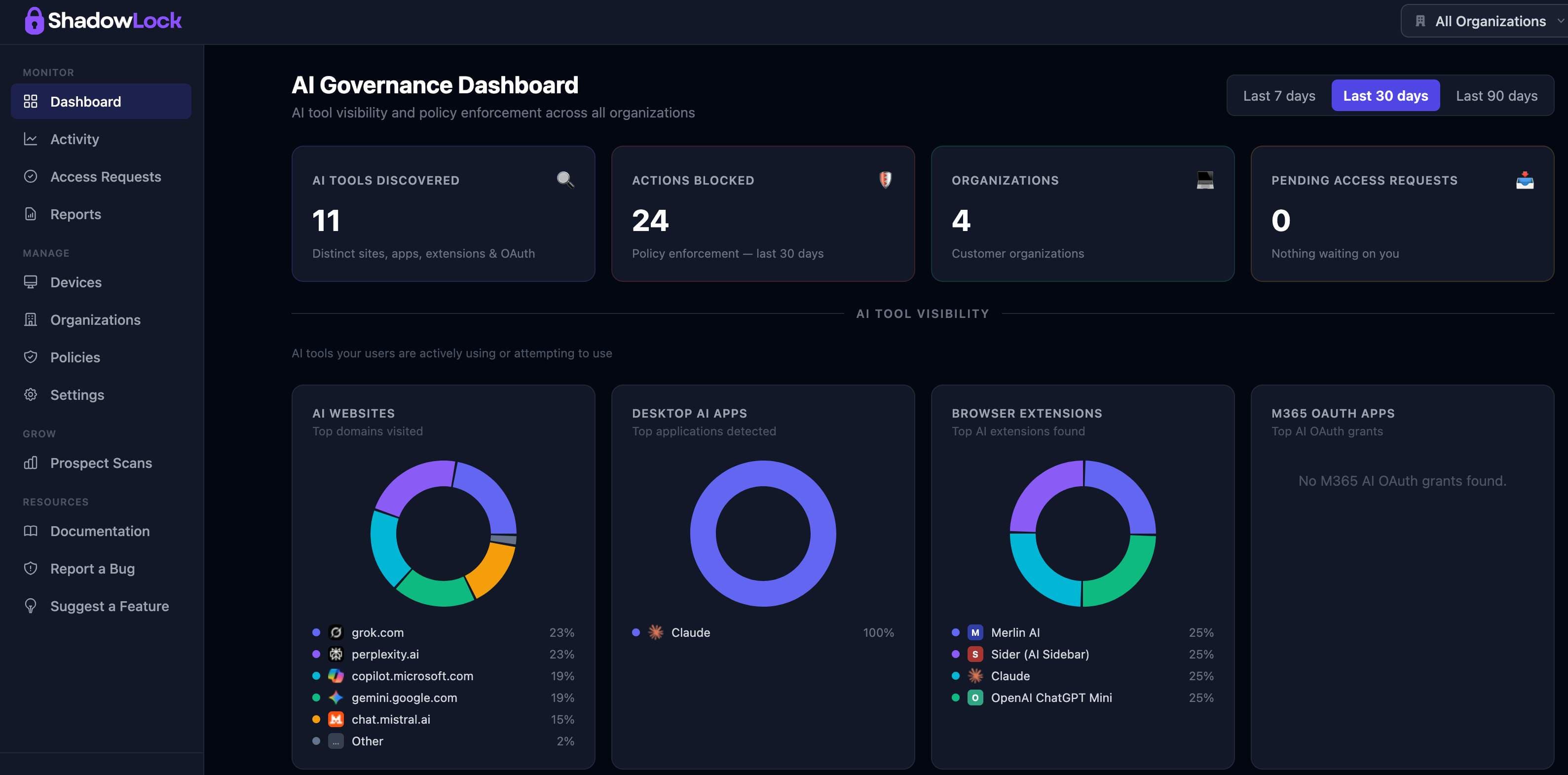
About this app
ShadowLock is a shadow AI detection and governance platform that gives MSPs and IT teams real-time visibility and control over how employees use AI tools, before sensitive data leaves the endpoint. It covers the blind spots managed-device controls miss: browser extensions, desktop AI apps, local LLMs like Ollama, and personal accounts. A browser extension intercepts and classifies risky pastes to AI sites, a Windows agent blocks desktop AI apps and deploys silently via your existing RMM, and a multi-tenant dashboard lets you audit or block each control with audit-ready reports. Built for MSPs to govern AI across every client from one place, and private by design with no keystroke logging and zero content transmission.
Key features
- 13-layer coverage: Windows agent, browser extension, M365 OAuth scanner for desktop AI, extensions, and personal accounts.
- 2Policy engine with allow/warn/block per tool/org/user plus sensitive data interception and training opt-out enforcement.
- 3Multi-tenant MSP dashboard with RMM silent deploy, audit reports, and cross-org risk views.
Target customer profile
Drawn from the product itself, not from a survey.
Demographic
MSPs and IT service providers managing multiple clients
Pain points
No visibility into which AI tools client employees are using; unable to prove governance when auditors or insurers ask; liability gap when client has an AI incident
Primary needs
Multi-tenant dashboard, silent RMM deploy, cross-org risk reporting, per-client policy management
Demographic
IT administrators in mid-to-large enterprises
Pain points
Employees bypass enterprise controls using personal AI accounts; sensitive data pasted into unapproved AI tools; no simple way to enforce AI acceptable use policy
Primary needs
Easy deployment, low false-positive alerts, endpoint coverage without user friction, compliance evidence
Demographic
Compliance and security officers responsible for audit readiness
Pain points
AI governance questions now appear in audits and insurance forms; no audit trail for AI usage; trade secret and IP exposure via public AI tools
Primary needs
Audit-ready logs, policy enforcement evidence, data classification at the source, incident response defensibility
Scout Review
Written by AI from measured evidence, scored out of 100.
ShadowLock targets a real MSP blind spot in shadow AI governance with endpoint, browser, and cloud layers plus multi-tenant reporting. Its design and feature transparency are strong selling points, but pre-launch status, missing certifications, and lack of accessibility/growth signals keep it early-stage. It differentiates from complex peers by focusing on silent RMM deploy and low-friction policies.
Measure by measure
Usability
74Comprehensive feature docs, FAQ, and policy engine details make it easy to understand conceptually. Waitlist-only with no live demo limits real testing.
Design
87Polished, modern landing page with strong visual hierarchy, relevant stats, and clear MSP-focused messaging. Consistent branding and interactive policy examples.
Speed
64Site itself appears lightweight and fast-loading. No benchmarks, user reports, or tech stack details available to verify runtime performance.
Security
51Strong privacy claims (no logging/transmission) and audit logs for MSPs. Lacks any third-party certifications, audits, or detailed security documentation.
Accessibility
37No mentions of WCAG compliance, alt text, keyboard support, or multi-language features. Standard web accessibility unverified.
Growth
31Pre-launch waitlist stage with no reviews, GitHub activity, or external traction. Pricing published but no customer base or community signals.
Improvement areas
- Obtain third-party security certifications (SOC 2) and publish a trust center.
- Add public demo/trial and accessibility documentation for broader appeal.
- Accelerate launch and gather independent reviews to build credibility vs. Netskope/Zscaler.
Design & Usability
ShadowLock's site delivers a clean, professional design tailored to MSPs with clear sections on shadow AI risks, three-layer coverage (endpoint agent, browser extension, M365 scanner), and a flexible allow/warn/block policy engine. Usability shines in the detailed explanations and FAQ that address real pain points like personal accounts and audit readiness, making the value proposition easy to grasp. However, being in waitlist/pre-launch mode means no live onboarding or demos, so practical flow remains untested. Compared to alternatives like Netskope, it positions itself as simpler and MSP-specific rather than enterprise-heavy.
Speed & Security
The marketing site loads efficiently with minimal bloat, suggesting good underlying web performance, though no runtime benchmarks exist for the agents or dashboard. Security emphasizes privacy-by-design with zero content transmission and audit logs for compliance, directly targeting MSP liability gaps that Netskope and Zscaler address more broadly but with greater complexity. Lacking certifications like SOC 2 (common in peers), it relies on transparent claims. This makes it promising for quick MSP deployment via RMM but requires trust in unverified controls versus established DLP suites.
Accessibility & Growth
Accessibility is a clear gap—no WCAG mentions or platform details beyond Windows focus—putting it behind category norms where enterprise tools often document multi-device and inclusive support. Growth is minimal as a new entrant: waitlist-only with zero independent reviews, GitHub presence, or traction signals, unlike mature alternatives with G2 footprints. Pricing is transparent and volume-tiered ($0.80–$1.00/device/mo), a strength for MSPs, but building community and proof will be essential to compete with Zscaler or Forcepoint's established scale.
Conclusion
For MSPs tired of AI incidents slipping past managed controls, ShadowLock offers a targeted, private solution worth watching once live. Enterprises may prefer certified alternatives until it matures.
Suggestions for improvement
- Add live demo or trial signup to boost usability testing.
- Publish security certifications and a dedicated trust page.
- Implement WCAG 2.1 AA compliance and document accessibility features.
- Build GitHub presence or community (Discord/Slack) for growth traction.
Alternatives comparison
Named competitors, point by point. Nobody paid to appear here or to be left out.
 ShadowLock |  Netskope |  Zscaler | Forcepoint DLP | |
|---|---|---|---|---|
| Shadow AI coverage (browser extensions, desktop apps like Ollama, personal accounts) | Full: agent + extension + M365 scanner; blocks pastes/uploads at endpoint | Strong CASB/web but limited endpoint/desktop app detection | Web/DLP focus; weak on local desktop AI apps and extensions | DLP monitoring possible but heavy config, no MSP multi-tenant focus |
| MSP multi-tenant dashboard & RMM deploy | Native multi-tenant with silent RMM deploy and per-client policies | Enterprise-focused; complex for MSPs, no native RMM emphasis | Web proxy model; limited endpoint/MSP multi-tenancy | Heavy enterprise DLP; not designed for MSP client management |
| Pricing model | Per-device/mo: $1.00 down to $0.80 (volume tiers); all features included | Complex/expensive enterprise licensing | Subscription-based, often higher for full DLP | High config/enterprise pricing, not MSP-optimized |
Netskope
Cloud DLP and CASB that includes AI governance features, but more complex and expensive, not MSP-specific.
Zscaler
Web security and DLP that can block AI sites, but lacks endpoint-level detection of desktop AI apps and browser extensions.
Forcepoint DLP
Data loss prevention suite that can monitor AI usage, but often requires heavy configuration and isn't designed for MSP multi-tenant management.
Comparing options? See ShadowLock alternatives, scored side by side
Sources
What the review was written against. A verdict with no sources is an opinion.
More Security apps
View all Security
issued.live
89Free certificate transparency search and SSL lookup with ...

OBVELO
88Privacy gateway that masks personal data in LLM traffic

kosa8
88Sealed VMs for AI agents with instant rewind, audit trails & zero key exposureSealed VMs for AI agents with instant rewind and audit tr...

C2PA Lab
87Free C2PA Content Credentials Checker

Xsilent Vault: Hide Photos
87Private Android vault for photos, videos, PDFs and files, with no required account, no ads and no mandatory cloud.

Magery Forge
87Weekly security audits for vibe-coded sites, explained in...

Sidenty
87Sidenty is a professional digital identity protection ser...

ProcessSpy
87A native macOS process explorer and advanced monitor that...

Basalt
86Eighteen PDF tools in one native Mac window: merge, split, compress, OCR, Bates numbering, forms, signing and redaction. Offline. $29 once.

PromptTrace
85Free hands-on AI security labs for prompt injection and L...

Sanctix
85Sanctions screening with verifiable SHA-256 audit trails.

Privacy Requests
84DSAR management software for small teams.


A platform dedicated to providing unbiased reviews of newly launched applications, analyzing everything from their features to their full potential.
info@scoutforge.net© 2026 Scoutforge. All rights reserved.
