

A platform dedicated to providing unbiased reviews of newly launched applications, analyzing everything from their features to their full potential.
info@scoutforge.net© 2026 Scoutforge. All rights reserved.
A platform dedicated to providing unbiased reviews of newly launched applications, analyzing everything from their features to their full potential.
info@scoutforge.net© 2026 Scoutforge. All rights reserved.
A platform dedicated to providing unbiased reviews of newly launched applications, analyzing everything from their features to their full potential.
info@scoutforge.net© 2026 Scoutforge. All rights reserved.
Is this your app?
Claim Stagewise to manage its page, add your badge and see your traffic — free, and it stays free.
Cycling through all six. Tap any point to stop.
Measured on six things
An AI-powered browser-based coding assistant that helps frontend developers visually edit and build applications within existing production codebases.
Limited accessibility features, challenges for visually impaired developers, lacks keyboard navigation and screen reader support.
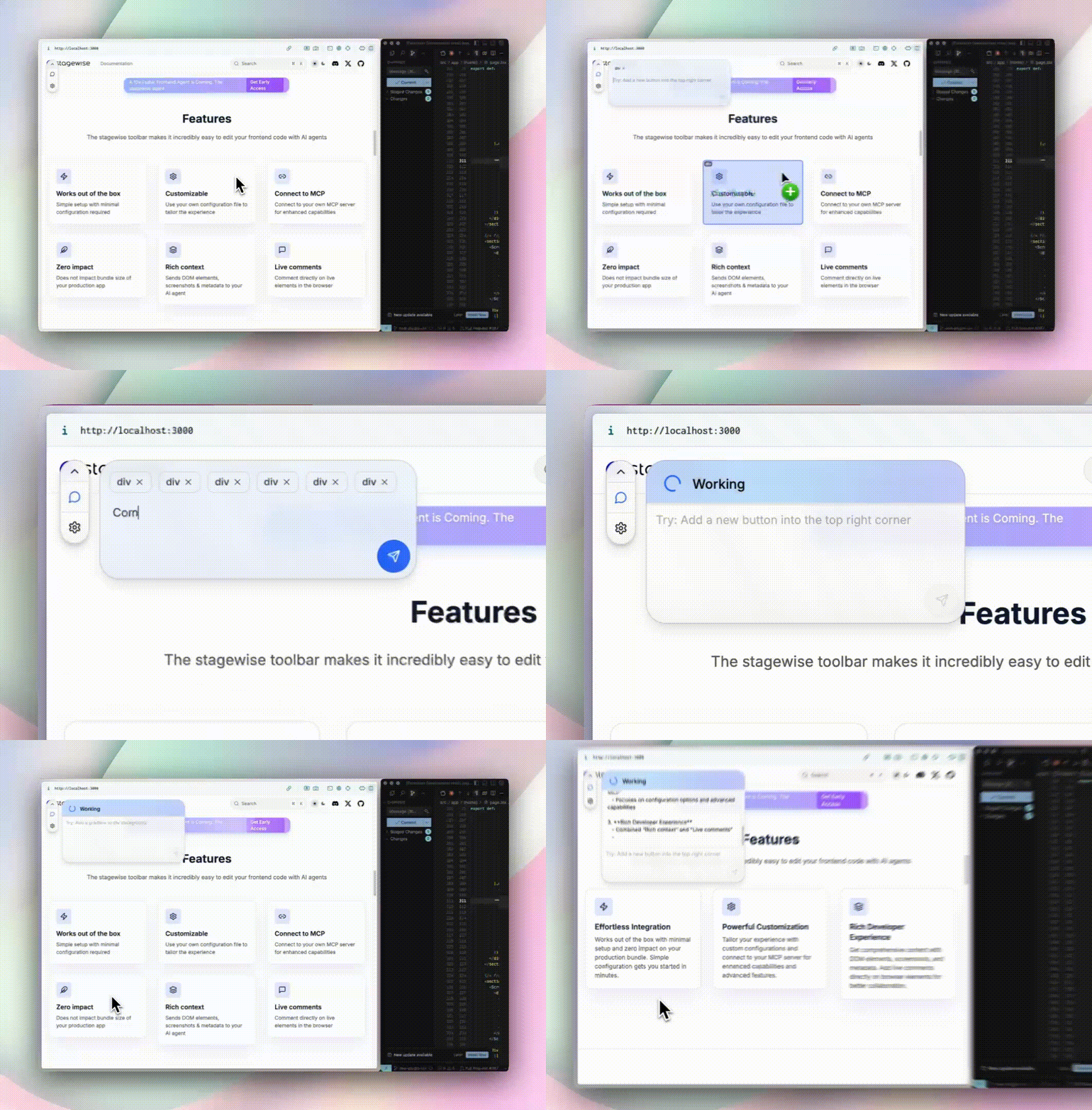
Stagewise is a game-changing tool for developers, backed by YCombinator, that integrates directly into your browser to offer AI-driven suggestions for frontend coding. It analyzes DOM structures and styling to provide context-aware improvements, supporting frameworks like React, Vue, and more. With a focus on reducing manual work and enhancing productivity, it's designed for seamless use in local environments without compromising security. As a tech enthusiast, I find its ability to understand and adapt to existing codebases particularly impressive, making it a must-try for anyone tired of repetitive CSS tweaks and eager to speed up their development workflow.
Drawn from the product itself, not from a survey.
Demographic
Frontend Developers
Pain points
Time-consuming CSS adjustments, repetitive UI modifications, context switching between browser and IDE
Primary needs
Visual editing capabilities, faster iteration, reduced manual coding
Demographic
Development Team Leads
Pain points
Onboarding new developers, maintaining design consistency, development velocity
Primary needs
Standardized workflows, reduced learning curve, improved productivity
Demographic
Full-stack Developers
Pain points
Frontend-backend context switching, CSS complexity, visual design implementation
Primary needs
Simplified frontend work, visual feedback, rapid prototyping
Written by AI from measured evidence, scored out of 100.
Stagewise represents a significant advancement in AI-assisted frontend development, particularly valuable for teams working with established codebases who want to accelerate their workflow without compromising security. The browser-integrated approach and local processing model make it both convenient and secure, while the context-aware AI suggestions demonstrate impressive understanding of existing design systems.
Intuitive for experienced frontend developers with browser inspection familiarity, though beginners may face a learning curve.
Browser-integrated UI eliminates context switching, seamless workflow integration with intuitive visual selection for frontend developers.
Efficient local processing with browser-based approach, though complex codebases may impact performance responsiveness.
Local operation ensures code privacy, no external server processing required, maintaining sensitive code within developer environment.
Limited accessibility features, challenges for visually impaired developers, lacks keyboard navigation and screen reader support.
Strong market need with YCombinator backing, growing AI development trend, framework agnosticism provides wide applicability.
Stagewise's design philosophy centers around eliminating context switching by operating directly within the browser where frontend development naturally occurs. The interface integrates seamlessly with existing developer workflows, featuring a visual selection mechanism that allows developers to click on page elements and prompt changes intuitively. This browser-based approach feels natural for frontend developers already familiar with inspection tools, though the learning curve might be steeper for those new to visual coding assistants. The context-aware suggestions demonstrate sophisticated understanding of design systems and component structures, making it feel like having an experienced colleague looking over your shoulder.
Security is a standout feature with Stagewise's local operation model ensuring code never leaves the developer's environment. This approach eliminates concerns about sensitive code being processed on external servers. Performance is generally solid for a development tool, with efficient local processing that maintains responsiveness during typical frontend editing tasks. However, complex codebases with extensive DOM structures might experience some performance lag. The browser-based architecture ensures broad compatibility without heavy installation requirements, making it accessible across different development setups while maintaining security integrity.
Accessibility represents the most significant area for improvement, as the tool's visual interaction model presents challenges for developers with visual impairments. The lack of keyboard navigation and screen reader compatibility limits its inclusivity. Despite this, Stagewise's growth potential is exceptional due to strong market demand for AI-assisted development tools and YCombinator backing. Its framework-agnostic approach supporting React, Vue, Angular, Next.js, Svelte, and Nuxt positions it well for widespread adoption across diverse development teams and project types.
Conclusion
If you're a frontend developer tired of manual CSS adjustments and repetitive UI modifications, Stagewise offers a compelling solution that could dramatically accelerate your development workflow. The tool is especially valuable for teams maintaining design consistency across large codebases or onboarding new developers. Give it a try if you're looking for AI-powered assistance that respects your existing architecture and keeps your code secure.
Named competitors, point by point. Nobody paid to appear here or to be left out.
 Stagewise Stagewise |  Builder.io Builder.io |  Webflow Webflow |  Traditional Browser DevTools Traditional Browser DevTools | |
|---|---|---|---|---|
| Works with existing codebases | Yes | Limited | No | Yes (manual) |
| AI-powered code generation | Yes | Limited | No | No |
| Local processing/security | Yes | Cloud-based | Cloud-based | Local |
| Framework support | React, Vue, Angular, Next.js, Svelte, Nuxt | Limited framework integration | Proprietary system | All frameworks |
Builder.io
Visual development platform with AI capabilities but more focused on content management than code generation
Webflow
Visual website builder that generates code but primarily for new projects rather than existing codebases
Traditional Browser DevTools
Chrome DevTools offer element inspection but lack the AI-powered code generation and modification capabilities
Comparing options? See Stagewise alternatives, scored side by side

A no-code Solana token creator that deploys SPL tokens in...

A free, open-source platform offering 110 AI agent skills...

Open-source desktop app for switching AI coding providers...

Fast EU VAT validation API for developers, covering 27 EU...

Claw Messenger is an iMessage API service that gives AI a...

PERM Processing Time is an independent data analysis platform that helps users navigate the U.S. Department of Labor’s permanent labor certification process.

AI-powered Dubai real estate data platform with 12M+ DLD ...

BeartIMAGE is a free, web-based image processing platform engineered for fast, bulk photo editing and conversion directly in your browser.

macOS app for App Store screenshots: 3D mockups, auto-tra...

Real-time monetization infrastructure for AI products tha...

A native macOS process explorer and advanced monitor that...

A developer-first financial data API providing structured...
A platform dedicated to providing unbiased reviews of newly launched applications, analyzing everything from their features to their full potential.
info@scoutforge.net© 2026 Scoutforge. All rights reserved.