Cycling through all six. Tap any point to stop.
Measured on six things
Turn stories into AI-generated video episodes with consis...
Security
52HTTPS + HSTS and Stripe-handled payments are solid, but only 5/13 header checks pass: no CSP, no frame protection, no DMARC, no secure cookies. No compliance claims published.
Screenshots
1 / 1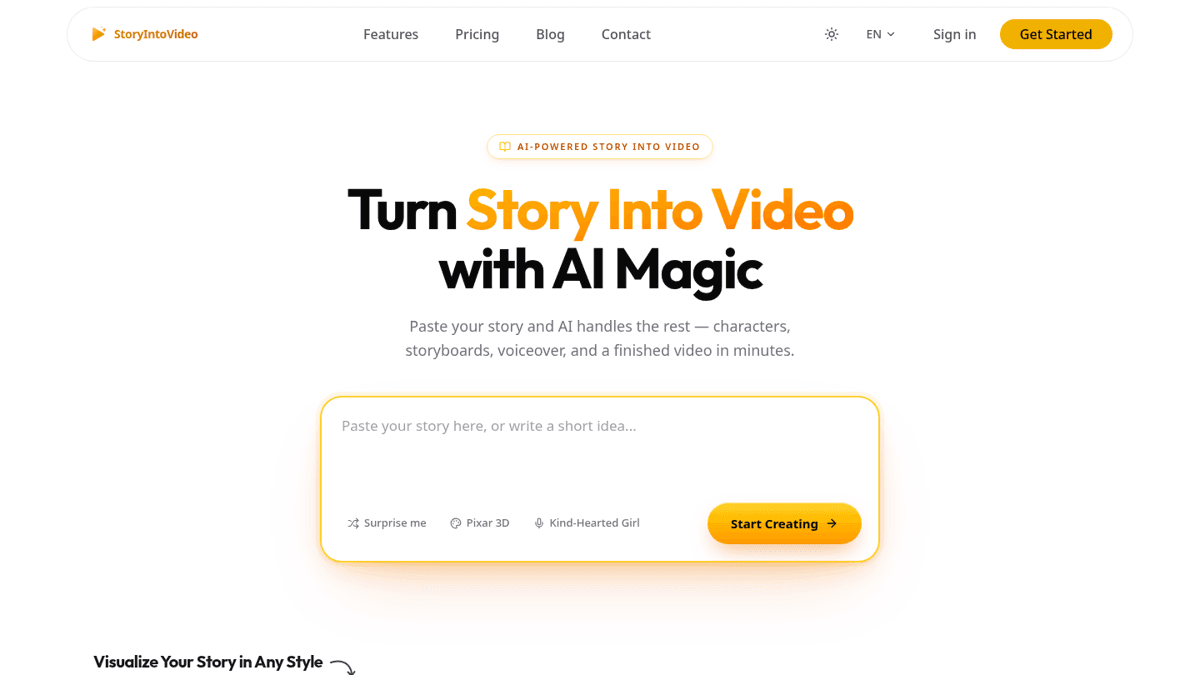
About this app
StoryIntoVideo is an AI-powered platform that transforms written stories, novels, scripts, or simple ideas into fully-produced video episodes. It handles character creation, storyboarding, voiceover, captions, and scene generation, offering 15 distinct art styles (from Pixar 3D to Ghibli, Anime, and Realism) and hundreds of natural voices across 40 languages. Its standout feature is a script-first workflow: the AI writes the script for free, users can read and edit it without spending credits, and only pay when they generate the video. Character consistency is maintained across shots and episodes via character portraits locked at the script stage, making it ideal for serialized content like web novel adaptations, YouTube Shorts series, and educational storytelling. The built-in editor lets users redraw individual shots, rewrite lines, animate key moments, and swap music or captions, with only modified shots incurring additional credits. StoryIntoVideo does not auto-post to social pl...
Key features
- 1Script-first workflow: AI writes the script free, editable without credits, pay only to render.
- 2Character consistency via portraits locked at the script stage across shots and episodes.
- 315 art styles (Pixar 3D, Ghibli, Anime, Lego, Pixel Art) and 670 voices across 40 languages.
- 4Built-in editor: redraw shots, rewrite lines, animate moments, swap music/captions — only changed shots cost credits.
Target customer profile
Drawn from the product itself, not from a survey.
Demographic
Novel and fan-fiction writers
Pain points
Readers want to see characters visually; adapting text to video is costly and technically complex
Primary needs
Consistent character visuals across chapters and an easy way to turn written stories into episodic video content
Demographic
Faceless YouTube Shorts / TikTok channel owners
Pain points
Producing regular story videos with consistent cast and look is time-consuming and requires editing skills
Primary needs
A recurring cast, locked visual style, and fast episode production without filming or editing
Demographic
Filmmakers and short-film directors
Pain points
Pitching scripts requires visual previs or animatics, which are expensive and slow to produce
Primary needs
Quick script-to-animatic conversion with the ability to tweak individual shots without redoing everything
Demographic
Educators and trainers
Pain points
Creating engaging educational video content requires production resources and time
Primary needs
Turning history, science, or literature into short story episodes that students want to watch
Scout Review
Written by AI from measured evidence, scored out of 100.
StoryIntoVideo is a competent, clearly-positioned AI text-to-video tool with a genuinely differentiated script-first workflow and character consistency across episodes. The landing page is fast (Lighthouse 90 mobile) and accessible (100/100 axe), with a coherent brand system and a short path from idea to first step. It's held back by a sparse, animation-gated hero, thin security headers and no published compliance. Against InVideo, Pictory and Fliki it competes on workflow rather than stock footage — a real wedge for serialized storytelling, if the credit economics hold up.
Measure by measure
Usability
68Script-first flow is genuinely smart: read and edit free, pay only to render. Pricing FAQ covers credits, expiry, refunds. Onboarding path from idea to first step is short.
Design
58Clean amber brand system, clear hero and a tidy 15-style grid. Undermined by large dead space, animation-gated content and tiny low-contrast chips.
Speed
82Lighthouse mobile 90/100 with 1.7s LCP and zero CLS; desktop 87. Snappy, well-optimized landing page with no lag complaints in evidence.
Security
52HTTPS + HSTS and Stripe-handled payments are solid, but only 5/13 header checks pass: no CSP, no frame protection, no DMARC, no secure cookies. No compliance claims published.
Accessibility
80Lighthouse a11y audit scores a perfect 100/100, with an EN language selector and 40-language voice support. No published WCAG statement, so it sits mid-band.
Growth
62Real problem (text-to-video with a consistent cast) aimed at specific segments — web-novel authors, Shorts channels, educators. Script-first + character lock is a genuine wedge.
Improvement areas
- Security headers incomplete (5/13): no CSP, DMARC, frame protection or secure cookies.
- Hero content is animation-gated, leaving the first paint sparse and blank.
- No published WCAG/accessibility statement despite a perfect automated score.
- Preset chips are tiny and low-contrast, easy to miss on first visit.
Design & Usability
The landing page has a coherent amber brand system, a clear hero and a well-organized 15-style grid, but the visual audit flagged large dead space and animation-gated content that leaves the first paint looking sparse. Usability is where StoryIntoVideo earns its keep: the script-first workflow lets you read and edit the script for free, only spending credits on the actual render, and the pricing FAQ answers credits, expiry, cancellation and 14-day refunds without hiding the ball. The tiny grey preset chips are the one usability miss — easy to overlook on first visit.
Speed & Security
Speed is a clear strength: Lighthouse mobile 90/100 with a 1.7s LCP, zero CLS and 360ms TBT, desktop 87 — a genuinely snappy marketing site with no lag complaints in the evidence. Security is the weak flank. HTTPS and HSTS are enforced and Stripe handles payments, but only 5 of 13 header checks pass: no CSP, no frame protection, no X-Content-Type-Options, no Referrer-Policy, no Permissions-Policy, no secure cookies and no DMARC. No SOC 2, ISO or pen-test claims are published. For a product handling user scripts and payment flows, that's a fixable but real gap.
Accessibility & Growth
Accessibility scores a perfect 100/100 on the Lighthouse axe audit, with an EN language selector and 40-language voice support — strong automated signals, though no published WCAG statement means the manual side is unverified. Growth is a judgement on the idea: StoryIntoVideo names a real problem (turning text into episodic video with a consistent cast) and targets specific segments — web-novel authors, faceless Shorts channels, filmmakers needing animatics, educators. Its wedge against InVideo, Pictory and Fliki is the script-first free workflow plus character portraits locked at the script stage, which the stock-footage competitors structurally don't do. The limit: per-shot credit pricing competes with simply prompting a general video model, and the category is crowded.
Conclusion
If you're a web-novel author or Shorts channel owner who needs the same cast across episodes, StoryIntoVideo's script-first model is worth a look — you can read and edit the script before spending a credit, and the 15-style grid plus 670 voices covers a lot of ground. If you just need a one-off video from a prompt, the stock-footage competitors are cheaper and simpler. The product's future hinges on whether per-shot credits stay competitive with general video models and whether the security posture gets tightened up.
Suggestions for improvement
- Fix the animation-gated hero so the first paint shows content, not a blank canvas.
- Add CSP, frame protection, X-Content-Type-Options, Referrer-Policy and DMARC headers.
- Publish a WCAG/accessibility statement and keyboard-navigation notes.
- Enlarge and darken the preset chips so they're not mistaken for fine print.
Alternatives comparison
Named competitors, point by point. Nobody paid to appear here or to be left out.
 StoryIntoVideo |  InVideo AI |  Pictory | Fliki | |
|---|---|---|---|---|
| Core approach | Script-first AI story-to-video with locked character cast | Prompt-to-video using stock footage and AI voiceover | Script/article-to-video using stock media and auto-captions | Text-to-video with AI voices and stock visuals |
| Character consistency across episodes | Yes — portraits locked at script stage, reused every shot/episode | Limited — stock footage, no persistent cast | No — stock media based | No — stock visuals based |
| Free script editing before paying | Yes — script written and editable free, credits only on render | Prompt-based; generation consumes plan quota | Script input free; video render uses plan minutes | Script input free; render uses plan credits |
| Art styles | 15 styles (Pixar 3D, Ghibli, Anime, Lego, Pixel Art, etc.) | Stock-footage templates, not illustration styles | Stock media templates | Stock media templates |
| Voice / language coverage | 670 voices across 40 languages | AI voiceover, multiple languages | AI voiceover, multiple languages | AI voices, 75+ languages |
| Per-shot editing | Yes — redraw shot, rewrite line, animate moment; only changed shots cost credits | Timeline editor with scene-level edits | Scene-level editing in timeline | Scene-level editing |
InVideo AI
AI video generation platform that turns text prompts into videos with stock footage, voiceover, and editing tools.
Pictory
AI-powered video creation tool that converts scripts and articles into short videos using stock media and auto-captioning.
Fliki
Text-to-video and text-to-speech platform that creates videos from scripts with AI voices and stock visuals.
Comparing options? See StoryIntoVideo alternatives, scored side by side
More AI Generations apps
View all AI Generations
Uni-1 by Luma AI
92Uni-1 is an advanced multimodal text-to-image AI model th...

Gerty
91Private, local AI assistant for Mac that runs offline

LTX 2.3 AI Video Generator
91Fast, open-source AI video generator with 4K support, mul...

DemoVexa
90Turn your code into professional product demo videos with AI-generated scripts, animated UI, and natural voiceovers.

AI Vocals Generator
89Add AI singers or rappers to your own beat, get two takes...

Voqusa
89Transcribe social media video and audio links into text (free signup, 5 free credits, then pay-as-you-go)

All of Us
89Add deceased loved ones to photos with AI and see free pr...

PodRescale
89Every episode becomes two weeks of posts. In your voice. Posted for you.

Pixelimg
88A free online AI-powered tool that instantly converts ima...

Cantoro
88Custom AI songs with a name, heard free before paying $4....

tradutor de mangá com IA
88O tradutor de mangá com IA traduz capítulos em lote, personaliza textos e oferece edição visual para estúdios.

IraVoice
88Private on-device dictation for Apple-silicon Macs.


A platform dedicated to providing unbiased reviews of newly launched applications, analyzing everything from their features to their full potential.
info@scoutforge.net© 2026 Scoutforge. All rights reserved.
