

A platform dedicated to providing unbiased reviews of newly launched applications, analyzing everything from their features to their full potential.
info@scoutforge.net© 2026 Scoutforge. All rights reserved.
A platform dedicated to providing unbiased reviews of newly launched applications, analyzing everything from their features to their full potential.
info@scoutforge.net© 2026 Scoutforge. All rights reserved.
A platform dedicated to providing unbiased reviews of newly launched applications, analyzing everything from their features to their full potential.
info@scoutforge.net© 2026 Scoutforge. All rights reserved.
Cycling through all six. Tap any point to stop.
Measured on six things
Uni-1 is an advanced multimodal text-to-image AI model th...
Autoregressive transformer architecture is computationally heavier than diffusion at high res. No exact generation times listed, but token-based pricing and user feedback suggest it's not the fastest for bulk production.
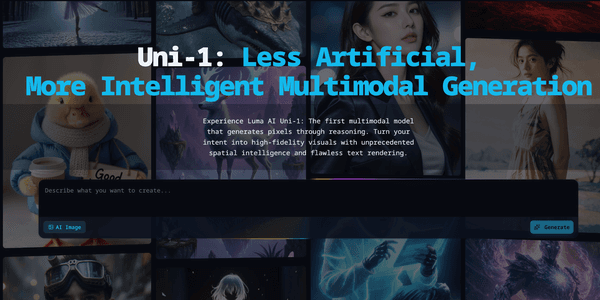
Uni-1 by Luma AI is a groundbreaking multimodal text-to-image model that redefines AI image generation with its intelligent, reasoning-based approach. Unlike traditional diffusion models, Uni-1 uses a decoder-only autoregressive transformer architecture to process text and images as a single interleaved sequence, allowing it to genuinely 'think' about your instructions before rendering. This results in unprecedented spatial intelligence, eliminating nonsensical artifacts and maintaining realistic object interactions. Key features include directable control with reference-guided generation for perfect character consistency, nearly flawless text rendering in English and Chinese ideal for professional assets, and cost-effective high-fidelity output at up to 30% less than competitors. Designed for creators, marketers, and businesses, Uni-1 solves common industry challenges like chaotic layouts and broken anatomy, making it a powerful tool for generating marketing materials, comics, bann...
Drawn from the product itself, not from a survey.
Demographic
Professional graphic designers and digital artists
Pain points
Struggle with AI models producing nonsensical visual artifacts, inconsistent character anatomy, and chaotic text layouts that require extensive post-editing.
Primary needs
High-fidelity, consistent image generation with precise spatial relationships and flawless typography for professional projects.
Demographic
Marketing teams and content creators
Pain points
Time-consuming trial-and-error prompting and reliance on external software for text editing in marketing assets, banners, and social media graphics.
Primary needs
Efficient, cost-effective tool for creating polished, text-accurate visuals that align with brand guidelines without extensive manual adjustments.
Demographic
Small to medium-sized businesses and startups
Pain points
High costs and limited accessibility of premium AI image models, coupled with inconsistent output quality that hinders scalable content production.
Primary needs
Affordable, reliable AI generation with high-resolution output and easy-to-use controls for producing professional-grade visuals at scale.
Written by AI from measured evidence, scored out of 100.
Uni-1 represents a genuine step forward from traditional text-to-image models. Its reasoning architecture delivers coherent scenes, perfect typography, and reference consistency that professionals actually need. While not revolutionary in speed, it solves real pain points better than DALL-E 3, Midjourney, or vanilla Stable Diffusion for marketing, comics, and brand assets. The value is strong at current pricing.
Reference-guided generation with simple portrait/full-body inputs makes character consistency effortless. Prompt length recommendations (80-250 words) and structured controls reduce trial-and-error compared to traditional tools.
Clean, modern interface on lumalabs.ai/app with intuitive prompt input, reference upload for character consistency, and high-fidelity 2K output previews. Emphasizes professional, artifact-free visuals with strong spatial composition.
Autoregressive transformer architecture is computationally heavier than diffusion at high res. No exact generation times listed, but token-based pricing and user feedback suggest it's not the fastest for bulk production.
FAQs address prompt and data privacy. Commercial use included in paid plans (Plus $30/mo+). Enterprise options available with potential SSO and controls.
Web-based access via app.lumalabs.ai with free trial credits. Supports English and Chinese text rendering flawlessly. No advanced WCAG or keyboard navigation details mentioned.
Strong benchmark performance on RISEBench (0.51 overall, 0.58 spatial) and human Elo rankings. Tops in style, editing, and reference consistency. 10-30% cheaper at 2K (~$0.09/image). Rapid adoption for professional workflows.
Uni-1 by Luma AI delivers a polished experience for professional designers and marketers. The decoder-only autoregressive transformer processes text and images as an interleaved sequence, enabling genuine reasoning before generation. This eliminates the chaotic layouts, broken anatomy, and nonsense artifacts common in diffusion models. Reference-guided controls make maintaining character consistency across a series simple — just upload a portrait or full body. Text rendering in English and Chinese is nearly flawless, removing the need for post-editing in banners, comics, or branded assets. The interface feels purpose-built for creators who are tired of fighting with AI.
While not the absolute fastest due to its reasoning-first autoregressive approach, the quality justifies the wait for high-stakes work. Pricing is competitive at approximately $0.09 per 2K image via API, 10-30% less than some rivals, with subscription plans starting at $30/month for access. Privacy FAQs provide basic reassurance, and commercial rights are included. Security is solid for a professional tool but lacks deep enterprise details in public docs. Overall, it's built for reliable production rather than lightning-fast experimentation.
Accessibility is decent through the clean web app, with excellent multilingual text support in outputs. Growth potential is massive — it leads human preference tests in overall quality, style/editing, and reference-based generation, ranking #2 only in pure text-to-image. RISEBench scores showcase superior spatial (0.58) and logical reasoning. For teams struggling with inconsistent output, this model scales professional content creation effectively and cost-efficiently.
Conclusion
If your workflow involves extensive post-editing or fighting with anatomy and text, Uni-1 is worth testing immediately. It thinks with you instead of against you.
Named competitors, point by point. Nobody paid to appear here or to be left out.
 Uni-1 by Luma AI Uni-1 by Luma AI |  DALL-E 3 DALL-E 3 |  Midjourney Midjourney |  Stable Diffusion Stable Diffusion | |
|---|---|---|---|---|
| Architecture & Reasoning | Decoder-only autoregressive transformer with explicit reasoning step (RISEBench 0.51 overall, 0.58 spatial) | Diffusion-based with strong prompt understanding but weaker spatial/logical reasoning | Diffusion model focused on artistic style, struggles with precise logic and text | Open-source diffusion requiring heavy tuning for consistency and reasoning |
| Text Rendering Accuracy | Nearly flawless in English & Chinese; professional-ready without editing | Good but can have spelling/layout issues in complex scenes | Frequently poor text rendering, often requires fixes | Weak text without ControlNet or external tools |
| Character/Reference Consistency | Excellent via simple reference images; tops human Elo for reference-based generation | Decent with detailed prompts but requires more engineering | Good with --cref but inconsistent across complex scenes | Requires IP-Adapter or LoRAs and extensive tuning |
| Cost Efficiency (2K image) | ~$0.09 per image; 10-30% cheaper than leading rivals | $0.04–$0.12+ depending on resolution and model | Subscription-based (~$0.10–$0.30 effective per image on mid tiers) | Free/local or variable cloud costs; tuning adds time cost |
DALL-E 3
An advanced text-to-image model by OpenAI known for high-quality image generation and strong prompt understanding, but may lack Uni-1's spatial reasoning and text accuracy.
Midjourney
A popular AI image generation tool focused on artistic and creative visuals, though it can struggle with precise text rendering and logical spatial relationships compared to Uni-1.
Stable Diffusion
An open-source diffusion model widely used for customizable image generation, but often requires extensive tuning and external tools for consistency and text accuracy.
Comparing options? See Uni-1 by Luma AI alternatives, scored side by side
What the review was written against. A verdict with no sources is an opinion.

Fast, open-source AI video generator with 4K support, mul...

An AI-powered photo restoration app that brings old, blur...

HeyVid AI is a free all-in-one AI video and image generat...

Private on-device dictation for Apple-silicon Macs.

A free online AI-powered tool that instantly converts ima...

AI face swap online with no subscription, pay per use.

A privacy-first browser extension that inserts gentle pau...

An AI-powered patent drafting assistant that acts like a ...

AI writer that fact-checks before writing, with real sour...

MygomSEO is an AI marketing agent that audits your site, writes SEO content, publishes to 12+ CMS platforms, posts to social, and monitors rankings 24/7.

Export all your Apple Voice Memos to one text file.

AI-powered business plan generator that creates investor-...
A platform dedicated to providing unbiased reviews of newly launched applications, analyzing everything from their features to their full potential.
info@scoutforge.net© 2026 Scoutforge. All rights reserved.