Cycling through all six. Tap any point to stop.
Measured on six things
AI wine scanner: scan a label or a whole shelf with AI
Security
52HTTPS enforced with frame protection, X-Content-Type-Options and Referrer-Policy set, but no HSTS, CSP, Permissions-Policy or DMARC. Header checklist 6/12. No published audits or bug bounty found.
Screenshots
1 / 1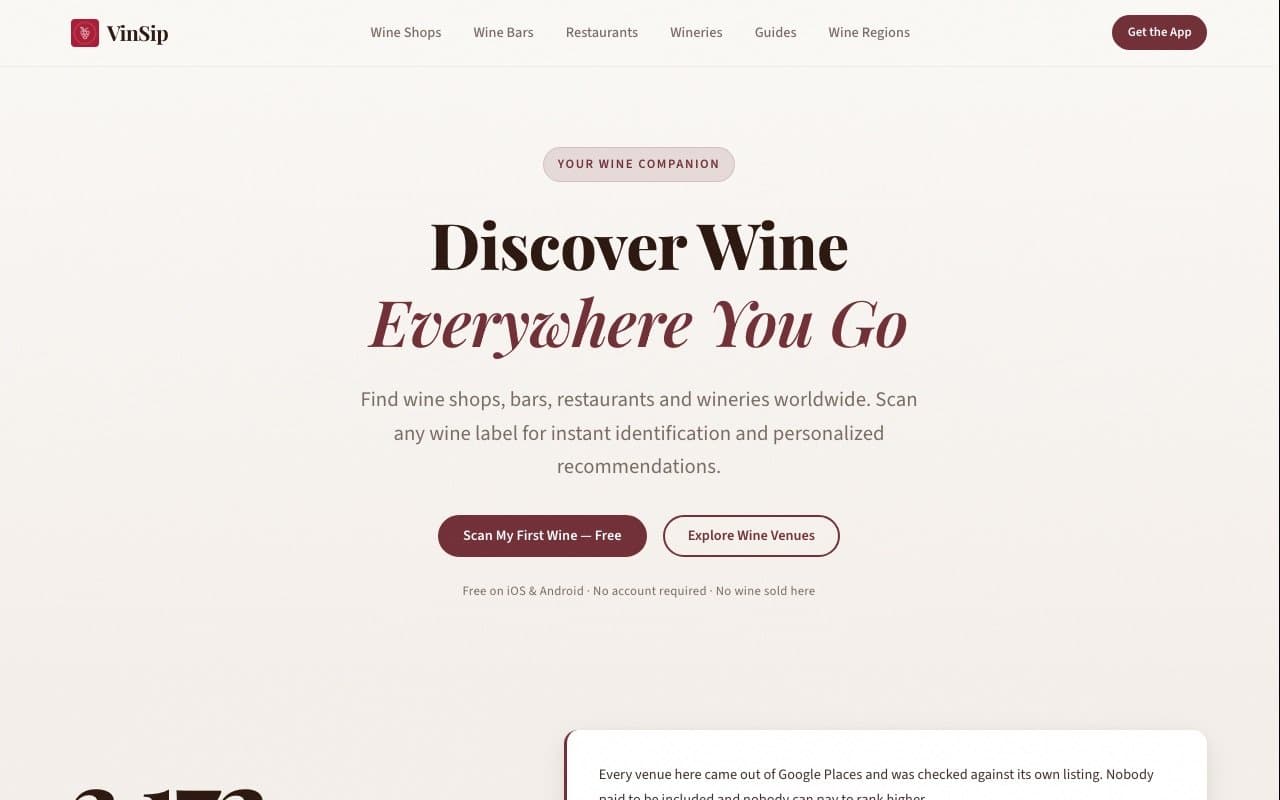
About this app
VinSip puts an AI sommelier next to the bottle in your hand. Scan the label, then ask: what does it go with, what else should I try, is there something lighter. The conversation takes your stated preferences into account, so follow-up questions build on the earlier ones. Everything you scan stays in a searchable history, and the wines you try can be rated and kept in a personal diary. VinSip does not sell wine: it identifies bottles and helps you decide.
Key features
- 1Whole-shelf scanning: point the camera at a shelf and identify dozens of bottles at once, not one at a time.
- 2Taste-aware AI sommelier with multi-turn conversation that remembers your preferences and budget.
- 3Personal wine diary with star ratings, tasting notes, Want to Try / Tasted tabs and searchable scan history.
- 463 attributed wine reference guides plus a venue directory of shops, bars, restaurants and wineries.
Target customer profile
Drawn from the product itself, not from a survey.
Demographic
People choosing wine in a shop
Pain points
Standing in front of a wall of bottles, it is hard to know where to start
Primary needs
Scan the shelf and see the bottles ranked against the taste and budget you set
Demographic
People choosing from a wine list
Pain points
A long wine list and no idea what to pick
Primary needs
Photograph the list and ask the AI sommelier about food pairings
Scout Review
Written by AI from measured evidence, scored out of 100.
VinSip is a wine scanner that actually behaves like a sommelier rather than a barcode lookup: scan the whole shelf, get bottles ranked against your taste and budget, then keep asking follow-ups in a conversation that remembers what you said. The wine diary and searchable scan history give it a reason to stay installed. The site is fast and the app UI is genuinely well-designed, with a coherent palette and a clear primary action. The cracks are in the details — a homepage that can't agree on its own venue count, small low-contrast body copy, an app home screen that looks half-finished, and a security posture with no HSTS, CSP or DMARC and no published audits. It's a competent, well-positioned early product with real polish in places and real sloppiness in others.
Measure by measure
Usability
64Clear primary path: scan, identify, discover, with no account required to start. Two-tab app nav is easy to read. The 63 attributed guides are a genuine asset. Dense small grey body copy on the homepage drags it down.
Design
70Judging the app UI and store creative: confident burgundy-on-cream palette, editorial serif type, one dominant scan CTA. Held back by an emoji-only home screen and a homepage stat that contradicts itself (3,172 vs 2,969).
Speed
88Lighthouse mobile 100/100 with LCP 1.5s, CLS 0 and TBT 27ms; desktop also 100/100. Genuinely fast, edge-clean delivery. No lag complaints found in the collected evidence.
Security
52HTTPS enforced with frame protection, X-Content-Type-Options and Referrer-Policy set, but no HSTS, CSP, Permissions-Policy or DMARC. Header checklist 6/12. No published audits or bug bounty found.
Accessibility
78Lighthouse accessibility 100/100 on automated checks, app localized in 13 languages with 30 claimed on the site. No public WCAG statement or keyboard/screen-reader documentation found, so automated-only coverage caps it.
Growth
58Real, specific problem (shelf paralysis, wine-list panic) with a genuine wedge: whole-shelf scanning, taste-ranked results, and no wine sold so nothing is recommended for commission. Early — no ratings yet — but the idea has room.
Improvement areas
- Contradictory venue counts on the homepage (3,172 vs 2,969) undermine trust in every other number.
- Security headers incomplete (no HSTS, CSP, Permissions-Policy, DMARC) and no published audits or security page.
- Small, low-contrast grey body copy on the homepage and in the sommelier chat mockup hurts readability.
- App home screen looks unfinished — emoji illustration and roughly half the screen empty.
Design & Usability
The app is the product here, and the app looks good: a disciplined burgundy-on-cream palette, editorial serif headlines, and a single dominant 'Scan Wine Shelf' action that tells you exactly what to do. The homepage carries the same system well, with a considered stats block and clean three-step explainer. Where it slips is detail discipline — the hero says 3,172 venues and the stats band says 2,969, and the app's home screen leans on an emoji wine glass with half the screen empty. Usability is straightforward: no account required to start, a two-tab nav that's hard to get lost in, and 63 attributed reference guides doing real work. The cost is small, light grey body copy that makes the feature details harder to scan than the headlines around them.
Speed & Security
Speed is the standout. Lighthouse returns 100/100 on both mobile and desktop, with LCP at 1.5s, CLS at 0 and TBT at 27ms — that's a genuinely snappy site, not a lab fluke, and nothing in the collected evidence suggests users experience lag. Security is the weak flank. HTTPS is enforced and frame protection, X-Content-Type-Options and Referrer-Policy are all set, but HSTS, CSP, Permissions-Policy and DMARC are all missing, giving a 6/12 header checklist. There's no published SOC 2, ISO certification, pen-test summary or bug bounty. For an app that stores a personal wine diary and taste profile, that's a thin public posture — not a breach, but not a signal of maturity either.
Accessibility & Growth
Accessibility scores 100/100 on Lighthouse's automated axe-core checks, and the app ships localized in 13 languages with 30 claimed on the site — real reach for a young product. The honest limit is that automated checks cover only part of WCAG: there's no public accessibility statement, no documented keyboard or screen-reader testing, and the small grey body copy flagged in the visual audit is exactly the kind of thing axe won't catch. Growth is a judgement on the idea. The problem is real and specific — standing in front of a shelf or a wine list with no idea where to start — and the wedge is concrete: whole-shelf recognition rather than one bottle at a time, ranking against your stated taste and budget rather than a crowd average, and no wine sold so nothing is recommended for commission. Against Vivino and the established scanner apps, that's a defensible niche, though the no-inventory stance also caps monetization to subscription. Traction is early: first released November 2025, no store ratings yet.
Conclusion
If you're the person who freezes in the wine aisle or hands the list to whoever's nearest, VinSip solves a real problem in a way that's faster than asking a human. The no-commission stance is the most trustworthy thing on the page. But this is a young app with no store ratings yet and a security setup that's more 'HTTPS and vibes' than hardened. Worth a download for the scanner and the guides; not yet worth trusting with anything sensitive. Fix the contradictory numbers, lift the body copy contrast, and publish a real security page, and this moves from promising to solid.
Suggestions for improvement
- Reconcile the venue count — the hero says 3,172 and the stats band says 2,969. One number, everywhere.
- Raise body-copy size and contrast on the homepage and in the sommelier chat mockup; small grey on cream is hard to read.
- Add HSTS, CSP and DMARC, and publish a short security page covering data handling and any audits.
- Give the app home screen a real illustration or recent-scan preview instead of an emoji and empty space.
Alternatives comparison
Named competitors, point by point. Nobody paid to appear here or to be left out.
 VinSip - AI Wine Scanner |  | |
|---|---|---|
| Wine identification method | Whole-shelf scanning — identifies dozens of bottles in one frame | Not specified in provided details |
| AI sommelier conversation | Multi-turn chat that remembers taste profile and budget | Not specified in provided details |
| Personal wine diary | Star ratings, notes, Want to Try / Tasted tabs, searchable history | Not specified in provided details |
| Sells wine / paid placements | No wine sold; no paid placements or paid ranking | Not specified in provided details |
| Venue directory | 3,172 venues across 60 cities and 6 countries | Not specified in provided details |
| Platforms & languages | iOS and Android; localized in 13 languages (30 claimed) | Not specified in provided details |
Comparing options? See VinSip - AI Wine Scanner alternatives, scored side by side
More Dining & Food apps
View all Dining & Food
Hireci
89Save every recipe. Plan every meal.

Klarr Restaurant
88Klarr: commission-free bookings and visibility on Google and AI assistants (ChatGPT, Gemini) for independent restaurants.

Platefolio
86Ad-free recipe manager and meal planner. Import recipes from any website, photo or AI chat, read them five ways, and turn your week into one grocery list.

MyCookingCalendar
86Free meal planning calendar with 4,600+ recipes and grocery lists

Melipo
83Family recipe keeper with meal journal and smart suggestions

Budy
83Cannabis dispensary POS and management software. Per-gram scale pricing, strain tracking, AI product scanner, compliance logs, full offline mode.

WhatsYourShare
82Free AI-powered group expense tracker and bill splitter w...

Recipe Notes
80Save recipes from TikTok, Instagram and any website

CellarMate: Easy Wine Tracking
80An AI-powered iPhone app that simplifies wine collection management with smart scanning and personalized recommendations.

WakeSharp
80Loud alarm clock with missions to wake heavy sleepers.

NewlyOpened
80A platform for discovering the latest restaurant openings in Toronto, designed for food enthusiasts and urban explorers.

Make Me a Cocktail
79An innovative app that helps users discover and create cocktails using ingredients they already have on hand.


A platform dedicated to providing unbiased reviews of newly launched applications, analyzing everything from their features to their full potential.
info@scoutforge.net© 2026 Scoutforge. All rights reserved.
