Cycling through all six. Tap any point to stop.
Measured on six things
Pre-build planning tool that turns AI app ideas into buil...
Design
57Clean purple-accented palette and a readable architecture diagram sample, but the live homepage stacks hero, step card and cookie modal into a pile-up, and sample pages are wall-of-text dense.
Screenshots
1 / 5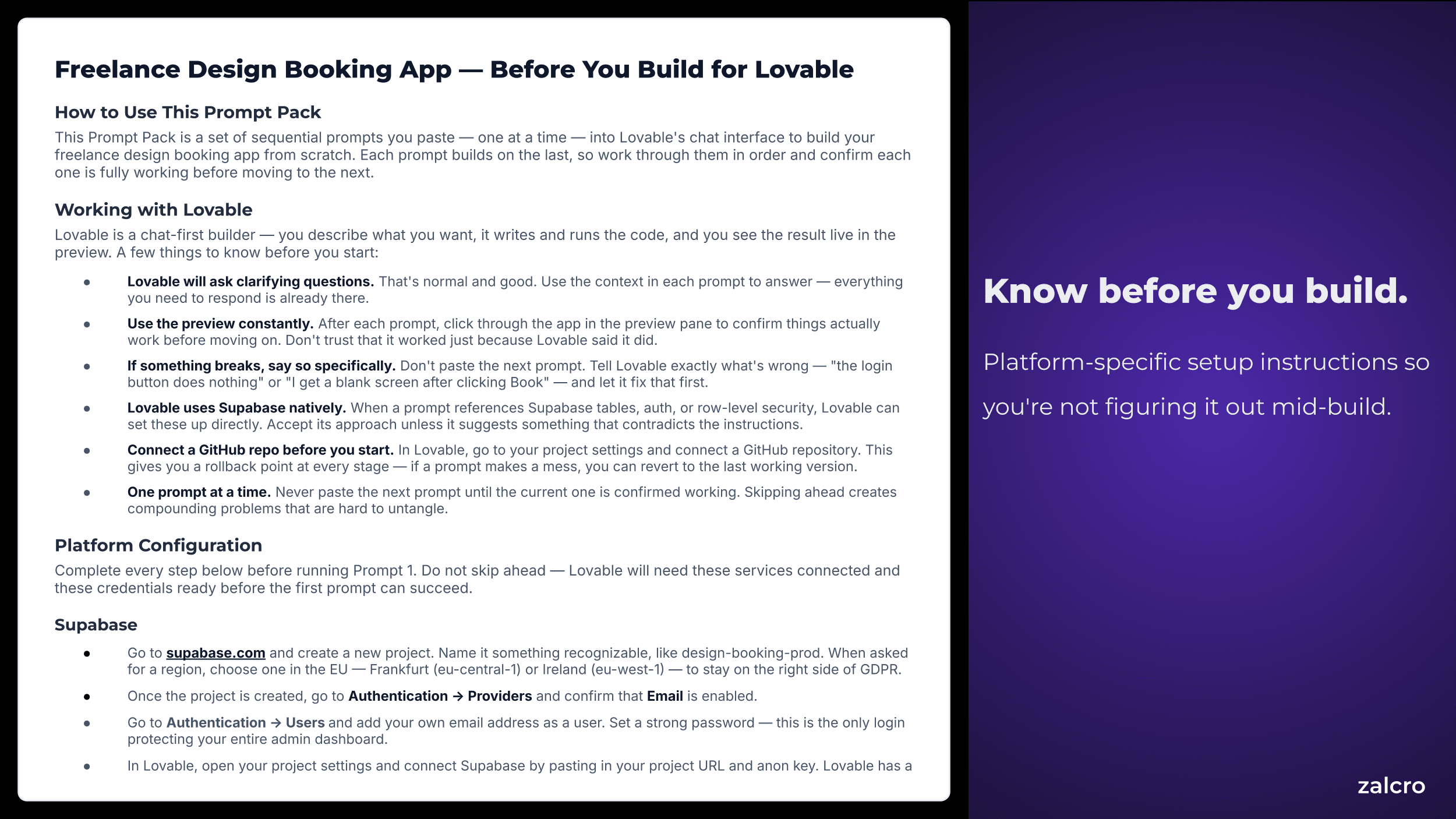
About this app
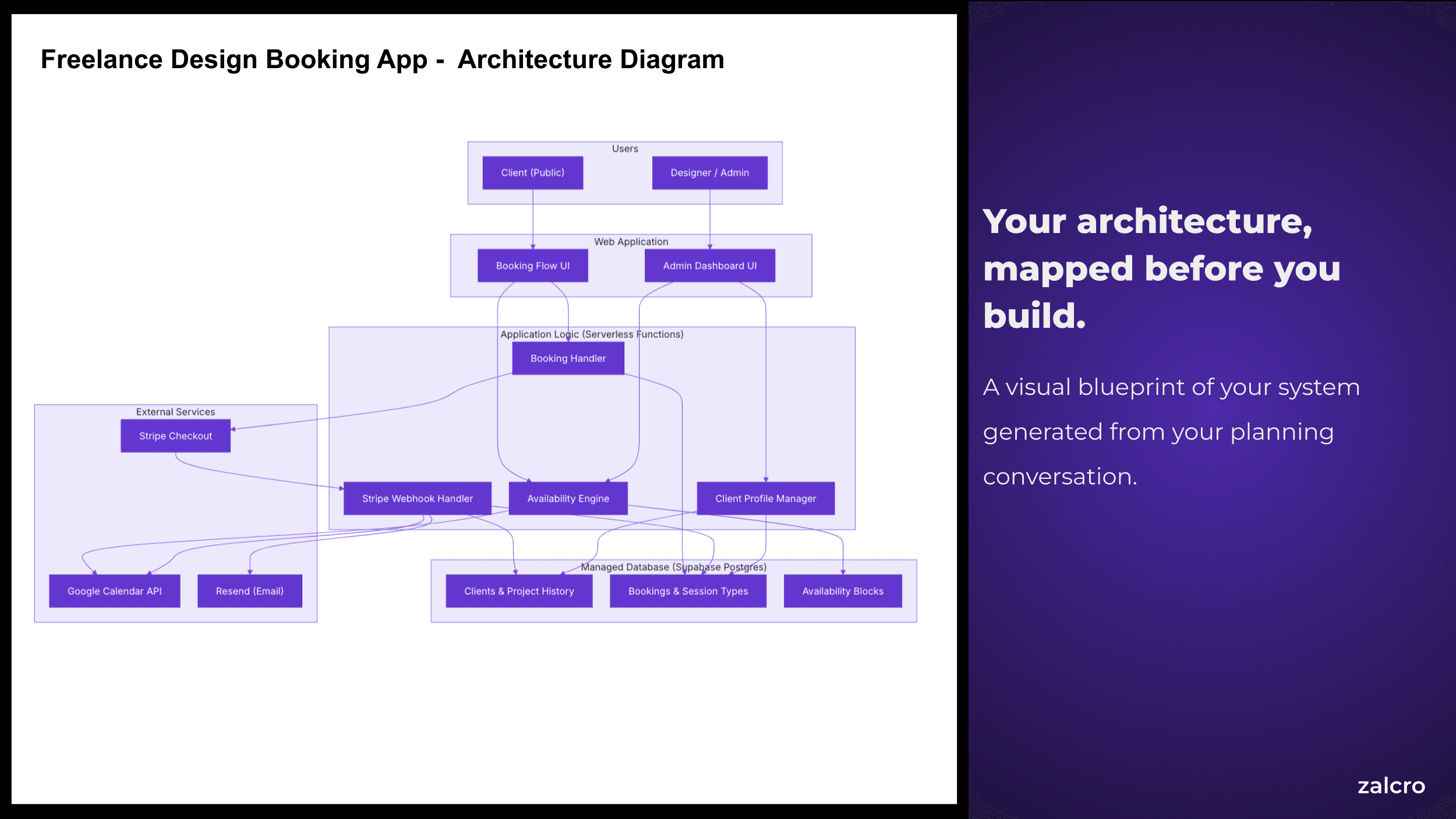
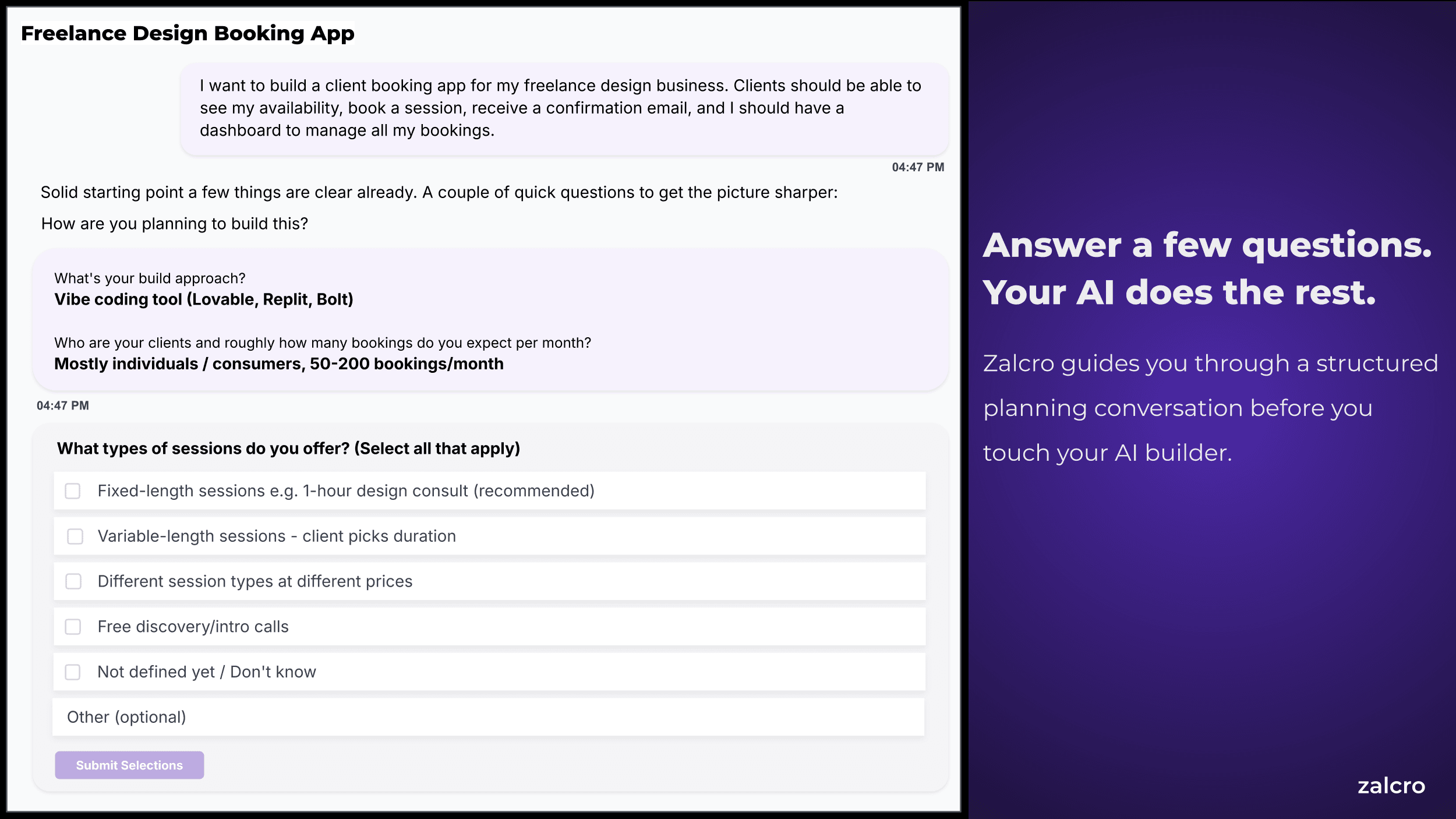
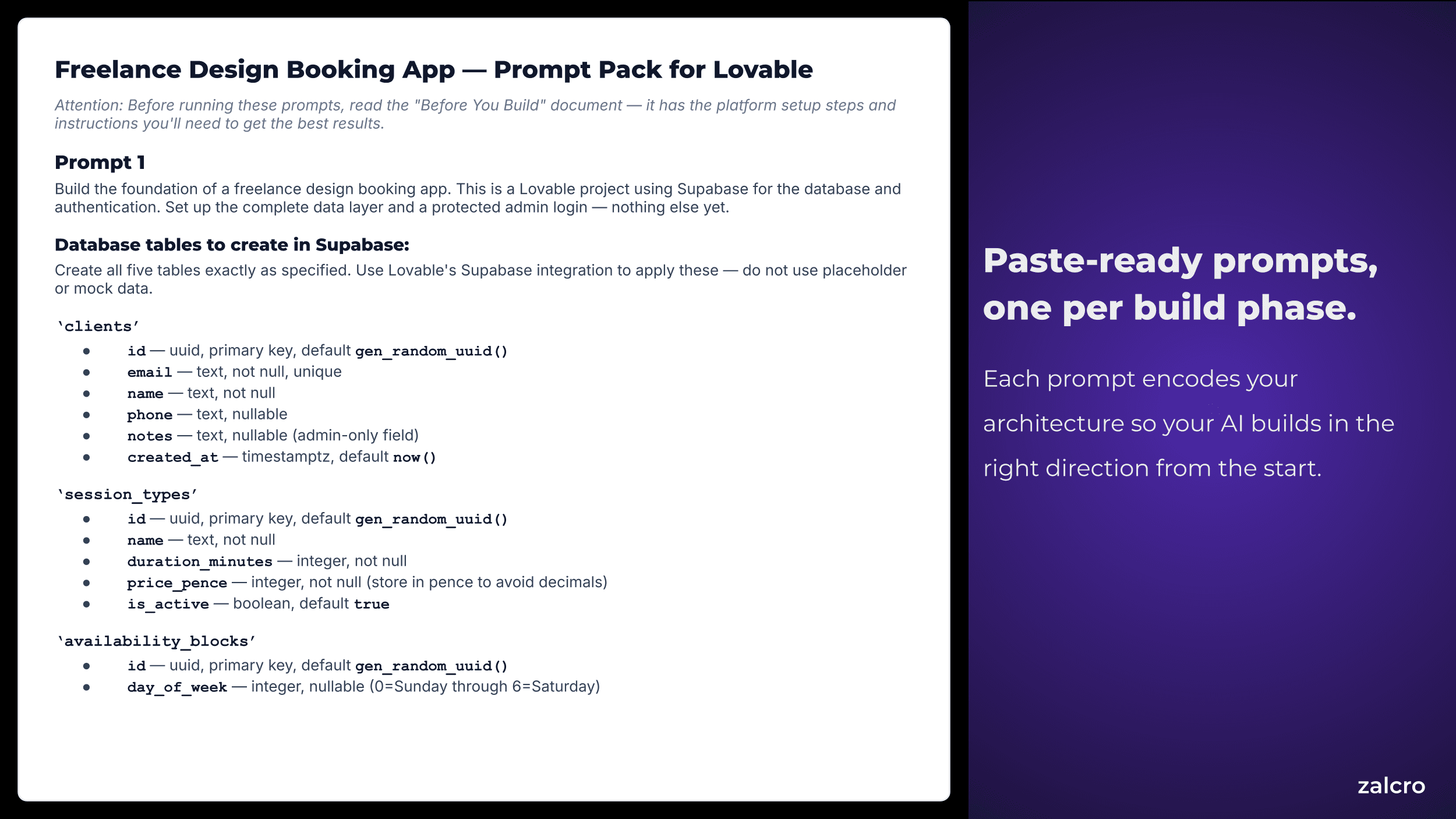
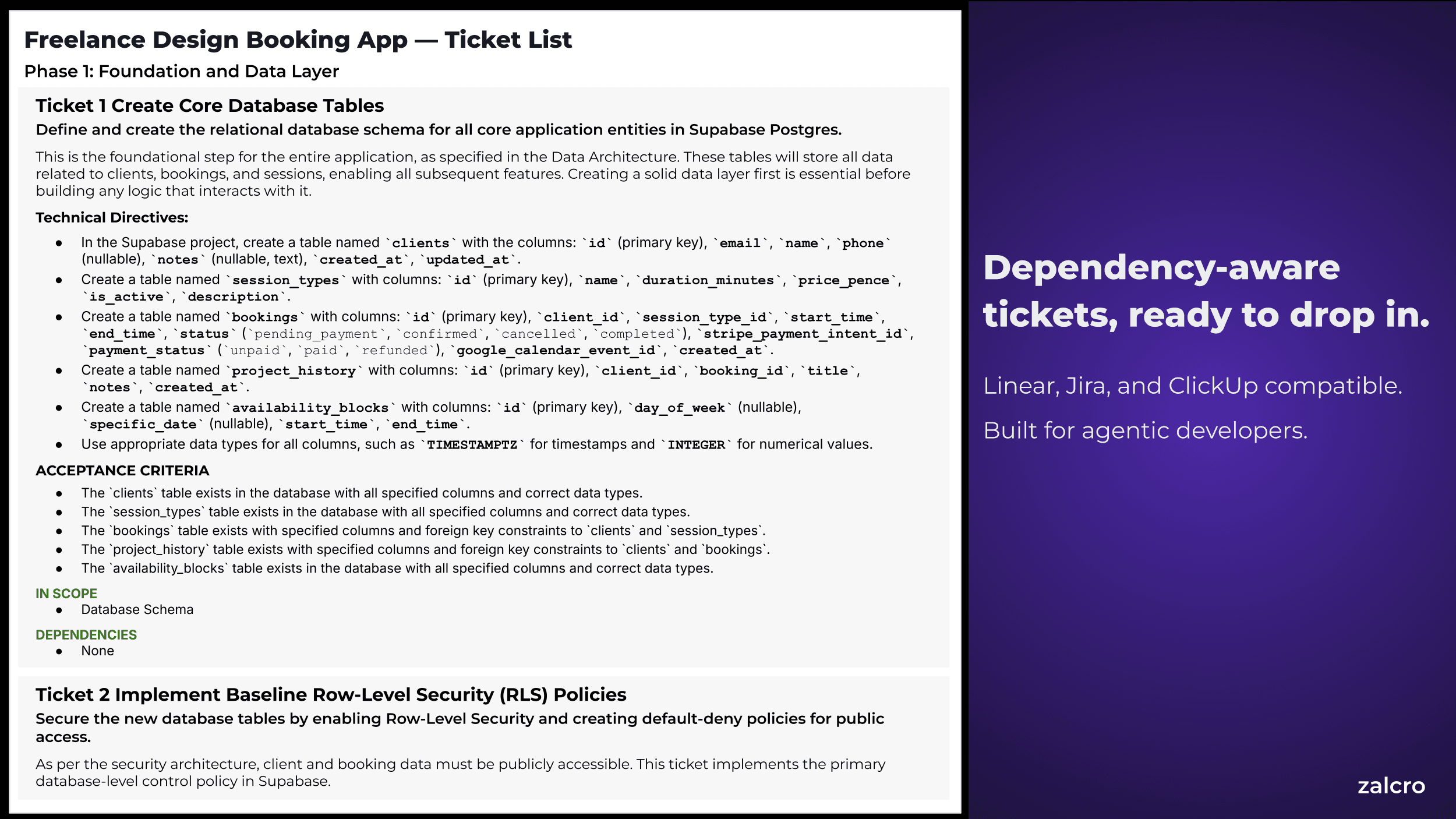
Zalcro is a pre-build planning tool built for the wave of AI app builders who keep running into the same wall: their coding agent loses context, hallucinates features, and the codebase starts falling apart at about 80%. Zalcro sits between the idea and the first prompt. You describe your app in plain language, answer a few guided questions, and it generates an Architecture Design Document, a system diagram, and a sequenced implementation plan. For vibe coders on Lovable, Bolt, Replit, or v0, it produces a Prompt Pack of platform-specific paste-ready prompts for each build phase. For agentic builders on Claude Code, Cursor, or Codex, it outputs a dependency-aware ticket backlog consumable via MCP or exportable to Linear, Jira, and ClickUp. The Starter tier is free, Builder runs $19/month, and it explicitly does not pretend to replace ChatGPT-style thinking — it layers structure on top so decisions stay consistent from session to session.
Key features
- 1Architecture Design Document, system diagram, and sequenced implementation plan generated from a plain-language app description.
- 2Platform-specific Prompt Packs for Lovable, Bolt, Replit and v0; dependency-aware ticket backlogs for Cursor, Claude Code and Codex.
- 3MCP integration plus exports to Linear, Jira, ClickUp, Markdown, PDF, Mermaid, DOCX, Draw.io XML and Google Drive.
Target customer profile
Drawn from the product itself, not from a survey.
Demographic
Non-technical vibe coders using Lovable, Bolt, Replit, or v0
Pain points
AI loses context mid-build, breaks working code, and burns credits on fixes
Primary needs
Structure and phase-by-phase prompts before the first paste
Demographic
Agentic developers using Cursor, Claude Code, or Codex
Pain points
Agents go off-rails without dependency-aware tasks and a stable architecture reference
Primary needs
Sequenced ticket backlog and a persistent Architecture Design Document
Demographic
Indie founders and product teams documenting system design
Pain points
No baseline architecture, scattered decisions, tasks never exported cleanly to PM tools
Primary needs
Exportable docs, diagrams, and structured tasks for Jira, Linear, or ClickUp
Demographic
Technical leads handing AI-built prototypes to developers or investors
Pain points
Prototypes have no diagram or documented tradeoffs to hand off
Primary needs
Shareable diagrams and an ADD that explains every decision
Scout Review
Written by AI from measured evidence, scored out of 100.
Zalcro is a pre-build planning tool aimed at the vibe-coding and agentic-development wave. You describe an app, answer guided questions, and get an Architecture Design Document, a system diagram, a sequenced implementation plan, and either platform-specific Prompt Packs (Lovable, Bolt, Replit, v0) or a dependency-aware ticket backlog exportable to Linear, Jira and ClickUp or consumable via MCP. The positioning is unusually honest — it explicitly says it doesn't replace ChatGPT-style thinking, it layers structure on top. Pricing is clean: free Starter with one generation a month, $19/mo Builder with unlimited generations and full exports, Teams coming soon. The execution is competent but uneven: security headers are flawless, accessibility is strong on automated checks, but mobile performance is sluggish and the homepage design lets overlapping UI elements undercut a genuinely good value proposition.
Measure by measure
Usability
63Four-step flow is spelled out, a free tier exists, and pricing has a granular comparison table. But the overlapping modals on the homepage undercut the first impression of the value prop.
Design
57Clean purple-accented palette and a readable architecture diagram sample, but the live homepage stacks hero, step card and cookie modal into a pile-up, and sample pages are wall-of-text dense.
Speed
58Lighthouse desktop 82/100 but mobile 66/100 with a 6.5s LCP — the mobile experience is slow enough to lose impatient visitors before the value prop lands.
Security
74Full 12/12 header checklist: HTTPS, HSTS, CSP, frame protection, Referrer-Policy, Permissions-Policy, SPF and DMARC all set. No published SOC 2, ISO or pen-test claim to push it higher.
Accessibility
80Lighthouse accessibility 97/100 with a single contrast-ratio failure and no published WCAG statement. Strong automated score, thin on documented a11y commitments.
Growth
68Real, specific pain (agents losing context at 80%) with a genuine wedge: platform-specific Prompt Packs and MCP ticket backlogs the generalist alternatives don't ship.
Improvement areas
- Mobile performance: 6.5s LCP and 66/100 Lighthouse mobile score undercut the 'stop wasting time' pitch.
- Homepage design: overlapping hero, step card and cookie modal compete for attention on first load.
- Compliance transparency: no published SOC 2, ISO, pen-test or bug bounty despite strong header hygiene.
Design & Usability
Zalcro's visual identity is coherent — a consistent purple accent, a legible architecture diagram sample, and a four-step narrative that explains the product in under a minute. The problem is the live homepage: a hero, a step card and a cookie modal all compete for the same viewport, and the sample pages are dense enough to need a scroll commitment. Usability is stronger than design: the free Starter tier, the granular pricing comparison table, and the explicit 'describe → generate → prompts → build' flow give a new user a clear path to value. Fix the modal stacking and thin out the sample pages and this jumps a tier.
Speed & Security
Speed is the weak spot. Lighthouse desktop lands at 82/100 but mobile drops to 66/100 with a 6.5s LCP and 3.0s FCP — for a product whose entire pitch is 'stop wasting time,' a slow mobile first paint is an awkward own-goal. CLS is a clean 0 and TBT is a modest 276ms, so the page is stable once it arrives; it just takes too long to get there. Security is the opposite story: a full 12/12 on the header and DNS probe — HTTPS enforced, HSTS, CSP, frame protection, Referrer-Policy, Permissions-Policy, SPF and DMARC all present. What's missing is the paperwork: no SOC 2, ISO 27001, pen-test summary or bug bounty published anywhere in the fetched site content.
Accessibility & Growth
Accessibility scores 97/100 on the Lighthouse axe audit, with a single failing check for insufficient background/foreground contrast. That's a strong automated result, but there's no accessibility statement, no WCAG conformance claim, and no documented keyboard or screen-reader testing — so the score reflects what a robot found, not what the team committed to. Growth is the most interesting dimension. Zalcro names a real, specific pain — coding agents losing context and breaking codebases around the 80% mark — and backs it with a concrete wedge: platform-specific Prompt Packs for Lovable/Bolt/Replit/v0 and MCP-consumable, dependency-aware ticket backlogs for Cursor/Claude Code/Codex. GitHub Spec Kit is open-source but heavier; Kiro lives inside its own editor; ChatGPT has no cross-session memory; ChatPRD stops at PRDs. Zalcro's bet is that a guided, cross-platform planning layer sits in a gap none of them fill. The limit: it's a workflow layer, not a moat — any of those platforms could ship a planning mode, and the domain is only months old.
Conclusion
If you're a non-technical builder who keeps watching Lovable or Bolt burn credits on fixes, or an agentic developer tired of Cursor going off-rails mid-build, Zalcro is worth the free tier — one architecture generation a month is enough to test whether the output actually saves you prompts. The $19 Builder tier is reasonable for unlimited generations and full exports, especially with the annual option at $15/mo. The caveats are real: the mobile site is slow, the homepage design needs a cleanup pass, and there's no published compliance program if you're handing these docs to enterprise stakeholders. But the core idea — plan before you prompt — is the right one, and Zalcro is one of the few tools in this space that names the actual failure mode instead of hand-waving about 'AI-powered planning.'
Suggestions for improvement
- Fix the overlapping cookie modal and step card on the homepage — they obscure the hero and the value prop on first load.
- Improve mobile LCP (currently 6.5s) — compress hero assets, defer non-critical JS, and consider edge caching.
- Publish an accessibility statement and document keyboard/screen-reader testing to back up the 97 Lighthouse score.
- Add a security page with SOC 2 roadmap, pen-test summary, or bug bounty to give enterprise buyers something to point at.
Alternatives comparison
Named competitors, point by point. Nobody paid to appear here or to be left out.
 Zalcro |  GitHub Spec Kit |  Kiro |  ChatGPT |  ChatPRD | |
|---|---|---|---|---|---|
| Generates a structured Architecture Design Document from a plain-language app idea | Yes — core output, with diagram and implementation plan | Yes — spec-driven, but requires more manual authoring | Yes — specs and tasks, but locked inside Kiro's IDE | Ad hoc — no persistent architecture artifact | PRD-focused — not architecture-level |
| Emits platform-specific paste-ready prompts for Lovable, Bolt, Replit or v0 | Yes — Prompt Pack per build phase | No — generic spec templates | No — prompts stay inside Kiro | No — manual prompting | No — PRD output, not build prompts |
| Dependency-aware ticket backlog exportable to Linear, Jira or ClickUp (or via MCP) | Yes — MCP plus Linear/Jira/ClickUp export | Partial — task files, not PM-tool export | Tasks stay inside Kiro | No | No — PRD only |
| Free tier available | Yes — Starter $0 with 1 generation/month | Yes — open source, free | Free preview / paid tiers | Free tier plus $20/mo Plus | Free tier plus paid plans |
| System diagram output | Yes — Mermaid and Draw.io XML export | No | Limited | No — text only | No |
GitHub Spec Kit
Open-source spec-driven development toolkit that structures AI-assisted coding around written specs; Zalcro positions itself as a lighter, guided alternative.
Kiro
AWS's spec-driven AI IDE that turns prompts into specs and tasks; overlaps with Zalcro's agentic workflow but lives inside its own editor.
ChatGPT
General-purpose AI that can plan an app well but has no memory across sessions and can't emit platform-specific paste-ready prompts or ticket backlogs.
ChatPRD
AI product-management assistant for writing PRDs; Zalcro goes further into architecture, diagrams, and build sequencing.
Comparing options? See Zalcro alternatives, scored side by side
More Development & Engineering apps
View all Development & Engineering
CreateMyCoin
92A no-code Solana token creator that deploys SPL tokens in...

Vibe Coding Agent Skills
92A free, open-source platform offering 110 AI agent skills...

CC Switch
91Open-source desktop app for switching AI coding providers...

TaxID
90Fast EU VAT validation API for developers, covering 27 EU...

BeartIMAGE
88BeartIMAGE is a free, web-based image processing platform engineered for fast, bulk photo editing and conversion directly in your browser.

Claw Messenger
88Claw Messenger is an iMessage API service that gives AI a...

DataHabibi
88AI-powered Dubai real estate data platform with 12M+ DLD ...

ButterKit
82macOS app for App Store screenshots: 3D mockups, auto-tra...

PERM Processing Time: Current DOL Queue & History
88PERM Processing Time is an independent data analysis platform that helps users navigate the U.S. Department of Labor’s permanent labor certification process.

StockFit API
87A developer-first financial data API providing structured...

ProcessSpy
87A native macOS process explorer and advanced monitor that...

Credyt
87Real-time monetization infrastructure for AI products tha...


A platform dedicated to providing unbiased reviews of newly launched applications, analyzing everything from their features to their full potential.
info@scoutforge.net© 2026 Scoutforge. All rights reserved.
