

A platform dedicated to providing unbiased reviews of newly launched applications, analyzing everything from their features to their full potential.
info@scoutforge.net© 2026 Scoutforge. All rights reserved.
A platform dedicated to providing unbiased reviews of newly launched applications, analyzing everything from their features to their full potential.
info@scoutforge.net© 2026 Scoutforge. All rights reserved.
A platform dedicated to providing unbiased reviews of newly launched applications, analyzing everything from their features to their full potential.
info@scoutforge.net© 2026 Scoutforge. All rights reserved.
Is this your app?
Claim ShadowGit to manage its page, add your badge and see your traffic — free, and it stays free.
Cycling through all six. Tap any point to stop.
Measured on six things
ShadowGit is a local tool that automatically tracks every code change and provides this history to AI assistants like Claude and Copilot, eliminating the need to re-explain context and enabling faster debugging with one-click code restoration.
Limited to command-line interaction with English-only documentation, assumes technical proficiency but benefits offline users
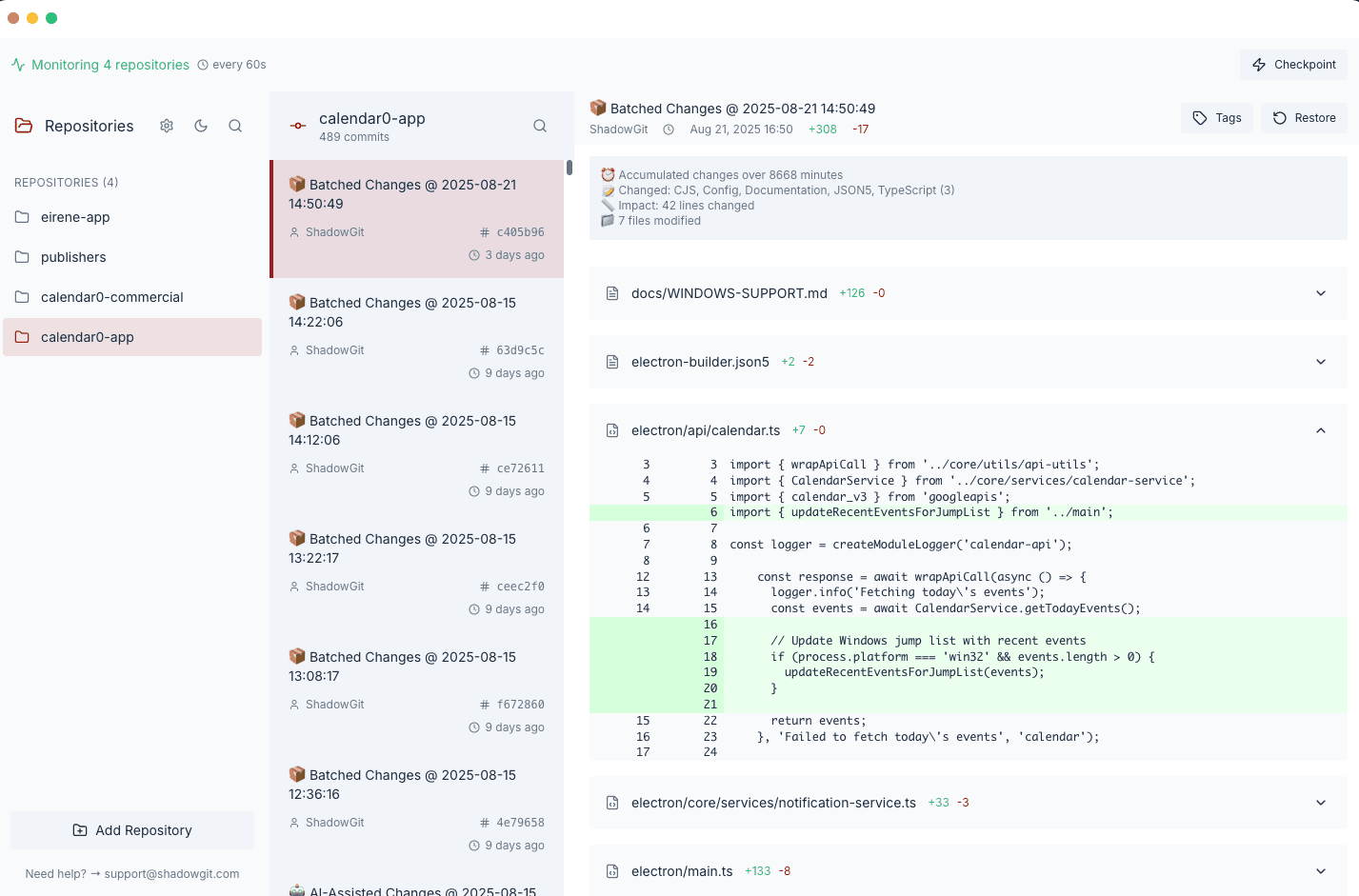
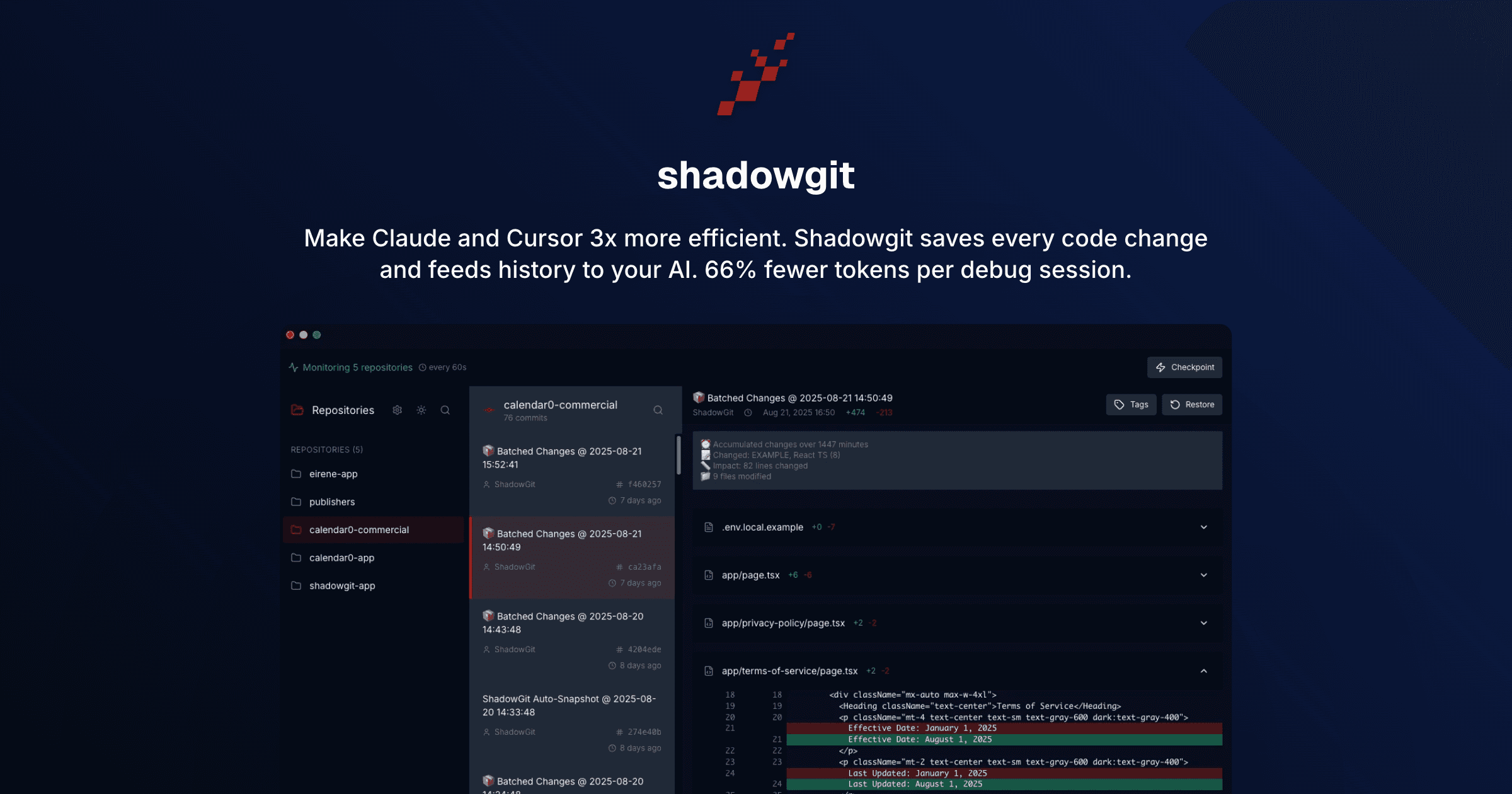
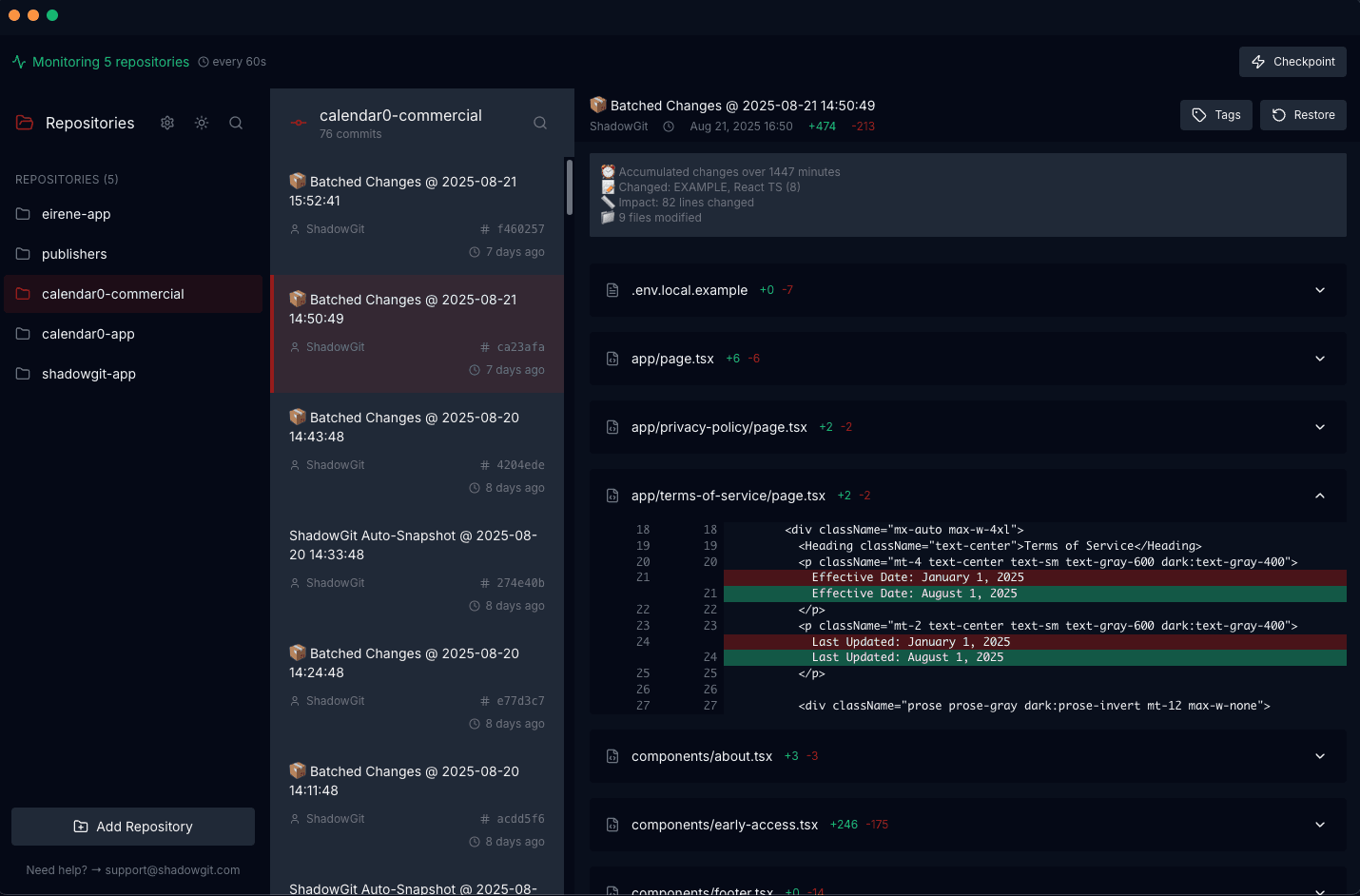
As someone who's spent countless hours re-explaining codebases to AI assistants, ShadowGit feels like discovering a secret weapon. This tool works silently in the background, capturing every single code change you make—even those between commits—and serves this detailed history to your AI coding companions through an MCP server. What makes it special is how it transforms AI from a forgetful intern into a colleague with perfect memory. When I'm debugging, the AI can now see what actually changed in my code, not just what's currently broken. And if an AI suggestion goes wrong, I can instantly revert to previous working versions with a single click. The fact that everything runs locally means my code never leaves my machine, addressing privacy concerns that often come with cloud-based AI tools. It's one of those simple ideas that makes you wonder why nobody built it sooner. ShadowGit excels at its core functionality with strong security and performance, though accessibility and UI polish could be improved. It's not for everyone—if you rarely use AI tools or work on simple projects, you might not notice the benefits. But for developers who regularly collaborate with AI assistants on complex codebases, this tool can significantly reduce context-switching overhead and debugging time. The local-first approach and one-time purchase model make it appealing compared to subscription-based alternatives. If you're tired of repeating yourself to AI or want a safety net for those occasional bad AI suggestions, ShadowGit is definitely worth exploring. It's one of those tools that quietly makes you more productive without demanding attention.
Drawn from the product itself, not from a survey.
Demographic
Software developers using AI coding assistants
Pain points
Repeating code context in every new AI chat, losing track of changes between commits, debugging without historical context
Primary needs
Automated version tracking, AI memory persistence, local privacy protection
Demographic
AI enthusiasts and early adopters
Pain points
AI assistants lacking project context, manual code restoration processes, security concerns with cloud-based AI tools
Primary needs
Seamless AI integration, one-click recovery, offline functionality
Demographic
Development teams working with multiple AI tools
Pain points
Inconsistent AI performance across different contexts, time wasted on context setup, version control gaps
Primary needs
Cross-platform AI memory, team collaboration features, reliable code history
Written by AI from measured evidence, scored out of 100.
ShadowGit is that rare tool that identifies a specific, growing problem and solves it elegantly. It transforms AI assistants from forgetful interns into colleagues with perfect memory by automatically tracking every code change and serving this history through local MCP integration. The local-only operation provides outstanding security while maintaining performance, and the one-click restoration feature is a lifesaver during debugging sessions. While it's not for casual coders or those who rarely use AI tools, developers working with AI assistants on complex projects will find it invaluable for reducing context-switching overhead.
Zero-configuration setup with seamless MCP integration and one-click restoration that doesn't disrupt coding workflow
Minimalist background service with no visible UI during operation, prioritizing functionality over visual polish
Near-real-time versioning with no noticeable performance impact and instant AI query responses through local processing
Complete local operation ensures code never leaves your machine with read-only MCP access protecting codebase integrity
Limited to command-line interaction with English-only documentation, assumes technical proficiency but benefits offline users
Strong positioning in growing AI coding market with unique memory functionality and one-time purchase appeal
ShadowGit takes a refreshingly practical approach to design by essentially having no visible interface. It operates as a background service that integrates seamlessly through the Model Context Protocol (MCP), meaning developers don't need to learn new workflows or deal with configuration headaches. The setup process is remarkably straightforward for a developer tool, requiring minimal steps to get running. What really shines is the one-click restoration feature - when an AI suggestion inevitably goes sideways, you get an instant escape hatch without breaking your coding rhythm. While there's no graphical interface to admire, the tool's invisible nature actually becomes its greatest strength for developers who value uninterrupted workflow.
Performance and security are where ShadowGit truly stands out. The automatic versioning happens in near-real-time without any noticeable drag on system resources - it's like having a silent coding partner taking meticulous notes. Since everything processes locally, there's zero network latency when AI assistants query your code history, making debugging sessions feel instantaneous. Security is even more impressive: your code never leaves your machine, eliminating common cloud-based privacy concerns. The local repositories give you complete control over intellectual property, while the MCP server's read-only access prevents accidental modifications. It's the digital equivalent of a maximum-security vault that somehow doesn't slow you down.
Accessibility follows the tool's developer-first philosophy, with command-line interaction and technical proficiency assumptions. There are no screen reader optimizations, high contrast modes, or multilingual support in the current iteration. However, the simplicity of operation and local-first approach provide unexpected accessibility benefits for developers in regions with poor connectivity or those working on sensitive projects. Growth potential is substantial given the exploding AI coding assistant market. ShadowGit's unique memory persistence functionality and one-time purchase model position it well against subscription-based alternatives. The tool solves a genuine pain point that becomes more relevant as AI coding becomes mainstream.
Conclusion
If you're tired of repeating your codebase context to AI assistants or want a safety net for those 'oops' moments when AI suggestions go wrong, ShadowGit is absolutely worth trying. It's specifically designed for software developers, AI enthusiasts, and teams who regularly collaborate with coding assistants. The tool quietly enhances productivity without demanding attention, making it one of those background utilities you'll wonder how you lived without. For developers seeking to optimize their AI coding workflow with robust security and seamless integration, this is a game-changer worth exploring.
Named competitors, point by point. Nobody paid to appear here or to be left out.
 ShadowGit ShadowGit |  git-shadow git-shadow |  Mem0 Mem0 | |
|---|---|---|---|
| AI Integration Method | MCP server with direct AI assistant integration | No direct AI integration, manual process required | General AI memory layer, not code-specific |
| Code Change Tracking | Automatic real-time tracking between commits | Records coding activity between commits | Learns from interactions, not code-specific tracking |
| One-Click Restoration | Instant code restoration from history | No built-in restoration features | General memory recall, not code restoration |
| Operation Mode | Local-only processing for maximum security | Local operation | Cloud-based processing |
git-shadow
An open-source tool that records coding activity between commits, but lacks direct AI integration and the MCP server functionality that makes ShadowGit unique.
Mem0
A general AI memory layer that learns from user interactions, but isn't specifically designed for code versioning and debugging workflows like ShadowGit.
Comparing options? See ShadowGit alternatives, scored side by side

A no-code Solana token creator that deploys SPL tokens in...

A free, open-source platform offering 110 AI agent skills...

Open-source desktop app for switching AI coding providers...

Fast EU VAT validation API for developers, covering 27 EU...

Claw Messenger is an iMessage API service that gives AI a...

PERM Processing Time is an independent data analysis platform that helps users navigate the U.S. Department of Labor’s permanent labor certification process.

AI-powered Dubai real estate data platform with 12M+ DLD ...

BeartIMAGE is a free, web-based image processing platform engineered for fast, bulk photo editing and conversion directly in your browser.

macOS app for App Store screenshots: 3D mockups, auto-tra...

Real-time monetization infrastructure for AI products tha...

A native macOS process explorer and advanced monitor that...

A developer-first financial data API providing structured...
A platform dedicated to providing unbiased reviews of newly launched applications, analyzing everything from their features to their full potential.
info@scoutforge.net© 2026 Scoutforge. All rights reserved.