Cycling through all six. Tap any point to stop.
Measured on six things
AI Ranking Pro is an evidence-first research and software project for measuring how B2B SaaS brands appear in AI-assisted discovery.
Usability
62Clear hero CTAs and a transparent trial flow, but the FAQ accordion buries the trial and billing answers behind clicks exactly where buyers need them, and five stacked offers with no recommended path add decision load before signup.
Screenshots
1 / 1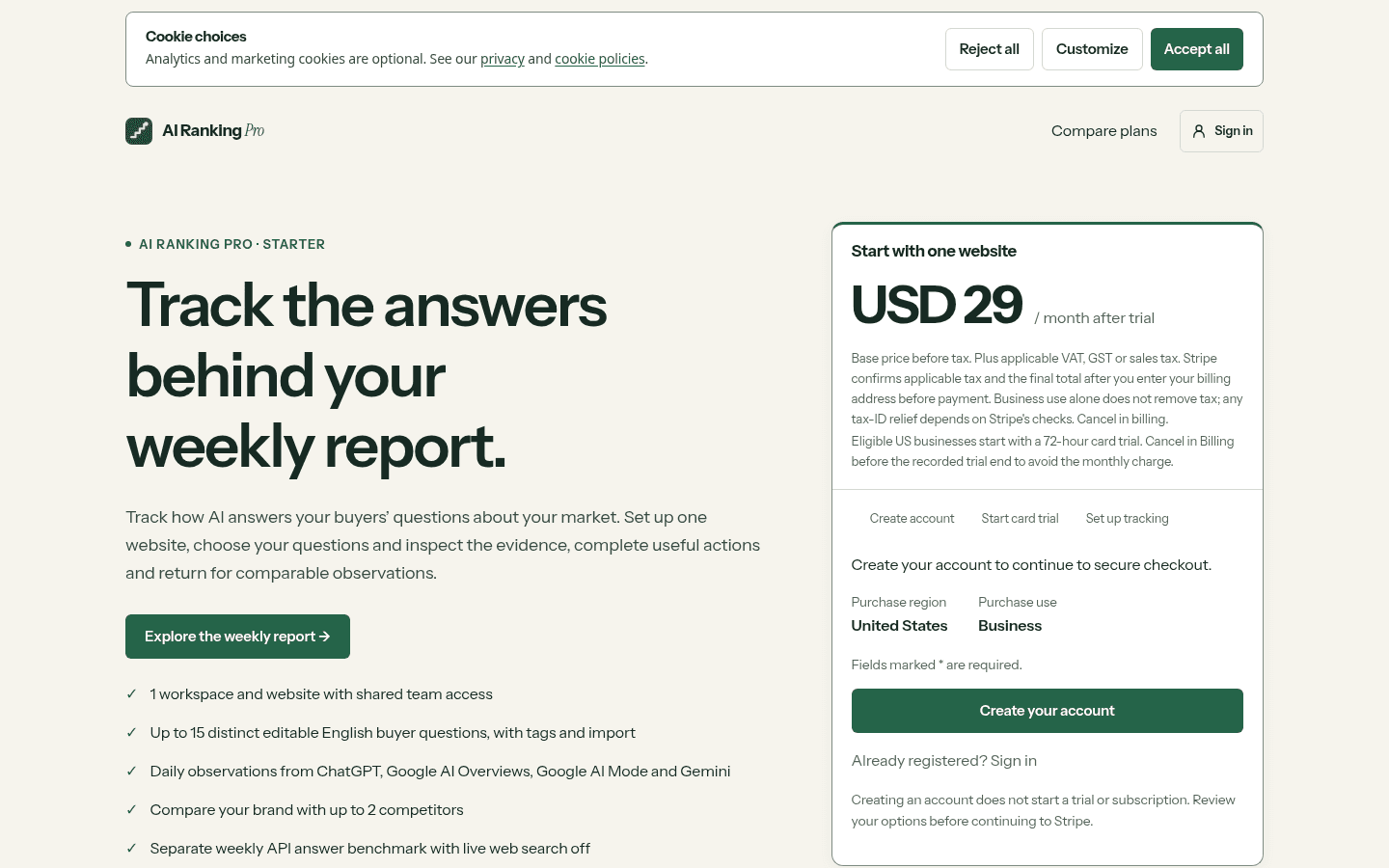
About this app
AI Ranking Pro is an evidence-first research and software project for measuring how B2B SaaS brands appear in AI-assisted discovery. Starter tracks up to 15 English buyer questions daily on ChatGPT, Google AI Overviews, Google AI Mode and Gemini, compares with up to 2 competitors, and keeps 90 days of history with source-linked reports. Pricing is Paid, USD 29/month. Founded 2026, Warsaw, Poland.
Key features
- 1Daily tracking of up to 15 English buyer questions across ChatGPT, Google AI Overviews, Google AI Mode and Gemini
- 2Dated, source-linked answers showing which pages get cited, with up to 2 competitors compared
- 3Before/after citation comparison on a specific page edit, with 90 days of history and CSV/HTML exports
Target customer profile
Drawn from the product itself, not from a survey.
Demographic
B2B SaaS marketing leads and growth managers (US)
Pain points
No visibility into which sources AI engines cite for buyer queries
Primary needs
Daily tracking of AI answers and competitor citations
Demographic
Content and SEO strategists at early-stage SaaS startups
Pain points
Content edits lack measurable AI search impact evidence
Primary needs
Before/after citation comparison on specific pages
Demographic
Solo consultants and fractional CMOs serving SaaS clients
Pain points
Cannot afford enterprise AI visibility platforms
Primary needs
Affordable one-time audits and exportable reports
Scout Review
Written by AI from measured evidence, scored out of 100.
AI Ranking Pro is an evidence-first AI-visibility tracker for B2B SaaS marketers, and it is unusually well-built for a product this young. The site is fast (Lighthouse 100/100 both form factors), the security headers are complete (12/12), and the homepage does the hard thing well: it shows the actual weekly report — a dated answer, a cited source, a repeated citation gap — instead of describing it. Pricing is transparent but scattered across five offers with mixed units, and the FAQ hides the trial and billing answers behind clicks. Accessibility passes automated checks but the small light-grey body copy is a real readability issue. The idea is sound and differentiated against Profound and Peec AI by price and by the before/after page-edit workflow; the open question is traction and distribution, not the product.
Measure by measure
Usability
62Clear hero CTAs and a transparent trial flow, but the FAQ accordion buries the trial and billing answers behind clicks exactly where buyers need them, and five stacked offers with no recommended path add decision load before signup.
Design
71Cohesive cream-and-forest-green palette, editorial hero with a serif accent, and a hero card that shows real output instead of feature bullets. Held back by small light-grey body copy and a pricing column that mixes monthly, one-time and 'From' units.
Speed
88Lighthouse 100/100 on both mobile and desktop: LCP 1.5s, CLS 0, TBT 0ms, FCP 1.1s. A genuinely fast, well-built static-feeling site with no measurable layout shift or blocking work.
Security
74Full security-header sweep passes 12/12 — HSTS, CSP, frame protection, Referrer and Permissions policies, plus SPF and DMARC. Granular cookie consent with reject-all. No published SOC 2, ISO or pen-test claims found.
Accessibility
79Lighthouse accessibility 100/100 on automated checks, dark-mode toggle, and a responsive layout. No WCAG statement or multi-language support found, and research coverage is US English only — automated checks cover only part of WCAG.
Growth
63A real, growing problem — AI answers shape B2B buying — with a specific wedge: dated, source-linked evidence and before/after citation comparison on a page edit, at USD 29/month under enterprise peers. Early stage (domain ~0.5 years).
Improvement areas
- Pricing page mixes monthly, one-time and 'From' units across five offers with no recommended default
- Trial and billing answers hidden in an FAQ accordion instead of surfaced at the decision point
- No published security certifications, accessibility statement, or multi-language support
Design & Usability
The homepage is the strongest part of this product. A restrained cream-and-forest palette, a large tightly-tracked headline, and a hero card that shows an actual weekly report — quoted answer, cited source, 'Repeated citation gap' callout — rather than abstract claims. Labeling it 'Fictional example' is honest and builds trust. The cracks show lower down: the three-column report section runs small light-grey body copy on cream, and the pricing list stacks monthly, one-time and 'From' prices in one column, making five offers hard to compare. Usability is competent but friction-heavy at the worst moment: the FAQ accordion hides the trial and billing answers behind clicks, and five offers with no recommended path force buyers to decide before they understand the difference.
Speed & Security
Speed is the standout measured result: Lighthouse 100/100 on mobile and desktop, LCP 1.5s, CLS 0, TBT 0ms, FCP 1.1s. Whatever stack this is, it is doing the boring things right. Security is similarly disciplined for a young product — the header probe passes 12/12 with HSTS, CSP, frame protection, Referrer and Permissions policies, plus SPF and DMARC, and the cookie banner offers a genuine reject-all with granular analytics/marketing toggles. What's missing is the paperwork enterprise buyers eventually ask for: no SOC 2, ISO 27001, pen-test summary or bug bounty is claimed anywhere in the collected content. For a USD 29/month self-serve tool aimed at US B2B marketers that is a reasonable stage to be at, but it caps how far upmarket the product can sell.
Accessibility & Growth
Accessibility scores 100/100 on Lighthouse's automated axe checks, with a dark-mode toggle and responsive layout — but automated checks only cover part of WCAG, and the light-grey small body copy flagged in the visual audit is exactly the kind of contrast/readability issue axe won't catch. There is no accessibility statement and no multi-language support; research coverage is US English only. Growth is the more interesting question. The problem is real and growing: B2B buyers increasingly get answers from ChatGPT, AI Overviews and Gemini, and marketers have no visibility into which sources get cited. Profound and Peec AI sit above this product as enterprise-grade trackers; AI Ranking Pro's wedge is narrower and sharper — dated, source-linked evidence plus a before/after comparison on a specific page edit, at USD 29/month with one-time audits from US$29 to US$6,500. That is a defensible niche for solo consultants and early-stage SaaS marketers. The limit is that the category is crowded and the product is brand new (domain ~0.5 years, LinkedIn only), so distribution, not the idea, is the constraint.
Conclusion
If you are a B2B SaaS marketing lead who suspects AI answers are shaping your pipeline but has no idea which pages get cited, this is a credible, cheap way to find out — USD 29/month with a 72-hour trial and 90 days of history is a low-risk experiment. Go in expecting a young product: no SOC 2, no accessibility statement, US English only, and a pricing page that makes you work to compare offers. The engineering discipline on display (perfect Lighthouse scores, complete security headers, honest 'Fictional example' labeling) suggests the team ships carefully, which matters more at this stage than a logo wall.
Suggestions for improvement
- Consolidate the five offers into a comparison table with a clear recommended default, and normalize price units so monthly vs one-time is obvious.
- Move the trial and billing answers out of the FAQ accordion and onto the pricing page where buyers decide.
- Increase body-copy size and contrast in the report section and footer — the light grey on cream fails readability even if axe passes.
- Publish a short security/trust page (data handling, subprocessors like DataForSEO and Stripe, retention) to shorten enterprise procurement conversations.
Alternatives comparison
Named competitors, point by point. Nobody paid to appear here or to be left out.
 AI Ranking Pro |  Profound |  Peec AI | |
|---|---|---|---|
| Entry price | USD 29/month after 72-hour trial; one-time audits from US$29 | Enterprise/custom pricing (not published in collected evidence) | Subscription pricing (not verified in collected evidence) |
| AI engines tracked | ChatGPT, Google AI Overviews, Google AI Mode, Gemini (via DataForSEO) | Multiple LLMs across answer engines (enterprise breadth) | ChatGPT, Perplexity and other AI assistants |
| Source-level citation evidence | Dated answers with cited pages and before/after comparison on a page edit | Citation and mention tracking at enterprise scale | Brand mention monitoring across AI assistants |
| Target customer | B2B SaaS marketing leads, solo consultants, fractional CMOs (US) | Enterprise marketing organizations | Brands and agencies monitoring AI search presence |
| Analyst / human service layer | Snapshot audit US$99, managed analysis from US$1,500/mo, improvement sprint from US$6,500 | Platform-led; services not detailed in collected evidence | Self-serve analytics platform |
Profound
Enterprise-grade AI search visibility and answer engine optimization platform tracking brand mentions across LLMs.
Peec AI
AI search analytics tool that monitors how brands appear in ChatGPT, Perplexity, and other AI assistants.
Comparing options? See AI Ranking Pro alternatives, scored side by side
More SEO Tools apps
View all SEO Tools
Geogrid
92A UULE-powered local rank tracker for SEO agencies, offer...

Kerbrank
91Local rank tracker for UK businesses with Google Maps heatmaps, ChatGPT visibility checks and a weekly fix list.

BACKLNK
90Backlnk is a free SEO and AI visibility website: 15 website checks, a full audit as a PDF report, and guides to get found in search and AI answers.

AuditCloser
89White-label website audits that close deals for digital a...

CitableReport
89CitableReport is an AI visibility audit:

named.ae
88named.ae asks ChatGPT, Claude, Gemini, Perplexity and Grok your buyers' questions live, and shows who they name and the pages they read.

Wajido
88See how your company appears in AI answers

Mover Marketing AI Local SEO
88Specialized SEO services for moving companies to dominate...

Askray
88See who ChatGPT, Gemini & Claude recommend instead of you...

Spek
88Grow your app with self-learning ASO agents

Cromagnon
88Free, private browser-based PDF, Word, Excel, and study t...

Indexaro
88AI visibility tracker for SEO, AEO, and GEO


A platform dedicated to providing unbiased reviews of newly launched applications, analyzing everything from their features to their full potential.
info@scoutforge.net© 2026 Scoutforge. All rights reserved.
